|
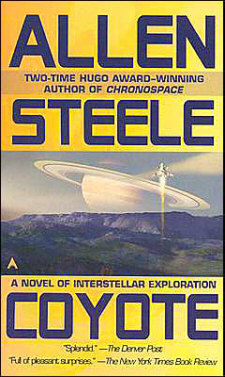
At the beginning of the twentieth century, only a few scientists and a handful of the general public thought intelligent life existed beyond Earth. By the time of the twenty-first century, it was difficult to find a well-educated person who thought otherwise. Theoretical and practical scientific research led to the discovery in 1996 of a giant gas planet orbiting 47 Ursae Majoris, a type go star, forty-six light-years from Earth.
What made this planet so interesting was that its orbit lay just beyond what had been coined the ‘habitable zone,’ the approximate distance away from its primary enabling it to sustain life. It was theorised that if this planet had its own satellite system, infrared radiation reflected from the giant gas could possibly render one or two of these moons capable of supporting human life.
NASA had during this time, been advancing and experimenting with the technology necessary for interstellar travel. This developed into what would become known as Project Starflight. The ongoing deterioration of the o-zone layer and the global situation, added to the discovery of six major satellites orbiting the gas giant 47 Ursae Majoris B, led to mankind taking the gigantic leap it had always dreamed of…
Upon the crew’s revival from biostasis, Captain Lee called a meeting aboard the Alabama, to discuss what lay ahead.
Little was known about the Moon, until they were close enough to concentrate their navigational telescope, in order to assess the atmosphere, environment and terrain. They discovered an Earth-toned world, dyed in shades of green and blue, with equally Earth-like white patches at it’s poles.
New data showed the clear presence of water vapour, Carbon Dioxide, atmospheric Oxygen and Nitrogen. Lee’s team were certain this atmosphere could support them. Indeed many of his scientists believed it was supporting life already…
|