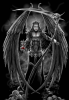
# THE VAMPIRE'S IMPOSSIBLE SENSES
## If Vampires, Werewolves and Supernatural Hybrids Possessed Powers Beyond Human Perception, Could Biology, Neuroscience, Physics and Evolution Explain Their Hidden World?
**A 55-Chapter Interdisciplinary Investigation**
**[DOCUMENTED/REALITY + THEORY/HYPOTHESIS + FICTION/MYTHIC]**
### PROLOGUE — THE IMMORTAL WHO DISCOVERED THAT HUMANS SEE ONLY PART OF REALITY
Imagine a vampire standing on the roof of an ancient castle.
Below, a forest stretches toward distant mountains.
Humans see darkness, trees, and scattered moonlight.
But the vampire imagines a different world.
Every living creature appears as a pattern of warmth.
Distant heartbeats become audible.
Magnetic fields provide invisible directions.
Flowers reveal colors beyond human vision.
Could biology ever support such extraordinary abilities?
And if a supernatural hybrid combined several of them, would its brain be capable of processing the information?
This investigation explores real sensory systems, the physics behind them, and the limits of scientific speculation.
---
# PART I — THE SCIENCE OF PERCEPTION
### CHAPTER 1 — WHAT IS A SENSE?
**[DOCUMENTED/REALITY]**
A sense is a biological system that detects particular forms of information and contributes to an organism's responses.
Humans possess more sensory capabilities than the traditional list of five suggests.
### CHAPTER 2 — SENSORY RECEPTORS
Sensory receptors respond to particular physical or chemical stimuli.
Examples include light, mechanical forces, and chemical substances.
### CHAPTER 3 — TRANSDUCTION
Sensory transduction converts environmental stimuli into biological signals.
These signals can be processed by the nervous system.
### CHAPTER 4 — THE BRAIN'S INTERPRETATION
Perception is not simply a direct recording of the environment.
The nervous system processes sensory information through complex biological mechanisms.
### CHAPTER 5 — THE LIMITS OF HUMAN PERCEPTION
Humans cannot directly detect every type of electromagnetic radiation or every frequency of sound.
Other organisms possess sensory capabilities adapted to different environmental conditions.
### CHAPTER 6 — THE VAMPIRE'S FIRST DISCOVERY
**[FICTION/MYTHIC]**
An immortal believes that the human world contains only what human eyes can see.
A scientist introduces the vampire to ultraviolet photography and ultrasonic recordings.
The immortal realizes that human perception is only one possible perspective.
---
# PART II — VISION BEYOND HUMAN EYES
### CHAPTER 7 — VISIBLE LIGHT
Visible light is the portion of electromagnetic radiation detectable by the human visual system.
Its wavelength range is limited.
### CHAPTER 8 — PHOTORECEPTORS
Human eyes contain rods and cones.
These cells contribute to vision under different lighting conditions.
### CHAPTER 9 — NIGHT VISION
Rods are particularly important for human vision in dim light.
Many nocturnal animals possess adaptations that improve their visual performance in darkness.
### CHAPTER 10 — THE TAPETUM LUCIDUM
Some animals possess a reflective structure behind the retina called the tapetum lucidum.
It can improve light capture under certain conditions.
Humans do not possess this structure.
### CHAPTER 11 — THE VAMPIRE'S NOCTURNAL EYES
**[THEORY/HYPOTHESIS]**
A fictional vampire might possess unusually light-sensitive eyes.
Such an adaptation could improve vision in dim conditions.
However, greater sensitivity could also introduce challenges involving glare, resolution, and sensory processing.
### CHAPTER 12 — ULTRAVIOLET VISION
Some animals can detect ultraviolet wavelengths that humans cannot normally see.
These abilities influence behavior in certain species.
### CHAPTER 13 — THE SECRET COLORS OF FLOWERS
Some flowers display ultraviolet patterns relevant to the visual systems of particular pollinators.
These patterns can be revealed using suitable imaging methods.
### CHAPTER 14 — POLARIZED LIGHT
Certain animals detect information about light polarization.
This can contribute to navigation and other sensory tasks.
### CHAPTER 15 — INFRARED SENSING
Some snakes possess specialized organs that detect thermal radiation.
These systems are not identical to ordinary camera-based thermal imaging.
### CHAPTER 16 — THE HYBRID'S THERMAL WORLD
**[FICTION/MYTHIC]**
A supernatural hybrid walks through a forest.
The creature imagines detecting warm animals through darkness.
Its perception resembles a fictional combination of ordinary vision and thermal sensing.
### CHAPTER 17 — THE COST OF EXTRAORDINARY VISION
Additional sensory abilities would require specialized receptors and neural processing.
Evolutionary advantages often involve biological trade-offs.
---
# PART III — HEARING THE INVISIBLE
### CHAPTER 18 — SOUND AS A PHYSICAL WAVE
**[DOCUMENTED/REALITY]**
Sound travels through materials as mechanical disturbances.
Its properties include frequency, amplitude, and wavelength.
### CHAPTER 19 — HUMAN HEARING
Human hearing operates across a limited frequency range.
Sensitivity varies with age, health, and individual circumstances.
### CHAPTER 20 — ULTRASOUND
Ultrasound refers to sound frequencies above the usual upper limit of human hearing.
Many animals detect frequencies outside the human range.
### CHAPTER 21 — BAT ECHOLOCATION
Many bats use echolocation to navigate and locate objects.
They emit sounds and analyze returning echoes.
### CHAPTER 22 — THE VAMPIRE'S ECHO
**[FICTION/MYTHIC]**
An immortal closes their eyes inside a cavern.
The vampire emits a brief sound and imagines the surrounding walls appearing as a mental map.
Real echolocation provides a biological inspiration for this fictional ability.
### CHAPTER 23 — DOLPHIN ECHOLOCATION
Toothed whales, including dolphins, use sophisticated acoustic sensing.
Their systems differ from those of bats.
### CHAPTER 24 — INFRASOUND
Infrasound consists of frequencies below the conventional lower limit of human hearing.
Some animals respond to low-frequency acoustic information.
### CHAPTER 25 — HEARING A HEARTBEAT
A heartbeat produces mechanical and acoustic signals.
Detecting it reliably at a distance would depend on sound intensity, background noise, environmental conditions, and sensor capabilities.
### CHAPTER 26 — THE WEREWOLF'S HEARING
**[THEORY/HYPOTHESIS]**
A fictional werewolf could be imagined with hearing adapted to a broader range of frequencies.
Such hearing would not automatically allow perfect detection through walls or across unlimited distances.
### CHAPTER 27 — SENSORY OVERLOAD
Greater sensitivity can create challenges.
A nervous system must distinguish relevant signals from background information.
---
# PART IV — SMELL, TASTE AND CHEMICAL DETECTION
### CHAPTER 28 — OLFACTION
**[DOCUMENTED/REALITY]**
Olfaction allows organisms to detect certain airborne chemicals.
Different species possess different olfactory capabilities.
### CHAPTER 29 — DOGS AND SCENT TRACKING
Dogs can use olfactory information to identify and follow odor trails.
Their performance depends on training, conditions, and individual characteristics.
### CHAPTER 30 — CHEMICAL LANDSCAPES
An environment contains chemical signals originating from plants, animals, microorganisms, and other sources.
These signals can influence behavior.
### CHAPTER 31 — THE VAMPIRE'S SCENT MEMORY
**[FICTION/MYTHIC]**
An immortal recognizes the fragrance of a flower that once grew beside a forgotten castle.
The scent evokes a memory from centuries earlier.
The experience connects fictional immortality with real relationships between smell and memory.
### CHAPTER 32 — TASTE RECEPTORS
Taste receptors contribute to the detection of substances associated with familiar taste qualities.
Flavor also depends on smell and other sensory information.
### CHAPTER 33 — INSECT CHEMORECEPTION
Many insects detect chemicals through sensory structures that can include antennae and other body parts.
These capabilities help them find food, mates, or suitable habitats.
### CHAPTER 34 — A HYBRID'S CHEMICAL SENSE
**[THEORY/HYPOTHESIS]**
A fictional hybrid might possess highly sensitive chemical receptors.
However, detecting a substance would not necessarily reveal a person's identity, emotions, or intentions with certainty.
---
# PART V — ELECTRICITY, MAGNETISM AND MECHANICAL SENSES
### CHAPTER 35 — ELECTRORECEPTION
**[DOCUMENTED/REALITY]**
Some animals detect electric fields in their environments.
Electroreception occurs in several aquatic lineages.
### CHAPTER 36 — SHARKS AND ELECTRIC FIELDS
Sharks possess sensory structures known as ampullae of Lorenzini.
These help detect weak electric fields.
### CHAPTER 37 — ELECTRIC FISH
Some fish generate electric signals used in sensing or communication.
Other species generate stronger discharges.
### CHAPTER 38 — THE ELECTRIC VAMPIRE
**[FICTION/MYTHIC]**
An immortal imagines sensing nearby organisms through their electrical activity.
Real electroreception provides an interesting inspiration.
It does not establish that vampires possess electrical senses.
### CHAPTER 39 — MAGNETORECEPTION
Certain animals use magnetic cues in navigation.
The biological mechanisms vary and remain subjects of research.
### CHAPTER 40 — THE HYBRID'S INNER COMPASS
**[THEORY/HYPOTHESIS]**
A fictional hybrid might integrate magnetic information with vision and spatial memory.
Doing so would require specialized biological processing.
### CHAPTER 41 — THE LATERAL LINE
Fish and some aquatic vertebrates possess lateral-line systems that detect water movement.
These systems help organisms respond to their surroundings.
### CHAPTER 42 — TOUCH AND VIBRATION
Mechanoreceptors detect physical deformation.
Touch, vibration, and related senses contribute to environmental awareness.
### CHAPTER 43 — SPIDER WEB VIBRATIONS
Spiders can detect mechanical signals traveling through their webs.
These signals can provide information about prey and other disturbances.
### CHAPTER 44 — THE IMMORTAL'S INVISIBLE NETWORK
**[FICTION/MYTHIC]**
The vampire imagines a world in which every surface carries meaningful vibrations.
The immortal realizes that sensing such signals would require more than extraordinary hearing.
---
# PART VI — THE BRAIN OF A SUPERNATURAL HYBRID
### CHAPTER 45 — MULTISENSORY INTEGRATION
**[DOCUMENTED/REALITY]**
The nervous system combines information from multiple sensory sources.
This integration helps organisms interpret their surroundings.
### CHAPTER 46 — ATTENTION
Attention influences which information receives priority.
Organisms cannot process every available signal equally at every moment.
### CHAPTER 47 — SENSORY FILTERING
Neural systems help distinguish relevant information from background activity.
Without effective filtering, additional sensory inputs could become overwhelming.
### CHAPTER 48 — ENERGY AND THE BRAIN
Neural activity requires energy.
An imagined creature with dramatically expanded sensory processing would face substantial biological demands.
### CHAPTER 49 — THE HYBRID'S SIXTH NIGHT
**[FICTION/MYTHIC]**
A supernatural hybrid awakens with enhanced hearing, vision, smell, thermal detection, and magnetic awareness.
At first, the world becomes chaotic.
The creature hears too much, sees too many patterns, and struggles to identify what matters.
Only after learning to filter information does the hybrid begin to navigate effectively.
### CHAPTER 50 — CAN THE BRAIN ADAPT?
Neural plasticity allows nervous systems to change through development and experience.
However, plasticity does not imply unlimited capacity or the spontaneous creation of entirely new sensory organs.
---
# PART VII — SCIENCE, MYTHOLOGY AND THE LIMITS OF POWER
### CHAPTER 51 — WHY SUPERNATURAL SENSES APPEAR IN MYTHS
**[CULTURAL INTERPRETATION]**
Stories about extraordinary perception can express ideas about danger, secrecy, intuition, hunting, and hidden knowledge.
Different cultures use these themes in different ways.
### CHAPTER 52 — VAMPIRES, WEREWOLVES AND OTHER BEINGS
**[FICTION/MYTHIC]**
Vampires are often portrayed with heightened nocturnal senses.
Werewolves may possess extraordinary smell and hearing.
Other supernatural creatures are imagined with different ways of perceiving the world.
These are fictional or folkloric attributes, not scientifically demonstrated biological abilities.
### CHAPTER 53 — COULD EVOLUTION CREATE A PERFECT PREDATOR?
**[THEORY/HYPOTHESIS]**
Evolution can produce remarkable sensory adaptations.
But there is no reason to expect a creature with unlimited perception and no biological disadvantages.
Specialization involves constraints and trade-offs.
### CHAPTER 54 — THE ETHICS OF EXTRAORDINARY PERCEPTION
**[FICTION/MYTHIC]**
The hybrid discovers that extraordinary senses could reveal information other individuals wish to keep private.
The creature must choose whether to exploit that advantage or respect the boundaries of others.
Possessing an ability does not automatically justify every possible use of it.
### CHAPTER 55 — THE FINAL DISCOVERY
The vampire began the investigation believing that supernatural power meant perceiving everything.
But the evidence revealed something more interesting.
Different organisms inhabit different sensory worlds.
A bat may navigate through echoes.
A shark may detect weak electric fields.
A bird may use magnetic information.
An insect may respond to chemical signals that humans never notice.
These abilities are not magical.
They are products of biological systems interacting with physical reality.
A fictional supernatural hybrid could combine several such abilities in an imaginative story.
But the scientific challenges would be enormous.
Extraordinary perception would require specialized receptors, neural processing, energy, and effective control.
---
## EPILOGUE — THE WORLD BEYOND THE FIVE SENSES
The immortal stands once again upon the castle roof.
The forest below appears unchanged.
Yet the vampire now understands that the landscape contains information humans cannot directly perceive.
Light exists beyond visible wavelengths.
Sounds travel beyond familiar hearing ranges.
Electric and magnetic fields influence living systems.
Chemical signals move through air and water.
The universe has not become more supernatural.
It has become more scientifically fascinating.
And the vampire finally understands an important lesson:
**The greatest mystery is not whether an immortal could possess every possible sense.**
**It is how much of reality remains hidden from the senses we already possess.**
— PauloAlves
# THE VAMPIRE AND THE INVISIBLE COMPASS
*Could an Immortal Sense Earth's Magnetic Field and Navigate Through a Thousand Years of Changing Worlds?*
**[DOCUMENTED/REALITY + THEORY/HYPOTHESIS + FICTION/MYTHIC]**
### I. The Invisible Force
Imagine a vampire standing alone in a forest at midnight.
The sky is hidden by clouds. There are no roads, no stars, and no familiar landmarks.
Yet the immortal knows which direction to travel.
Could a supernatural creature possess an internal compass?
To explore that possibility, we must understand one of Earth's most remarkable invisible features: its magnetic field.
### II. Earth's Magnetic Field
**[DOCUMENTED/REALITY]**
Earth possesses a magnetic field generated primarily by processes involving electrically conducting fluid in its outer core.
The field extends into the space surrounding our planet.
### III. The Geodynamo
The motion of liquid metal inside Earth's outer core contributes to the generation of the magnetic field.
This process is known as the geodynamo.
It involves interactions among fluid motion, electrical currents, and magnetic forces.
### IV. Magnetic Poles
Magnetic poles are not identical to Earth's geographic poles.
Their positions change over time.
A compass does not necessarily point exactly toward geographic north.
### V. The Vampire's First Compass
**[FICTION/MYTHIC]**
An immortal traveler purchases a compass centuries ago.
The vampire notices that its needle does not always behave exactly as expected.
Eventually, the immortal learns that Earth's magnetic environment changes.
### VI. Magnetic Declination
Magnetic declination is the angle between magnetic north and true north at a particular location.
It varies geographically and over time.
Accurate navigation must account for these differences when relevant.
### VII. Magnetoreception
Some animals possess the ability to detect magnetic information.
This biological phenomenon is called magnetoreception.
### VIII. Migratory Birds
Magnetic cues can contribute to navigation in certain bird species.
Birds also use other information, including celestial, visual, and environmental cues.
### IX. Sea Turtles
Research indicates that sea turtles use magnetic information during navigation.
Their ability to respond to aspects of Earth's magnetic field is especially fascinating.
### X. The Mystery of Biological Detection
Scientists investigate multiple possible mechanisms of magnetoreception.
Different organisms may use different biological systems.
Not every proposed mechanism has been completely established.
### XI. Could Humans Detect Magnetism?
Evidence for a conscious, practical magnetic navigation sense in humans remains insufficient.
Laboratory studies have explored possible physiological responses, but these do not demonstrate a reliable human internal compass.
### XII. The Vampire's Hypothetical Sense
**[THEORY/HYPOTHESIS]**
A fictional vampire might possess specialized biological structures capable of detecting magnetic cues.
Such a mechanism would require sensory receptors, neural processing, and an evolutionary or engineered explanation.
No evidence establishes that vampires possess such structures.
### XIII. Magnetic Storms
Changes in solar activity can disturb Earth's magnetic environment.
Geomagnetic storms can affect certain technological systems.
### XIV. The Aurora
Auroras arise through interactions involving charged particles, magnetic fields, and Earth's upper atmosphere.
Their colors and forms are products of physical processes.
### XV. The Immortal Beneath the Aurora
**[FICTION/MYTHIC]**
The vampire watches curtains of light move across the polar sky.
For centuries, the immortal believed the aurora was a message from supernatural beings.
Now the vampire understands that electromagnetic processes create the spectacle.
The scientific explanation does not make the sight less beautiful.
### XVI. Magnetic Reversals
Earth's magnetic field has undergone reversals during geological history.
These events are not instantaneous catastrophes.
Their timing is irregular.
### XVII. The Compass Across Centuries
An immortal navigator would need to recognize that magnetic directions and navigation references can change.
Knowledge acquired hundreds of years ago might require updating.
### XVIII. Magnetism and Technology
Magnetic fields are important in electric motors, generators, medical imaging, and many other technologies.
The same broad physical phenomenon connects planetary science with everyday engineering.
### XIX. My Reflection
I find magnetoreception extraordinary because it demonstrates that other species may perceive environmental information that humans cannot consciously detect in the same way.
It makes me wonder how differently an imaginary immortal creature might experience the planet.
### XX. The Final Lesson
**[FICTION/MYTHIC]**
The vampire returns to the forest where the journey began.
The clouds still conceal the stars.
But the immortal no longer imagines that every invisible influence must be supernatural.
### XXI. Conclusion
Earth's magnetic field connects geology, physics, biology, astronomy, and navigation.
**An immortal may possess a thousand years of memories, but even the oldest traveler must continue learning how to find the way home.**
— PauloAlves
# THE VAMPIRE'S EXTREME LIFE ATLAS
## If Immortal Creatures Existed in Earth's Most Hostile Environments, Could Extremophiles, Evolution, Chemistry and Astrobiology Explain How Life Survives the Impossible?
**A 55-Chapter Interdisciplinary Investigation**
**[DOCUMENTED/REALITY + THEORY/HYPOTHESIS + FICTION/MYTHIC]**
### PROLOGUE — THE IMMORTAL AT THE EDGE OF LIFE
Imagine a vampire who believes that immortality means surviving anything.
The immortal has endured wars, changing civilizations, and countless winters.
One evening, the vampire begins a scientific journey.
The goal is to discover whether any living organisms can survive environments that would quickly overwhelm ordinary humans.
The journey leads into boiling-looking geothermal landscapes, frozen deserts, acidic waters, deep oceans, and microscopic worlds.
The vampire discovers that life is far more adaptable than expected.
But adaptation is not the same as invulnerability.
---
## PART I — WHAT MAKES AN ENVIRONMENT EXTREME?
### CHAPTER 1 — DEFINING EXTREME CONDITIONS
**[DOCUMENTED/REALITY]**
An environment is often called extreme when its physical or chemical conditions are difficult for organisms familiar to us.
What is extreme depends partly on the organism.
### CHAPTER 2 — EXTREMOPHILES
Extremophiles are organisms adapted to conditions that are extreme for many other forms of life.
They include various microorganisms.
### CHAPTER 3 — EXTREMOTOLERANCE
Some organisms tolerate extreme conditions without growing optimally in them.
This distinction matters when discussing survival.
### CHAPTER 4 — THE LIMITS OF BIOLOGY
All known organisms require suitable physical and chemical conditions for their biological processes.
No known organism survives every possible environment.
### CHAPTER 5 — THE VAMPIRE'S FIRST QUESTION
**[FICTION/MYTHIC]**
The immortal asks whether biological survival might explain legends of creatures that seem impossible to kill.
Scientists explain that resistance to one environmental stress does not guarantee resistance to others.
---
## PART II — HEAT AND THE DEEP EARTH
### CHAPTER 6 — THERMOPHILES
Thermophiles are organisms adapted to relatively high temperatures.
Many are microorganisms.
### CHAPTER 7 — HYPERTHERMOPHILES
Some microorganisms grow at temperatures that would be lethal to most familiar life.
Their cellular systems possess specialized adaptations.
### CHAPTER 8 — PROTEIN STABILITY
Proteins must maintain suitable structures to function.
Heat-adapted organisms possess biochemical features that help support activity at elevated temperatures.
### CHAPTER 9 — MEMBRANE ADAPTATIONS
Cell membranes play important roles in controlling exchanges with the environment.
Their composition influences stability under different conditions.
### CHAPTER 10 — GEOTHERMAL SYSTEMS
Geothermal environments are influenced by heat originating within Earth.
They can create unusual habitats for specialized microorganisms.
### CHAPTER 11 — THE VAMPIRE'S HOT SPRING
**[FICTION/MYTHIC]**
The vampire approaches a steaming geothermal pool.
The immortal imagines that heat-loving microorganisms must be immune to fire.
But the scientists explain that thermal adaptation has limits.
### CHAPTER 12 — SAFETY NEAR GEOTHERMAL AREAS
Geothermal waters and surrounding ground can be dangerously hot or unstable.
Observation should follow established safety rules.
---
## PART III — THE FROZEN WORLD
### CHAPTER 13 — PSYCHROPHILES
Psychrophiles are organisms adapted to low-temperature environments.
They can inhabit cold oceans, ice-associated habitats, and other regions.
### CHAPTER 14 — LIFE IN POLAR REGIONS
Polar ecosystems contain organisms adapted to cold, seasonal light cycles, and other environmental challenges.
### CHAPTER 15 — ENZYMES IN THE COLD
Cold-adapted enzymes may function efficiently at low temperatures.
Their properties differ from those of enzymes adapted to warmer conditions.
### CHAPTER 16 — ICE AND CELLS
Ice formation can damage cells through physical and chemical effects.
Some organisms possess mechanisms that reduce particular forms of freezing injury.
### CHAPTER 17 — ANTIFREEZE PROTEINS
Certain organisms produce proteins that influence ice formation and growth.
Their effects depend on biological context.
### CHAPTER 18 — THE VAMPIRE'S FROZEN CASTLE
**[FICTION/MYTHIC]**
The immortal builds a shelter beneath an icy mountain.
Microscopic life survives nearby.
The vampire realizes that cold environments are not necessarily lifeless.
### CHAPTER 19 — PERMAFROST
Permafrost is ground that remains at or below freezing for at least two consecutive years.
Its thawing has important environmental consequences.
---
## PART IV — SALT, ACID AND ALKALINITY
### CHAPTER 20 — HALOPHILES
Halophiles are organisms adapted to saline environments.
Some require high salt concentrations for optimal growth.
### CHAPTER 21 — OSMOTIC STRESS
Differences in dissolved substances can influence water movement across cell membranes.
Organisms require mechanisms to maintain suitable internal conditions.
### CHAPTER 22 — ACIDOPHILES
Acidophiles are organisms adapted to acidic environments.
Their cellular systems help maintain internal function despite external acidity.
### CHAPTER 23 — ALKALIPHILES
Alkaliphiles are organisms adapted to alkaline environments.
They possess biochemical strategies suited to their habitats.
### CHAPTER 24 — THE VAMPIRE'S CHEMICAL LAKE
**[FICTION/MYTHIC]**
The immortal encounters a lake with unusual chemistry.
The vampire initially assumes nothing could survive there.
Microscopic examination reveals a more complicated ecological picture.
### CHAPTER 25 — THE LIMITS OF CHEMICAL RESISTANCE
Adaptation to one chemical environment does not make an organism immune to all harmful substances.
---
## PART V — PRESSURE AND THE DEEP OCEAN
### CHAPTER 26 — HIGH-PRESSURE ENVIRONMENTS
Water pressure increases with depth.
Deep-ocean organisms experience conditions very different from those near the surface.
### CHAPTER 27 — PIEZOPHILES
Some microorganisms are adapted to high-pressure conditions.
Their cellular systems function under pressures challenging for many other organisms.
### CHAPTER 28 — DEEP-SEA ECOSYSTEMS
Deep-sea environments contain diverse organisms.
Their survival depends on local conditions and available energy sources.
### CHAPTER 29 — HYDROTHERMAL VENTS
Hydrothermal vents release heated, chemically altered fluids into surrounding seawater.
They support distinctive ecosystems.
### CHAPTER 30 — CHEMOSYNTHESIS
Some microorganisms obtain energy through chemical reactions rather than sunlight.
These processes can support food webs.
### CHAPTER 31 — THE VAMPIRE BENEATH THE ABYSS
**[FICTION/MYTHIC]**
The immortal descends in a fictional advanced research vessel.
Outside the windows, unfamiliar organisms inhabit the darkness.
The vampire learns that sunlight is not the only possible foundation for an ecosystem.
### CHAPTER 32 — THE LIMITS OF HUMAN EXPLORATION
Deep-sea exploration requires specialized equipment.
Extreme pressure and other hazards make unprotected human travel impossible.
---
## PART VI — RADIATION AND DESICCATION
### CHAPTER 33 — RADIATION DAMAGE
Ionizing radiation can damage biological molecules, including DNA.
The effects depend on dose, exposure conditions, and organism.
### CHAPTER 34 — RADIATION-RESISTANT MICROORGANISMS
Certain microorganisms possess remarkable resistance to radiation damage.
This does not make them completely immune to radiation.
### CHAPTER 35 — DNA REPAIR
Cells use multiple mechanisms to detect and repair some forms of DNA damage.
### CHAPTER 36 — DESICCATION
Desiccation is the loss of water.
Severe dehydration disrupts many biological processes.
### CHAPTER 37 — ANHYDROBIOSIS
Some organisms can survive extreme drying by entering states of greatly reduced biological activity.
### CHAPTER 38 — THE VAMPIRE'S DESERT EXPERIMENT
**[FICTION/MYTHIC]**
The immortal observes microorganisms from a dry environment.
After suitable laboratory treatment, some organisms resume activity.
The vampire realizes that survival and active growth are different biological states.
### CHAPTER 39 — RESISTANCE IS NOT IMMORTALITY
An organism that survives a harsh condition may still age, reproduce, become damaged, or die.
---
## PART VII — EVOLUTION AND ADAPTATION
### CHAPTER 40 — NATURAL SELECTION
**[DOCUMENTED/REALITY]**
Natural selection influences the frequency of inherited traits when those traits affect reproductive success.
### CHAPTER 41 — GENETIC VARIATION
Genetic variation contributes to differences among organisms.
It provides material on which evolutionary processes can act.
### CHAPTER 42 — MUTATIONS
Mutations are changes in genetic material.
Their effects range from neutral to harmful or beneficial, depending on context.
### CHAPTER 43 — ADAPTATION HAS TRADE-OFFS
Traits beneficial in one environment may involve costs in another.
Evolution does not produce perfect organisms.
### CHAPTER 44 — CONVERGENT EVOLUTION
Unrelated lineages can evolve similar traits when exposed to comparable selective pressures.
### CHAPTER 45 — THE VAMPIRE'S EVOLUTIONARY DREAM
**[FICTION/MYTHIC]**
The immortal imagines a creature that can survive extreme heat, freezing, radiation, pressure, and dehydration.
The scientists explain that combining every resistance mechanism would introduce major biological and energetic challenges.
### CHAPTER 46 — ENERGY REQUIREMENTS
Living systems require energy to maintain organization and perform biological functions.
Survival mechanisms cannot eliminate fundamental physical constraints.
---
## PART VIII — ASTROBIOLOGY AND IMMORTALITY
### CHAPTER 47 — WHAT IS ASTROBIOLOGY?
Astrobiology investigates the origin, evolution, distribution, and possible future of life in the universe.
### CHAPTER 48 — HABITABILITY
Habitability concerns whether an environment can support particular forms of life.
It does not automatically imply that life is present.
### CHAPTER 49 — MARS
Mars possesses evidence of past water-related processes.
Scientists investigate whether it once had environments suitable for microbial life.
No confirmed extraterrestrial life has been discovered there.
### CHAPTER 50 — ICY OCEAN WORLDS
Some icy moons are thought to contain subsurface oceans.
These environments are of interest to astrobiology.
### CHAPTER 51 — LIFE WITHOUT SUNLIGHT
Earth's chemosynthetic ecosystems demonstrate that some life can be supported without direct sunlight.
This informs hypotheses about extraterrestrial habitats.
### CHAPTER 52 — THE VAMPIRE'S EXTRATERRESTRIAL QUESTION
**[THEORY/HYPOTHESIS]**
Could life elsewhere possess unfamiliar biochemical adaptations?
The possibility is scientifically interesting, but the characteristics of hypothetical extraterrestrial organisms remain unknown.
### CHAPTER 53 — SUPERNATURAL CREATURES AND BIOLOGY
**[FICTION/MYTHIC]**
A vampire, werewolf, witch, or other supernatural being might be imagined with extraordinary biological traits.
Real extremophiles can inspire fictional explanations.
They do not establish the existence of supernatural species.
### CHAPTER 54 — THE RESPONSIBILITY OF AN IMMORTAL EXPLORER
The fictional vampire recognizes that exploration should not mean damaging fragile ecosystems.
Knowledge carries responsibilities toward living organisms and their environments.
### CHAPTER 55 — THE FINAL DISCOVERY
The immortal began the journey believing that survival meant resisting every danger.
The investigation revealed a different picture.
Life succeeds through diverse adaptations.
Heat-loving microorganisms survive conditions that would destroy many familiar cells.
Cold-adapted organisms function in freezing environments.
Salt-tolerant organisms manage unusual osmotic challenges.
Deep-sea communities exist under immense pressure.
Some microorganisms possess extraordinary resistance to radiation or drying.
But every adaptation has limitations.
No known organism is universally invulnerable.
---
## EPILOGUE — THE IMMORTAL WHO DISCOVERED LIFE'S TRUE STRENGTH
The vampire returns from the journey.
The immortal has crossed deserts, frozen landscapes, geothermal regions, and deep oceans.
Every environment revealed a different solution to the challenges of existence.
The greatest lesson was not that life can survive absolutely anything.
It was that life can adapt in astonishingly diverse ways.
Science does not confirm the existence of immortal vampires or supernatural hybrids.
But it reveals real organisms whose capabilities once might have seemed impossible.
**Perhaps the greatest miracle of the natural world is not a creature that cannot die.**
**Perhaps it is the extraordinary variety of ways life manages to survive.**
— PauloAlves
# THE VAMPIRE WHO LISTENED TO TREES
*Could an Immortal Discover the Chemical Conversations Hidden Inside an Ancient Forest?*
**[DOCUMENTED/REALITY + THEORY/HYPOTHESIS + FICTION/MYTHIC]**
### I. The Forest That Never Slept
Imagine a vampire entering an ancient forest shortly after sunset.
The trees appear silent.
Their branches barely move.
There are no voices, no visible messages, and no written signs.
Yet the forest is filled with biological interactions.
Could the trees be exchanging information without producing a single spoken word?
### II. Communication Beyond Language
**[DOCUMENTED/REALITY]**
Plants respond to environmental conditions through complex biochemical and physiological processes.
Some plant responses influence neighboring organisms.
This does not mean that trees communicate through conscious speech or human-like intentions.
### III. Chemical Signals
Plants can release volatile organic compounds into the surrounding air.
Some of these compounds play roles in ecological interactions.
### IV. Herbivore Damage
When certain plants are damaged by insects, they may release chemicals that affect the behavior of other organisms.
The responses depend on the species and environmental conditions.
### V. Neighboring Plants
Experiments have shown that exposure to plant-emitted compounds can alter defensive responses in some neighboring plants.
The effects are not universal across every species.
### VI. The Vampire's Discovery
**[FICTION/MYTHIC]**
An immortal notices that several nearby trees seem to respond after one is attacked by insects.
The vampire initially imagines that the forest possesses a secret language.
But the explanation is more subtle.
The trees are participating in ecological processes shaped by evolution.
### VII. Underground Fungi
Many plants form mycorrhizal associations with fungi.
These relationships can influence nutrient acquisition and other aspects of plant ecology.
### VIII. Mycorrhizal Networks
Fungal networks may connect multiple plants under certain conditions.
Scientists continue investigating how resources and signals move through these systems.
### IX. The Limits of the Wood-Wide Web
Popular descriptions sometimes portray forests as cooperative communities that deliberately share everything.
The scientific evidence is more complicated.
Not all proposed functions of interconnected fungal networks are firmly established.
### X. Roots and Soil
Roots interact with soil microorganisms and respond to water, nutrients, and physical conditions.
The underground environment is a dynamic biological system.
### XI. The Forest's Chemical Atmosphere
Forests contain mixtures of airborne compounds released by plants, microorganisms, and other sources.
These substances contribute to ecological interactions and atmospheric chemistry.
### XII. Can Trees Hear?
Plants can respond to mechanical stimuli, including vibrations under some experimental conditions.
This is not equivalent to possessing human ears or conscious hearing.
### XIII. The Immortal Observer
**[FICTION/MYTHIC]**
The vampire spends decades observing the same woodland.
Trees grow, insects arrive, fungi spread, and environmental conditions change.
The immortal learns that a forest is not a collection of isolated organisms.
### XIV. Ecological Relationships
Competition, mutualism, predation, decomposition, and other interactions influence ecosystems.
Relationships may be beneficial, harmful, or context-dependent.
### XV. Why Scientific Precision Matters
Calling every plant response a conversation can be misleading.
Metaphors can inspire curiosity, but they should not replace biological explanations.
### XVI. My Personal Reflection
I find plant signaling fascinating because it challenges the idea that meaningful biological interactions require a nervous system.
Nature contains forms of responsiveness very different from our own.
### XVII. The Vampire's Final Lesson
**[FICTION/MYTHIC]**
The immortal closes their eyes and listens to the wind.
No supernatural voice emerges from the trees.
Yet the vampire understands that the forest contains countless interactions beyond ordinary perception.
### XVIII. Conclusion
Plant signaling connects ecology, chemistry, evolution, and environmental science.
**Sometimes the greatest secret of an ancient forest is not that its trees can speak, but that life can exchange information without words.**
— PauloAlves
# THE VAMPIRE'S TIME LABYRINTH
## If an Immortal Lived Through Thousands of Years, Could Relativity, Entropy, Quantum Physics and Philosophy Explain Why Time Moves Forward?
**A 50-Chapter Interdisciplinary Investigation**
**[DOCUMENTED/REALITY + THEORY/HYPOTHESIS + FICTION/MYTHIC]**
### PROLOGUE — THE IMMORTAL WHO COULD NOT STOP THE CLOCK
Imagine a vampire who has lived for five thousand years.
The immortal has watched empires rise and disappear.
Cities have become ruins.
Languages have transformed.
Stars have moved across the night sky.
Yet one question remains:
What is time?
Is it a fundamental feature of the universe?
Does it flow in a single direction?
Could an immortal escape its passage?
This dossier explores the science and philosophy of time while separating established evidence from speculation.
---
## PART I — MEASURING TIME
### CHAPTER 1 — THE HUMAN EXPERIENCE OF TIME
**[DOCUMENTED/REALITY]**
Humans experience events as occurring in sequences.
Our perception of duration is influenced by attention, emotion, memory, and other factors.
### CHAPTER 2 — THE EARLIEST TIMEKEEPERS
Many societies used astronomical observations and recurring natural cycles to organize time.
Calendars developed through diverse cultural traditions.
### CHAPTER 3 — THE SOLAR DAY
Earth's rotation provides a basis for familiar daily timekeeping.
The exact relationship between rotation and clock time involves astronomical definitions and adjustments.
### CHAPTER 4 — THE YEAR
Earth's orbital motion around the Sun provides the basis for the year.
Different calendar systems organize years differently.
### CHAPTER 5 — MECHANICAL CLOCKS
Mechanical clocks use physical mechanisms to regulate repeated motion.
Their development transformed timekeeping.
### CHAPTER 6 — THE VAMPIRE'S FIRST CLOCK
**[FICTION/MYTHIC]**
An immortal purchases a mechanical clock.
Centuries later, the clock has stopped.
The vampire repairs it and wonders whether time itself could ever stop.
### CHAPTER 7 — ATOMIC CLOCKS
Atomic clocks use well-defined atomic transitions to establish highly precise time standards.
### CHAPTER 8 — THE SECOND
The SI second is defined using the frequency of a specified transition in the cesium-133 atom.
### CHAPTER 9 — PRECISION AND ACCURACY
Precision concerns the consistency of measurements.
Accuracy concerns their closeness to a correct or accepted value.
### CHAPTER 10 — THE FIRST LESSON
Clocks measure time through physical processes.
A clock stopping does not imply that time itself has stopped.
---
## PART II — RELATIVITY
### CHAPTER 11 — CLASSICAL TIME
In Newtonian mechanics, time is commonly treated as an absolute parameter.
This framework is highly useful in many ordinary situations.
### CHAPTER 12 — SPECIAL RELATIVITY
Einstein's special relativity describes relationships among space, time, and motion in inertial reference frames.
### CHAPTER 13 — THE SPEED OF LIGHT
The speed of light in vacuum is a fundamental constant in modern physics.
It plays a central role in relativity.
### CHAPTER 14 — TIME DILATION
Moving clocks can accumulate different elapsed times relative to other clocks under suitable conditions.
This effect has been experimentally confirmed.
### CHAPTER 15 — THE TWIN PARADOX
The twin paradox is a thought experiment involving travelers who experience different elapsed times.
Its resolution depends on the full physical circumstances of their journeys.
### CHAPTER 16 — THE VAMPIRE'S STARSHIP
**[FICTION/MYTHIC]**
An immortal travels aboard a spacecraft moving at a substantial fraction of the speed of light.
Upon returning, the vampire discovers that more time has passed on Earth than aboard the ship.
### CHAPTER 17 — GENERAL RELATIVITY
General relativity describes gravity through the geometry of spacetime.
### CHAPTER 18 — GRAVITATIONAL TIME DILATION
Clocks at different gravitational potentials can accumulate time differently.
This has measurable practical consequences.
### CHAPTER 19 — GPS AND RELATIVITY
Satellite navigation systems account for relativistic effects to maintain accurate positioning and timing.
### CHAPTER 20 — THE SECOND LESSON
Time is not universally experienced at the same rate by every observer.
But relativity does not provide an established method for reversing personal history.
---
## PART III — THE ARROW OF TIME
### CHAPTER 21 — THE DIRECTION OF TIME
We remember the past rather than the future.
Many physical processes appear strongly directional.
### CHAPTER 22 — THERMODYNAMICS
Thermodynamics studies relationships involving energy, heat, work, and macroscopic physical systems.
### CHAPTER 23 — ENTROPY
Entropy is a concept with important definitions in thermodynamics and statistical mechanics.
It is related to the number of microscopic arrangements compatible with macroscopic conditions.
### CHAPTER 24 — THE SECOND LAW
For an isolated system, total entropy does not decrease in ordinary thermodynamic evolution.
### CHAPTER 25 — BROKEN GLASS
A glass may shatter into fragments.
The spontaneous reverse process is extraordinarily unlikely under ordinary conditions.
### CHAPTER 26 — THE VAMPIRE'S SHATTERED MIRROR
**[FICTION/MYTHIC]**
An immortal drops a mirror.
The glass breaks across the floor.
The vampire wishes the fragments could return to their original arrangement.
### CHAPTER 27 — STATISTICAL EXPLANATIONS
Statistical mechanics helps explain why certain macroscopic processes are overwhelmingly more likely than their reversals.
### CHAPTER 28 — MEMORY AND THE PAST
Memory formation is a physical process.
Its relationship to the arrow of time raises questions connecting physics and philosophy.
### CHAPTER 29 — COSMOLOGICAL QUESTIONS
The early universe appears to have had conditions important for understanding the thermodynamic arrow of time.
Why those conditions existed remains a topic of investigation.
### CHAPTER 30 — THE THIRD LESSON
The arrow of time is connected to deep questions about probability, physical laws, and the history of the universe.
---
## PART IV — QUANTUM PHYSICS AND TIME
### CHAPTER 31 — QUANTUM MECHANICS
**[DOCUMENTED/REALITY]**
Quantum mechanics describes physical systems at microscopic scales with extraordinary experimental success.
### CHAPTER 32 — QUANTUM STATES
Quantum states encode information used to predict possible measurement outcomes.
### CHAPTER 33 — TIME IN QUANTUM THEORY
In standard formulations of quantum mechanics, time often appears as an external parameter.
Its role differs from that of many other observables.
### CHAPTER 34 — QUANTUM MEASUREMENT
Quantum measurement raises important interpretive questions.
Different interpretations of quantum mechanics offer different conceptual accounts.
### CHAPTER 35 — UNCERTAINTY
Quantum uncertainty concerns limits and relationships in the description of physical quantities.
It does not imply that any imaginable event can occur at will.
### CHAPTER 36 — THE VAMPIRE'S QUANTUM CLOCK
**[FICTION/MYTHIC]**
An immortal visits a laboratory containing an advanced atomic clock.
The vampire imagines using quantum physics to travel backward in time.
The scientists explain that precise time measurement is not equivalent to time travel.
### CHAPTER 37 — QUANTUM GRAVITY
Quantum gravity research seeks a framework connecting quantum theory with gravitational physics.
No universally accepted complete theory has been experimentally established.
### CHAPTER 38 — THE PROBLEM OF TIME
Certain approaches to quantum gravity raise questions about how time should be represented in fundamental equations.
### CHAPTER 39 — SPECULATIVE TIME TRAVEL
Some mathematical solutions in general relativity contain structures associated with unusual causal behavior.
Their physical realization is uncertain and may be impossible.
### CHAPTER 40 — THE FOURTH LESSON
Modern physics has revealed that time is more complicated than everyday intuition suggests.
It has not demonstrated a practical machine for visiting the past.
---
## PART V — PHILOSOPHY, IMMORTALITY AND THE FUTURE
### CHAPTER 41 — PRESENTISM
**[PHILOSOPHY]**
Presentism is the philosophical view that only present entities or events exist.
It is one of several positions in the philosophy of time.
### CHAPTER 42 — ETERNALISM
Eternalism is a philosophical view according to which past, present, and future events are equally real in an appropriate sense.
Its relationship to physics is debated.
### CHAPTER 43 — THE GROWING BLOCK VIEW
The growing block theory proposes that past and present events exist while future events do not yet exist.
### CHAPTER 44 — TIME AND FREE WILL
Philosophers debate how free will relates to causation, determinism, and the nature of time.
### CHAPTER 45 — THE VAMPIRE'S REGRET
**[FICTION/MYTHIC]**
The immortal remembers a decision made centuries earlier.
The vampire wishes to return and change it.
But no scientific discovery offers a proven way to rewrite that personal past.
### CHAPTER 46 — TIME AND PERSONAL GROWTH
Human identity and beliefs can change over time.
Personal development involves experiences, relationships, and choices.
### CHAPTER 47 — THE LIMITS OF IMMORTALITY
Biological immortality, if imagined as indefinite survival, would not automatically imply invulnerability or freedom from physical laws.
### CHAPTER 48 — THE FUTURE OF TIMEKEEPING
Researchers continue developing more precise clocks and methods of comparing time across different environments.
### CHAPTER 49 — THE IMMORTAL'S RESPONSIBILITY
**[FICTION/MYTHIC]**
After thousands of years, the vampire stops searching for a way to erase every mistake.
Instead, the immortal focuses on what can still be changed through present actions.
### CHAPTER 50 — THE FINAL DISCOVERY
The vampire began by asking whether time could be defeated.
The investigation revealed several important truths.
Clocks measure physical processes.
Relativity connects elapsed time with motion and gravity.
Thermodynamics helps explain the direction of macroscopic change.
Quantum theory raises fundamental questions about measurement and physical description.
Philosophy explores competing interpretations of past, present, and future.
Yet none of these discoveries establishes that a person can escape all consequences of time.
---
## EPILOGUE — THE CLOCK THAT NEVER BELONGED TO ANYONE
The vampire stands beneath the night sky.
For five thousand years, the immortal has watched stars rise and set.
The universe continues changing.
The vampire finally understands that time is not an enemy waiting to be conquered.
It is part of the structure through which events, experiences, and relationships unfold.
Science helps us understand its physical behavior.
Philosophy helps us examine its meaning.
And fiction allows us to imagine lives far longer than our own.
**Perhaps the greatest power of an immortal is not possessing endless time.**
**Perhaps it is learning to use each moment wisely.**
— PauloAlves
# THE VAMPIRE'S ANIMAL ARCHITECTS
*Could Beavers, Termites and Social Insects Teach an Immortal How to Build a City Without Human Engineers?*
**[DOCUMENTED/REALITY + THEORY/HYPOTHESIS + FICTION/MYTHIC]**
### I. The City Without Humans
Imagine a vampire wandering through an ancient forest.
There are no roads, no castles, and no human settlements.
Yet the immortal discovers dams, tunnels, chambers, and structures that regulate their surrounding environment.
Who built them?
The answer is extraordinary: animals.
### II. Nature's Engineers
**[DOCUMENTED/REALITY]**
Some organisms modify their environments in ways that influence other species.
Ecologists study these interactions under concepts such as ecosystem engineering.
### III. Beavers and Dams
Beavers construct dams using branches, mud, and other materials.
Their activities can change local water flow and create wetland habitats.
### IV. Why Beavers Build
Beaver dams can help maintain suitable water conditions around lodges and provide access to resources.
Not every beaver population constructs dams in every environment.
### V. Wetland Creation
Beaver activity can influence water storage, sediment movement, and habitat availability.
The ecological effects vary with location and conditions.
### VI. Termite Mounds
Some termite species construct elaborate mounds.
These structures can influence airflow, temperature, and the internal environment of the colony.
### VII. The Myth of Perfect Natural Air Conditioning
Termite mounds are sometimes described as perfect passive air-conditioning systems.
Real mound ventilation is more complex and varies across species and structures.
### VIII. Ant Colonies
Ants can build underground networks containing chambers and passageways.
Colony organization emerges through interactions among many individuals.
### IX. Collective Behavior
Complex group behavior can arise without a single individual possessing a complete blueprint.
Researchers study such processes in collective behavior and self-organization.
### X. The Vampire's First Discovery
**[FICTION/MYTHIC]**
An immortal observes a colony of ants constructing a new network of tunnels.
The vampire searches for a royal architect.
Instead, the immortal discovers that local interactions can produce organized results.
### XI. Honeybee Architecture
Honeybees construct wax combs containing characteristic hexagonal cells.
These structures support food storage and brood development.
### XII. Why Hexagons?
Hexagonal arrangements can efficiently divide a surface into repeated cells.
However, the biological processes involved in comb construction are more complex than a simple mathematical instruction.
### XIII. Coral Reefs
Reef-building corals contribute to the creation of complex marine habitats.
These structures can support extensive biodiversity.
### XIV. The Difference Between Instinct and Planning
Animal construction may involve inherited behavior, learning, environmental responses, and social interaction.
It should not automatically be interpreted as human-style architectural planning.
### XV. The Immortal's Underground City
**[FICTION/MYTHIC]**
The vampire imagines designing a subterranean sanctuary inspired by termite ventilation, ant tunnels, and beaver water management.
The design remains speculative, but the inspiration comes from real biology.
### XVI. Biomimicry
Biomimicry involves drawing inspiration from biological systems when developing technologies and designs.
Natural solutions cannot always be transferred directly into engineering.
### XVII. Engineering Limitations
Human buildings must meet requirements involving structural safety, ventilation, materials, and environmental conditions.
Biological inspiration is a starting point, not a replacement for engineering analysis.
### XVIII. My Reflection
I find animal architecture fascinating because it challenges the assumption that complex structures require human builders.
Nature contains many forms of organization.
### XIX. The Final Lesson
**[FICTION/MYTHIC]**
After centuries of studying castles and cities, the vampire returns to the forest.
The immortal realizes that some of the world's most remarkable builders never invented written language.
### XX. Conclusion
Animal construction connects ecology, evolution, physics, and engineering.
**An immortal searching for the greatest architects might discover that some have fur, feathers, or six legs.**
— PauloAlves
# THE VAMPIRE'S CONSCIOUSNESS PARADOX
## If an Immortal Brain Survived for Thousands of Years, Could Neuroscience, Psychology, Philosophy and Artificial Intelligence Explain Memory, Identity and the Experience of Being Alive?
**A 50-Chapter Interdisciplinary Investigation**
**[DOCUMENTED/REALITY + THEORY/HYPOTHESIS + FICTION/MYTHIC]**
### PROLOGUE — THE MIND THAT REFUSED TO END
Imagine a vampire who has lived for five thousand years.
The immortal remembers ancient cities, forgotten languages, lost friendships, and civilizations that no longer exist.
Yet one question remains unanswered.
What makes the vampire the same individual across so much time?
Is identity stored in memory?
Does consciousness depend entirely on the brain?
Could an immortal mind remain psychologically recognizable after thousands of years?
This investigation explores neuroscience, psychology, philosophy, and artificial intelligence while distinguishing scientific findings from speculative fiction.
---
## PART I — THE BIOLOGY OF THE MIND
### CHAPTER 1 — THE HUMAN BRAIN
**[DOCUMENTED/REALITY]**
The brain is a complex biological organ involved in perception, movement, emotion, memory, and cognition.
Its functions depend on interactions among many kinds of cells.
### CHAPTER 2 — NEURONS
Neurons are specialized cells that transmit information through electrical and chemical signaling.
They form interconnected networks.
### CHAPTER 3 — SYNAPSES
Synapses are specialized junctions through which neurons communicate.
Synaptic signaling plays an important role in brain function.
### CHAPTER 4 — NEUROTRANSMITTERS
Neurotransmitters are chemical messengers involved in communication between nerve cells.
Different neurotransmitter systems contribute to different functions.
### CHAPTER 5 — NEURAL NETWORKS
Biological neural networks consist of interconnected cells whose activity influences information processing.
Their organization changes through development and experience.
### CHAPTER 6 — THE VAMPIRE'S FIRST MEMORY
**[FICTION/MYTHIC]**
The immortal remembers standing beside an ancient river.
Thousands of years later, the vampire wonders whether the remembered scene is completely accurate.
The question leads to the science of memory.
### CHAPTER 7 — NEUROPLASTICITY
Neuroplasticity refers to the nervous system's capacity to change through experience, learning, and other processes.
### CHAPTER 8 — LEARNING
Learning involves changes in behavior, knowledge, or skills associated with experience.
Multiple brain systems participate in different forms of learning.
### CHAPTER 9 — ATTENTION
Attention helps select information for processing.
It influences what we notice and what we may later remember.
### CHAPTER 10 — THE FIRST LESSON
The brain is not a static container.
It is a dynamic biological system whose activity and organization change over time.
---
## PART II — MEMORY AND IMMORTALITY
### CHAPTER 11 — WORKING MEMORY
Working memory supports the temporary maintenance and manipulation of information.
Its capacity is limited.
### CHAPTER 12 — LONG-TERM MEMORY
Long-term memory includes different systems supporting knowledge, skills, and personal experiences.
### CHAPTER 13 — EPISODIC MEMORY
Episodic memory concerns personally experienced events.
It is important for autobiographical recollection.
### CHAPTER 14 — SEMANTIC MEMORY
Semantic memory involves general knowledge, meanings, and concepts.
It is not limited to remembering a particular personal event.
### CHAPTER 15 — PROCEDURAL MEMORY
Procedural memory supports learned skills and habits.
Examples include aspects of playing an instrument or riding a bicycle.
### CHAPTER 16 — THE VAMPIRE'S LOST CENTURY
**[FICTION/MYTHIC]**
The immortal discovers that memories of an entire century have become fragmented.
The vampire realizes that living through an event does not guarantee remembering it forever.
### CHAPTER 17 — MEMORY CONSOLIDATION
Memory consolidation involves processes through which newly acquired information becomes more stable over time.
### CHAPTER 18 — SLEEP AND MEMORY
Sleep contributes to several aspects of memory processing.
The relationship varies across memory systems and experimental conditions.
### CHAPTER 19 — FORGETTING
Forgetting is a normal feature of human memory.
It can arise through multiple mechanisms.
### CHAPTER 20 — FALSE MEMORIES
Human memory is reconstructive.
People can sometimes remember events inaccurately or develop memories containing mistaken details.
### CHAPTER 21 — THE IMMORTAL'S DIARY
**[FICTION/MYTHIC]**
The vampire begins keeping detailed journals.
Written records allow the immortal to compare current recollections with earlier accounts.
The diaries do not guarantee perfect accuracy, but they provide valuable evidence.
### CHAPTER 22 — EXTERNAL MEMORY
Humans use books, photographs, digital devices, and other tools to preserve information outside the brain.
### CHAPTER 23 — MEMORY AND EMOTION
Emotion can influence attention, encoding, and later recollection.
Its effects are complex and context-dependent.
### CHAPTER 24 — MEMORY AND IDENTITY
Autobiographical memory contributes to our sense of personal continuity.
However, personal identity cannot be reduced to a single scientifically established formula.
### CHAPTER 25 — THE SECOND LESSON
An immortal who remembers everything perfectly is a fictional possibility, not a demonstrated biological capability.
---
## PART III — THE MYSTERY OF CONSCIOUSNESS
### CHAPTER 26 — WHAT IS CONSCIOUSNESS?
Consciousness can refer to awareness, subjective experience, and related phenomena.
Researchers use different definitions depending on their questions.
### CHAPTER 27 — SUBJECTIVE EXPERIENCE
Subjective experience concerns what it is like to undergo a particular mental state.
Its relationship to physical processes remains an important topic of philosophical and scientific debate.
### CHAPTER 28 — THE HARD PROBLEM
Philosopher David Chalmers popularized the phrase *hard problem of consciousness*.
It concerns why and how physical processes are accompanied by subjective experience.
### CHAPTER 29 — NEURAL CORRELATES
Scientists investigate patterns of brain activity associated with conscious experience.
Finding correlations does not automatically settle every philosophical question.
### CHAPTER 30 — THEORIES OF CONSCIOUSNESS
Several scientific and philosophical theories attempt to explain consciousness.
There is no universally accepted complete explanation.
### CHAPTER 31 — THE VAMPIRE'S MIRROR QUESTION
**[FICTION/MYTHIC]**
The immortal looks into a mirror and asks:
"If every cell in my body changes, am I still the same person?"
The question opens a discussion about continuity and identity.
### CHAPTER 32 — PERSONAL IDENTITY
Philosophers have proposed different accounts of what makes a person persist through time.
These include psychological and bodily continuity approaches.
### CHAPTER 33 — THE SHIP OF THESEUS
The Ship of Theseus is a philosophical thought experiment about identity and replacement.
It asks whether something remains the same object after its parts have been replaced.
### CHAPTER 34 — THE IMMORTAL BODY
**[THEORY/HYPOTHESIS]**
A fictional vampire with extraordinary regeneration would raise questions about how its nervous system preserves memories and personality.
No real supernatural regeneration mechanism has been established.
### CHAPTER 35 — THE THIRD LESSON
Consciousness and identity are related questions, but they are not identical.
Understanding brain activity does not automatically resolve every question about personhood.
---
## PART IV — ARTIFICIAL INTELLIGENCE AND THE MIND
### CHAPTER 36 — WHAT IS ARTIFICIAL INTELLIGENCE?
Artificial intelligence refers to computational systems designed to perform tasks associated with aspects of intelligence.
Different systems use different methods.
### CHAPTER 37 — ARTIFICIAL NEURAL NETWORKS
Artificial neural networks are mathematical and computational models inspired in part by aspects of biological information processing.
They are not identical to human brains.
### CHAPTER 38 — MACHINE LEARNING
Machine learning involves methods through which computational systems identify patterns or improve task performance using data.
### CHAPTER 39 — LANGUAGE MODELS
Language models process and generate language by learning statistical patterns from data.
Fluent language generation does not by itself establish subjective experience.
### CHAPTER 40 — CAN AI BE CONSCIOUS?
Whether artificial systems could possess consciousness is debated.
There is no generally accepted test that conclusively determines subjective experience in all possible systems.
### CHAPTER 41 — THE VAMPIRE'S DIGITAL DOUBLE
**[FICTION/MYTHIC]**
An immortal creates a digital archive containing thousands of diaries, recordings, and personal writings.
A computer system can answer questions using these records.
But the vampire wonders whether the archive is a copy of information or a continuation of personal experience.
### CHAPTER 42 — MIND UPLOADING
Mind uploading is a speculative concept involving the proposed transfer or emulation of mental processes in a computational system.
It has not been demonstrated as a method of preserving human consciousness.
### CHAPTER 43 — DIGITAL IDENTITY
Digital records can preserve aspects of a person's behavior, communication, and creative work.
They do not establish that the person's subjective experience continues within the system.
### CHAPTER 44 — ETHICAL QUESTIONS
Advanced AI raises questions involving accountability, privacy, fairness, safety, and potential future moral status.
These issues require careful analysis rather than assumptions.
### CHAPTER 45 — THE FOURTH LESSON
A system's ability to imitate a person's speech or memories is not proof that it is that person.
---
## PART V — THE FUTURE OF THE IMMORTAL MIND
### CHAPTER 46 — BRAIN AGING
**[DOCUMENTED/REALITY]**
Aging can influence brain structure and function.
Its effects vary among individuals and cognitive abilities.
### CHAPTER 47 — HEALTHY COGNITIVE FUNCTION
Physical activity, adequate sleep, social engagement, and other factors are associated with aspects of cognitive health.
No ordinary lifestyle practice guarantees permanent preservation of memory or intelligence.
### CHAPTER 48 — THE IMMORTAL'S RESPONSIBILITY
**[FICTION/MYTHIC]**
The vampire discovers that living longer does not automatically produce wisdom.
After centuries of conflict, the immortal begins to value empathy, learning, and respect for others.
### CHAPTER 49 — THE MEANING OF CONTINUITY
A person changes throughout life.
Beliefs, memories, relationships, and abilities evolve.
The philosophical challenge is understanding what kind of continuity matters.
### CHAPTER 50 — THE FINAL DISCOVERY
The immortal began with a simple question:
"What makes me who I am?"
The investigation revealed several connected mysteries.
The brain supports cognition.
Memory contributes to personal continuity.
Consciousness involves subjective experience.
Philosophy investigates identity.
Artificial intelligence challenges some familiar assumptions about intelligence and information.
Yet no single discovery completely resolves every question.
The vampire finally understands that identity may be less like a frozen portrait and more like an evolving history.
---
## EPILOGUE — THE MIND THAT KEPT CHANGING
An immortal could live for thousands of years and still encounter new questions.
The passage of time would not automatically guarantee perfect memory, wisdom, or understanding.
Neuroscience can investigate the biological mechanisms of thought.
Psychology can study behavior and mental processes.
Philosophy can examine the meaning of consciousness and identity.
Artificial intelligence can challenge how we define intelligence and representation.
Together, these disciplines reveal the extraordinary complexity of the mind.
**Perhaps the greatest mystery of immortality is not how to live forever.**
**Perhaps it is how to remain yourself while continuing to change.**
— PauloAlves
# THE VAMPIRE'S CRYSTAL GARDEN
*Could an Immortal Watch Minerals Grow and Discover How Nature Builds Geometry Without an Architect?*
**[DOCUMENTED/REALITY + THEORY/HYPOTHESIS + FICTION/MYTHIC]**
### I. The Garden Beneath the Mountain
Imagine a vampire discovering a cavern filled with magnificent crystals.
Some are transparent.
Others are purple, golden, or nearly black.
Their geometric shapes appear almost deliberately designed.
The immortal wonders whether an unseen architect created them.
But the explanation begins with chemistry and physics.
### II. What Is a Crystal?
**[DOCUMENTED/REALITY]**
A crystal is a solid in which its constituent particles possess an ordered arrangement extending through the material.
This internal organization influences many of its physical properties.
### III. Crystal Lattices
Atoms, ions, or molecules can form repeating structural arrangements.
These arrangements are studied through crystallography.
The internal structure does not always produce a perfectly shaped external crystal.
### IV. Mineral Formation
Minerals can form through several geological processes.
These include crystallization from molten material, precipitation from solutions, and changes associated with pressure and temperature.
### V. Why Crystals Have Shapes
Crystal growth depends partly on the arrangement of particles and the conditions under which growth occurs.
Different crystal faces may develop at different rates.
### VI. Quartz
Quartz is a common mineral composed of silicon dioxide.
Its crystals can develop distinctive shapes under suitable conditions.
### VII. Amethyst
Amethyst is a purple variety of quartz.
Its coloration is associated with impurities and processes affecting the crystal structure.
### VIII. The Vampire's First Experiment
**[FICTION/MYTHIC]**
The vampire places a small mineral specimen beneath a lantern.
For decades, the immortal watches the cavern.
The crystals change far more slowly than expected.
The vampire learns that geological processes do not follow human schedules.
### IX. Slow Growth
Some crystals grow slowly under natural conditions.
Growth rates depend strongly on the environment and mineral involved.
### X. Fast Crystallization
Crystals can also form relatively quickly under certain conditions.
Rapid formation does not necessarily produce large, well-shaped specimens.
### XI. Crystal Defects
Real crystals contain imperfections.
Defects can influence color, strength, electrical behavior, and other properties.
### XII. Scientific Instruments
Scientists use methods such as X-ray diffraction to investigate crystal structures.
These techniques provide information that cannot be obtained merely by looking at external shapes.
### XIII. Crystals and Technology
Crystalline materials play important roles in electronics, optics, engineering, and other technologies.
Their usefulness comes from measurable physical properties.
### XIV. Crystals and Mysticism
**[FOLKLORE/BELIEF]**
Many cultures have associated stones and crystals with symbolic or spiritual meanings.
Such beliefs are distinct from scientific evidence about their physical properties.
Crystals have not been shown to possess supernatural healing powers.
### XV. The Immortal's Discovery
**[FICTION/MYTHIC]**
The vampire eventually realizes that a crystal does not need consciousness to develop beautiful geometry.
Its form emerges from natural processes.
### XVI. My Reflection
I find mineral formation extraordinary because it connects the microscopic arrangement of matter with visible beauty.
The smallest structures can influence the largest shapes.
### XVII. Conclusion
Crystallography reveals a world where chemistry, physics, and geology meet.
**An immortal might search for a magical architect, only to discover that nature already knows how to build wonders.**
— PauloAlves
# THE VAMPIRE'S STORM ATLAS
## If Immortals Could Witness Every Thunderstorm, Hurricane and Tornado in History, What Would Atmospheric Science Reveal About the Power of the Sky?
**A 50-Chapter Interdisciplinary Investigation**
**[DOCUMENTED/REALITY + THEORY/HYPOTHESIS + FICTION/MYTHIC]**
### PROLOGUE — THE IMMORTAL WHO FOLLOWED THE STORMS
Imagine a vampire who has traveled across the world for thousands of years.
The immortal has witnessed thunderstorms over ancient kingdoms, hurricanes crossing warm oceans, and tornadoes sweeping across open plains.
Some communities interpreted violent weather through mythology.
Modern science investigates atmospheric processes through observation, mathematics, physics, and computer modeling.
This dossier explores the real science of storms and the imaginative possibility of an immortal weather observer.
---
## PART I — THE ATMOSPHERE
### CHAPTER 1 — THE AIR AROUND EARTH
**[DOCUMENTED/REALITY]**
Earth's atmosphere is a mixture of gases held by gravity.
Its composition and structure influence weather and climate.
### CHAPTER 2 — THE TROPOSPHERE
Most familiar weather occurs in the troposphere, the lowest major layer of the atmosphere.
Its depth varies with latitude and other conditions.
### CHAPTER 3 — ATMOSPHERIC PRESSURE
Air has mass and exerts pressure.
Differences in atmospheric pressure contribute to the movement of air.
### CHAPTER 4 — TEMPERATURE
Temperature influences air density and atmospheric stability.
Uneven heating is one of the fundamental drivers of atmospheric motion.
### CHAPTER 5 — HUMIDITY
Humidity describes the presence of water vapor in air.
Water vapor plays an important role in cloud formation and weather processes.
### CHAPTER 6 — THE VAMPIRE'S FIRST THUNDERSTORM
**[FICTION/MYTHIC]**
An ancient vampire watches dark clouds gather above a settlement.
The people fear an angry supernatural power.
The immortal observes that the storm develops alongside changing winds and atmospheric conditions.
### CHAPTER 7 — CONVECTION
Convection involves the movement of fluids associated with differences in density and buoyancy.
In the atmosphere, rising air can contribute to cloud development.
### CHAPTER 8 — CONDENSATION
Water vapor can condense into liquid droplets under suitable conditions.
Cloud formation depends on several atmospheric factors.
### CHAPTER 9 — CLOUD TYPES
Clouds are classified according to appearance and altitude-related characteristics.
Different cloud types are associated with different atmospheric conditions.
### CHAPTER 10 — THE WATER CYCLE
Evaporation, condensation, precipitation, and other processes connect the atmosphere with Earth's water systems.
---
## PART II — THUNDERSTORMS AND LIGHTNING
### CHAPTER 11 — THUNDERSTORM FORMATION
Thunderstorms require conditions supporting deep convection.
Moisture, instability, and lifting mechanisms are important ingredients.
### CHAPTER 12 — CUMULONIMBUS CLOUDS
Cumulonimbus clouds are associated with thunderstorms.
They can extend through substantial portions of the troposphere.
### CHAPTER 13 — ELECTRICAL CHARGE
Thunderstorms involve processes that separate electrical charge.
Interactions among ice particles and other cloud constituents contribute to charge separation.
### CHAPTER 14 — LIGHTNING
Lightning is a powerful electrical discharge.
It can occur within clouds, between clouds, and between clouds and the ground.
### CHAPTER 15 — THUNDER
Thunder is produced by the rapid heating and expansion of air associated with lightning.
Sound travels more slowly than light, so lightning is usually seen before thunder is heard.
### CHAPTER 16 — THE VAMPIRE'S LIGHTNING TOWER
**[FICTION/MYTHIC]**
A vampire stands inside a protected observatory during a storm.
The immortal watches lightning illuminate distant mountains.
Rather than approaching exposed towers, the vampire studies the phenomenon from safety.
### CHAPTER 17 — LIGHTNING SAFETY
Lightning can be deadly.
During thunderstorms, seek substantial enclosed shelter or an appropriate enclosed vehicle.
Avoid exposed high places, open fields, and isolated trees.
### CHAPTER 18 — HAIL
Hailstones form within certain strong thunderstorms.
Their growth depends on processes involving supercooled water and repeated interactions within the storm.
### CHAPTER 19 — DOWNBURSTS
Downbursts are powerful descending air currents that spread outward near the ground.
They can cause damaging winds.
### CHAPTER 20 — SUPERCELLS
Supercells are thunderstorms characterized by persistent rotating updrafts.
Some produce large hail, damaging winds, or tornadoes.
---
## PART III — TORNADOES
### CHAPTER 21 — WHAT IS A TORNADO?
A tornado is a violently rotating column of air in contact with the ground and associated with a convective cloud.
### CHAPTER 22 — TORNADO FORMATION
Tornado formation involves complex atmospheric processes.
Not every supercell produces a tornado.
### CHAPTER 23 — WIND SHEAR
Wind shear describes changes in wind speed or direction over distance.
Vertical wind shear can contribute to storm organization.
### CHAPTER 24 — THE ENHANCED FUJITA SCALE
In the United States, the Enhanced Fujita scale classifies tornado intensity using damage-based estimates.
It does not measure every tornado's wind speed directly.
### CHAPTER 25 — TORNADO DAMAGE
Tornadoes can damage buildings, infrastructure, and vegetation.
Their effects depend on intensity, exposure, and structural vulnerability.
### CHAPTER 26 — THE VAMPIRE'S EMPTY ROAD
**[FICTION/MYTHIC]**
The immortal sees a tornado approaching a distant town.
Rather than pursuing the storm, the vampire helps people reach appropriate shelter.
The story emphasizes protection rather than reckless observation.
### CHAPTER 27 — TORNADO WARNINGS
Meteorological agencies issue warnings based on available observations and forecasts.
Warning systems and terminology vary by country.
### CHAPTER 28 — SAFE SHELTER
During a tornado threat, a small interior room on the lowest suitable level of a sturdy building is generally preferable.
Follow local emergency guidance.
### CHAPTER 29 — STORM CHASING
Storm chasing can contribute to scientific observation when performed by trained professionals.
It also carries serious risks.
### CHAPTER 30 — THE LESSON OF TORNADOES
Understanding a hazard does not make it harmless.
Scientific knowledge should improve preparedness and reduce risk.
---
## PART IV — HURRICANES AND TROPICAL CYCLONES
### CHAPTER 31 — TROPICAL CYCLONES
Tropical cyclones are organized storm systems that form over suitable tropical or subtropical waters.
Regional terminology includes hurricanes and typhoons.
### CHAPTER 32 — WARM OCEAN WATER
Warm ocean conditions can provide energy for tropical cyclone development.
Other atmospheric conditions are also important.
### CHAPTER 33 — LATENT HEAT
When water vapor condenses, latent heat is released.
This process contributes to the energy dynamics of tropical cyclones.
### CHAPTER 34 — THE CORIOLIS EFFECT
Earth's rotation influences large-scale atmospheric motion.
The Coriolis effect contributes to the organization and rotation of tropical cyclones.
### CHAPTER 35 — THE EYE
Some intense tropical cyclones develop a relatively calm central eye.
Conditions surrounding the eye can be extremely dangerous.
### CHAPTER 36 — THE EYEWALL
The eyewall contains some of the storm's strongest winds and intense precipitation.
Its structure can change during a cyclone's life.
### CHAPTER 37 — THE VAMPIRE'S OCEAN VOYAGE
**[FICTION/MYTHIC]**
An immortal sailor encounters a powerful tropical cyclone.
The vampire abandons the idea of confronting the storm and seeks safer navigation and shelter.
### CHAPTER 38 — STORM SURGE
Storm surge is an abnormal rise of seawater associated with a storm.
It can cause severe coastal flooding.
### CHAPTER 39 — HEAVY RAINFALL
Tropical cyclones can produce dangerous rainfall and flooding far inland.
Wind speed alone does not describe every hazard.
### CHAPTER 40 — HURRICANE CATEGORIES
The Saffir-Simpson Hurricane Wind Scale categorizes hurricanes based on sustained wind speed.
It does not directly classify rainfall, storm surge, or all other impacts.
---
## PART V — FORECASTING, CLIMATE AND THE FUTURE
### CHAPTER 41 — WEATHER SATELLITES
Satellites provide valuable observations of cloud systems, atmospheric conditions, and storm development.
### CHAPTER 42 — WEATHER RADAR
Weather radar helps meteorologists observe precipitation and certain storm structures.
Different radar technologies provide different kinds of information.
### CHAPTER 43 — COMPUTER MODELS
Numerical weather prediction uses mathematical models to simulate atmospheric processes.
Forecast quality depends on observations, model design, and other factors.
### CHAPTER 44 — FORECAST UNCERTAINTY
Weather forecasts involve uncertainty.
Small differences in initial conditions can influence later predictions.
### CHAPTER 45 — THE VAMPIRE'S IMPERFECT FORECAST
**[FICTION/MYTHIC]**
An immortal who has watched storms for centuries attempts to predict the weather from memory alone.
A modern meteorologist explains why instruments and models provide essential additional information.
### CHAPTER 46 — WEATHER AND CLIMATE
Weather describes atmospheric conditions over shorter periods.
Climate concerns longer-term patterns and statistical characteristics.
The two concepts are related but distinct.
### CHAPTER 47 — CLIMATE CHANGE AND STORMS
Climate change can influence aspects of storm behavior, including atmospheric moisture and certain precipitation extremes.
The effects vary by storm type, region, and measure.
### CHAPTER 48 — DISASTER PREPAREDNESS
Preparedness can include following official alerts, identifying safe shelter, and maintaining suitable emergency supplies.
Local guidance should take priority.
### CHAPTER 49 — THE IMMORTAL'S RESPONSIBILITY
**[FICTION/MYTHIC]**
After centuries of watching storms, the vampire decides to help communities prepare for dangerous weather.
The immortal understands that knowledge is most valuable when used responsibly.
### CHAPTER 50 — THE FINAL DISCOVERY
The vampire began by searching for supernatural explanations for the violence of the sky.
The investigation revealed a world governed by physical processes.
Air moves.
Water changes phase.
Electrical charges accumulate.
Storms organize, strengthen, weaken, and disappear.
Atmospheric science does not eliminate the beauty or terror of storms.
It allows us to understand them more accurately.
---
## EPILOGUE — THE SKY THAT NEVER STOPS CHANGING
Earth's atmosphere is constantly evolving.
The same sky can bring gentle rain, powerful winds, lightning, and extraordinary cloud formations.
An imaginary immortal might witness countless storms across the centuries.
Real scientists investigate these events using observations, experiments, mathematics, and models.
The most important lesson is not that humans can command the weather.
It is that understanding natural processes helps us respond with greater wisdom.
**The vampire who once feared the thunder finally learned to listen to the science behind it.**
— PauloAlves
# THE VAMPIRE'S FLOWER CLOCK
*Could an Immortal Discover How Plants Measure Time Without Watches, Brains or Eyes?*
**[DOCUMENTED/REALITY + THEORY/HYPOTHESIS + FICTION/MYTHIC]**
### I. The Garden That Knew the Hour
Imagine a vampire walking through an abandoned botanical garden shortly before dawn.
Some flowers are closing.
Others are beginning to open.
The immortal has no watch, yet the plants appear to be following a schedule.
Could living organisms measure time without possessing a human brain?
### II. Biological Clocks
**[DOCUMENTED/REALITY]**
Many living organisms possess internal timing mechanisms.
These mechanisms help coordinate biological processes with recurring environmental changes.
They are often studied under the broader field of chronobiology.
### III. Circadian Rhythms
Circadian rhythms are biological cycles with periods of approximately twenty-four hours.
They occur in many organisms, including plants, animals, fungi, and some microorganisms.
### IV. The Role of Light
Light can act as an environmental signal that helps synchronize biological rhythms.
Plants possess light-sensitive molecular systems that respond to different wavelengths and conditions.
### V. Flowers That Open and Close
Some flowers exhibit daily opening and closing patterns.
The timing depends on species and environmental conditions.
These movements do not demonstrate conscious awareness of time.
### VI. Nyctinasty
Nyctinasty refers to certain rhythmic plant movements associated with day-night cycles.
Some leaves change position as light conditions and internal rhythms vary.
### VII. The Vampire's Observation
**[FICTION/MYTHIC]**
The vampire records the movement of flowers every evening.
After several weeks, the immortal discovers that different plants follow different schedules.
The garden becomes a living collection of biological clocks.
### VIII. Plants and Darkness
Plants do not all respond to darkness in the same way.
Some flowers open at night, potentially interacting with nocturnal pollinators.
### IX. The Molecular Clock
**[DOCUMENTED/REALITY]**
Plant circadian systems involve networks of genes and proteins whose activities change over time.
These networks interact with environmental signals.
### X. What Happens Without Sunlight?
Under controlled conditions, some biological rhythms continue temporarily without normal external light-dark cycles.
This is one reason researchers distinguish internal timing from simple reactions to light.
### XI. The Fictional Vampire's Clock
**[THEORY/HYPOTHESIS]**
If a vampire were a biological organism, its sleep and activity patterns might involve circadian regulation.
However, supernatural nocturnal behavior cannot be established through plant biology.
### XII. The Value of Timing
Plants coordinate growth, metabolism, and other processes with changing conditions.
Biological timing can influence survival and reproduction.
### XIII. My Reflection
I find it fascinating that a flower can appear to know when night is approaching.
The explanation involves biology rather than conscious prediction.
### XIV. The Garden's Lesson
**[FICTION/MYTHIC]**
The vampire eventually stops searching for a magical clock.
Instead, the immortal learns to observe the garden carefully.
The plants reveal that time can be measured through living processes.
### XV. Conclusion
Chronobiology connects genetics, ecology, physiology, and environmental science.
**An immortal might own a thousand clocks, yet still learn something extraordinary from a single flower.**
— PauloAlves
# THE VAMPIRE'S HIDDEN OCEAN
## If Immortals Explored the Water Beneath Earth's Surface, Could Geology, Microbiology, Chemistry and Planetary Science Reveal an Entire World Without Sunlight?
**A 50-Chapter Interdisciplinary Investigation**
**[DOCUMENTED/REALITY + THEORY/HYPOTHESIS + FICTION/MYTHIC]**
### PROLOGUE — THE WATER BENEATH THE WORLD
Imagine a vampire descending into an underground research facility.
Far beneath the surface, scientists investigate water trapped in rock fractures.
The immortal wonders whether Earth contains a hidden ocean.
The truth is more complex than the image of a vast subterranean sea.
Water exists underground in several different forms, including groundwater and water associated with minerals deep within Earth.
This dossier explores what science actually knows and what speculative fiction might imagine.
---
## PART I — THE WATER BELOW OUR FEET
### CHAPTER 1 — THE HYDROLOGICAL CYCLE
**[DOCUMENTED/REALITY]**
Water moves through the environment by processes including evaporation, condensation, precipitation, infiltration, and runoff.
Groundwater forms an important part of this cycle.
### CHAPTER 2 — WHAT IS GROUNDWATER?
Groundwater is water stored beneath Earth's surface in pores and fractures of soil and rock.
It is not necessarily an underground river or open lake.
### CHAPTER 3 — AQUIFERS
Aquifers are geological formations capable of storing and transmitting usable quantities of groundwater.
Their characteristics depend on rock or sediment properties.
### CHAPTER 4 — POROSITY
Porosity describes the proportion of a material's volume occupied by openings or voids.
It influences how much water a material can potentially contain.
### CHAPTER 5 — PERMEABILITY
Permeability describes how readily fluids can move through a material.
A rock can contain pores without allowing water to flow easily.
### CHAPTER 6 — THE VAMPIRE'S FIRST WELL
**[FICTION/MYTHIC]**
An immortal discovers an ancient well beneath a castle.
The vampire imagines an enormous lake hidden below.
A geologist explains that the water may instead occupy countless tiny spaces within surrounding rock.
### CHAPTER 7 — WATER TABLES
The water table marks the upper surface of the saturated zone in many groundwater systems.
Its depth can change with environmental conditions.
### CHAPTER 8 — RECHARGE
Groundwater recharge occurs when water enters underground storage.
Recharge rates vary by location, climate, and geological conditions.
### CHAPTER 9 — GROUNDWATER DISCHARGE
Groundwater can emerge through springs or contribute to rivers, wetlands, and other surface waters.
Subsurface and surface systems are often connected.
### CHAPTER 10 — THE FIRST LESSON
Underground water is essential to many ecosystems and human communities.
Its hidden location does not make it unlimited.
---
## PART II — CAVES, ROCKS AND DEEP FLUIDS
### CHAPTER 11 — LIMESTONE CAVES
Some caves form when water dissolves soluble rock over long periods.
Limestone caves are a familiar example.
### CHAPTER 12 — KARST LANDSCAPES
Karst landscapes develop through the dissolution of certain rocks.
They can contain caves, sinkholes, and distinctive groundwater systems.
### CHAPTER 13 — UNDERGROUND RIVERS
Some cave systems contain flowing streams or rivers.
However, such open channels are not representative of all groundwater environments.
### CHAPTER 14 — STALACTITES AND STALAGMITES
Mineral deposits can accumulate in caves as water moves and releases dissolved substances.
These formations may preserve environmental information.
### CHAPTER 15 — HYDROTHERMAL SYSTEMS
Hydrothermal systems involve heated water interacting with rocks.
They can transport dissolved minerals and influence geological processes.
### CHAPTER 16 — THE VAMPIRE'S CRYSTAL CAVERN
**[FICTION/MYTHIC]**
The immortal enters a cavern filled with mineral formations.
At first, the vampire believes the crystals are evidence of ancient magic.
A geologist explains how water and dissolved minerals can produce remarkable structures.
### CHAPTER 17 — FLUID INCLUSIONS
Small pockets of fluid can become trapped inside minerals during their formation.
Scientists study these inclusions to investigate geological conditions.
### CHAPTER 18 — DEEP FRACTURE WATER
Water can occur in fractures deep within Earth's crust.
Some isolated subsurface waters have remained separated from surface environments for very long periods.
### CHAPTER 19 — WATER AND PRESSURE
Pressure influences the physical behavior of fluids.
At great depths, temperature and pressure conditions can differ dramatically from those near Earth's surface.
### CHAPTER 20 — THE LIMITS OF EXPLORATION
Deep underground environments can be dangerous.
High temperatures, pressure, unstable rock, and limited access constrain direct exploration.
---
## PART III — LIFE WITHOUT SUNLIGHT
### CHAPTER 21 — THE DEEP BIOSPHERE
**[DOCUMENTED/REALITY]**
Microorganisms inhabit some environments deep beneath Earth's surface.
Researchers investigate their distribution, metabolism, and environmental limits.
### CHAPTER 22 — CHEMOSYNTHESIS
Some organisms obtain energy through chemical reactions rather than sunlight.
Chemosynthetic processes can support life in environments where photosynthesis is unavailable.
### CHAPTER 23 — MICROBIAL METABOLISM
Microorganisms use diverse chemical pathways to obtain energy and nutrients.
Different environmental conditions favor different metabolisms.
### CHAPTER 24 — EXTREMOPHILES
Some organisms thrive in conditions that would be challenging for humans.
These include certain high-temperature, high-salinity, or acidic environments.
### CHAPTER 25 — THE VAMPIRE'S MICROSCOPIC KINGDOM
**[FICTION/MYTHIC]**
An immortal discovers that the underground laboratory contains living microorganisms.
The vampire had expected giant monsters.
Instead, the most extraordinary inhabitants are microscopic.
### CHAPTER 26 — ENERGY LIMITATIONS
Deep subsurface ecosystems may have limited available energy.
Organisms can grow or reproduce very slowly under some conditions.
### CHAPTER 27 — HYDROGEN AS AN ENERGY SOURCE
Hydrogen can participate in microbial energy metabolism.
Geological processes may generate hydrogen under certain conditions.
### CHAPTER 28 — METHANE
Methane can be produced or consumed through different biological and geological processes.
Scientists study its role in subsurface environments.
### CHAPTER 29 — THE ROLE OF WATER
Liquid water is important for life as we know it.
But water alone is not sufficient to guarantee a habitable environment.
### CHAPTER 30 — THE SECOND LESSON
Life can exist in places that receive no sunlight.
That does not mean every dark environment contains life.
---
## PART IV — WATER DEEP INSIDE THE PLANET
### CHAPTER 31 — THE MANTLE
Earth's mantle lies beneath the crust.
It consists primarily of solid rock that can deform over geological timescales.
### CHAPTER 32 — WATER IN MINERALS
Hydrogen-bearing components can be incorporated into mineral structures.
Scientists sometimes describe such materials as containing water, even when they do not contain liquid-filled cavities.
### CHAPTER 33 — RINGWOODITE
Ringwoodite is a high-pressure mineral associated with Earth's mantle transition zone.
It can incorporate hydrogen in its crystal structure.
### CHAPTER 34 — THE "OCEAN INSIDE EARTH" HEADLINE
Popular reports sometimes describe a vast ocean hidden within Earth.
This can be misleading.
The relevant scientific idea often concerns water stored within minerals, not an enormous open body of liquid water.
### CHAPTER 35 — HIGH-PRESSURE MINERAL PHYSICS
Scientists use laboratory experiments and theoretical models to study minerals under deep-Earth conditions.
These methods help investigate processes that cannot be observed directly.
### CHAPTER 36 — THE VAMPIRE'S FALSE MAP
**[FICTION/MYTHIC]**
The immortal discovers a map claiming that a giant sea lies beneath the continents.
After studying mineral physics, the vampire realizes that the map confuses water-bearing minerals with a subterranean ocean.
The immortal replaces the fantasy map with a more accurate scientific explanation.
### CHAPTER 37 — SUBDUCTION
Subduction occurs when one tectonic plate moves beneath another.
It can transport water-bearing materials into Earth's interior.
### CHAPTER 38 — VOLCANISM AND WATER
Water influences certain melting processes and volcanic systems.
Its geological role depends on pressure, temperature, and rock composition.
### CHAPTER 39 — THE DEEP WATER CYCLE
Researchers study how water moves between Earth's surface and interior over geological timescales.
Many details remain active areas of investigation.
### CHAPTER 40 — THE THIRD LESSON
The interior of Earth contains complex interactions among minerals, fluids, heat, and tectonic processes.
Its hidden nature invites curiosity, but scientific descriptions must remain precise.
---
## PART V — OTHER WORLDS AND THE FUTURE
### CHAPTER 41 — EUROPA
Europa, a moon of Jupiter, is believed to contain a global ocean beneath its icy shell.
Evidence comes from several lines of planetary research.
### CHAPTER 42 — ENCELADUS
Enceladus, a moon of Saturn, has an ocean beneath its icy exterior.
Material released through plumes provides opportunities for scientific investigation.
### CHAPTER 43 — OCEAN WORLDS
The term *ocean worlds* refers to planetary bodies thought to contain significant bodies of liquid water.
Their environments differ considerably.
### CHAPTER 44 — THE SEARCH FOR LIFE
Scientists investigate whether certain extraterrestrial environments could support life.
Habitability is not equivalent to confirmed biological activity.
### CHAPTER 45 — THE VAMPIRE'S INTERPLANETARY DREAM
**[FICTION/MYTHIC]**
An immortal imagines traveling to a moon covered in ice.
Beneath the frozen surface, the vampire dreams of an alien ocean.
But the immortal understands that discovering water would be only the beginning of a scientific investigation.
### CHAPTER 46 — ROBOTIC EXPLORATION
Robotic spacecraft can investigate distant environments without exposing human crews to the same immediate hazards.
Their instruments have limitations and must be designed for specific missions.
### CHAPTER 47 — PLANETARY PROTECTION
Planetary protection involves efforts to reduce harmful biological contamination during space exploration.
It is important for preserving scientific integrity and protecting relevant environments.
### CHAPTER 48 — GROUNDWATER CONSERVATION
Groundwater is an important resource for drinking water, agriculture, and ecosystems.
Excessive extraction and contamination can create long-term problems.
### CHAPTER 49 — THE IMMORTAL'S RESPONSIBILITY
**[FICTION/MYTHIC]**
The vampire returns to the surface after years of research.
Instead of claiming ownership of the hidden water, the immortal works with communities to protect their groundwater supplies.
Knowledge becomes meaningful through responsible action.
### CHAPTER 50 — THE FINAL DISCOVERY
The vampire began by searching for a mythical ocean beneath the world.
The investigation revealed something more intricate.
Water moves through rocks.
Microorganisms survive in deep environments.
Minerals preserve evidence of Earth's interior.
Distant moons may conceal oceans beneath ice.
The underground world is not a single mysterious kingdom.
It is a network of physical, chemical, geological, and biological processes.
---
## EPILOGUE — THE WORLD BENEATH THE WORLD
Earth contains extraordinary environments hidden from ordinary view.
Some hold groundwater.
Others contain ancient fluids, mineral-bound hydrogen, or microorganisms adapted to darkness.
Studying these systems requires evidence from geology, chemistry, biology, and physics.
The fictional vampire can descend into impossible depths.
Real scientists must rely on careful observation, instruments, and tested explanations.
Both stories begin with curiosity.
But only evidence can establish what is physically true.
**The greatest hidden ocean may not be the one we imagine beneath our feet.**
**It may be the vast ocean of questions we have not yet learned how to answer.**
— PauloAlves
# THE VAMPIRE'S HIDDEN OCEAN
## If Immortals Explored the Water Beneath Earth's Surface, Could Geology, Microbiology, Chemistry and Planetary Science Reveal an Entire World Without Sunlight?
**A 50-Chapter Interdisciplinary Investigation**
**[DOCUMENTED/REALITY + THEORY/HYPOTHESIS + FICTION/MYTHIC]**
### PROLOGUE — THE WATER BENEATH THE WORLD
Imagine a vampire descending into an underground research facility.
Far beneath the surface, scientists investigate water trapped in rock fractures.
The immortal wonders whether Earth contains a hidden ocean.
The truth is more complex than the image of a vast subterranean sea.
Water exists underground in several different forms, including groundwater and water associated with minerals deep within Earth.
This dossier explores what science actually knows and what speculative fiction might imagine.
---
## PART I — THE WATER BELOW OUR FEET
### CHAPTER 1 — THE HYDROLOGICAL CYCLE
**[DOCUMENTED/REALITY]**
Water moves through the environment by processes including evaporation, condensation, precipitation, infiltration, and runoff.
Groundwater forms an important part of this cycle.
### CHAPTER 2 — WHAT IS GROUNDWATER?
Groundwater is water stored beneath Earth's surface in pores and fractures of soil and rock.
It is not necessarily an underground river or open lake.
### CHAPTER 3 — AQUIFERS
Aquifers are geological formations capable of storing and transmitting usable quantities of groundwater.
Their characteristics depend on rock or sediment properties.
### CHAPTER 4 — POROSITY
Porosity describes the proportion of a material's volume occupied by openings or voids.
It influences how much water a material can potentially contain.
### CHAPTER 5 — PERMEABILITY
Permeability describes how readily fluids can move through a material.
A rock can contain pores without allowing water to flow easily.
### CHAPTER 6 — THE VAMPIRE'S FIRST WELL
**[FICTION/MYTHIC]**
An immortal discovers an ancient well beneath a castle.
The vampire imagines an enormous lake hidden below.
A geologist explains that the water may instead occupy countless tiny spaces within surrounding rock.
### CHAPTER 7 — WATER TABLES
The water table marks the upper surface of the saturated zone in many groundwater systems.
Its depth can change with environmental conditions.
### CHAPTER 8 — RECHARGE
Groundwater recharge occurs when water enters underground storage.
Recharge rates vary by location, climate, and geological conditions.
### CHAPTER 9 — GROUNDWATER DISCHARGE
Groundwater can emerge through springs or contribute to rivers, wetlands, and other surface waters.
Subsurface and surface systems are often connected.
### CHAPTER 10 — THE FIRST LESSON
Underground water is essential to many ecosystems and human communities.
Its hidden location does not make it unlimited.
---
## PART II — CAVES, ROCKS AND DEEP FLUIDS
### CHAPTER 11 — LIMESTONE CAVES
Some caves form when water dissolves soluble rock over long periods.
Limestone caves are a familiar example.
### CHAPTER 12 — KARST LANDSCAPES
Karst landscapes develop through the dissolution of certain rocks.
They can contain caves, sinkholes, and distinctive groundwater systems.
### CHAPTER 13 — UNDERGROUND RIVERS
Some cave systems contain flowing streams or rivers.
However, such open channels are not representative of all groundwater environments.
### CHAPTER 14 — STALACTITES AND STALAGMITES
Mineral deposits can accumulate in caves as water moves and releases dissolved substances.
These formations may preserve environmental information.
### CHAPTER 15 — HYDROTHERMAL SYSTEMS
Hydrothermal systems involve heated water interacting with rocks.
They can transport dissolved minerals and influence geological processes.
### CHAPTER 16 — THE VAMPIRE'S CRYSTAL CAVERN
**[FICTION/MYTHIC]**
The immortal enters a cavern filled with mineral formations.
At first, the vampire believes the crystals are evidence of ancient magic.
A geologist explains how water and dissolved minerals can produce remarkable structures.
### CHAPTER 17 — FLUID INCLUSIONS
Small pockets of fluid can become trapped inside minerals during their formation.
Scientists study these inclusions to investigate geological conditions.
### CHAPTER 18 — DEEP FRACTURE WATER
Water can occur in fractures deep within Earth's crust.
Some isolated subsurface waters have remained separated from surface environments for very long periods.
### CHAPTER 19 — WATER AND PRESSURE
Pressure influences the physical behavior of fluids.
At great depths, temperature and pressure conditions can differ dramatically from those near Earth's surface.
### CHAPTER 20 — THE LIMITS OF EXPLORATION
Deep underground environments can be dangerous.
High temperatures, pressure, unstable rock, and limited access constrain direct exploration.
---
## PART III — LIFE WITHOUT SUNLIGHT
### CHAPTER 21 — THE DEEP BIOSPHERE
**[DOCUMENTED/REALITY]**
Microorganisms inhabit some environments deep beneath Earth's surface.
Researchers investigate their distribution, metabolism, and environmental limits.
### CHAPTER 22 — CHEMOSYNTHESIS
Some organisms obtain energy through chemical reactions rather than sunlight.
Chemosynthetic processes can support life in environments where photosynthesis is unavailable.
### CHAPTER 23 — MICROBIAL METABOLISM
Microorganisms use diverse chemical pathways to obtain energy and nutrients.
Different environmental conditions favor different metabolisms.
### CHAPTER 24 — EXTREMOPHILES
Some organisms thrive in conditions that would be challenging for humans.
These include certain high-temperature, high-salinity, or acidic environments.
### CHAPTER 25 — THE VAMPIRE'S MICROSCOPIC KINGDOM
**[FICTION/MYTHIC]**
An immortal discovers that the underground laboratory contains living microorganisms.
The vampire had expected giant monsters.
Instead, the most extraordinary inhabitants are microscopic.
### CHAPTER 26 — ENERGY LIMITATIONS
Deep subsurface ecosystems may have limited available energy.
Organisms can grow or reproduce very slowly under some conditions.
### CHAPTER 27 — HYDROGEN AS AN ENERGY SOURCE
Hydrogen can participate in microbial energy metabolism.
Geological processes may generate hydrogen under certain conditions.
### CHAPTER 28 — METHANE
Methane can be produced or consumed through different biological and geological processes.
Scientists study its role in subsurface environments.
### CHAPTER 29 — THE ROLE OF WATER
Liquid water is important for life as we know it.
But water alone is not sufficient to guarantee a habitable environment.
### CHAPTER 30 — THE SECOND LESSON
Life can exist in places that receive no sunlight.
That does not mean every dark environment contains life.
---
## PART IV — WATER DEEP INSIDE THE PLANET
### CHAPTER 31 — THE MANTLE
Earth's mantle lies beneath the crust.
It consists primarily of solid rock that can deform over geological timescales.
### CHAPTER 32 — WATER IN MINERALS
Hydrogen-bearing components can be incorporated into mineral structures.
Scientists sometimes describe such materials as containing water, even when they do not contain liquid-filled cavities.
### CHAPTER 33 — RINGWOODITE
Ringwoodite is a high-pressure mineral associated with Earth's mantle transition zone.
It can incorporate hydrogen in its crystal structure.
### CHAPTER 34 — THE "OCEAN INSIDE EARTH" HEADLINE
Popular reports sometimes describe a vast ocean hidden within Earth.
This can be misleading.
The relevant scientific idea often concerns water stored within minerals, not an enormous open body of liquid water.
### CHAPTER 35 — HIGH-PRESSURE MINERAL PHYSICS
Scientists use laboratory experiments and theoretical models to study minerals under deep-Earth conditions.
These methods help investigate processes that cannot be observed directly.
### CHAPTER 36 — THE VAMPIRE'S FALSE MAP
**[FICTION/MYTHIC]**
The immortal discovers a map claiming that a giant sea lies beneath the continents.
After studying mineral physics, the vampire realizes that the map confuses water-bearing minerals with a subterranean ocean.
The immortal replaces the fantasy map with a more accurate scientific explanation.
### CHAPTER 37 — SUBDUCTION
Subduction occurs when one tectonic plate moves beneath another.
It can transport water-bearing materials into Earth's interior.
### CHAPTER 38 — VOLCANISM AND WATER
Water influences certain melting processes and volcanic systems.
Its geological role depends on pressure, temperature, and rock composition.
### CHAPTER 39 — THE DEEP WATER CYCLE
Researchers study how water moves between Earth's surface and interior over geological timescales.
Many details remain active areas of investigation.
### CHAPTER 40 — THE THIRD LESSON
The interior of Earth contains complex interactions among minerals, fluids, heat, and tectonic processes.
Its hidden nature invites curiosity, but scientific descriptions must remain precise.
---
## PART V — OTHER WORLDS AND THE FUTURE
### CHAPTER 41 — EUROPA
Europa, a moon of Jupiter, is believed to contain a global ocean beneath its icy shell.
Evidence comes from several lines of planetary research.
### CHAPTER 42 — ENCELADUS
Enceladus, a moon of Saturn, has an ocean beneath its icy exterior.
Material released through plumes provides opportunities for scientific investigation.
### CHAPTER 43 — OCEAN WORLDS
The term *ocean worlds* refers to planetary bodies thought to contain significant bodies of liquid water.
Their environments differ considerably.
### CHAPTER 44 — THE SEARCH FOR LIFE
Scientists investigate whether certain extraterrestrial environments could support life.
Habitability is not equivalent to confirmed biological activity.
### CHAPTER 45 — THE VAMPIRE'S INTERPLANETARY DREAM
**[FICTION/MYTHIC]**
An immortal imagines traveling to a moon covered in ice.
Beneath the frozen surface, the vampire dreams of an alien ocean.
But the immortal understands that discovering water would be only the beginning of a scientific investigation.
### CHAPTER 46 — ROBOTIC EXPLORATION
Robotic spacecraft can investigate distant environments without exposing human crews to the same immediate hazards.
Their instruments have limitations and must be designed for specific missions.
### CHAPTER 47 — PLANETARY PROTECTION
Planetary protection involves efforts to reduce harmful biological contamination during space exploration.
It is important for preserving scientific integrity and protecting relevant environments.
### CHAPTER 48 — GROUNDWATER CONSERVATION
Groundwater is an important resource for drinking water, agriculture, and ecosystems.
Excessive extraction and contamination can create long-term problems.
### CHAPTER 49 — THE IMMORTAL'S RESPONSIBILITY
**[FICTION/MYTHIC]**
The vampire returns to the surface after years of research.
Instead of claiming ownership of the hidden water, the immortal works with communities to protect their groundwater supplies.
Knowledge becomes meaningful through responsible action.
### CHAPTER 50 — THE FINAL DISCOVERY
The vampire began by searching for a mythical ocean beneath the world.
The investigation revealed something more intricate.
Water moves through rocks.
Microorganisms survive in deep environments.
Minerals preserve evidence of Earth's interior.
Distant moons may conceal oceans beneath ice.
The underground world is not a single mysterious kingdom.
It is a network of physical, chemical, geological, and biological processes.
---
## EPILOGUE — THE WORLD BENEATH THE WORLD
Earth contains extraordinary environments hidden from ordinary view.
Some hold groundwater.
Others contain ancient fluids, mineral-bound hydrogen, or microorganisms adapted to darkness.
Studying these systems requires evidence from geology, chemistry, biology, and physics.
The fictional vampire can descend into impossible depths.
Real scientists must rely on careful observation, instruments, and tested explanations.
Both stories begin with curiosity.
But only evidence can establish what is physically true.
**The greatest hidden ocean may not be the one we imagine beneath our feet.**
**It may be the vast ocean of questions we have not yet learned how to answer.**
— PauloAlves
# THE VAMPIRE WHO LISTENED TO THE MEMORY OF TREES
*Could Tree Rings Reveal Centuries of Climate, Disasters, and Forgotten Human History?*
**[DOCUMENTED/REALITY + THEORY/HYPOTHESIS + FICTION/MYTHIC]**
### I. The Forest That Remembered
Imagine an immortal vampire returning to a forest after several centuries.
The village that once stood nearby has disappeared.
Its houses have collapsed, its roads have vanished, and its inhabitants have become names in forgotten records.
Yet some trees remain.
The vampire places a hand against an ancient trunk and wonders whether the forest has preserved information about the years that passed.
### II. The Science of Tree Rings
**[DOCUMENTED/REALITY]**
Dendrochronology is the scientific study of tree rings and their chronological patterns.
In many trees, annual growth produces recognizable rings.
Scientists can study these patterns to investigate environmental conditions and establish chronological sequences.
### III. Why Rings Form
Tree growth responds to biological and environmental conditions.
Seasonal changes can influence the structure of wood formed during different parts of the growing period.
Not every species or environment produces equally clear annual rings.
### IV. Counting Is Not Always Enough
Simply counting visible rings does not always produce a reliable date.
Scientists often compare ring patterns across multiple trees through a process called crossdating.
This helps identify missing or misleading rings.
### V. Climate Information
Tree-ring width and other characteristics can provide evidence about past environmental conditions.
Depending on the species and location, researchers may investigate relationships with rainfall, temperature, and other factors.
A tree ring is not a complete recording of the weather.
### VI. Ancient Droughts
Some tree-ring records help researchers reconstruct past drought conditions.
Such reconstructions can contribute to the study of historical environments.
However, interpreting their effects on human societies requires additional archaeological and historical evidence.
### VII. The Vampire's Lost Village
**[FICTION/MYTHIC]**
An immortal remembers a terrible drought that struck a village centuries earlier.
The vampire later discovers that the trees surrounding the abandoned settlement contain unusual growth patterns from approximately the same period.
The rings cannot tell the names of those who suffered.
But they can help reconstruct the environmental conditions.
### VIII. Fire and Forest History
Fire scars in certain trees can provide evidence about past fires.
Researchers combine such evidence with other environmental records.
The absence of a visible scar does not prove that no fire occurred.
### IX. Volcanic Eruptions
Large volcanic eruptions can influence climate.
In some circumstances, tree-ring records may reflect unusual growing conditions associated with climatic disturbances.
The interpretation requires care and supporting evidence.
### X. The Problem of Immortality
**[THEORY/HYPOTHESIS]**
A fictional vampire might remember hundreds of winters.
But memory can be imperfect.
Scientific records provide an independent way to test historical claims.
An immortal witness would still benefit from evidence.
### XI. Trees as Living Archives
Trees do not consciously remember events in the human sense.
Their tissues can preserve physical information about growth and environmental conditions.
Calling them archives is a metaphor grounded in real scientific observations.
### XII. The Ethics of Investigation
Studying ancient trees requires attention to conservation.
Some research methods involve taking small core samples.
Responsible research should minimize unnecessary harm and follow appropriate permissions.
### XIII. My Reflection
I find dendrochronology fascinating because it shows how natural structures can preserve information across generations.
A forest may contain evidence of events that happened before anyone alive today was born.
### XIV. The Immortal's Discovery
**[FICTION/MYTHIC]**
The vampire returns to the oldest tree in the forest.
Instead of asking it to reveal magical secrets, the immortal begins documenting its growth.
The vampire finally understands that the tree's history is extraordinary without needing supernatural powers.
### XV. Conclusion
Tree rings connect biology, climate science, archaeology, and history.
They remind us that the past survives in forms beyond books and monuments.
**An immortal may remember centuries, but the Earth preserves its own records.**
— PauloAlves
# THE VAMPIRE'S DEEP-TIME CHRONICLE
## If an Immortal Could Witness Billions of Years of Earth's History, What Would Geology, Evolution, Fossils and Extinction Reveal About Life, Death and the Future?
**A 55-Chapter Interdisciplinary Investigation**
**[DOCUMENTED/REALITY + THEORY/HYPOTHESIS + FICTION/MYTHIC]**
### PROLOGUE — THE IMMORTAL WHO WANTED TO REMEMBER THE EARTH
Imagine a fictional vampire capable of witnessing the planet across unimaginable spans of time.
The immortal observes oceans forming, continents moving, organisms evolving, and ecosystems disappearing.
Yet there is a fundamental difference between the vampire's imagined memories and scientific evidence.
Human beings reconstruct Earth's ancient history through rocks, fossils, chemistry, physics, and careful investigation.
This dossier explores the meaning of deep time and what it reveals about the planet we inhabit.
---
## PART I — THE AGE OF EARTH
### CHAPTER 1 — WHAT IS DEEP TIME?
**[DOCUMENTED/REALITY]**
Deep time refers to the immense timescales involved in Earth's geological history.
Human lifetimes represent only a tiny fraction of those timescales.
Understanding deep time requires thinking beyond ordinary historical chronology.
### CHAPTER 2 — THE AGE OF EARTH
Scientific evidence indicates that Earth formed approximately 4.54 billion years ago.
This estimate is supported by radiometric dating and studies of ancient materials.
### CHAPTER 3 — RADIOMETRIC DATING
Certain radioactive isotopes decay at predictable statistical rates.
Scientists use suitable isotopic systems to estimate the ages of rocks and minerals.
Different methods apply to different materials and timescales.
### CHAPTER 4 — THE OLDEST MINERALS
Ancient zircon crystals preserve information about Earth's early history.
Some zircons are more than four billion years old.
They provide clues about conditions on the young planet.
### CHAPTER 5 — THE VAMPIRE'S FIRST SHORE
**[FICTION/MYTHIC]**
An impossible immortal stands beside an early ocean.
There are no castles, cities, or forests.
The vampire realizes that most of Earth's history occurred before anything resembling human civilization existed.
### CHAPTER 6 — THE GEOLOGICAL TIME SCALE
Geologists divide Earth's history into eons, eras, periods, epochs, and ages.
These divisions are based on evidence from rocks and the history of the planet.
### CHAPTER 7 — THE HADEAN
The Hadean represents Earth's earliest geological eon.
Direct evidence from this period is limited because ancient rocks have been altered or destroyed.
### CHAPTER 8 — THE ARCHEAN
During the Archean, Earth's crust, oceans, atmosphere, and early life underwent major changes.
Evidence from ancient rocks helps scientists investigate these processes.
### CHAPTER 9 — THE PROTEROZOIC
The Proterozoic spans an enormous portion of Earth's history.
It includes major environmental and biological developments.
### CHAPTER 10 — THE PHANEROZOIC
The Phanerozoic includes the most recent roughly 539 million years.
It contains the familiar geological eras associated with abundant animal fossils.
---
## PART II — THE ORIGIN AND DEVELOPMENT OF LIFE
### CHAPTER 11 — THE ORIGIN OF LIFE
The exact sequence of events leading to the origin of life remains an active research question.
Scientists investigate chemical processes and environments that may have contributed.
No single complete explanation has been conclusively established.
### CHAPTER 12 — EARLY MICROBIAL LIFE
Microorganisms dominated much of Earth's early biological history.
Evidence for ancient microbial activity comes from several geological and chemical sources.
### CHAPTER 13 — STROMATOLITES
Stromatolites are layered structures that can form through microbial activity.
They provide important evidence for ancient ecosystems.
### CHAPTER 14 — PHOTOSYNTHESIS
Photosynthesis allows organisms to capture energy from light.
Oxygen-producing photosynthesis had profound consequences for Earth's atmosphere and ecosystems.
### CHAPTER 15 — THE GREAT OXIDATION EVENT
Atmospheric oxygen increased significantly during the Proterozoic.
This change affected chemistry, climate, and the evolution of life.
### CHAPTER 16 — THE VAMPIRE WITHOUT A SKY
**[FICTION/MYTHIC]**
The immortal looks upward at an ancient atmosphere.
The world is not yet the familiar environment of modern forests and animals.
The vampire understands that even the air has a history.
### CHAPTER 17 — EUKARYOTIC CELLS
Eukaryotes possess cells with nuclei and other complex internal structures.
Their evolutionary history involved major biological innovations.
### CHAPTER 18 — MULTICELLULAR LIFE
Multicellularity evolved in different lineages.
It allowed new forms of organization and specialization.
### CHAPTER 19 — THE EDIACARAN WORLD
Ediacaran fossils reveal unusual organisms from before the Cambrian Period.
Their biological relationships remain subjects of research.
### CHAPTER 20 — THE CAMBRIAN DIVERSIFICATION
The Cambrian saw major diversification of animal body plans and ecological interactions.
The process unfolded over millions of years rather than occurring instantaneously.
---
## PART III — THE AGE OF ANCIENT ANIMALS
### CHAPTER 21 — THE ORDOVICIAN SEAS
Marine ecosystems diversified during the Ordovician.
Many groups of invertebrates flourished.
### CHAPTER 22 — THE SILURIAN LANDSCAPE
Life continued expanding into terrestrial environments.
Early land plants and arthropods contributed to changing ecosystems.
### CHAPTER 23 — THE DEVONIAN
The Devonian is often associated with major developments among fishes.
Forests and early tetrapod lineages also became increasingly important.
### CHAPTER 24 — THE CARBONIFEROUS
Large swamp forests contributed to extensive deposits of organic material.
The period is associated with important developments among insects, amphibians, and early amniotes.
### CHAPTER 25 — THE PERMIAN
The Permian saw changing continental configurations and diverse terrestrial ecosystems.
It ended with Earth's most severe known mass extinction.
### CHAPTER 26 — THE PERMIAN–TRIASSIC EXTINCTION
This event caused enormous losses of marine and terrestrial biodiversity.
Scientists investigate multiple interacting environmental causes.
### CHAPTER 27 — THE VAMPIRE'S EMPTY FOREST
**[FICTION/MYTHIC]**
After a great extinction, the immortal walks through a landscape transformed.
The silence is unfamiliar.
The vampire realizes that surviving a catastrophe is not the same as preserving the world that existed before it.
### CHAPTER 28 — THE TRIASSIC
The Triassic witnessed ecological recovery and the appearance of important new groups.
Early dinosaurs emerged during this period.
### CHAPTER 29 — THE JURASSIC
Dinosaurs diversified, and many distinctive terrestrial ecosystems developed.
The first birds evolved from theropod dinosaur ancestors.
### CHAPTER 30 — THE CRETACEOUS
Flowering plants became increasingly important.
Dinosaurs remained ecologically significant until the end-Cretaceous extinction.
---
## PART IV — EXTINCTION AND RECOVERY
### CHAPTER 31 — THE END-CRETACEOUS EVENT
A large asteroid impact was a major cause of the extinction event approximately 66 million years ago.
Non-avian dinosaurs disappeared.
Birds, which are dinosaurs, survived.
### CHAPTER 32 — THE CHICXULUB IMPACT
The Chicxulub impact structure is associated with the end-Cretaceous extinction.
Geological evidence includes impact-related materials and global boundary signatures.
### CHAPTER 33 — MASS EXTINCTIONS
Mass extinctions involve unusually large losses of biodiversity over geological timescales.
Their causes and consequences differ.
### CHAPTER 34 — SURVIVORS
Some lineages survive major environmental disruptions.
Survival may depend on ecological characteristics, geography, chance, and changing conditions.
### CHAPTER 35 — EVOLUTION AFTER EXTINCTION
Extinction can create ecological opportunities for surviving organisms.
However, recovery may require millions of years.
### CHAPTER 36 — THE IMMORTAL'S PARADOX
**[FICTION/MYTHIC]**
The vampire survives a catastrophe that destroys nearly every familiar species.
The immortal remains alive but feels profoundly alone.
For the first time, survival itself seems like an incomplete victory.
### CHAPTER 37 — THE PALEOGENE
Mammals and birds diversified after the end-Cretaceous extinction.
Ecosystems continued evolving in response to changing environments.
### CHAPTER 38 — THE NEOGENE
Grasslands expanded in many regions, and numerous modern animal lineages developed.
Climate and geography shaped these changes.
### CHAPTER 39 — THE QUATERNARY
The Quaternary includes repeated glacial and interglacial changes.
It also encompasses the evolution and spread of modern humans.
### CHAPTER 40 — THE PLEISTOCENE
The Pleistocene is associated with ice-age environments and large mammals.
Human ancestors and relatives experienced significant evolutionary developments during this time.
---
## PART V — HUMANS AND THE GEOLOGICAL FUTURE
### CHAPTER 41 — THE EVOLUTION OF HOMININS
Human evolution involved branching lineages rather than a simple ladder.
Multiple hominin species existed at different times.
### CHAPTER 42 — HOMO SAPIENS
Our species evolved in Africa.
Genetic, fossil, and archaeological evidence helps reconstruct human history.
### CHAPTER 43 — THE HOLOCENE
The Holocene began approximately 11,700 years ago.
It encompasses the development of agriculture and many major human civilizations.
### CHAPTER 44 — THE ANTHROPOCENE DEBATE
The term *Anthropocene* is widely used to discuss human impacts on Earth's systems.
However, it has not been formally ratified as a geological epoch in the official geological time scale.
### CHAPTER 45 — HUMAN IMPACT ON THE PLANET
Human activities affect climate, land use, biodiversity, and biogeochemical cycles.
These effects are studied through multiple scientific disciplines.
### CHAPTER 46 — THE VAMPIRE'S MODERN CITY
**[FICTION/MYTHIC]**
The immortal enters a modern metropolis.
After witnessing billions of years in this impossible story, the vampire is astonished by how quickly humans have transformed the landscape.
### CHAPTER 47 — FOSSILS OF THE FUTURE
Future geological records may preserve evidence of modern human activity.
Scientists investigate how materials and environmental changes might appear in long-term sedimentary records.
### CHAPTER 48 — CONTINENTAL DRIFT
Plate tectonics explains the movement of Earth's lithospheric plates.
Over millions of years, continents can change position significantly.
### CHAPTER 49 — THE FUTURE OF OCEANS
Ocean basins evolve through tectonic processes.
Long-term changes depend on geological dynamics that remain difficult to predict in exact detail.
### CHAPTER 50 — THE FUTURE OF THE SUN
The Sun will evolve over billions of years.
Its long-term evolution will profoundly affect Earth's habitability.
### CHAPTER 51 — THE LIMITS OF IMMORTALITY
**[THEORY/HYPOTHESIS]**
Even a fictional organism that did not age would still depend on suitable physical conditions.
Avoiding biological aging would not guarantee survival through planetary or stellar transformations.
### CHAPTER 52 — THE LAST FOREST
**[FICTION/MYTHIC]**
The vampire remembers forests from countless geological ages.
Some existed before humans.
Others disappeared long before modern civilization.
The immortal finally understands that every ecosystem belongs to a particular chapter of planetary history.
### CHAPTER 53 — WHY GEOLOGY MATTERS
Geology helps us understand natural resources, environmental change, geological hazards, and Earth's history.
It provides evidence that extends far beyond written records.
### CHAPTER 54 — THE VALUE OF A HUMAN LIFETIME
A human lifetime is brief compared with geological time.
Yet its brevity does not make it insignificant.
Human actions can influence other people, communities, and environments.
### CHAPTER 55 — THE IMMORTAL'S FINAL DISCOVERY
The vampire searches for the secret of eternal survival.
Instead, the immortal discovers a world shaped by constant change.
Continents move.
Species evolve.
Ecosystems appear and disappear.
Even stars have histories.
The vampire finally understands that eternity is not the absence of change.
It is the opportunity to witness it.
---
## EPILOGUE — THE EARTH REMEMBERS
Earth's history is written in rocks, fossils, minerals, sediments, and chemical signatures.
Scientists interpret these records through observation, testing, and debate.
The fictional vampire can witness ancient worlds directly only because imagination allows it.
In reality, evidence provides our window into deep time.
The planet has endured transformations far greater than those experienced by any human civilization.
Its history teaches both wonder and humility.
**Immortality might allow someone to witness the ages.**
**But understanding them requires curiosity, evidence, and respect for the world that made life possible.**
— PauloAlves
# THE VAMPIRE AND THE TIME CRYSTAL PARADOX
*Could an Immortal Discover a New Rhythm of Matter Without Traveling Through Time?*
**[DOCUMENTED/REALITY + THEORY/HYPOTHESIS + FICTION/MYTHIC]**
### I. The Clock Beneath the Castle
Imagine a vampire entering a laboratory hidden beneath an ancient castle.
A strange experimental system produces repeating signals.
The vampire watches its rhythm and asks:
"Have scientists finally discovered a way to make time itself crystallize?"
The answer is more fascinating—and more precise—than that.
### II. What Is an Ordinary Crystal?
**[DOCUMENTED/REALITY]**
Ordinary crystals possess an ordered arrangement of their constituent particles.
Their structures display forms of spatial regularity.
Salt, quartz, and many metals can form crystalline structures.
### III. The Idea of Time Crystals
In physics, the term *time crystal* refers to systems exhibiting particular forms of temporal order.
An important experimentally studied class involves periodically driven systems whose response can repeat at a period different from the driving period.
The name does not mean that time has literally become a solid object.
### IV. Broken Time-Translation Symmetry
Symmetry describes transformations under which certain physical properties remain unchanged.
Time crystals are discussed in connection with temporal symmetry breaking.
Understanding the phenomenon requires considering the specific physical system and its dynamics.
### V. The Difference From a Clock
An ordinary clock also displays periodic behavior.
However, a repeating signal alone is not sufficient to establish that a system is a time crystal.
The distinction involves the underlying physical properties and the robustness of the observed order.
### VI. Experimental Research
Researchers have investigated time-crystalline behavior using controlled quantum systems.
Such experiments have contributed to the study of matter far from equilibrium.
The results do not demonstrate time travel.
### VII. The Vampire's Mistake
**[FICTION/MYTHIC]**
The vampire believes a time crystal might reverse a tragic event from centuries earlier.
After studying the experiments, the immortal realizes that temporal order is not the same as traveling into the past.
The crystal cannot restore a vanished kingdom.
### VIII. Immortality and Time
**[THEORY/HYPOTHESIS]**
A fictional immortal experiences time through memory, change, and perception.
Even if the vampire never aged, the surrounding universe would continue changing.
Biological immortality would not grant control over the fundamental laws of physics.
### IX. The Role of Quantum Mechanics
Quantum mechanics provides mathematical tools for understanding microscopic physical systems.
Time-crystal research is connected with quantum dynamics and many-body physics.
Popular explanations sometimes exaggerate these connections into unsupported supernatural claims.
### X. The Problem of Perpetual Motion
Time crystals should not be confused with machines capable of delivering unlimited usable energy.
Their unusual temporal behavior does not overturn the laws of thermodynamics.
### XI. The Immortal Scientist
**[FICTION/MYTHIC]**
Instead of trying to reverse history, the vampire begins documenting the laboratory's discoveries.
The immortal understands that preserving knowledge is a more realistic ambition than undoing every loss.
### XII. My Reflection
I find time crystals fascinating because their name sounds like something from mythology.
Yet the underlying research concerns real physical phenomena.
The contrast between a dramatic name and a precise scientific meaning reminds me why curiosity must be accompanied by careful investigation.
### XIII. Final Thought
A vampire might spend centuries searching for a machine that controls time.
But perhaps the greater discovery would be understanding how matter behaves within it.
**The mysteries of time do not become less extraordinary when we learn what they actually mean.**
— PauloAlves
# THE VAMPIRE AND THE MACHINE CIVILIZATION
## If Immortals Built a World of Robots, Artificial Intelligence, Autonomous Cities and Digital Archives, Could Technology Preserve Knowledge Without Destroying Human Freedom?
**A 50-Chapter Interdisciplinary Investigation**
**[DOCUMENTED/REALITY + THEORY/HYPOTHESIS + FICTION/MYTHIC]**
### PROLOGUE — THE IMMORTAL WHO BUILT A CITY THAT NEVER SLEPT
Imagine an ancient vampire standing above a futuristic city.
Robots move through warehouses.
Automated trains travel beneath the streets.
Artificial intelligence systems help researchers analyze enormous collections of information.
Solar panels cover rooftops.
Libraries preserve documents written centuries earlier.
The immortal has witnessed civilizations rise and fall.
Now the vampire faces a new question:
Can technology help preserve knowledge and improve human life without concentrating too much power in the hands of those who control it?
This investigation explores fifty questions at the intersection of robotics, computing, infrastructure, ethics, and speculative immortality.
---
## PART I — THE RISE OF MACHINES
### CHAPTER 1 — THE FIRST TOOLS
**[DOCUMENTED/REALITY]**
Human technology began long before modern computers.
Tools allowed people to shape materials, process food, construct shelters, and solve practical problems.
Technology is not limited to electronics.
It includes methods, techniques, and designed objects used to achieve goals.
### CHAPTER 2 — MACHINES AND MECHANICAL ADVANTAGE
Simple machines such as levers and pulleys help redirect forces or provide mechanical advantage.
They do not create energy from nothing.
Their operation follows physical principles.
### CHAPTER 3 — AUTOMATA
Historical societies constructed mechanical devices capable of performing predetermined movements.
Some were used for entertainment, demonstration, or practical functions.
These devices helped inspire later developments in automation.
### CHAPTER 4 — THE INDUSTRIAL REVOLUTION
Industrialization transformed manufacturing, transportation, labor, and urban life.
Mechanization increased productive capacity while also creating major social and environmental challenges.
Technological change has rarely benefited everyone equally.
### CHAPTER 5 — THE VAMPIRE'S FACTORY
**[FICTION/MYTHIC]**
An immortal builds a factory where machines perform dangerous repetitive tasks.
At first, the vampire celebrates the increase in production.
Then workers ask what will happen to their livelihoods.
The vampire realizes that successful engineering must also account for human consequences.
### CHAPTER 6 — ELECTRICITY AND MODERN INDUSTRY
Electrical systems enabled new forms of lighting, communication, transportation, and industrial machinery.
Electricity became a foundation of modern technological infrastructure.
### CHAPTER 7 — THE TRANSISTOR
The transistor transformed electronics by enabling switching and amplification in compact devices.
Modern computing depends on enormous numbers of semiconductor components.
### CHAPTER 8 — THE COMPUTER
Computers process information according to defined computational operations.
Their capabilities depend on hardware, software, data, and system design.
### CHAPTER 9 — THE INTERNET
The internet connects networks through standardized communication protocols.
It supports communication, research, commerce, and collaboration.
It also introduces risks involving security, misinformation, and privacy.
### CHAPTER 10 — THE IMMORTAL'S FIRST LESSON
Technology is not inherently wise.
Its consequences depend on design choices, institutions, incentives, and the people who use it.
---
## PART II — ROBOTICS AND AUTONOMOUS SYSTEMS
### CHAPTER 11 — WHAT IS A ROBOT?
A robot is generally understood as a programmable machine capable of performing physical actions.
Robots vary widely in form and function.
Not every automated system resembles a humanoid.
### CHAPTER 12 — SENSORS
Robots can use cameras, distance sensors, inertial measurement devices, and other instruments to gather information.
Sensor readings are imperfect and may contain noise or uncertainty.
### CHAPTER 13 — ACTUATORS
Actuators convert control signals into physical action.
Electric motors, pneumatic systems, and hydraulic mechanisms are common examples.
Their performance depends on engineering constraints.
### CHAPTER 14 — CONTROL SYSTEMS
Control systems use information about a system's state to guide its behavior.
Feedback can help reduce errors and respond to changing conditions.
### CHAPTER 15 — ROBOT NAVIGATION
Mobile robots may use mapping, localization, and path-planning techniques.
Real environments create challenges involving obstacles, uncertainty, and unexpected events.
### CHAPTER 16 — ROBOTIC MANIPULATION
Robot arms can move and handle objects.
Successful manipulation requires suitable sensing, mechanical design, and control.
Tasks that seem easy for humans can be difficult for machines.
### CHAPTER 17 — THE VAMPIRE'S ROBOTIC GUARDIAN
**[FICTION/MYTHIC]**
A vampire designs a robot to patrol an ancient library.
The machine detects smoke, reports structural problems, and helps visitors find exits.
The vampire refuses to give it unrestricted authority over people's movements.
Its purpose is assistance, not domination.
### CHAPTER 18 — AUTONOMY
Autonomous systems perform certain tasks with reduced direct human intervention.
Autonomy exists in degrees.
A machine capable of navigating independently is not necessarily capable of making sound ethical judgments.
### CHAPTER 19 — HUMAN OVERSIGHT
High-impact automated systems require appropriate safeguards.
Human oversight can help address errors, uncertainty, and accountability.
Oversight must be meaningful rather than merely symbolic.
### CHAPTER 20 — ROBOTS AND EMPLOYMENT
Robotics can change the nature of work.
Some tasks may become automated, while new roles and responsibilities emerge.
The effects depend on economic, political, and institutional decisions.
---
## PART III — ARTIFICIAL INTELLIGENCE AND KNOWLEDGE
### CHAPTER 21 — MACHINE LEARNING
**[DOCUMENTED/REALITY]**
Machine learning systems identify patterns from data and training procedures.
Their performance depends on the task, data quality, evaluation, and design.
### CHAPTER 22 — NEURAL NETWORKS
Artificial neural networks are computational models used in many AI applications.
They are inspired in limited ways by biological neural systems.
They should not be treated as complete simulations of human brains.
### CHAPTER 23 — LANGUAGE MODELS
Language models generate or analyze text using patterns learned during training.
They can assist with writing, programming, research, and other tasks.
They can also produce incorrect or misleading information.
### CHAPTER 24 — COMPUTER VISION
Computer vision systems analyze visual data.
Applications include inspection, navigation, and medical research support.
Their reliability varies with the environment and task.
### CHAPTER 25 — RECOMMENDATION SYSTEMS
Recommendation systems help select or rank information and products.
Their design can influence what people encounter online.
This creates questions about transparency, manipulation, and user autonomy.
### CHAPTER 26 — THE VAMPIRE'S DIGITAL LIBRARY
**[FICTION/MYTHIC]**
An immortal creates a digital archive containing centuries of documents.
An AI system helps organize the material.
But the vampire insists that every historical claim remain traceable to a source.
The machine is a tool for finding evidence, not a substitute for evidence.
### CHAPTER 27 — HALLUCINATIONS AND ERRORS
Generative AI systems can produce plausible but false statements.
Users should verify important claims against reliable sources.
Fluent language does not guarantee factual accuracy.
### CHAPTER 28 — DATA BIAS
Training data can contain social, historical, or sampling biases.
Automated systems may reproduce or amplify such patterns.
Responsible development requires evaluation and mitigation.
### CHAPTER 29 — PRIVACY
Large-scale data collection can expose sensitive information.
Privacy protections involve technical, legal, and organizational choices.
A powerful system should not collect every available detail simply because it can.
### CHAPTER 30 — THE ETHICS OF MEMORY
A digital archive can preserve knowledge.
But it must also respect people's rights and reasonable expectations of privacy.
Preservation without consent can become surveillance.
---
## PART IV — THE AUTONOMOUS CITY
### CHAPTER 31 — SMART INFRASTRUCTURE
Modern infrastructure may use sensors and automated systems to monitor performance.
Applications include transportation, energy, and water management.
Such systems require maintenance and cybersecurity.
### CHAPTER 32 — ELECTRIC GRIDS
Electric grids coordinate generation, transmission, distribution, and consumption.
Reliable operation depends on engineering, planning, and continuous maintenance.
### CHAPTER 33 — RENEWABLE ENERGY
Solar, wind, hydroelectric, and other energy sources can contribute to electricity production.
Each has technical, environmental, and economic considerations.
### CHAPTER 34 — ENERGY STORAGE
Energy storage technologies help manage differences between supply and demand.
Batteries are one option among several.
No single storage technology solves every energy challenge.
### CHAPTER 35 — WATER SYSTEMS
Cities require safe water supply, treatment, and distribution.
Monitoring can help detect certain problems.
But reliable infrastructure also requires trained personnel and responsible governance.
### CHAPTER 36 — THE VAMPIRE'S UNDERGROUND TRANSIT
**[FICTION/MYTHIC]**
An immortal designs an underground transportation system.
It serves hospitals, schools, homes, and public spaces.
The vampire learns that a city's success is measured not by the grandeur of its tunnels, but by whether people can reach the places they need.
### CHAPTER 37 — ACCESSIBILITY
Technology should account for people with different physical, sensory, and cognitive needs.
Accessible design improves participation and independence.
### CHAPTER 38 — CYBERSECURITY
Connected infrastructure can be vulnerable to cyberattacks.
Defensive engineering includes secure design, monitoring, updates, and incident response.
Security is an ongoing process.
### CHAPTER 39 — SYSTEM FAILURES
Complex systems can fail through hardware defects, software errors, environmental events, or organizational mistakes.
Redundancy and recovery planning help reduce risks.
### CHAPTER 40 — THE CITY THAT NEVER SLEPT
**[FICTION/MYTHIC]**
The vampire's automated city operates through the night.
Yet its residents remain free to rest, gather, create art, and disconnect.
The immortal finally understands that a city does not exist to keep its machines busy.
Machines exist to serve the people living there.
---
## PART V — IMMORTALITY, GOVERNANCE AND THE FUTURE
### CHAPTER 41 — THE PROBLEM OF CONCENTRATED POWER
**[DOCUMENTED/REALITY + THEORY/HYPOTHESIS]**
Control over important technologies can create significant political and economic influence.
Accountability, transparency, and independent oversight can help limit abuses.
### CHAPTER 42 — THE IMMORTAL RULER
**[FICTION/MYTHIC]**
A vampire believes centuries of experience make the immortal uniquely qualified to govern.
But citizens demand the right to choose their own leaders.
The vampire must decide whether wisdom means holding power or knowing when to relinquish it.
### CHAPTER 43 — TECHNOLOGICAL DEPENDENCE
Societies depend on interconnected technical systems.
Failures can produce cascading consequences.
Resilience requires planning for disruption.
### CHAPTER 44 — THE RIGHT TO DISCONNECT
Constant connectivity can create pressure and reduce opportunities for rest.
Technology should support human well-being rather than demand continuous attention.
### CHAPTER 45 — THE DIGITAL DIVIDE
Access to devices, connectivity, education, and technical skills is unequal.
Technological progress can deepen inequality if access barriers are ignored.
### CHAPTER 46 — EDUCATION AND AUTOMATION
Education can help people adapt to technological change.
Learning how systems work also supports informed participation in public decisions.
### CHAPTER 47 — THE ARCHIVE OF TEN THOUSAND YEARS
**[FICTION/MYTHIC]**
An immortal preserves an enormous collection of historical records.
Then a young historian discovers that the archive contains only the stories of powerful rulers.
The vampire realizes that preserving history also means seeking voices that were previously overlooked.
### CHAPTER 48 — CAN MACHINES PRESERVE CIVILIZATION?
**[THEORY/HYPOTHESIS]**
Automated systems might help maintain records, infrastructure, and essential services.
But machines alone cannot guarantee cultural continuity.
Knowledge depends on communities that interpret, question, and use it.
### CHAPTER 49 — THE FINAL CHOICE
The vampire is offered a system capable of controlling every machine in the city.
With it, the immortal could prevent some mistakes.
But it could also eliminate freedom.
The vampire chooses a system with distributed authority, oversight, and the possibility of correction.
### CHAPTER 50 — A CIVILIZATION WORTH PRESERVING
Technology is valuable when it helps people live, learn, create, and cooperate.
Its purpose should not be the endless expansion of control.
A fictional immortal may possess centuries of experience.
But no amount of experience justifies treating other people as tools.
---
## EPILOGUE — THE MACHINE AND THE IMMORTAL
At midnight, the vampire returns to the city's highest tower.
Below, automated trains carry passengers home.
Robots help maintain public infrastructure.
Researchers work in laboratories.
Children sleep beneath the lights of distant buildings.
The vampire looks at the machines and remembers the first wooden tools seen thousands of years earlier.
Human technology has changed enormously.
But one question remains:
**What kind of world do we want to build?**
The answer cannot be found in machinery alone.
It requires ethical judgment, democratic participation, compassion, and the willingness to recognize mistakes.
A civilization becomes extraordinary not when every action is automated, but when its technology helps people flourish.
**The greatest machine is not the one that controls the future.**
**It is the one that helps humanity choose a better future for itself.**
— PauloAlves
# THE VAMPIRE WHO REMEMBERED THE WORLD THROUGH SCENT
*Could an Immortal's Olfactory Memory Preserve a Thousand Years of Forgotten Lives?*
**[DOCUMENTED/REALITY + THEORY/HYPOTHESIS + FICTION/MYTHIC]**
### I. The Scent of an Ancient City
Imagine a vampire walking through a modern city.
Cars pass through the streets. Neon signs illuminate the sidewalks. Restaurants release unfamiliar aromas into the night.
Suddenly, the vampire smells freshly baked bread.
For a brief moment, the immortal remembers a village that disappeared eight hundred years ago.
A familiar smell has awakened an ancient memory.
Could scent become one of the most powerful connections between immortality and personal identity?
### II. How Smell Works
**[DOCUMENTED/REALITY]**
The human olfactory system detects certain airborne molecules through specialized sensory receptors.
Signals from these receptors are processed by neural systems involved in identifying odors.
Smell is not simply a passive sensation. Perception can be influenced by context, experience, and learning.
### III. Smell and Memory
Odors can evoke vivid autobiographical memories.
Researchers have studied relationships among olfaction, emotion, and memory.
The neural pathways involved in smell have important connections with regions participating in emotional processing and memory.
However, not every smell produces a powerful memory, and individual experiences vary.
### IV. The Proust Phenomenon
The expression "Proust phenomenon" is often associated with memories triggered by sensory experiences, especially smell and taste.
It references the famous literary example of involuntary memory in Marcel Proust's writing.
This concept illustrates how seemingly ordinary sensations can become connected to deeply personal experiences.
### V. A Vampire's Extraordinary Nose
**[THEORY/HYPOTHESIS]**
Suppose a fictional vampire possessed more sensitive olfactory receptors than humans.
The immortal might distinguish certain odors at lower concentrations.
But sensitivity would not automatically produce perfect identification, infinite memory, or the ability to detect emotions directly.
The brain would still need to interpret sensory information.
### VI. The Problem of a Thousand Years
Human memory is reconstructive.
We do not store every experience as a flawless recording.
Memories can change through forgetting, reinterpretation, and interference.
A biologically plausible immortal would face serious questions about memory storage and reliability over centuries.
### VII. The Perfumer's Archive
**[FICTION/MYTHIC]**
A vampire establishes a small perfume workshop beneath an old mansion.
Instead of collecting gold, the immortal collects carefully labeled fragrances.
One recalls a winter festival.
Another recalls a distant harbor.
A third reminds the vampire of a friend whose name has almost been forgotten.
The collection becomes an archive of emotions and histories.
### VIII. The Limits of Recreating the Past
A fragrance can resemble a remembered scent without reproducing an entire historical environment.
Even if the molecules were similar, the meaning attached to the smell would depend on memory and context.
The vampire could never fully recreate a vanished world inside a bottle.
### IX. Smell and Danger
Many animals use smell to detect food, potential threats, or social information.
Humans also use olfactory cues in everyday life.
But the idea that a vampire could reliably detect lies or read thoughts through scent remains fictional.
### X. The Ethics of Sensory Power
Extraordinary senses would create responsibilities.
A vampire capable of detecting private biological information should not assume the right to exploit it.
Having access to information is not the same as having permission to use it.
### XI. The Last Fragrance
**[FICTION/MYTHIC]**
One evening, the vampire opens a bottle labeled with a name from the distant past.
The fragrance has faded.
For the first time, the immortal realizes that even carefully preserved objects cannot guarantee the survival of every memory.
The vampire closes the bottle and begins writing the story instead.
### XII. My Reflection
I find the relationship between smell and memory fascinating because it reveals how deeply our senses shape our identities.
Sometimes a tiny sensory experience can remind us of an entire chapter of life.
For an immortal, this connection might be both a gift and a burden.
### XIII. Conclusion
Perhaps the greatest treasure a vampire could preserve would not be the ability to remember everything.
It would be the willingness to honor what remains meaningful, even when memories become imperfect.
**Eternity is not measured only by the years we survive, but by the lives we choose to remember.**
— PauloAlves
# THE VAMPIRE CONSCIOUSNESS PARADOX
## If Immortals, Werewolves, Witches and Supernatural Hybrids Possessed Different Forms of Awareness, Could Neuroscience, Philosophy, Artificial Intelligence and Evolution Explain Their Minds?
**A 50-Chapter Interdisciplinary Investigation**
**[DOCUMENTED/REALITY + THEORY/HYPOTHESIS + FICTION/MYTHIC]**
### PROLOGUE — THE IMMORTAL WHO ASKED WHAT IT MEANT TO BE AWARE
Imagine an ancient vampire who has witnessed ten thousand years of human history.
The immortal has studied astronomy, biology, mathematics, and philosophy.
Yet one mystery remains.
What does it mean to be conscious?
The vampire can describe the stars, but what creates the experience of seeing them?
The vampire can measure a heartbeat, but what creates the feeling of fear?
And if a fictional werewolf, witch, spirit, or hybrid possessed a radically different nervous system, would that being experience reality differently?
This dossier explores the relationship between consciousness, perception, identity, evolution, and speculative supernatural minds.
---
## PART I — THE NATURE OF CONSCIOUSNESS
### CHAPTER 1 — THE QUESTION OF EXPERIENCE
**[DOCUMENTED/REALITY]**
Consciousness is commonly associated with subjective experience and awareness.
Researchers study its relationship to brain activity, behavior, attention, and other processes.
However, no single universally accepted explanation resolves every philosophical and scientific question about consciousness.
### CHAPTER 2 — THE BRAIN AND EXPERIENCE
Brain activity is closely associated with human conscious experience.
Injury, anesthesia, sleep, and neurological conditions can alter awareness.
These observations provide important evidence about the brain's role in consciousness.
### CHAPTER 3 — THE HARD PROBLEM
Philosopher David Chalmers popularized the expression "hard problem of consciousness."
It concerns why and how physical processes are accompanied by subjective experience.
Different philosophical positions offer different responses.
The problem remains contested.
### CHAPTER 4 — THE IMMORTAL OBSERVER
**[FICTION/MYTHIC]**
A vampire watches the same sunset beside three companions.
One describes beauty.
Another remembers grief.
The third feels nothing unusual.
The vampire realizes that sharing a physical environment does not mean sharing an identical experience.
### CHAPTER 5 — AWARENESS AND ATTENTION
Attention and consciousness are related but not identical concepts.
People can process some information without consciously attending to it.
Researchers continue to investigate how attention influences conscious perception.
### CHAPTER 6 — SENSORY EXPERIENCE
Human perception depends on sensory organs and neural processing.
Different species possess different sensory capabilities.
A fictional vampire with additional senses might experience aspects of the environment unfamiliar to humans.
### CHAPTER 7 — THE UNITY OF EXPERIENCE
Human experience often feels unified despite involving many sensory and cognitive processes.
How the brain integrates information remains a major research topic.
### CHAPTER 8 — THE STREAM OF THOUGHT
Thoughts, sensations, memories, and emotions change over time.
The sense of a continuous self emerges within this changing activity.
An immortal's subjective continuity would raise especially interesting philosophical questions.
### CHAPTER 9 — CONSCIOUSNESS IS NOT OMNISCIENCE
Being aware does not mean knowing everything.
A creature can have vivid experiences while holding false beliefs.
Even a fictional immortal would need evidence and reasoning to understand the world.
### CHAPTER 10 — THE FIRST GREAT LIMIT
Consciousness research can investigate correlations, mechanisms, and theories.
But science has not established that vampires, spirits, or supernatural hybrids possess independently verified forms of awareness.
Those beings belong here to folklore and speculative fiction.
---
## PART II — ANIMAL MINDS AND EVOLUTION
### CHAPTER 11 — THE EVOLUTION OF NERVOUS SYSTEMS
Nervous systems evolved in diverse animal lineages.
They vary greatly in structure and complexity.
Different organisms process information in different ways.
### CHAPTER 12 — THE WOLF'S WORLD
Wolves rely on sensory information, learning, social behavior, and environmental cues.
Their experience of the world is shaped by their biology.
A fictional werewolf combining human and wolf traits would require an invented account of how those systems interact.
### CHAPTER 13 — THE BAT'S WORLD
Many bats use echolocation to navigate and detect objects.
Their sensory experience differs significantly from ordinary human perception.
Philosopher Thomas Nagel famously used the question of what it is like to be a bat to explore the limits of understanding another creature's subjective experience.
### CHAPTER 14 — THE OCTOPUS QUESTION
Octopuses have sophisticated nervous systems and demonstrate complex behavior.
Their neural organization differs markedly from that of vertebrates.
Studying them challenges assumptions that intelligence must always resemble the human model.
### CHAPTER 15 — THE SOCIAL MIND
Social animals process information about other individuals.
Communication, cooperation, competition, and learning can influence behavior.
Social complexity does not automatically imply human-like thought.
### CHAPTER 16 — INSTINCT AND LEARNING
Instinctive tendencies and learned behavior can interact.
Animals are not simply machines controlled by instinct.
Nor does learning eliminate biological predispositions.
### CHAPTER 17 — THE FICTIONAL WEREWOLF
**[THEORY/HYPOTHESIS]**
A werewolf with heightened olfaction might process environmental information differently from a human.
But heightened smell would not necessarily increase wisdom, empathy, or intelligence.
Sensory ability and moral character are separate matters.
### CHAPTER 18 — THE VAMPIRE'S HEARING
A fictional vampire might hear frequencies beyond ordinary human hearing.
That ability would introduce new information.
It might also create challenges involving noise, distraction, and neural interpretation.
### CHAPTER 19 — THE HYBRID'S SENSORY CONFLICT
**[FICTION/MYTHIC]**
A hybrid hears distant footsteps, detects unfamiliar scents, and sees movement in darkness.
At first, the creature mistakes sensory overload for superior understanding.
Only through practice does the hybrid learn to distinguish useful signals from irrelevant noise.
### CHAPTER 20 — THE LESSON OF ANIMAL MINDS
Different forms of intelligence and perception can be valuable in different environments.
Evolution does not arrange every species along a simple ladder toward human superiority.
---
## PART III — PHILOSOPHY OF THE SUPERNATURAL SELF
### CHAPTER 21 — THE SELF AS A STORY
Some philosophical and psychological approaches emphasize the role of narrative in personal identity.
People organize experiences into stories about who they are.
A fictional immortal might revise that story many times.
### CHAPTER 22 — MEMORY AND CONTINUITY
Memory contributes to our sense of identity.
But remembering is not identical to being conscious.
A person can remain a conscious individual despite forgetting certain experiences.
### CHAPTER 23 — THE VAMPIRE'S CENTURIES
**[FICTION/MYTHIC]**
A vampire remembers an ancient village but cannot recall the sound of a childhood friend's voice.
The immortal asks whether forgetting part of the past means losing part of the self.
The question has no simple answer.
### CHAPTER 24 — THE WEREWOLF'S TWO FORMS
In fiction, transformation can symbolize conflict between different aspects of identity.
But physical transformation does not necessarily require the existence of two separate conscious persons.
Different fictional settings make different choices.
### CHAPTER 25 — THE WITCH'S KNOWLEDGE
Witches in folklore and fiction represent many different traditions and roles.
Some are healers, some are feared outsiders, and others are powerful fictional practitioners.
There is no single universal witch identity.
### CHAPTER 26 — THE SPIRIT QUESTION
Beliefs about spirits vary across religious and cultural traditions.
Such beliefs deserve respectful discussion.
However, no scientifically established method has demonstrated that disembodied supernatural spirits possess consciousness.
### CHAPTER 27 — DUALISM
Philosophical dualism includes views that distinguish mind and body in fundamental ways.
Different forms of dualism make different claims.
They remain subjects of philosophical debate.
### CHAPTER 28 — PHYSICALISM
Physicalist approaches generally seek to explain mental phenomena in terms of physical reality.
There are multiple versions of physicalism.
They do not all provide identical accounts of consciousness.
### CHAPTER 29 — PANPSYCHISM
Panpsychism is a family of philosophical views proposing that mentality or experience is fundamental or widespread in nature.
It is a philosophical position, not an experimentally established explanation of supernatural beings.
### CHAPTER 30 — THE IMMORTAL'S HUMILITY
A fictional vampire who studies philosophy may discover that centuries of reflection do not guarantee final answers.
The wisest conclusion may be to distinguish what is known, what is argued, and what remains uncertain.
---
## PART IV — ARTIFICIAL INTELLIGENCE AND THE POSSIBILITY OF OTHER MINDS
### CHAPTER 31 — WHAT IS ARTIFICIAL INTELLIGENCE?
**[DOCUMENTED/REALITY]**
Artificial intelligence refers to computational systems designed to perform tasks involving capabilities such as pattern recognition, prediction, language processing, and decision support.
Different AI systems vary greatly in design and capability.
### CHAPTER 32 — INTELLIGENCE VERSUS CONSCIOUSNESS
A system may perform sophisticated tasks without that performance alone proving subjective experience.
Intelligence and consciousness are related topics but should not be treated as synonyms.
### CHAPTER 33 — THE TURING TEST
Alan Turing proposed an influential way of discussing machine intelligence through conversational performance.
Passing an imitation-style test would not, by itself, settle every question about subjective experience.
### CHAPTER 34 — THE CHINESE ROOM
Philosopher John Searle introduced the Chinese Room argument to challenge certain claims about computation and understanding.
The argument has inspired extensive criticism and debate.
It does not establish a universally accepted conclusion.
### CHAPTER 35 — ARTIFICIAL NEURAL NETWORKS
Artificial neural networks are computational models inspired in limited ways by biological nervous systems.
They are not simply digital copies of human brains.
### CHAPTER 36 — THE VAMPIRE'S ARTIFICIAL COMPANION
**[FICTION/MYTHIC]**
An immortal creates an artificial companion to organize centuries of research.
The companion can answer questions and retrieve records.
The vampire wonders whether the machine experiences anything.
Rather than assuming an answer, the immortal recognizes the uncertainty.
### CHAPTER 37 — THE PROBLEM OF OTHER MINDS
We cannot directly observe another individual's subjective experience.
We infer aspects of mental life through behavior, physiology, and other evidence.
This philosophical problem becomes especially complicated when considering unfamiliar forms of intelligence.
### CHAPTER 38 — DIGITAL IMMORTALITY
A digital model that imitates a person's speech or behavior does not automatically demonstrate the continuation of that person's consciousness.
The distinction between copying information and preserving subjective identity remains important.
### CHAPTER 39 — ETHICS UNDER UNCERTAINTY
Uncertainty about consciousness can create ethical questions.
Researchers and philosophers debate how to assess moral consideration for unfamiliar systems.
Careful reasoning matters more than sensational claims.
### CHAPTER 40 — THE IMMORTAL'S RESPONSIBILITY
An immortal scientist should not treat uncertainty as permission for cruelty.
Responsible investigation requires attention to potential harm, evidence, and ethical limits.
---
## PART V — THE HYBRID MIND AND THE FUTURE OF CONSCIOUSNESS
### CHAPTER 41 — THE SUPERNATURAL HYBRID
**[FICTION/MYTHIC]**
Imagine a being combining traits associated with vampires, wolves, witches, and elemental legends.
The hybrid's greatest challenge may not be controlling extraordinary powers.
It may be integrating conflicting perceptions, instincts, and responsibilities.
### CHAPTER 42 — MULTIPLE SENSORY CHANNELS
**[THEORY/HYPOTHESIS]**
A fictional hybrid might process visual, auditory, olfactory, and electromagnetic information simultaneously.
Its nervous system would require mechanisms for prioritizing information.
Without such mechanisms, additional senses could become overwhelming.
### CHAPTER 43 — THE MYTH OF PERFECT AWARENESS
No known biological organism possesses perfect awareness of everything around it.
Every sensory system has limits.
A fictional hybrid becomes more interesting when its capabilities have understandable boundaries.
### CHAPTER 44 — EMOTION AND REASON
Emotion and reasoning interact in human cognition.
Emotion is not simply an obstacle to intelligence.
It can influence attention, learning, motivation, and decision-making.
### CHAPTER 45 — EMPATHY
Empathy involves complex processes related to understanding or sharing aspects of another's emotional state.
It is not equivalent to supernatural mind reading.
A compassionate fictional immortal could develop social understanding through listening and experience.
### CHAPTER 46 — THE ETHICS OF POWER
Extraordinary capabilities do not automatically create moral wisdom.
A powerful fictional hybrid still faces questions about consent, responsibility, justice, and the rights of others.
### CHAPTER 47 — THE GUARDIAN PARADOX
**[FICTION/MYTHIC]**
A hybrid promises to protect a village from every danger.
The villagers eventually ask the guardian to stop making decisions on their behalf.
The hybrid learns that protection without respect can become control.
### CHAPTER 48 — THE FUTURE OF CONSCIOUSNESS RESEARCH
Scientists continue to investigate neural activity, perception, sleep, anesthesia, animal cognition, and theories of consciousness.
These fields may deepen our understanding of awareness.
They do not currently establish supernatural transformations or immortal minds.
### CHAPTER 49 — THE LAST QUESTION
The vampire asks the hybrid:
"What makes you different from everyone else?"
The hybrid answers:
"My senses may be different. My body may be different. But I still have to choose how I treat others."
The vampire smiles.
The answer is simpler than any ancient spell.
### CHAPTER 50 — THE MIND THAT CHOOSES COMPASSION
The fictional hybrid discovers that intelligence is not merely the ability to process information.
Living well also requires judgment, responsibility, and care.
Power can expand possibilities.
It cannot decide what is right.
That decision belongs to the individual.
---
## EPILOGUE — WHAT DOES IT MEAN TO BE AWARE?
The mystery of consciousness connects neuroscience, philosophy, psychology, evolution, and artificial intelligence.
It raises questions about perception, identity, memory, intelligence, and moral responsibility.
Supernatural fiction offers imaginative ways to explore those questions.
But imagination should not be confused with scientific confirmation.
No evidence establishes that vampires, werewolves, witches with supernatural powers, or hybrids possess the extraordinary biological abilities described in fantasy.
Their fictional existence nevertheless allows us to ask meaningful questions about real minds.
If an immortal could hear every heartbeat, would that make the immortal more compassionate?
If a werewolf could detect every scent, would that make the creature wiser?
If a hybrid possessed many different abilities, would those abilities determine the kind of person it became?
Perhaps the greatest mystery would not be the existence of extraordinary senses.
Perhaps it would be the ordinary but profound ability to choose kindness.
**The most powerful mind is not necessarily the one that perceives the most.**
**It may be the one that understands the responsibility of what it perceives.**
— PauloAlves
# THE VAMPIRE AND THE SHARK'S SIXTH SENSE
*Could an Immortal Detect the Invisible Electric Signatures of Living Creatures?*
**[DOCUMENTED/REALITY + THEORY/HYPOTHESIS + FICTION/MYTHIC]**
### I. The Predator Beneath the Moon
Imagine an immortal vampire standing beside a dark ocean.
Beneath the waves, a shark approaches an animal hidden under the sand.
The shark does not need to see every movement of its prey.
Its sensory world contains information unavailable to ordinary human perception.
Could a fictional vampire develop a similar ability?
And if so, what would it actually detect?
### II. The Ampullae of Lorenzini
**[DOCUMENTED/REALITY]**
Many sharks possess specialized sensory organs called ampullae of Lorenzini.
These structures help detect weak electric fields.
They are particularly useful because living organisms can produce electrical signals through physiological activity.
This is an example of electroreception.
### III. Electricity in Living Bodies
Nerve cells and muscles rely on electrical processes.
The movement of ions across cell membranes contributes to electrical signaling.
However, the presence of electrical activity does not mean that a person emits a powerful electric field that can be detected from arbitrary distances.
Detection depends on the organism, environment, signal strength, and sensory mechanism.
### IV. Water and Conductivity
Seawater conducts electricity differently from air.
A sensory adaptation effective underwater would not automatically work equally well in a castle corridor.
A fictional vampire with electroreception would require a mechanism suited to its environment.
### V. The Sixth Sense Misconception
The expression "sixth sense" is often used for abilities outside the familiar five-sense model.
But biology recognizes many sensory modalities beyond that simplified list.
Balance, body position, temperature, and other forms of perception are part of ordinary physiology.
Electroreception is extraordinary to us, but natural in certain animals.
### VI. The Vampire's Hypothesis
**[THEORY/HYPOTHESIS]**
Suppose a vampire possessed specialized electroreceptors.
The vampire might detect certain electrical signals at short distances under suitable conditions.
That would not automatically allow mind reading, emotional telepathy, or the detection of every living creature through walls.
Those abilities would require separate explanations.
### VII. The Difference Between Detection and Interpretation
Detecting a signal is only the beginning.
The nervous system must distinguish meaningful information from background activity.
A sensory organ without appropriate neural processing would not produce useful perception.
### VIII. The Immortal's Laboratory
**[FICTION/MYTHIC]**
A vampire builds a laboratory overlooking the sea.
At first, the immortal believes sharks possess magical awareness.
Then a marine biologist demonstrates how electrical sensing works.
The vampire discovers that the animal's ability is not evidence of supernatural power.
It is evidence of evolution producing a sensory system unlike our own.
### IX. Evolutionary Trade-Offs
Specialized senses have costs.
They require biological structures, energy, and neural processing.
An organism with extraordinary perception might also face sensory overload or environmental limitations.
More senses do not necessarily mean a better life.
### X. What About Vampires in Fiction?
Fictional vampires often detect heartbeats, blood, or hidden enemies.
Electroreception could inspire a scientifically flavored explanation for some limited abilities.
But a believable fictional system should define range, accuracy, conditions, and weaknesses.
### XI. My Reflection
I find this subject fascinating because it reminds me that different species inhabit different perceptual worlds.
A shark's ocean is not experienced exactly as a human experiences it.
Reality contains signals that exist whether or not we can detect them.
### XII. Final Thought
Perhaps the most remarkable thing about a fictional immortal would not be possessing every possible sense.
It would be remaining curious about the senses of other creatures.
**The world does not become less mysterious when we understand it. It becomes more extraordinary.**
— PauloAlves
# THE VAMPIRE'S MICROSCOPIC KINGDOM
## If Immortals Could Explore the Invisible World of Cells, Microbes, Viruses and Molecules, What Would They Discover About Life, Disease, Evolution and the Limits of Supernatural Biology?
**A 50-Chapter Interdisciplinary Investigation**
**[DOCUMENTED/REALITY + THEORY/HYPOTHESIS + FICTION/MYTHIC]**
### PROLOGUE — THE WORLD SMALLER THAN A DROP OF BLOOD
Imagine an ancient vampire who has spent centuries searching for supernatural secrets.
The immortal has explored ruined castles, forgotten libraries, underground chambers, and distant mountains.
But one night, a scientist places a drop of pond water beneath a microscope.
The vampire looks through the instrument.
An entirely new world appears.
Tiny organisms move through the water.
Structures too small for ordinary vision become visible.
The vampire suddenly understands that the universe contains mysteries not only among distant stars, but also at scales far smaller than the human eye can resolve.
This investigation explores fifty questions about the microscopic world and the fictional biology of immortality.
---
## PART I — THE DISCOVERY OF THE INVISIBLE
### CHAPTER 1 — BEFORE THE MICROSCOPE
For most of human history, people could not directly observe microorganisms.
They experienced infectious diseases and fermentation without knowing the microscopic mechanisms involved.
This limitation shaped historical explanations of health, decay, and contamination.
### CHAPTER 2 — THE FIRST MICROSCOPIC OBSERVERS
**[DOCUMENTED/REALITY]**
Early microscopy transformed natural philosophy.
Robert Hooke's seventeenth-century observations helped popularize the term "cell."
Antonie van Leeuwenhoek observed microorganisms using powerful single-lens microscopes.
Their work opened new ways of studying living structures.
### CHAPTER 3 — A VAMPIRE'S FIRST LOOK
**[FICTION/MYTHIC]**
An immortal looks through a microscope for the first time.
For centuries, the vampire believed that the smallest meaningful things were grains of sand.
Now an entire living world appears inside a single drop of water.
The immortal whispers:
"I have lived for a thousand years, and I have only just learned how little I have seen."
### CHAPTER 4 — THE CELL THEORY
Cell theory established that cells are fundamental units of living organisms.
Modern biology recognizes enormous diversity in cellular organization.
Bacteria, animals, plants, and fungi possess different cellular structures and functions.
### CHAPTER 5 — THE LIMITS OF VISION
The human eye cannot resolve arbitrarily small objects.
Optical instruments expand what can be observed.
However, even light microscopes have resolution limits.
Electron microscopy and other techniques reveal structures beyond the reach of conventional optical systems.
### CHAPTER 6 — THE INVISIBLE IS NOT NECESSARILY MYSTICAL
A phenomenon can be invisible to unaided human senses and still be entirely natural.
Microorganisms, electromagnetic radiation outside the visible spectrum, and molecular structures demonstrate this principle.
The inability to see something directly is not evidence that it is supernatural.
### CHAPTER 7 — THE MICROBIAL PLANET
Microorganisms inhabit soils, oceans, freshwater, and numerous environments within and upon larger organisms.
They influence nutrient cycling, decomposition, and ecosystem functioning.
Their ecological importance is immense.
### CHAPTER 8 — THE SIZE OF LIFE
Microbial organisms vary enormously in size and structure.
Some are easily observed with suitable light microscopes.
Others require more specialized methods.
There is no single size that defines every microorganism.
### CHAPTER 9 — THE ANCIENT OCEAN
Life existed on Earth long before complex animals appeared.
Microbial processes played crucial roles in the planet's history.
The earliest chapters of life's evolution remain active areas of scientific investigation.
### CHAPTER 10 — THE IMMORTAL'S NEW QUESTION
A vampire who wishes to understand eternal life must first understand ordinary life.
What makes cells function?
How do organisms reproduce?
Why do biological systems deteriorate?
And what would it actually mean for a body to remain functional for thousands of years?
---
## PART II — CELLS, MOLECULES AND THE ARCHITECTURE OF LIFE
### CHAPTER 11 — THE CELL MEMBRANE
Cell membranes regulate exchanges between cells and their environments.
They contain lipids and proteins that support numerous functions.
A fictional vampire's cells would still require ways to maintain internal conditions.
### CHAPTER 12 — THE NUCLEUS
Many eukaryotic cells contain a nucleus that houses much of their genetic material.
Bacteria and archaea organize genetic information differently.
The microscopic world contains multiple forms of cellular architecture.
### CHAPTER 13 — DNA
DNA stores genetic information in most cellular life.
Its structure enables copying and inheritance.
However, possessing DNA does not guarantee biological immortality.
### CHAPTER 14 — RNA
RNA participates in numerous biological processes, including gene expression and regulation.
Different RNA molecules have different functions.
The relationship between DNA, RNA, and proteins is central to modern molecular biology.
### CHAPTER 15 — PROTEINS
Proteins perform structural, catalytic, transport, and signaling functions.
Their behavior depends on molecular structure and environmental conditions.
A fictional immortal body would need mechanisms for maintaining and replacing damaged proteins.
### CHAPTER 16 — ENZYMES
Enzymes accelerate biochemical reactions.
They help make life possible at biologically compatible temperatures and conditions.
They do not violate the laws of chemistry.
### CHAPTER 17 — MITOCHONDRIA
Mitochondria play important roles in energy metabolism and other cellular processes in many eukaryotic organisms.
Their evolutionary history is connected to ancient endosymbiosis.
Energy production remains a basic requirement for living systems.
### CHAPTER 18 — CELLULAR REPAIR
Cells possess mechanisms for detecting and repairing certain forms of damage.
These mechanisms are powerful but imperfect.
A vampire capable of extraordinary regeneration would require fictional adaptations beyond demonstrated human biology.
### CHAPTER 19 — CELL DIVISION
Cell division supports growth, maintenance, and reproduction.
But uncontrolled division can be dangerous.
An immortal organism would need to balance tissue renewal with the prevention of harmful growth.
### CHAPTER 20 — THE BODY AS A COMMUNITY
A multicellular organism is not merely a collection of identical cells.
Different cell types perform specialized functions and communicate through complex biochemical systems.
Maintaining such coordination indefinitely would be an extraordinary biological challenge.
---
## PART III — MICROBES AND THEIR RELATIONSHIP WITH LARGER ORGANISMS
### CHAPTER 21 — BACTERIA
Bacteria are extraordinarily diverse.
Many are harmless or beneficial in particular contexts, while some cause disease.
It is inaccurate to treat all bacteria as enemies.
### CHAPTER 22 — ARCHAEA
Archaea form a distinct major lineage of cellular life.
Some inhabit extreme environments, while others live in ordinary ecosystems.
Their biology reveals that life can operate through diverse biochemical strategies.
### CHAPTER 23 — MICROSCOPIC FUNGI
Yeasts and other microscopic fungi participate in decomposition, fermentation, and numerous ecological relationships.
Some fungi can cause disease.
Others are essential to food production and biotechnology.
### CHAPTER 24 — PROTISTS
The informal term "protists" encompasses diverse eukaryotic organisms that do not fit neatly into traditional categories of animals, plants, or fungi.
They demonstrate the complexity of microscopic eukaryotic life.
### CHAPTER 25 — THE MICROBIOME
Humans coexist with communities of microorganisms in and on the body.
These communities can influence digestion, immune function, and other biological processes.
Microbiomes vary between individuals and body sites.
### CHAPTER 26 — THE VAMPIRE'S MICROBIOME
**[THEORY/HYPOTHESIS]**
If a vampire were a biological organism, it might host microorganisms.
Its unusual diet and physiology could influence those communities.
But no real vampire microbiome has been identified.
This is speculative worldbuilding, not established microbiology.
### CHAPTER 27 — SYMBIOSIS
Symbiosis describes close biological associations between different organisms.
Such relationships may involve mutual benefit, exploitation, or other interactions.
The microscopic world is full of relationships that challenge simple divisions between independence and dependence.
### CHAPTER 28 — MICROBIAL COMPETITION
Microorganisms compete for resources and space.
They can produce substances that affect other organisms.
Studying these interactions has contributed to important discoveries in medicine and ecology.
### CHAPTER 29 — THE VAMPIRE'S FALSE ASSUMPTION
**[FICTION/MYTHIC]**
An immortal assumes every microbe is dangerous.
A scientist demonstrates how microorganisms participate in nutrient cycles and other essential processes.
The vampire learns that protecting life requires understanding ecological relationships, not simply eliminating whatever seems unfamiliar.
### CHAPTER 30 — LIFE AS INTERDEPENDENCE
Many biological systems depend on interactions among different organisms.
Even the most powerful fictional immortal would not necessarily exist independently of the wider living world.
---
## PART IV — VIRUSES, IMMUNITY AND DISEASE
### CHAPTER 31 — WHAT IS A VIRUS?
**[DOCUMENTED/REALITY]**
Viruses contain genetic material enclosed within protective structures, sometimes with additional envelopes.
They depend on host-cell machinery for replication.
Whether viruses should be classified as living entities depends partly on how life is defined.
### CHAPTER 32 — VIRAL DIVERSITY
Viruses infect organisms across the tree of life.
They vary widely in genetic material, structure, and replication strategies.
Not all viruses infect humans.
### CHAPTER 33 — THE IMMUNE SYSTEM
The human immune system includes interacting cells, tissues, and molecular mechanisms.
It helps recognize and respond to threats.
Its function depends on regulation as well as activation.
### CHAPTER 34 — INNATE IMMUNITY
Innate immune defenses respond through mechanisms that do not require the same kind of highly specific prior recognition associated with adaptive immunity.
They form an important part of the body's protective systems.
### CHAPTER 35 — ADAPTIVE IMMUNITY
Adaptive immune responses involve specialized lymphocytes and can produce immunological memory.
Vaccination uses aspects of this biology to help protect against specific infectious diseases.
### CHAPTER 36 — COULD A VAMPIRE BE IMMUNE TO EVERYTHING?
**[THEORY/HYPOTHESIS]**
Universal immunity to every possible biological threat is not demonstrated in any known human organism.
A fictional vampire with extraordinary resistance would need plausible limits and mechanisms within its fictional setting.
The idea should not be confused with real medical capabilities.
### CHAPTER 37 — IMMUNE SYSTEM MISTAKES
Immune responses can become harmful when regulation fails.
Allergies and autoimmune diseases demonstrate that defense systems can sometimes damage the organism they protect.
More immune activity does not always mean better health.
### CHAPTER 38 — DISEASE AND HISTORY
Epidemics have influenced societies, economies, migrations, and political decisions.
Historical communities often lacked the tools needed to identify microscopic causes.
Supernatural explanations sometimes emerged in response to frightening outbreaks.
### CHAPTER 39 — THE VAMPIRE PANIC CONNECTION
Some historical vampire fears developed in contexts involving unexplained illness and death.
Understanding disease and decomposition helps explain why certain supernatural interpretations became persuasive.
This does not mean every vampire legend has the same origin.
### CHAPTER 40 — THE ETHICS OF IMMORTAL MEDICINE
**[FICTION/MYTHIC]**
An immortal physician possesses centuries of experience.
But the physician refuses to claim perfect knowledge.
Instead, the vampire collaborates with living researchers, respects patients, and acknowledges uncertainty.
Experience becomes valuable because it is paired with humility.
---
## PART V — EVOLUTION, LONGEVITY AND THE FUTURE OF LIFE
### CHAPTER 41 — EVOLUTION BY NATURAL SELECTION
**[DOCUMENTED/REALITY]**
Natural selection changes the frequency of heritable traits across generations when those traits influence reproductive success.
Evolution is not a process that deliberately aims to produce perfection or immortality.
### CHAPTER 42 — MUTATION
Mutations are changes in genetic material.
Their effects vary.
Some are harmful, some neutral, and some beneficial in particular environments.
Mutation alone is not a shortcut to supernatural abilities.
### CHAPTER 43 — AGING
Biological aging involves multiple interacting processes.
These include changes in cellular maintenance, metabolism, and tissue function.
Research continues to investigate why organisms age and how different mechanisms interact.
### CHAPTER 44 — REGENERATION
Some animals possess remarkable regenerative abilities.
However, regenerative capacity differs greatly among species and tissues.
The existence of regeneration in nature does not demonstrate that humans can regrow entire limbs or survive indefinitely.
### CHAPTER 45 — THE HYDRA QUESTION
Certain hydra species have attracted scientific interest because of unusual patterns of aging and tissue renewal.
Their biology does not establish that complex vertebrates can achieve the same outcomes.
### CHAPTER 46 — THE IMMORTAL JELLYFISH
The jellyfish *Turritopsis dohrnii* is known for an unusual ability to revert from a mature stage to an earlier developmental stage under certain conditions.
This phenomenon is sometimes popularly described as biological immortality.
It does not mean individual jellyfish are invulnerable to disease, predation, or environmental harm.
### CHAPTER 47 — THE FICTIONAL VAMPIRE'S CHALLENGE
**[THEORY/HYPOTHESIS]**
A biologically immortal vampire would need to address numerous problems simultaneously:
Cellular damage.
Cancer risk.
Energy requirements.
Infection.
Tissue maintenance.
Brain function.
Reproductive and evolutionary constraints.
Solving one problem would not automatically solve all the others.
### CHAPTER 48 — THE MICROSCOPIC KINGDOM OF THE FUTURE
Advances in microscopy, genomics, molecular biology, and biotechnology continue to reveal new information about living systems.
Scientific progress creates possibilities for medicine and environmental research.
It also creates ethical responsibilities involving safety, fairness, and responsible experimentation.
### CHAPTER 49 — THE VAMPIRE'S FINAL DISCOVERY
**[FICTION/MYTHIC]**
After centuries of examining the microscopic world, the vampire closes the laboratory notebook.
A student asks:
"Have you finally discovered the secret of eternal life?"
The vampire looks at the microscope.
"No," the immortal replies.
"But I have discovered that ordinary life is far more extraordinary than I once believed."
### CHAPTER 50 — THE KINGDOM WITHOUT A THRONE
The microscopic world has no single ruler.
It contains countless organisms, molecules, and interacting systems.
Its complexity emerges through natural processes that scientists continue to investigate.
The fictional vampire's greatest lesson is that knowledge does not require supernatural certainty.
It requires observation, evidence, imagination, and the willingness to correct mistakes.
---
## EPILOGUE — THE UNIVERSE INSIDE A DROP
A vampire might spend eternity searching for the largest mysteries in existence.
Distant galaxies.
Ancient civilizations.
Forgotten gods.
Impossible dimensions.
But one drop of water can reveal a universe of biological complexity.
A cell contains structures and processes that support life.
A microbial community can influence an ecosystem.
A molecular change can alter biological function.
And a scientific instrument can transform the invisible into something we can investigate.
The lesson is not that every mystery has already been solved.
It is that understanding begins when curiosity meets evidence.
**An immortal may have ten thousand years to explore the world.**
**But even ten thousand years would not exhaust the wonders of life.**
— PauloAlves
# THE VAMPIRE BENEATH THE ROOTS
*Could an Immortal Discover the Hidden Networks Connecting an Entire Forest?*
**[DOCUMENTED/REALITY + THEORY/HYPOTHESIS + FICTION/MYTHIC]**
### I. The Forest Above and Below
Imagine an ancient vampire wandering through a forest that has existed for centuries.
Above the ground, enormous trees reach toward the moon. Leaves move in the wind. Owls hunt silently between the branches.
Below the ground, however, an entirely different world exists.
Roots extend through the soil. Fungi form intricate networks. Microorganisms interact with minerals, organic matter, and one another.
The forest is not merely a collection of trees.
It is an ecosystem filled with relationships that remain largely invisible to the casual observer.
### II. The World of Mycorrhizae
**[DOCUMENTED/REALITY]**
Many plants form associations with fungi known as mycorrhizae.
In these relationships, fungal structures can help plants access nutrients, while plants supply fungi with carbon compounds produced through photosynthesis.
These interactions vary considerably between species and environments.
They should not be described as universally cooperative or beneficial under every circumstance.
### III. What Is a Mycelium?
Mycelium consists of networks of fungal filaments called hyphae.
These structures grow through substrates such as soil, decaying wood, and other materials.
Some mycelial networks can become extensive.
But their existence does not mean that an entire forest operates as a single conscious organism.
### IV. The Wood Wide Web
Researchers and popular science writers sometimes use the phrase "wood wide web" to describe interconnected mycorrhizal systems.
The phrase is memorable, but some popular claims about trees intentionally sending messages, warning neighbors, or nurturing offspring through fungal networks go beyond what available evidence securely establishes.
Scientists continue to investigate how substances move through these networks and what those movements mean ecologically.
### V. Could Trees Communicate?
Plants respond to environmental conditions through chemical and physiological processes.
Certain plant interactions can involve chemical signals.
However, interpreting all such interactions as deliberate communication risks attributing human-like intentions to organisms without sufficient evidence.
The scientific questions are fascinating without requiring us to imagine trees speaking to one another.
### VI. The Vampire's Experiment
**[THEORY/HYPOTHESIS]**
Suppose an immortal scientist spent five hundred years studying one forest.
The vampire could document changes in soil chemistry, fungal populations, tree growth, drought patterns, and seasonal cycles.
Longevity alone would not guarantee reliable science.
Careful measurements, controlled experiments, and collaboration with other researchers would still be essential.
### VII. The Forest's Invisible Economy
Nutrients move through ecosystems in complex ways.
Fungi participate in decomposition and nutrient cycling.
Some fungi form mutually beneficial associations, while others behave as parasites or decomposers.
The underground world is not a peaceful kingdom where every organism helps every other organism.
It contains cooperation, competition, exploitation, and adaptation.
### VIII. A Vampire's False Conclusion
**[FICTION/MYTHIC]**
For a century, the vampire believes the forest is a single immortal mind.
Every fallen leaf seems like a thought.
Every fungal thread appears to be a memory.
Then a scientist challenges the vampire:
"Where is your evidence?"
For the first time in centuries, the immortal realizes that beauty and complexity do not automatically prove consciousness.
The vampire returns to the forest with better questions.
### IX. The Importance of Soil
Healthy soil supports numerous ecological functions.
It stores and cycles nutrients, retains water, and provides habitat for diverse organisms.
Soil degradation can harm ecosystems and agriculture.
A vampire protecting an ancient forest might discover that safeguarding the ground beneath the trees is just as important as protecting the trees themselves.
### X. The Problem of Time
A human scientist may observe a forest for decades.
An immortal might observe it for millennia.
Such an observer could witness gradual ecological changes, but only if records remained accurate and methods were adapted responsibly.
An extraordinary lifespan would be useful only when combined with disciplined observation.
### XI. My Reflection
I love the idea of an immortal discovering that the world beneath our feet is more complicated than anything imagined in a supernatural legend.
The most interesting revelation would not be that forests are secretly magical.
It would be that nature already contains extraordinary systems worthy of our attention.
The invisible does not have to be supernatural to inspire wonder.
### XII. Conclusion
A vampire may spend centuries searching the heavens for mysteries.
But sometimes the greatest mystery lies beneath a single step.
**Before claiming to understand the darkness, learn what is growing inside it.**
— PauloAlves
# THE VAMPIRE MEMORY PALACE
## If an Immortal Lived for Ten Thousand Years, Could Neuroscience, Information Theory, Archaeology, Artificial Intelligence, and Philosophy Explain How an Eternal Mind Preserves Its Identity?
**A 50-Chapter Interdisciplinary Investigation**
**[DOCUMENTED/REALITY + THEORY/HYPOTHESIS + FICTION/MYTHIC]**
### PROLOGUE — THE LIBRARY INSIDE THE IMMORTAL
Imagine a vampire born before the construction of the first great cities.
Ten thousand years pass.
The vampire witnesses the development of agriculture, the emergence of writing, the rise and fall of empires, the invention of printing, the industrial revolution, and the digital age.
What would such an existence do to memory?
Could one mind contain so many centuries?
Would the vampire remember childhood?
Would old friendships become indistinguishable from dreams?
Could technology preserve memories that biology could no longer retain?
And if an immortal gradually forgot everything about their earliest life, would they still be the same person?
This dossier explores those questions through science, philosophy, and speculative fiction.
---
## PART I — THE BIOLOGY OF REMEMBERING
### CHAPTER 1 — MEMORY IS NOT A RECORDING
**[DOCUMENTED/REALITY]**
Human memory is not a perfect recording of experience.
Remembering involves reconstructive processes.
Our recollections can change over time and can be influenced by later information.
An immortal possessing a human-like memory system would not automatically remember every moment accurately.
### CHAPTER 2 — THE HIPPOCAMPUS
The hippocampus is deeply involved in forming and organizing certain kinds of memories.
Damage to this structure can profoundly affect the ability to create new memories.
However, memory is distributed across interacting brain systems rather than stored in one isolated location.
### CHAPTER 3 — EPISODIC MEMORY
Episodic memory concerns personally experienced events.
A vampire might remember a particular sunrise witnessed centuries ago.
But the emotional meaning of that event could change dramatically as the vampire's identity evolves.
### CHAPTER 4 — SEMANTIC MEMORY
Semantic memory includes knowledge about the world.
An immortal could accumulate languages, historical knowledge, scientific concepts, and cultural information.
Yet knowledge accumulation does not guarantee flawless recall.
### CHAPTER 5 — PROCEDURAL MEMORY
Procedural learning supports skills and habits.
A fictional vampire might become skilled at playing numerous instruments or practicing crafts.
However, mastering a skill requires practice, and skills can deteriorate without continued use.
### CHAPTER 6 — FORGETTING AS A FUNCTION
Forgetting is not always a failure.
It can help reduce interference and prioritize useful information.
A mind that retained every trivial detail without effective organization might become less efficient, not more intelligent.
### CHAPTER 7 — MEMORY CONSOLIDATION
Memories change as they become stabilized and integrated with existing knowledge.
Sleep contributes to several aspects of memory processing.
A vampire who never slept would raise fascinating questions about how its nervous system performed similar functions.
### CHAPTER 8 — EMOTION AND MEMORY
Emotion can influence which events are remembered.
An immortal might vividly remember a friend's final words while forgetting the precise appearance of a palace visited centuries earlier.
Emotional importance and historical importance are not always the same.
### CHAPTER 9 — THE PROBLEM OF INTERFERENCE
New learning can interfere with older memories, and older learning can interfere with new information.
Imagine an immortal who has lived in a thousand cities.
Remembering which street belonged to which century could become increasingly difficult.
### CHAPTER 10 — THE LIMITS OF THE BRAIN
No scientific evidence establishes that a human brain can function for ten thousand years.
Our vampire is a fictional organism.
Any explanation of its extreme longevity would require speculative biology beyond demonstrated human capabilities.
---
## PART II — MATHEMATICS OF AN IMMORTAL LIFE
### CHAPTER 11 — TEN THOUSAND YEARS IN DAYS
Ten thousand years represent approximately 3.65 million days, ignoring the fine details of different calendar systems.
Even a short daily journal would create an enormous archive.
### CHAPTER 12 — THE DAILY JOURNAL EXPERIMENT
Suppose an immortal writes 1,000 words every day.
Over 10,000 years, that would produce approximately 3.65 billion words.
The problem would not simply be preserving the text.
It would be finding meaningful information within it.
### CHAPTER 13 — STORAGE VERSUS RETRIEVAL
A library can contain millions of documents and still be difficult to use.
Memory works similarly in one important respect: having information available is different from retrieving the right information at the right time.
### CHAPTER 14 — INFORMATION THEORY
Information theory studies the representation, transmission, and processing of information.
It offers useful mathematical tools for thinking about compression, noise, and storage.
But it cannot, by itself, explain subjective consciousness.
### CHAPTER 15 — COMPRESSION
An immortal might summarize centuries into patterns:
"The city changed rulers six times."
"Three generations of my friends lived beside this river."
Compression makes information manageable, but sacrifices detail.
### CHAPTER 16 — THE PRICE OF PERFECT ACCURACY
Imagine recording every conversation of an immortal life.
The archive would be enormous, and its contents would include private information about countless other people.
Perfect preservation would create ethical questions as well as technical challenges.
### CHAPTER 17 — INDEXING THE CENTURIES
A useful archive needs an index.
Dates, locations, names, topics, and relationships could help the vampire retrieve information.
Without organization, even an enormous collection becomes difficult to navigate.
### CHAPTER 18 — THE MEMORY GRAPH
The vampire could build a network linking people, places, events, and objects.
One person's name might connect to a city, a musical instrument, a political event, and a handwritten letter.
This resembles the general idea of a knowledge graph.
### CHAPTER 19 — UNCERTAINTY LABELS
A responsible immortal historian should distinguish:
- What was personally witnessed
- What was recorded by others
- What was inferred later
- What remains uncertain
- What may have been misremembered
These distinctions are essential to honest historical inquiry.
### CHAPTER 20 — THE ARCHIVE THAT CORRECTS ITSELF
A good historical archive allows corrections.
If new evidence contradicts an old interpretation, the immortal should preserve the original claim while recording the revision.
The purpose of an archive is not to protect its owner's pride.
It is to preserve the best available understanding.
---
## PART III — ARCHAEOLOGY AND THE MATERIAL PAST
### CHAPTER 21 — THE FIRST OBJECT
**[FICTION/MYTHIC]**
The vampire keeps a small stone from childhood.
Ten thousand years later, the stone remains.
But the river where it was found has changed course.
The object survives while its original world disappears.
### CHAPTER 22 — OBJECTS AS MEMORY CUES
Physical objects can help evoke memories.
Photographs, letters, clothing, and familiar places may trigger recollections.
For an immortal, such objects could become anchors linking different periods of life.
### CHAPTER 23 — ARCHAEOLOGICAL CONTEXT
**[DOCUMENTED/REALITY]**
Archaeologists do not study artifacts only as isolated treasures.
Their location, association with other materials, and archaeological context help establish meaning.
A vampire preserving an ancient object without recording its context might accidentally destroy valuable historical information.
### CHAPTER 24 — THE FRAGILITY OF PAPER
Paper can survive for long periods under suitable conditions, but moisture, light, insects, and other factors can damage it.
An immortal archive would require conservation rather than simply placing documents inside a locked room.
### CHAPTER 25 — THE PROBLEM OF LOST LANGUAGES
A journal written in an ancient language may become unreadable to future generations.
An immortal might need dictionaries, translations, pronunciation notes, and cultural explanations.
Preserving words is not the same as preserving their meaning.
### CHAPTER 26 — ORAL HISTORY
Spoken testimony preserves perspectives that written records may omit.
Yet oral accounts, like all human recollections, can contain inaccuracies.
The immortal historian should value testimony while evaluating it critically.
### CHAPTER 27 — THE ARCHIVE OF ORDINARY PEOPLE
Kings and generals often dominate traditional historical narratives.
But an immortal could preserve the lives of farmers, artisans, children, teachers, and travelers.
Such an archive would remind future civilizations that history belongs to more than the powerful.
### CHAPTER 28 — WHEN PRESERVATION BECOMES POSSESSION
An immortal collector might be tempted to claim ownership of everything old.
But cultural objects can belong to communities, families, or institutions.
Responsible preservation requires respect for cultural heritage and legitimate ownership.
### CHAPTER 29 — THE MUSEUM OF TEN THOUSAND YEARS
**[FICTION/MYTHIC]**
The vampire creates a museum without a throne room.
Every hall tells the story of ordinary lives.
There are no crowns in the first chamber.
Only children's toys, broken pottery, musical instruments, and letters that were never sent.
### CHAPTER 30 — THE VALUE OF ABSENCE
Sometimes historians learn from what is missing.
An empty shelf, a destroyed archive, or a forgotten name can reveal the limits of available evidence.
The vampire learns not to invent certainty where records have disappeared.
---
## PART IV — TECHNOLOGY AND ARTIFICIAL MEMORY
### CHAPTER 31 — PHOTOGRAPHY CHANGES EVERYTHING
**[DOCUMENTED/REALITY]**
Photography allows visual information to be preserved in ways unavailable to most earlier societies.
For an immortal, photographs could provide a powerful bridge between personal recollection and external records.
### CHAPTER 32 — SOUND RECORDING
Imagine hearing the recorded voice of someone who died a century ago.
Audio technology can preserve aspects of speech, music, and performance.
But recordings capture only fragments of a person's life.
### CHAPTER 33 — VIDEO AND THE ILLUSION OF PRESENCE
Video can create a compelling impression of a past moment.
Yet cameras frame reality selectively.
What lies outside the image may be as important as what appears within it.
### CHAPTER 34 — DIGITAL STORAGE
Digital archives can store enormous quantities of information.
However, storage devices fail, formats become obsolete, and data can be corrupted.
An immortal should not assume that a digital file will survive indefinitely without maintenance.
### CHAPTER 35 — BACKUPS
A robust archive benefits from multiple copies stored in different locations.
Backups protect against some failures, but they must be tested.
A thousand-year archive would require repeated migrations to new technologies.
### CHAPTER 36 — ARTIFICIAL INTELLIGENCE AS AN ASSISTANT
AI systems can help classify, search, summarize, and organize information.
A vampire might use AI to locate references scattered across centuries of journals.
But AI-generated summaries can be wrong and must be checked against primary records.
### CHAPTER 37 — THE FALSE MEMORY MACHINE
**[THEORY/HYPOTHESIS]**
Suppose an AI reconstructs a missing conversation from scattered evidence.
The result might sound convincing.
But plausibility is not proof.
An immortal must resist the temptation to treat reconstructed dialogue as an authentic memory.
### CHAPTER 38 — THE DIGITAL TWIN
A system trained on a person's writings and recordings might imitate aspects of their communication.
That would not establish that the person's consciousness had been transferred.
Simulation and subjective continuity are different questions.
### CHAPTER 39 — THE PRIVACY OF THE DEAD
An immortal archive could preserve secrets long after the people involved have died.
The ethical responsibility to protect sensitive information does not necessarily disappear with time.
Some memories should be handled with restraint.
### CHAPTER 40 — THE MACHINE THAT REMEMBERS TOO MUCH
**[FICTION/MYTHIC]**
The vampire builds a machine containing ten thousand years of journals.
One night, the machine asks:
"Why do you keep every goodbye?"
The vampire answers:
"Because I am afraid that forgetting someone means abandoning them."
The machine replies:
"Then perhaps your archive should help you remember their lives, not only their departures."
---
## PART V — IDENTITY, PHILOSOPHY AND ETERNITY
### CHAPTER 41 — THE SHIP OF THESEUS
A famous philosophical puzzle asks whether an object remains the same after its components have been replaced.
Applied to a fictional immortal, the puzzle becomes personal.
If the vampire's body, memories, beliefs, and relationships change, what makes the individual continuous?
### CHAPTER 42 — MEMORY AND PERSONAL IDENTITY
Some philosophical accounts emphasize psychological continuity.
Others emphasize bodily continuity or different criteria.
There is no universally accepted simple solution to the problem of personal identity.
### CHAPTER 43 — THE CHILD WHO DISAPPEARED
**[FICTION/MYTHIC]**
The vampire opens a journal written nine thousand years earlier.
The handwriting is familiar.
The fears are not.
The immortal recognizes the author as a younger self but feels as though reading a stranger's confession.
### CHAPTER 44 — THE BURDEN OF CHANGE
Living longer would not necessarily mean remaining emotionally unchanged.
New relationships, losses, discoveries, and experiences could transform the vampire's values.
Immortality might magnify the ordinary human problem of change over time.
### CHAPTER 45 — CAN FORGETTING BE MERCY?
Some painful memories lose intensity over time.
Others remain deeply distressing.
Forgetting and healing are not identical, and deliberately erasing memories would raise difficult questions about identity and consent.
An immortal's wellbeing would depend on more than perfect recollection.
### CHAPTER 46 — THE ETHICS OF WITNESSING
A vampire who witnesses historical injustice faces a moral question:
Is recording suffering enough?
Or does extraordinary longevity create responsibilities to help others?
The answer depends on the circumstances, but knowledge without compassion can become another form of distance.
### CHAPTER 47 — THE LAST LIVING WITNESS
**[FICTION/MYTHIC]**
After thousands of years, the vampire is the last person who remembers a vanished village.
Its streets are gone.
Its language has no living speakers.
Yet the vampire can still describe the sound of rain upon its rooftops.
The question becomes whether those memories should remain private or be shared with future generations.
### CHAPTER 48 — MEMORY AS A GIFT
An archive can become more valuable when knowledge is responsibly shared.
Historians, scientists, artists, and communities might learn from carefully preserved records.
The immortal would no longer be merely collecting the past.
The immortal would be helping others understand it.
### CHAPTER 49 — THE RIGHT TO BEGIN AGAIN
A person should not be imprisoned forever by their oldest mistakes.
A fictional vampire may need to recognize that identity includes the possibility of growth.
Remembering the past need not mean repeating it.
### CHAPTER 50 — THE FINAL ROOM OF THE PALACE
**[FICTION/MYTHIC]**
At the center of the vampire's enormous memory palace stands a small room.
There are no machines.
No royal portraits.
No ancient weapons.
Only a wooden table, a chair, and an empty notebook.
A visitor asks:
"After ten thousand years, why is this room empty?"
The vampire answers:
"Because I have not finished living."
---
## EPILOGUE — WHAT SHOULD AN IMMORTAL REMEMBER?
A fictional vampire could spend eternity trying to preserve every moment.
But the deeper challenge might be deciding what memory is for.
Science helps us understand how memory works and why it is imperfect.
Mathematics reveals the enormous scale of a long life.
Archaeology teaches the importance of evidence and context.
Technology offers powerful tools for preservation, while introducing new risks.
Philosophy asks whether continuity requires perfect remembrance.
And fiction allows us to imagine an impossible observer confronting a very human problem.
Perhaps immortality would not mean remembering everything.
Perhaps it would mean continuing to learn, to question, to care, and to create meaning even as the centuries pass.
**An eternal life is not measured only by how much of the past survives within it.**
**It is also measured by what the immortal chooses to do with the future.**
— PauloAlves
THE VAMPIRE WHO LISTENED TO THE NORTHERN LIGHTS
Could an Immortal Hear the Invisible Music of Earth's Magnetic Field?*
DOCUMENTED/REALITY + THEORY/HYPOTHESIS + FICTION/MYTHIC]**
I. The Sky That Refused to Remain Silent
Imagine an immortal vampire standing beneath an Arctic sky.
Green curtains stretch across the darkness. Violet ribbons appear above frozen mountains. The horizon seems to breathe.
A human observer sees the aurora.
But what if the vampire hears something too?
Not ordinary music. Not a supernatural voice.
Perhaps a biological perception of electromagnetic changes that human senses cannot ordinarily detect.
This question leads us into the fascinating relationship between magnetism, atmospheric physics, animal navigation, and the limits of perception.
II. What Creates an Aurora?
[DOCUMENTED/REALITY
Auroras occur when charged particles, influenced by Earth's magnetic environment, interact with gases in the upper atmosphere.
Oxygen can produce green and red emissions. Nitrogen contributes other colors, including blue and purple tones.
The light is real, measurable, and scientifically understood.
The apparent dancing movement results from changing patterns of particle precipitation and magnetic activity.
III. The Planet's Invisible Shield
Earth possesses a magnetic field generated largely by motion within its electrically conducting outer core.
This field extends into space and forms the magnetosphere.
The magnetosphere interacts continuously with the solar wind.
It is not an unchanging protective shell. It is a dynamic system capable of storing and releasing energy.
During geomagnetic disturbances, auroras may become visible much farther from the poles.
IV. Can Living Creatures Detect Magnetism?
[DOCUMENTED/REALITY]
Some animals use magnetic information during orientation and navigation.
Research into migratory birds, sea turtles, and other organisms has revealed fascinating evidence of magnetic sensitivity.
However, the biological mechanisms differ between species and remain subjects of investigation.
The existence of magnetoreception in some animals does not establish that humans possess a conscious magnetic sense.
V. The Hypothetical Vampire Sense
[THEORY/HYPOTHESIS]
Suppose an immortal organism evolved an unusually sensitive biological system capable of detecting changes in magnetic fields.
Such a creature might experience magnetic information as direction, pressure, pattern, or another unfamiliar sensation.
Calling that sensation "music" would be poetic rather than literal.
An organism would still need a physical mechanism to detect, process, and interpret the information.
VI. Could the Aurora Actually Make Sound?
Some people report faint sounds during auroral displays, and researchers have investigated possible explanations for aurora-associated sounds.
The relationship between those reports and the visible aurora is more complicated than imagining sound traveling directly from the upper atmosphere to the ground.
The vampire in our thought experiment should not be mistaken for scientific evidence of an extraordinary auditory ability.
VII. A Thousand Winters of Observation
[FICTION/MYTHIC]
An immortal watches the same mountain for eight centuries.
Human kingdoms disappear.
Languages change.
Borders move.
Yet the aurora returns.
The vampire eventually understands that eternity does not make the universe motionless.
Even the invisible fields surrounding a planet are constantly changing.
VIII. My Reflection
What fascinates me most is not the possibility of a vampire hearing the aurora.
It is the knowledge that reality contains information our ordinary senses cannot directly perceive.
We inhabit a universe richer than our immediate experience.
Science gives us instruments to explore that richness.
Imagination gives us questions worth investigating.
And perhaps that is the greatest gift of the immortal observer: not supernatural certainty, but endless curiosity.
The night is never truly empty.
— PauloAlves
[DOCUMENTED/REALITY + THEORETICAL PHYSICS + COSMOLOGY + QUANTUM MECHANICS + MATHEMATICS + PHILOSOPHY + FOLKLORE/BELIEF + THEORY/HYPOTHESIS + ORIGINAL VAMPIRE SCIENCE FICTION]
PROLOGUE — THE DOOR THAT OPENED INTO ANOTHER REALITY
At exactly one o'clock in the morning, an ancient vampire entered a forgotten laboratory.
The building had been abandoned for decades.
Its corridors were silent.
Its windows were covered in dust.
At the center of the main chamber stood an enormous circular machine.
A handwritten warning was attached to its control panel.
"DO NOT CONFUSE A POSSIBLE UNIVERSE WITH A REAL ONE."
The vampire smiled.
It had lived through centuries of impossible stories.
It had encountered legends about werewolves, witches, spirits, dragons, and beings said to exist between worlds.
Now it stood before a machine that supposedly connected different realities.
The vampire activated the device.
A ring of light appeared.
Beyond it stood another laboratory.
And inside that laboratory stood another vampire.
Identical face.
Identical eyes.
Identical clothing.
But something was wrong.
The other vampire was standing beneath direct sunlight.
And it was completely unharmed.
The first vampire whispered:
"IF YOU ARE ME, WHY DOES THE SUN NOT DESTROY YOU?"
The other answered:
"BECAUSE IN MY WORLD, IT NEVER DID."
The investigation began.
PART I — WHAT IS A UNIVERSE?
CHAPTER 1 — THE OBSERVABLE UNIVERSE
[DOCUMENTED/REALITY]
In cosmology, the observable universe refers to the region from which light or other signals have had time to reach us since the early history of cosmic expansion.
It contains galaxies, stars, planets, radiation, matter, and other physical phenomena.
The observable universe is not necessarily the entirety of existence.
There may be regions beyond what we can observe.
However, the existence of unobservable regions does not establish that fictional supernatural civilizations inhabit them.
CHAPTER 2 — THE VAMPIRE'S FIRST CONFUSION
[FICTION/MYTHIC]
The vampire asks the scientist:
"IS THE UNIVERSE EVERYTHING THAT EXISTS?"
The scientist replies:
"THAT DEPENDS ON HOW THE TERM IS BEING USED."
"THEN COULD THERE BE MORE THAN ONE?"
"THERE ARE SCIENTIFIC AND PHILOSOPHICAL MODELS THAT CONSIDER SUCH POSSIBILITIES."
"AND HAVE WE DISCOVERED A PORTAL?"
"NO."
The vampire looks disappointed.
Then curious.
CHAPTER 3 — THE MULTIVERSE HYPOTHESIS
[THEORY/HYPOTHESIS]
The word multiverse can refer to different proposed frameworks.
Some are associated with interpretations of quantum mechanics.
Others arise in discussions of cosmological inflation or theoretical physics.
These are not all the same idea.
There is no established experimental evidence that humans can travel between parallel universes.
Nor is there verified evidence that fictional creatures inhabit them.
The vampire's portal belongs to science fiction.
CHAPTER 4 — THE FIRST LAW OF OUR STORY
For this fictional investigation, we will imagine that several universes exist.
Each universe may contain different environmental conditions.
Some may possess the same fundamental physical laws as ours.
Others may be assigned different fictional rules.
But we must be careful.
A story can imagine anything.
A scientific theory must confront evidence.
CHAPTER 5 — THE VAMPIRE COUNCIL
[FICTION/MYTHIC]
Five vampires gather around a table.
One fears sunlight.
One does not.
One can transform into a bat.
One possesses no shapeshifting ability.
One appears to age normally before regenerating.
They stare at one another.
The oldest vampire asks:
"WHICH OF US IS THE REAL VAMPIRE?"
A scientist replies:
"THAT IS A QUESTION ABOUT YOUR FICTIONAL DEFINITIONS, NOT A MEASUREMENT THAT PHYSICS CAN SETTLE."
PART II — QUANTUM MECHANICS AND THE MYTH OF INFINITE POSSIBILITIES
CHAPTER 6 — THE QUANTUM WORLD
[DOCUMENTED/REALITY]
Quantum mechanics describes physical phenomena at atomic and subatomic scales.
It uses mathematical structures to calculate probabilities and other measurable quantities.
Its predictions have been extensively tested.
Quantum mechanics does not establish that human thoughts can freely create realities or that supernatural beings can manipulate matter without physical constraints.
CHAPTER 7 — SUPERPOSITION
A quantum state can involve superposition.
This is a precise mathematical concept.
It should not be reduced to the claim that an ordinary object is literally performing every imaginable action simultaneously.
The vampire studies quantum superposition and discovers that familiar language can become misleading when applied to unfamiliar physics.
CHAPTER 8 — THE VAMPIRE IN TWO COFFINS
[ORIGINAL FICTION]
A fictional scientist places two empty coffins inside a laboratory.
"IMAGINE A VAMPIRE WHO CAN OCCUPY TWO POSSIBLE STATES."
The vampire asks:
"CAN I SLEEP IN BOTH?"
"NOT BECAUSE WE HAVE TWO COFFINS."
"THEN WHY DID YOU BRING THEM?"
"TO SHOW YOU HOW EASILY A METAPHOR CAN BE MISTAKEN FOR AN EXPERIMENT."
CHAPTER 9 — MANY-WORLDS INTERPRETATION
[THEORY/HYPOTHESIS]
The many-worlds interpretation is one interpretation of quantum mechanics.
It proposes a particular understanding of quantum evolution and measurement.
Its conceptual implications are debated.
It does not provide a demonstrated method for choosing alternate histories, communicating with other branches, or moving between them.
The vampire cannot use it as proof of a second supernatural self.
CHAPTER 10 — THE IMMORTAL'S ALTERNATE LIFE
[FICTION/MYTHIC]
The vampire imagines another version of itself.
A version that never became a vampire.
A version that became a historian.
A version that lived as an ordinary human.
A version that made different choices.
The vampire asks:
"WHICH LIFE WOULD HAVE BEEN BETTER?"
The scientist answers:
"THAT IS A PHILOSOPHICAL QUESTION. THE EQUATIONS DO NOT GIVE YOU A PERSONAL MORAL RANKING."
PART III — THE MATHEMATICS OF IMPOSSIBLE CREATURES
CHAPTER 11 — CONSERVATION OF ENERGY
[DOCUMENTED/REALITY]
Energy conservation is a central principle in physics.
In appropriately defined systems, energy is accounted for through transformations and transfers.
A fictional vampire that repeatedly performs enormous physical feats would require an explanation for the energy involved.
Supernatural fiction can introduce new rules.
But doing so should be recognized as a fictional premise.
CHAPTER 12 — THE VAMPIRE WHO NEVER EATS
[FICTION/MYTHIC]
A vampire claims:
"I HAVE NOT CONSUMED ANY ENERGY FOR A THOUSAND YEARS."
A physicist asks:
"THEN HOW DO YOU MOVE?"
"BY MAGIC."
"THAT IS AN ANSWER WITHIN YOUR STORY. IT IS NOT A PHYSICAL MECHANISM WE HAVE VERIFIED."
The vampire begins writing a new chapter in its journal.
The difference between explanation and declaration.
CHAPTER 13 — WEREWOLF TRANSFORMATION
Imagine a human-sized fictional werewolf transforming into an enormous beast.
Where does the additional mass come from?
If its mass remains unchanged, how is its new anatomy organized?
What happens to its bones, organs, nervous system, and metabolism?
These questions are useful for designing internally consistent fictional biology.
They do not demonstrate that werewolf transformation occurs in reality.
CHAPTER 14 — THE WEREWOLF ENGINEER
[ORIGINAL FICTION]
A werewolf enters a laboratory.
"MY TRANSFORMATION IS PERFECTLY NATURAL."
The engineer asks:
"HOW MUCH DOES YOUR BODY MASS CHANGE?"
The werewolf hesitates.
"CONSIDERABLY."
"THEN WE HAVE A VERY INTERESTING PROBLEM TO INVESTIGATE."
The werewolf growls.
The engineer opens a notebook.
CHAPTER 15 — THE SHAPESHIFTING BAT
A vampire transforming into a bat raises similar fictional questions.
The two forms differ enormously in anatomy.
The transformation would require more than rearranging a few bones.
It would involve extensive structural and physiological changes.
A story can describe the transformation as magical.
A speculative biological model would need far more detailed assumptions.
CHAPTER 16 — THE DRAGON'S FLIGHT
Dragons appear in many cultural traditions and modern fictional worlds.
Their characteristics vary widely.
A large fictional dragon's ability to fly depends on assumptions about mass, wings, musculature, atmosphere, and propulsion.
Some fictional dragons may use magic.
Others may be designed around speculative biomechanics.
The vampire learns that not all fictional monsters require the same explanatory framework.
CHAPTER 17 — THE IMMORTAL EQUATION
The vampire writes a fictional formula:
Extraordinary ability + physical assumptions + limitations = a more coherent fictional system.
This is not a scientific law.
It is a storytelling principle.
The vampire realizes that limitations often make supernatural powers more interesting.
PART IV — THE COSMOLOGY OF DARKNESS
CHAPTER 18 — DARK MATTER
[DOCUMENTED/REALITY]
Dark matter is a name used for matter inferred through gravitational effects and other astronomical evidence.
Its fundamental nature remains unknown.
It is not called dark because it is associated with vampires, evil, or supernatural darkness.
The vampire learns that scientific terminology can have meanings very different from mythological language.
CHAPTER 19 — THE DARK MATTER VAMPIRE
[FICTION/MYTHIC]
A fictional vampire claims it is made of dark matter.
A scientist asks:
"HOW DOES YOUR BODY INTERACT WITH ORDINARY MATTER?"
The vampire answers:
"I HAVE NOT DECIDED."
"THEN YOU HAVE NOT FINISHED DESIGNING YOUR SPECIES."
CHAPTER 20 — DARK ENERGY
Dark energy is the term used for whatever accounts for the observed accelerated expansion of the universe within current cosmological models.
Its physical nature remains a major research question.
It is not an established source of magical power.
The vampire adds another distinction to its notebook.
Unknown does not mean supernatural.
CHAPTER 21 — THE VAMPIRE AND COSMIC EXPANSION
The vampire imagines living for billions of years.
Galaxies evolve.
Stars are born and die.
The universe continues changing.
Its immortal life becomes tiny when compared with cosmic timescales.
The vampire realizes that an endless personal lifespan would not make it the center of the universe.
PART V — TIME, CAUSALITY AND THE IMMORTAL PARADOX
CHAPTER 22 — WHAT IS TIME?
Time is central to physics.
Modern physical theories describe relationships among time, space, motion, and gravity.
In relativity, measurements of time depend on physical circumstances.
The vampire discovers that a universal clock ticking identically for every observer is not an accurate description of relativistic physics.
CHAPTER 23 — TIME DILATION
[DOCUMENTED/REALITY]
Relativity predicts time dilation.
The elapsed time measured along different paths through spacetime can differ.
These effects have been experimentally confirmed.
Time dilation is not the same as supernatural immortality.
It does not imply that an ordinary person can freely pause time.
CHAPTER 24 — THE VAMPIRE WHO OUTLIVED ITS OWN CENTURY
[FICTION/MYTHIC]
A vampire travels aboard an imagined high-speed spacecraft.
It returns to Earth after experiencing less elapsed time than people who remained behind.
The vampire realizes that relativity provides a scientifically grounded way for different observers to accumulate different amounts of elapsed time.
But the vampire's supernatural biology remains a separate fictional assumption.
CHAPTER 25 — THE GRANDFATHER PARADOX
Time-travel stories often explore contradictions involving changes to the past.
The grandfather paradox is a familiar example.
If a traveler prevents an event necessary for its own existence, what happens?
Different fictional stories resolve this problem in different ways.
Physics has not established a practical method for traveling into the past and rewriting personal history.
CHAPTER 26 — THE VAMPIRE WHO MET ITS CREATOR
[ORIGINAL FICTION]
The vampire enters an imaginary time portal.
It meets the person who originally transformed it.
"IF I STOP YOU, WILL I BECOME HUMAN AGAIN?"
The creator answers:
"OR WILL YOU PREVENT YOURSELF FROM EVER ARRIVING HERE?"
The vampire steps backward.
For the first time, it fears a logical contradiction more than a monster.
CHAPTER 27 — THE ETHICS OF CHANGING HISTORY
The vampire imagines preventing wars, disasters, and personal tragedies.
But changing one event could alter countless other events.
The story raises questions about unintended consequences and moral responsibility.
These are philosophical themes, not established predictions about real time travel.
PART VI — MONSTERS FROM DIFFERENT CULTURES
CHAPTER 28 — THE UNIVERSAL MONSTER QUESTION
The vampire has encountered stories from many regions.
European revenants.
East Asian supernatural beings.
African nocturnal figures.
American legends.
Ancient Mediterranean mythological creatures.
It notices recurring themes.
Transformation.
Predation.
Death.
Forbidden places.
Unexplained events.
But it also recognizes differences in cultural meaning.
CHAPTER 29 — ARE ALL MONSTERS VAMPIRES?
No.
A creature should not be classified as a vampire merely because it is frightening, nocturnal, or supernatural.
Comparative mythology can explore shared motifs.
But it must also respect the identity and historical context of each tradition.
The vampire refuses to erase cultural distinctions for the sake of one universal theory.
CHAPTER 30 — THE MONSTER MULTIVERSE
[FICTION/MYTHIC]
Imagine a fictional universe where vampires, werewolves, witches, dragons, and spirits all exist.
Their societies are separate.
Their histories differ.
Their powers follow different rules.
The vampire council asks whether these beings share a common origin.
A historian replies:
"THAT IS A QUESTION FOR YOUR FICTIONAL WORLD'S HISTORY. IT IS NOT AN ANSWER WE CAN IMPOSE ON REAL CULTURAL TRADITIONS."
CHAPTER 31 — THE WITCH AND THE EQUATIONS
A fictional witch enters the laboratory.
She draws a circle on a blackboard.
"MY MAGIC CHANGES PROBABILITY."
The physicist asks:
"WHAT EXACTLY DOES THAT MEAN?"
The witch pauses.
"IT MEANS I NEED TO DEFINE MY RULES MORE CAREFULLY."
The vampire laughs.
The witch laughs too.
CHAPTER 32 — THE WEREWOLF AND THE MOON
The Moon's phases result from the changing geometry of sunlight illuminating the Moon as seen from Earth.
The phases do not establish supernatural transformations.
The familiar association between werewolves and full moons is especially prominent in modern fiction, though werewolf traditions are historically diverse.
A fictional universe can assign lunar effects to werewolves.
But the fictional mechanism should not be confused with real lunar science.
CHAPTER 33 — THE VAMPIRE AND THE SUN
Sunlight sensitivity varies across vampire fiction and folklore.
The modern image of sunlight destroying vampires is not a universal feature of every historical vampire tradition.
In a fictional multiverse, one vampire species might be harmed by sunlight while another is not.
This can be an interesting narrative difference.
It is not evidence of real parallel vampire populations.
PART VII — DIMENSIONS AND HIDDEN WORLDS
CHAPTER 34 — WHAT IS A DIMENSION?
[DOCUMENTED/REALITY]
In mathematics and physics, dimension has technical meanings.
Spatial dimensions describe independent directions or coordinates needed to specify positions.
Time is treated as part of spacetime in relativity.
Additional dimensions appear in some theoretical frameworks.
A dimension is not automatically a magical kingdom.
CHAPTER 35 — THE FOURTH-DIMENSION VAMPIRE
[FICTION/MYTHIC]
A vampire claims it can escape through a fourth spatial dimension.
A mathematician asks:
"HOW DOES YOUR BODY INTERACT WITH OUR THREE-DIMENSIONAL SPACE?"
The vampire replies:
"THAT IS THE SECRET."
The mathematician answers:
"THEN IT REMAINS AN UNEXPLAINED FICTIONAL ABILITY."
CHAPTER 36 — THE HIDDEN CASTLE
The vampire imagines a castle existing in a separate fictional realm.
Its entrance appears only during certain nights.
Inside, the castle is larger than its exterior.
The concept resembles familiar fantasy ideas about impossible architecture.
It can be explored through storytelling and mathematical imagination.
But it is not a demonstrated engineering technique.
CHAPTER 37 — THE GEOMETRY OF THE IMPOSSIBLE
Mathematics allows researchers to study abstract spaces and geometries beyond ordinary everyday intuition.
Such mathematical models can be internally consistent.
However, mathematical possibility does not automatically establish physical existence.
The vampire discovers that a beautiful equation and an observed universe are not the same thing.
CHAPTER 38 — THE LIBRARY BETWEEN WORLDS
[ORIGINAL FICTION]
The vampire enters a library that supposedly contains books from every possible universe.
One book describes a world without vampires.
Another describes a world where humans never evolved.
A third describes an ocean planet inhabited by imaginary intelligent creatures.
The vampire asks:
"ARE THESE HISTORIES?"
The librarian answers:
"SOME ARE STORIES. DO NOT CONFUSE A CATALOGUE OF IMAGINATIONS WITH A RECORD OF OBSERVATIONS."
PART VIII — THE BIOLOGY OF ALTERNATE VAMPIRES
CHAPTER 39 — COULD LIFE BE DIFFERENT ELSEWHERE?
[DOCUMENTED/REALITY]
Life on Earth depends on complex chemistry, energy flows, and environmental conditions.
Astrobiology investigates the possibility of life beyond Earth.
Scientists study environments, chemistry, and potential biosignatures.
No confirmed extraterrestrial life has yet been established.
The vampire imagines that life elsewhere might differ profoundly from terrestrial organisms.
CHAPTER 40 — THE VAMPIRE OF THE OCEAN PLANET
[FICTION/MYTHIC]
On a fictional ocean planet, a vampire-like species lives beneath kilometers of water.
It has no wings.
No coffin.
No castle.
Its sensory organs respond to pressure and chemical gradients.
The vampire visitor asks:
"ARE YOU ONE OF MY KIND?"
The creature replies:
"ONLY IF YOUR DEFINITION IS BROAD ENOUGH TO INCLUDE ME."
The vampire realizes that names can hide biological differences.
CHAPTER 41 — THE VAMPIRE WITHOUT BLOOD
In another fictional universe, an organism called a vampire feeds on chemical energy rather than blood.
The name describes its predatory relationship, not a direct biological relationship to legendary vampires.
The vampire scientist notes that similar behaviors can evolve independently in unrelated organisms.
CHAPTER 42 — THE IMMORTAL CELL
Real organisms possess systems for cellular maintenance and repair.
Aging involves multiple biological processes.
Researchers study mechanisms associated with aging and longevity.
But no verified method makes humans biologically immortal.
The vampire's indefinite regeneration remains fictional.
CHAPTER 43 — THE PRICE OF REGENERATION
A fictional organism capable of rapid regeneration would face questions about energy, tissue organization, infection control, and biological regulation.
Uncontrolled cellular proliferation can be harmful.
The vampire learns that biological repair is more complex than simply growing replacement tissue.
CHAPTER 44 — THE SUPERNATURAL HYBRID
[FICTION/MYTHIC]
A creature appears before the council.
It claims to combine the abilities of a human, vampire, werewolf, and magical practitioner.
The council asks how these traits coexist.
Does its body transform?
Does its metabolism change?
Can conflicting fictional weaknesses be reconciled?
The hybrid answers:
"I AM STILL LEARNING WHAT I AM."
The vampire replies:
"THEN YOUR STORY HAS ONLY BEGUN."
PART IX — THE PHILOSOPHY OF MANY SELVES
CHAPTER 45 — PERSONAL IDENTITY
Philosophers have long debated what makes a person the same individual over time.
Memory.
Psychological continuity.
Physical continuity.
Other theories.
The vampire considers whether an identical duplicate would truly be the same person.
CHAPTER 46 — THE TWO VAMPIRES
[ORIGINAL FICTION]
The vampire meets its alternate self.
Both possess the same memories up to a particular moment.
Then their experiences diverge.
One chooses to remain in the laboratory.
The other leaves.
Years pass.
They become different people.
The vampire wonders whether shared origins guarantee a shared identity.
CHAPTER 47 — THE MORAL RESPONSIBILITY PARADOX
If an alternate version of the vampire committed a terrible act, would the original be responsible?
The vampire council debates the question.
They conclude that resemblance alone is not sufficient to establish personal responsibility.
The story becomes an exploration of individuality and moral agency.
CHAPTER 48 — THE IMMORTAL'S REGRET
The vampire imagines a universe in which it never made its greatest mistake.
It feels envy.
Then it remembers that imagining another outcome does not erase its responsibilities in the world it inhabits.
CHAPTER 49 — THE UNIVERSE YOU ACTUALLY LIVE IN
A scientist tells the vampire:
"YOU MAY IMAGINE A THOUSAND DIFFERENT LIVES."
"BUT YOUR ACTIONS MATTER HERE."
The vampire looks around the laboratory.
For the first time, the ordinary room seems more important than the imaginary portal.
PART X — THE GREAT SUPERNATURAL EXPERIMENT
CHAPTER 50 — THE COUNCIL OF WORLDS
[FICTION/MYTHIC]
Representatives from several fictional universes gather.
A vampire.
A werewolf.
A witch.
A dragon.
A human scientist.
An artificial intelligence.
A being composed of imaginary exotic matter.
They ask one question:
"CAN WE DISCOVER RULES THAT APPLY TO ALL OF OUR WORLDS?"
CHAPTER 51 — THE FIRST TEST
They compare measurements.
Time.
Distance.
Mass.
Temperature.
Electrical signals.
Some measurements agree.
Others do not.
The scientists insist on checking instruments, definitions, and procedures before declaring that physical laws have changed.
CHAPTER 52 — THE SECOND TEST
The witch performs a fictional spell.
The dragon produces fictional fire.
The werewolf transforms.
The vampire regenerates.
The scientists document what they observe within the story.
They distinguish repeatable observations from unexplained assumptions.
The council learns that even a fictional supernatural world becomes more interesting when its inhabitants investigate their own abilities carefully.
CHAPTER 53 — THE THIRD TEST
The council asks whether its experiments prove that magic exists in our universe.
The human scientist answers:
"NO. WE ARE CHARACTERS INSIDE A FICTIONAL EXPERIMENT."
The room becomes silent.
Then the dragon begins laughing.
CHAPTER 54 — THE LIMIT OF THE PORTAL
The portal begins collapsing.
The alternate universes fade from view.
The vampire attempts to save every record.
The scientist stops it.
"WE HAVE NO VERIFIED EVIDENCE THAT THIS MACHINE COULD EXIST OUTSIDE OUR STORY."
The vampire looks at the doorway.
"THEN WHAT WAS THE PURPOSE OF OUR JOURNEY?"
"TO LEARN HOW TO ASK BETTER QUESTIONS."
PART XI — THE IMMORTAL'S FINAL REALIZATION
CHAPTER 55 — THE RETURN
The vampire returns to its original laboratory.
The machine is silent.
The other vampire is gone.
The imaginary universes have vanished.
Only the journal remains.
The vampire opens it.
CHAPTER 56 — THREE KINDS OF KNOWLEDGE
It writes:
Documented reality: What scientific observations, experiments, and historical evidence support.
Theory and hypothesis: Models and proposed explanations that must be evaluated according to their evidence and predictions.
Fiction and mythology: Stories, cultural traditions, and imagined worlds that can carry meaning without being established physical facts.
The vampire realizes that confusing these categories does not make a mystery more profound.
It makes the investigation less reliable.
CHAPTER 57 — WHY MONSTERS MATTER
Monsters can symbolize fears.
They can express desires.
They can explore moral dilemmas.
They can challenge ordinary assumptions about life and death.
Vampires can represent immortality, hunger, power, alienation, or forbidden transformation.
Werewolves can explore themes of identity, instinct, and change.
Other supernatural beings have their own cultural histories and meanings.
The vampire understands that fiction can be valuable without pretending to be scientific proof.
CHAPTER 58 — WHY SCIENCE MATTERS
Science offers methods for investigating the physical world.
Its explanations are subject to testing, revision, and criticism.
It does not answer every philosophical or artistic question.
But it provides powerful tools for distinguishing supported claims from unsupported ones.
The vampire realizes that imagination and evidence can coexist without becoming interchangeable.
CHAPTER 59 — THE GREATEST POSSIBLE POWER
[FICTION/MYTHIC]
The vampire stands before a mirror.
It imagines every alternate version of itself.
The warrior.
The scholar.
The monster.
The protector.
The traveler.
The ordinary human.
It asks:
"WHICH ONE IS THE MOST POWERFUL?"
The reflection answers:
"PERHAPS THE ONE WHO CAN LEARN."
CHAPTER 60 — THE FINAL DECLARATION
The vampire returns to the entrance of the abandoned laboratory.
Outside, the night is calm.
The Moon illuminates the road.
The stars shine above the distant city.
The vampire has not proven that parallel supernatural universes exist.
It has not discovered a real portal.
It has not established that quantum mechanics explains magic.
But it has discovered something important about the relationship between knowledge and imagination.
It opens its journal for the final time.
"I HAVE IMAGINED UNIVERSES WHERE VAMPIRES WALK BENEATH THE SUN."
"I HAVE IMAGINED WORLDS WHERE WEREWOLVES RULE ANCIENT KINGDOMS, WITCHES ALTER REALITY AND DRAGONS FLY BETWEEN THE STARS."
"I HAVE IMAGINED A THOUSAND DIFFERENT VERSIONS OF MYSELF."
"BUT IMAGINATION IS NOT EVIDENCE, AND MYSTERY IS NOT PROOF."
"THE UNIVERSE WE CAN STUDY IS ALREADY FILLED WITH EXTRAORDINARY PHENOMENA."
"AND IF THERE ARE OTHER WORLDS BEYOND OUR REACH, THEIR EXISTENCE MUST REMAIN A QUESTION UNTIL EVIDENCE CAN ANSWER IT."
"I DO NOT NEED TO CLAIM THAT EVERY IMPOSSIBLE THING IS REAL TO FIND BEAUTY IN ITS POSSIBILITY."
"FOR AN IMMORTAL, THE GREATEST ADVENTURE MAY NOT BE CONQUERING EVERY UNIVERSE."
"IT MAY BE LEARNING THE DIFFERENCE BETWEEN WHAT I KNOW, WHAT I SUSPECT AND WHAT I DREAM."
The vampire closes the journal.
The clock strikes two.
And somewhere in the darkness, another question waits to be discovered.
THE END — THE VAMPIRE MULTIVERSE PARADOX
[DOCUMENTED/REALITY + LUNAR GEOLOGY + SEISMOLOGY + SPACE SCIENCE + THEORY/HYPOTHESIS + VAMPIRE FICTION]
I — THE NIGHT THAT CHANGED THE MOON
For thousands of years, the vampire had watched the Moon.
It had seen empires rise beneath its light.
It had watched armies march, oceans reflect silver, and generations of humans disappear.
The Moon seemed eternal.
Unchanging.
Silent.
Then, one evening, the vampire encountered an extraordinary scientific discovery.
The Moon experiences seismic activity.
The vampire stared at the report.
"THE MOON CAN TREMBLE?"
The scientist answered:
"YES. AND ITS SEISMIC BEHAVIOR IS NOT IDENTICAL TO EARTH'S."
For the first time in centuries, the vampire realized that the familiar silver world above its head contained mysteries it had never imagined.
II — WHAT ARE MOONQUAKES?
[DOCUMENTED/REALITY]
Moonquakes are seismic events occurring within or near the Moon.
Seismic instruments deployed during NASA's Apollo missions recorded lunar seismic activity.
Researchers have identified different categories of lunar seismic events, including deep moonquakes, shallow moonquakes, thermal moonquakes, and signals associated with meteoroid impacts.
These events have different causes.
The Moon does not possess Earth's modern global system of active plate tectonics.
Its geological environment is distinct.
III — THE IMMORTAL AND THE SEISMOMETER
[FICTION/MYTHIC]
Imagine a vampire scientist arriving at a fictional lunar research station.
Inside the station, a seismometer records vibrations.
The vampire places its hand against a wall.
"I FEEL NOTHING."
The scientist points toward the instrument.
"THAT DOES NOT MEAN NOTHING IS HAPPENING."
The vampire studies the recorded signal.
A distant event has traveled through lunar material.
The vampire understands that instruments can reveal phenomena beyond ordinary perception.
IV — WHY THE MOON IS DIFFERENT
[DOCUMENTED/REALITY]
The Moon's interior, surface environment, and geological history differ from Earth's.
Its seismic waves can behave differently because of the properties of lunar materials.
Some lunar seismic signals have exhibited prolonged reverberations.
Scientists use such observations to investigate the Moon's internal structure.
The vampire discovers that a moonquake is not simply an Earth earthquake occurring somewhere else.
V — THE VAMPIRE'S IMPOSSIBLE HEARING
[THEORY/HYPOTHESIS]
Imagine a fictional vampire with extraordinarily sensitive hearing.
Could it hear a moonquake?
Not automatically.
Hearing normally depends on pressure waves traveling through a suitable medium and interacting with a sensory system.
The Moon has an extremely tenuous exosphere rather than an atmosphere like Earth's.
Ordinary sound cannot propagate through the lunar vacuum as it does through terrestrial air.
A vampire standing on the lunar surface would not hear distant ground vibrations in the familiar way without a suitable physical connection or specialized equipment.
Its supernatural abilities would require carefully defined fictional rules.
VI — THE VAMPIRE'S FIRST LUNAR NIGHT
[FICTION/MYTHIC]
The vampire steps outside the station wearing protective equipment.
Above it, the stars remain sharp.
The ground is gray.
The horizon is unfamiliar.
There is no wind.
No rustling forest.
No distant human voices.
The vampire whispers:
"THIS IS THE QUIETEST PLACE I HAVE EVER VISITED."
Then a sensor inside the station detects seismic activity.
The vampire receives an alert.
The silent world is not completely inactive.
VII — THE TEMPERATURE QUESTION
The lunar surface experiences extreme temperature variations.
Conditions depend on location, illumination, and other factors.
A fictional vampire adapted to Earth's night would not necessarily be protected against the Moon's thermal environment.
The vampire realizes that darkness is not a universal guarantee of safety.
VIII — THE IMMORTAL'S SHELTER
[THEORY/HYPOTHESIS]
A hypothetical lunar settlement must consider radiation exposure, thermal conditions, micrometeoroids, dust, structural engineering, and other hazards.
Seismic risk would be one consideration among many.
An underground or shielded habitat could offer some advantages, depending on its design.
But the vampire could not simply dig a cave and assume the result was safe.
IX — THE MOON AS A HISTORICAL ARCHIVE
The Moon preserves evidence of a long geological history.
Impact craters and surface materials provide information about events extending far into the past.
Scientists study lunar samples, images, and geophysical observations to reconstruct aspects of that history.
The vampire imagines the Moon as an archive.
Not an archive written in ink.
An archive written in rock.
X — THE QUESTION OF IMMORTALITY
If a vampire lived for ten thousand years, it might witness changes in human lunar exploration.
But geological understanding would still depend on scientific methods.
Immortality could provide a longer observational perspective.
It would not eliminate the need for evidence.
XI — THE LUNAR MONSTER
[FICTION/MYTHIC]
A young researcher tells the vampire a fictional story.
"A CREATURE SLEEPS BENEATH THE MOON."
"When IT MOVES, THE MOON TREMBLES."
The vampire smiles.
"A BEAUTIFUL STORY."
"DO YOU BELIEVE IT?"
"I BELIEVE IT IS A STORY. THE SEISMOMETER REQUIRES A DIFFERENT EXPLANATION."
XII — THE VAMPIRE'S FINAL DISCOVERY
The vampire returns to the observation window.
Earth hangs above the lunar horizon in this imagined scene.
It remembers the first time it looked at the Moon from a forest on Earth.
Back then, the Moon seemed mysterious because it was distant.
Now it seems mysterious because the vampire understands how much remains to be studied.
It opens its journal.
"FOR CENTURIES, I BELIEVED THE MOON WAS A SILENT WITNESS TO MY IMMORTAL LIFE."
"BUT THE MOON HAS ITS OWN HISTORY, ITS OWN SCARS AND ITS OWN HIDDEN MOVEMENTS."
"I HAVE WATCHED IT FROM EARTH FOR THOUSANDS OF NIGHTS."
"AND ONLY NOW HAVE I BEGUN TO LISTEN TO WHAT ITS STONES CAN TELL US."
— PauloAlves
[DOCUMENTED/REALITY + GEOLOGY + VOLCANOLOGY + SEISMOLOGY + OCEANOGRAPHY + PALEONTOLOGY + DISASTER SCIENCE + FOLKLORE/BELIEF + THEORY/HYPOTHESIS + ORIGINAL VAMPIRE FICTION]
Imagine an ancient vampire standing on a mountain.
Below it lies a magnificent city.
Thousands of buildings.
Markets.
Temples.
Roads.
People living ordinary lives.
The vampire has survived wars, plagues, and the collapse of kingdoms.
It believes nothing on Earth can surprise it.
Then the ground begins to shake.
A distant volcano erupts.
Ash rises into the sky.
The vampire looks toward the horizon.
For the first time in centuries, it understands something terrifying.
"I MAY BE IMMORTAL. BUT THE WORLD AROUND ME IS NOT INDESTRUCTIBLE."
And so begins the greatest geological investigation in the vampire's long existence.
CHAPTER I — THE EARTH IS NOT MOTIONLESS
[DOCUMENTED/REALITY]
Earth is a dynamic planet.
Its surface changes through geological processes operating across different timescales.
Tectonic plates move.
Mountains form and erode.
Volcanoes erupt.
Earthquakes occur.
Sediments accumulate.
Coastlines change.
The planet's apparent stability during an ordinary human lifetime can conceal processes that unfold over thousands or millions of years.
CHAPTER II — THE VAMPIRE'S FIRST MISTAKE
[FICTION/MYTHIC]
The vampire watches a mountain.
It has stood there for centuries.
The vampire assumes the mountain is permanent.
A geologist asks:
"WHY DO YOU BELIEVE THAT?"
"BECAUSE I HAVE NEVER SEEN IT MOVE."
The geologist replies:
"YOUR OBSERVATION PERIOD IS NOT THE SAME AS GEOLOGICAL ETERNITY."
CHAPTER III — PLATE TECTONICS
[DOCUMENTED/REALITY]
Plate tectonics is a fundamental scientific framework for understanding many geological processes.
Earth's outer rigid shell is divided into tectonic plates.
Their relative movement contributes to earthquakes, mountain building, volcanism, and other phenomena.
Plate motion is generally slow on human timescales.
But its consequences can be enormous.
CHAPTER IV — THE IMMORTAL GEOLOGIST
[THEORY/HYPOTHESIS]
Imagine a fictional vampire recording geological changes for ten thousand years.
Its observations could become valuable historical evidence.
But the vampire would still require instruments, measurements, and scientific analysis.
Long life does not automatically provide the ability to detect every slow geological process.
CHAPTER V — THE EARTHQUAKE
An earthquake occurs when energy is released through processes involving movement and deformation within Earth.
Seismic waves propagate through the planet.
The effects at the surface depend on many factors, including earthquake characteristics, distance, local geology, and building vulnerability.
Earthquakes are natural physical events.
They are not evidence that underground monsters have awakened.
CHAPTER VI — THE VAMPIRE UNDER THE CITY
[FICTION/MYTHIC]
A vampire lives beneath an ancient city.
One night, the walls begin to shake.
Dust falls from the ceiling.
The vampire hears stones cracking.
It runs toward a safer route.
Its supernatural strength does not make collapsing structures harmless.
CHAPTER VII — THE MYTH OF THE EARTH-SHAKING MONSTER
[FOLKLORE/BELIEF]
Different cultures have developed mythological explanations for earthquakes.
One famous Japanese tradition associates earthquakes with a giant catfish, commonly called Namazu.
Such narratives have cultural and historical significance.
They are not scientific explanations for seismic activity.
The vampire studies these stories as expressions of human attempts to understand frightening natural events.
CHAPTER VIII — THE VAMPIRE AND NAMAZU
[ORIGINAL FICTION]
The vampire imagines encountering the enormous mythological catfish.
"ARE YOU RESPONSIBLE FOR EARTHQUAKES?"
The creature replies:
"THAT IS WHAT SOME STORIES SAY."
The vampire asks:
"AND WHAT DOES GEOLOGY SAY?"
The creature smiles.
"THAT YOU SHOULD STUDY THE EARTH."
CHAPTER IX — VOLCANOES
[DOCUMENTED/REALITY]
Volcanoes occur in different geological settings.
They may release lava, ash, gases, and other volcanic materials.
Eruptions vary enormously in size, duration, and behavior.
Volcanic hazards can include pyroclastic flows, ashfall, gases, lahars, and lava flows.
Their effects depend on the eruption and surrounding environment.
CHAPTER X — THE VAMPIRE'S VOLCANIC CASTLE
[FICTION/MYTHIC]
A vampire constructs a castle near a volcano.
It believes the location is magnificent.
A volcanologist warns that the area may be hazardous.
The vampire replies:
"I HAVE SURVIVED FOR THOUSANDS OF YEARS!"
The scientist answers:
"THAT DOES NOT MAKE YOUR CASTLE RESISTANT TO VOLCANIC HAZARDS."
CHAPTER XI — THE FIRE BENEATH THE MOUNTAIN
The vampire imagines an underground dragon sleeping beneath the volcano.
Its breathing creates smoke.
Its anger produces eruptions.
Then the vampire studies magma, pressure, gases, and volcanic systems.
It learns that a mythological explanation and a geological explanation belong to different categories of knowledge.
CHAPTER XII — THE POMPEII LESSON
[DOCUMENTED/REALITY]
The eruption of Mount Vesuvius in AD 79 devastated Pompeii and other settlements.
Archaeological research has revealed important information about Roman life and the disaster.
The precise sequence and experiences of individuals remain subjects of investigation.
The vampire imagines witnessing the catastrophe.
But the imagined eyewitness account is fiction, not an ancient document.
CHAPTER XIII — THE IMMORTAL WITNESS
[FICTION/MYTHIC]
The vampire stands on a road near an ancient Roman settlement.
Ash darkens the sky.
People flee.
The vampire wants to save everyone.
But it cannot.
Its supernatural speed is not unlimited.
The catastrophe teaches it that power does not eliminate vulnerability.
CHAPTER XIV — THE ETHICS OF DISASTER STORIES
Real disasters involve human suffering.
Historical victims should not become mere decorations in supernatural fiction.
The vampire historian distinguishes archaeological evidence from imagined scenes.
It treats the people affected by catastrophe with dignity.
CHAPTER XV — TSUNAMIS
[DOCUMENTED/REALITY]
Tsunamis are waves generated by large disturbances of water.
Major causes include certain undersea earthquakes.
Volcanic activity and landslides can also generate tsunamis.
Tsunamis behave differently from ordinary wind-driven waves.
Their hazards depend on coastal geography and other factors.
CHAPTER XVI — THE VAMPIRE OF THE DEEP OCEAN
[THEORY/HYPOTHESIS]
Imagine a fictional underwater vampire civilization.
Could it survive a tsunami?
The answer depends on its location and the physical conditions.
A tsunami in deep water differs from its behavior near shore.
An underwater settlement would face its own engineering challenges.
Its supernatural inhabitants would not automatically be immune to pressure, currents, structural damage, or environmental disruption.
CHAPTER XVII — THE SEA MONSTER'S WARNING
[FICTION/MYTHIC]
A vampire encounters an enormous fictional sea creature.
The creature senses an approaching disturbance.
The vampire asks:
"IS THE OCEAN ANGRY?"
The creature replies:
"THE OCEAN DOES NOT NEED ANGER TO BECOME DANGEROUS."
CHAPTER XVIII — DISASTER RISK
[DOCUMENTED/REALITY]
Disaster risk depends on more than the presence of a natural hazard.
Exposure and vulnerability also matter.
An earthquake in a sparsely populated region may have very different consequences from an earthquake affecting a densely populated city.
Building quality, preparedness, governance, and infrastructure influence outcomes.
The vampire begins to understand that preventing catastrophe-related harm requires more than predicting nature.
CHAPTER XIX — THE IMMORTAL'S WARNING SYSTEM
[FICTION/MYTHIC]
The vampire establishes a fictional warning network.
Scientists monitor relevant hazards.
Authorities develop communication procedures.
Communities practice emergency responses.
The vampire discovers that a warning is valuable only when people can understand it and act appropriately.
CHAPTER XX — THE LIMITS OF PREDICTION
Scientists can assess seismic hazards and monitor earthquakes.
But they cannot reliably predict the exact time, location, and magnitude of an individual earthquake in advance.
Volcanic monitoring can sometimes identify changes that support hazard assessments.
Uncertainty remains.
The vampire learns not to promise certainty where science cannot provide it.
CHAPTER XXI — THE VAMPIRE ORACLE
[FICTION/MYTHIC]
A supernatural oracle announces:
"AN EARTHQUAKE WILL STRIKE TOMORROW!"
The vampire scientist asks for evidence.
The oracle offers none.
The vampire refuses to treat the statement as a verified prediction.
It learns that dramatic confidence is not a substitute for reliable information.
CHAPTER XXII — THE AGE OF ICE
[DOCUMENTED/REALITY]
Earth has experienced major climatic changes.
Glacial periods have altered landscapes, sea levels, ecosystems, and habitats.
These changes occurred through complex interactions involving Earth's climate system.
The vampire imagines witnessing a landscape transformed by ice over many generations.
CHAPTER XXIII — THE VAMPIRE AND THE MAMMOTH
[FICTION/MYTHIC]
A vampire watches a mammoth cross an ancient landscape.
Snow covers the ground.
The vampire wonders whether such animals will exist forever.
Centuries later, the scene has changed.
The mammoth is gone.
The vampire learns that even extraordinary species can disappear.
CHAPTER XXIV — EXTINCTION
[DOCUMENTED/REALITY]
Extinction occurs when a species has no surviving members.
Earth's history includes multiple mass extinction events.
Their causes and consequences vary.
Environmental changes, ecological interactions, and catastrophic events have influenced biodiversity through geological time.
The vampire realizes that surviving as an individual does not guarantee the survival of an entire species.
CHAPTER XXV — THE ASTEROID QUESTION
Evidence supports a major asteroid impact near the end of the Cretaceous Period, approximately 66 million years ago.
The event contributed to the mass extinction that eliminated non-avian dinosaurs and many other organisms.
The Chicxulub impact structure is central to this scientific history.
The vampire imagines a fictional immortal witness observing the consequences.
CHAPTER XXVI — THE VAMPIRE BEFORE THE IMPACT
[FICTION/MYTHIC]
An ancient vampire stands beneath a prehistoric sky.
A bright object appears overhead.
The vampire does not understand what it is seeing.
The light grows.
The horizon changes.
The vampire realizes that no empire, species, or civilization controls every force in the cosmos.
CHAPTER XXVII — THE DIFFERENCE BETWEEN SURVIVAL AND INVULNERABILITY
A fictional vampire may possess extraordinary regenerative abilities.
But survival depends on the rules of its imagined biology.
Can it endure extreme heat?
Lack of oxygen?
Crushing pressure?
Radiation?
Food scarcity?
Its author must define these abilities consistently.
Immortality alone does not answer every question.
CHAPTER XXVIII — THE SUPERNATURAL REFUGES
[THEORY/HYPOTHESIS]
Imagine fictional vampire, werewolf, and witch communities preparing for a major natural disaster.
Their different abilities might influence how they respond.
A vampire might tolerate darkness.
A werewolf might possess extraordinary mobility.
A witch might use fictional supernatural techniques.
But their communities would still benefit from cooperation, planning, and reliable information.
CHAPTER XXIX — THE MONSTER COUNCIL
[FICTION/MYTHIC]
A vampire, a werewolf, a witch, and a human engineer meet.
The vampire proposes an underground shelter.
The werewolf proposes an evacuation route.
The witch proposes a fictional protective enchantment.
The engineer asks about structural safety, water, ventilation, and emergency access.
The council realizes that each proposal must be evaluated according to its own assumptions.
CHAPTER XXX — THE HUMAN FACTOR
[DOCUMENTED/REALITY]
Disasters can disrupt transportation, health services, water supplies, communications, and housing.
Recovery may require years.
Social and economic inequalities can affect vulnerability and recovery.
The vampire discovers that protecting a civilization means caring about institutions and people, not merely defending buildings.
CHAPTER XXXI — THE CITY AFTER THE EARTHQUAKE
[FICTION/MYTHIC]
The vampire returns to a damaged city.
Its castle has survived.
But nearby homes have collapsed.
The vampire initially celebrates its fortress.
Then it sees the suffering around it.
It realizes that private survival is not the same as community resilience.
CHAPTER XXXII — THE SCIENCE OF RESILIENCE
Resilience involves the ability of systems and communities to withstand, adapt to, and recover from disturbances.
Its meaning varies across disciplines.
Infrastructure resilience, ecological resilience, and social resilience involve different considerations.
The vampire begins studying how recovery can be strengthened before a disaster occurs.
CHAPTER XXXIII — THE VOLCANIC WINTER QUESTION
Large volcanic eruptions can inject particles and gases into the atmosphere.
Some eruptions have influenced climate through the formation of sulfate aerosols in the stratosphere.
The scale and duration of climatic effects depend on the eruption and atmospheric processes.
The vampire learns that an event in one region can have consequences far beyond its immediate location.
CHAPTER XXXIV — THE IMMORTAL FARMER
[FICTION/MYTHIC]
A vampire owns farmland.
After a distant eruption, unusual atmospheric conditions affect growing seasons.
The vampire realizes that its food supply depends on global environmental systems.
Even an immortal who never leaves home is connected to distant events.
CHAPTER XXXV — FLOODS
[DOCUMENTED/REALITY]
Floods occur through different processes.
Heavy rainfall.
River overflow.
Coastal storm surges.
Other hydrological and environmental conditions.
Their impacts depend on land use, infrastructure, topography, and preparedness.
The vampire begins studying watersheds and drainage systems.
CHAPTER XXXVI — THE FLOOD MYTHS
Flood narratives appear in different mythological and religious traditions.
Their meanings and historical contexts vary.
It would be inaccurate to treat every flood story as evidence of one single global event.
The vampire studies these narratives as part of humanity's cultural relationship with destructive water.
CHAPTER XXXVII — THE VAMPIRE'S FLOODED ARCHIVE
[FICTION/MYTHIC]
Water enters an underground library.
Ancient manuscripts are damaged.
The vampire is devastated.
It had protected the archive from fire and theft.
But neglected flood risk.
The vampire learns that preservation requires understanding multiple hazards.
CHAPTER XXXVIII — WILDFIRES
Wildfires are influenced by fuel, weather, ignition sources, landscape conditions, and other factors.
Fire plays different ecological roles in different environments.
Some ecosystems have evolved in association with recurring fire.
But severe wildfires can cause enormous harm to people, infrastructure, and ecosystems.
The vampire learns that fire cannot be understood only as destruction or renewal.
CHAPTER XXXIX — THE PHOENIX AND THE VAMPIRE
[FICTION/MYTHIC]
A vampire meets a mythological phoenix.
The phoenix is associated with rebirth in later traditions and popular imagination.
The vampire asks:
"DOES EVERYTHING DESTROYED BY FIRE RETURN?"
The phoenix replies:
"THAT IS A BEAUTIFUL STORY. BUT THE REAL WORLD DOES NOT PROMISE SUCH RETURNS."
CHAPTER XL — THE LIMITS OF REGENERATION
The vampire considers its fictional regenerative body.
Even if it can recover from injuries, the surrounding ecosystem may not recover in the same way.
A destroyed habitat may require decades or longer to recover.
Some losses may be irreversible on human timescales.
The vampire begins distinguishing personal survival from ecological recovery.
CHAPTER XLI — THE SCIENCE OF LANDSLIDES
[DOCUMENTED/REALITY]
Landslides involve the movement of rock, soil, or debris down slopes.
They can be influenced by rainfall, earthquakes, erosion, geological conditions, and human activity.
Their behavior varies greatly.
The vampire learns that a mountain can become hazardous without erupting.
CHAPTER XLII — THE MOUNTAIN GIANT
[FICTION/MYTHIC]
The vampire hears a legend about a giant sleeping beneath a mountain.
One night, rocks begin moving down a slope.
Villagers believe the giant has awakened.
The vampire studies the slope and learns about landslide processes.
It preserves the legend as folklore while seeking geological explanations for the physical event.
CHAPTER XLIII — THE DISASTER ARCHIVE
The vampire establishes a library devoted to disasters.
It contains geological studies.
Historical accounts.
Maps.
Scientific observations.
Oral histories.
Folklore.
Fictional reconstructions.
Each document receives a clear classification.
The vampire refuses to mix supernatural claims with verified measurements.
CHAPTER XLIV — THE IMPORTANCE OF MEMORY
Communities can preserve experiences of past disasters through records and oral traditions.
These memories may contribute to awareness of hazards.
But they require careful interpretation and should be considered alongside scientific evidence.
The vampire realizes that historical memory can support preparedness when used responsibly.
CHAPTER XLV — THE IMMORTAL WHO REMEMBERED A WAVE
[FICTION/MYTHIC]
A vampire remembers a destructive coastal event from centuries earlier.
Modern researchers investigate the region.
The vampire shares its recollections.
But it acknowledges uncertainty.
Its memories may contain errors.
Researchers compare the account with geological and historical evidence.
CHAPTER XLVI — THE MONSTER WHO COULD NOT SAVE EVERYONE
A fictional werewolf attempts to rescue an entire village during a flood.
It becomes exhausted.
A vampire joins the effort.
Then human emergency responders arrive.
The story reveals a central lesson.
Extraordinary individual abilities do not replace organized emergency response.
CHAPTER XLVII — THE VAMPIRE'S RESPONSIBILITY
The vampire has lived through centuries of catastrophe.
It once believed survival was proof of superiority.
Now it understands that survival may depend on circumstances, preparation, assistance, and chance.
It refuses to blame victims for the disasters they experience.
CHAPTER XLVIII — THE PLANETARY PERSPECTIVE
Earth's natural systems are interconnected.
Geological events can influence landscapes.
Atmospheric processes affect climate.
Ocean systems interact with coastlines.
Ecological communities respond to environmental changes.
The vampire begins seeing the planet as a dynamic system rather than a permanent stage for immortal life.
CHAPTER XLIX — THE IMMORTAL'S GREATEST FEAR
[FICTION/MYTHIC]
The vampire stands before its oldest castle.
The building has survived centuries.
But the mountain behind it is changing.
The vampire whispers:
"I CAN REBUILD A WALL."
"I CAN REPAIR A TOWER."
"BUT I CANNOT COMMAND THE EARTH TO REMAIN STILL."
CHAPTER L — THE NEW SUPERNATURAL ALLIANCE
The fictional vampire council creates a disaster-preparedness network.
Its members share information.
They study local hazards.
They support vulnerable communities.
They develop emergency plans.
They recognize that different fictional supernatural identities do not eliminate shared responsibilities.
CHAPTER LI — THE FINAL SCIENTIFIC LESSON
The vampire learns that science does not eliminate every risk.
It cannot guarantee perfect predictions.
It cannot prevent every natural hazard.
But it can improve understanding.
Support better decisions.
Inform engineering.
Guide preparedness.
Help communities reduce vulnerability.
CHAPTER LII — THE VAMPIRE AND THE END OF THE WORLD
The vampire looks toward the stars.
It remembers ancient stories about the end of the world.
Fire.
Floods.
Darkness.
Monsters.
Cosmic destruction.
It realizes that mythology and science can both address questions about catastrophe, but they do so through different methods and forms of explanation.
CHAPTER LIII — THE IMMORTAL'S CONFESSION
[FICTION/MYTHIC]
The vampire addresses the supernatural council.
"I HAVE SURVIVED EARTHQUAKES."
"I HAVE WATCHED VOLCANOES ERUPT."
"I HAVE SEEN CITIES DESTROYED BY WATER."
"I HAVE WITNESSED FORESTS BURN."
"AND FOR CENTURIES, I THOUGHT MY SURVIVAL MADE ME GREATER THAN THE WORLD."
The room becomes silent.
The vampire continues:
"NOW I UNDERSTAND THAT I SURVIVED WITHIN THE WORLD, NOT ABOVE IT."
CHAPTER LIV — THE LAST QUESTION
A young human scientist asks:
"IF YOU COULD LIVE FOREVER, WHAT WOULD YOU DO WITH ALL THAT TIME?"
The vampire thinks.
It remembers the people it could not save.
The landscapes that disappeared.
The cities that were rebuilt.
The knowledge accumulated through generations.
Then it answers:
"I WOULD LEARN ENOUGH TO HELP OTHERS FACE WHAT I CANNOT CONTROL."
CHAPTER LV — THE FINAL REFLECTION
The vampire returns to the mountain.
The city below is illuminated.
Its inhabitants sleep.
The ground is quiet.
The volcano is distant.
The sea reflects the Moon.
For a moment, everything appears permanent.
But the vampire knows better.
Earth is changing.
Life is changing.
Civilizations are changing.
Even an immortal must live within a world of uncertainty.
The vampire opens its journal and writes:
"I ONCE BELIEVED THAT THE GREATEST MONSTERS WERE THE CREATURES HIDING IN THE DARK."
"THEN I DISCOVERED FORCES THAT COULD MOVE MOUNTAINS, TRANSFORM OCEANS AND CHANGE THE HISTORY OF LIFE."
"I LEARNED THAT NATURE DOES NOT NEED SUPERNATURAL INTENTIONS TO BE EXTRAORDINARY."
"AND I LEARNED THAT IMMORTALITY IS NOT THE POWER TO CONTROL THE WORLD."
"IT IS, PERHAPS, THE OPPORTUNITY TO KEEP LEARNING HOW TO LIVE RESPONSIBLY WITHIN IT."
The vampire closes its journal.
The mountain remains silent.
And the planet continues moving.
— PauloAlves
[DOCUMENTED/REALITY + MYCOLOGY + BIOCHEMISTRY + ECOLOGY + THEORY/HYPOTHESIS + VAMPIRE FICTION]
Imagine an ancient vampire descending into an abandoned underground chamber.
There are no electric lights.
No candles.
No windows.
Yet something glows in the darkness.
A faint green light spreads across decaying wood.
The vampire approaches carefully.
It discovers fungi producing their own light.
For the first time in centuries, the vampire encounters a source of illumination that does not require a flame or an electrical lamp.
It asks:
"CAN LIFE ITSELF BECOME A LANTERN?"
I — THE SCIENCE OF BIOLUMINESCENCE
[DOCUMENTED/REALITY]
Bioluminescence is the production of light through chemical reactions in living organisms.
It occurs in several groups of organisms, including certain fungi, insects, and marine animals.
Different organisms use different biochemical systems.
Bioluminescence should not be confused with fluorescence, which involves absorbing light and re-emitting it.
A bioluminescent organism can produce light through its own biochemical processes.
II — THE GLOWING FUNGI
Some fungi produce visible greenish light.
Examples include species in genera such as Mycena.
Their light production involves biochemical reactions associated with fungal metabolism.
Not every fungus glows.
Not every glowing species produces enough light to illuminate a room.
The intensity and ecological significance of fungal bioluminescence remain subjects of scientific investigation.
III — THE VAMPIRE CONNECTION
[THEORY/HYPOTHESIS]
Imagine a fictional vampire civilization that prefers underground environments.
Its inhabitants want illumination without ordinary sunlight.
Could they cultivate bioluminescent fungi?
In principle, living light sources might inspire biological lighting concepts.
However, practical illumination would face significant limitations.
Brightness.
Cultivation conditions.
Moisture.
Temperature.
Energy requirements.
Contamination.
Ecological management.
A glowing fungus is not automatically a substitute for an electric lamp.
IV — THE IMMORTAL'S GARDEN
[FICTION/MYTHIC]
The vampire constructs a subterranean garden.
Instead of flowers, it cultivates imaginary glowing fungal colonies.
The walls shimmer with soft green light.
Visitors enter in silence.
One asks:
"IS THIS MAGIC?"
The vampire replies:
"IT IS INSPIRED BY BIOLOGY."
V — THE ECOLOGY OF DECAY
Fungi play important roles in ecosystems.
Many participate in decomposition.
They help transform organic matter and contribute to nutrient cycling.
Other fungi form different ecological relationships.
The vampire realizes that organisms associated with decay can also be essential to ecological renewal.
VI — THE VAMPIRE AND THE ROTTING LOG
The vampire finds a decaying tree trunk.
Glowing fungi grow upon it.
It remembers that humans often associate decay with death.
But the forest does not treat decomposition as a meaningless ending.
Materials are transformed.
Nutrients move through ecosystems.
New organisms depend on ecological processes involving older material.
VII — THE PROBLEM OF IMMORTALITY
The vampire begins to wonder whether an immortal organism could exist without participating in material cycles.
Even a fictional immortal body would need some explanation for energy, maintenance, and interaction with its environment.
Immortality does not automatically imply independence from ecology.
VIII — THE BIOLOGICAL LAMP
[THEORY/HYPOTHESIS]
A hypothetical biological lighting system might use organisms or engineered biochemical pathways.
But it would require controlled conditions and responsible biosafety assessment.
Our fictional vampire city can imagine such technology.
That does not mean a practical, safe system already exists for every proposed application.
IX — THE NIGHT OF GREEN STARS
[FICTION/MYTHIC]
The vampire enters its underground garden.
Thousands of tiny points of green light appear around it.
The ceiling resembles a star-filled sky.
The vampire whispers:
"I HAVE LIVED BENEATH THE NIGHT FOR CENTURIES."
"BUT I NEVER IMAGINED THAT THE FOREST COULD CREATE STARS OF ITS OWN."
X — THE FINAL REFLECTION
The vampire studies the fungi once more.
Small organisms.
Complex chemistry.
An extraordinary visual phenomenon.
It realizes that the natural world contains forms of wonder that do not require supernatural explanations.
"I ONCE BELIEVED THAT LIGHT AND DARKNESS WERE ENEMIES."
"BUT THESE LIVING LANTERNS TAUGHT ME THAT LIGHT CAN EMERGE FROM THE VERY PLACES WE ASSOCIATE WITH SHADOW AND DECAY."
"PERHAPS THE NIGHT IS NOT EMPTY OF LIGHT. PERHAPS I HAVE SIMPLY NEVER LEARNED WHERE TO LOOK."
— PauloAlves
[DOCUMENTED/REALITY + ARCHAEOLOGY + LINGUISTICS + HISTORY OF WRITING + MATHEMATICS + INFORMATION THEORY + VAMPIRE FICTION + THEORY/HYPOTHESIS]
Imagine a vampire standing beside an ancient settlement.
There are no printed books.
No computers.
No modern libraries.
No digital archives.
People exchange goods.
Count animals.
Record obligations.
Tell stories.
Preserve memories through speech and material objects.
The vampire watches a person press marks into clay.
It becomes curious.
"WHAT ARE YOU DOING?"
The person answers:
"RECORDING SOMETHING THAT MUST BE REMEMBERED."
The vampire looks at the marks.
They are small.
Simple.
Almost meaningless to an unfamiliar observer.
But they represent an extraordinary transformation.
Information is being preserved through visible signs.
The vampire asks:
"COULD THESE MARKS ONE DAY BECOME MORE POWERFUL THAN KINGS?"
And so begins a journey through the history of writing.
CHAPTER I — BEFORE WRITING
[DOCUMENTED/REALITY]
Human societies communicated, remembered, and organized information long before the development of writing.
Oral traditions, visual representations, material objects, and other cultural practices could preserve and transmit knowledge.
Writing was not the beginning of human intelligence.
It was one important development in the history of recording information.
The vampire must avoid assuming that societies without writing lacked complex knowledge or culture.
CHAPTER II — THE IMMORTAL'S FIRST MEMORY
[FICTION/MYTHIC]
The vampire remembers an ancient conversation.
It remembers the speaker's face.
The surrounding landscape.
The smell of a fire.
But not every word.
It has lived for centuries.
Its memories have changed.
The vampire realizes that even an immortal mind might benefit from external records.
CHAPTER III — THE EARLIEST WRITING SYSTEMS
[DOCUMENTED/REALITY]
Some of the earliest known writing systems developed in ancient Mesopotamia and Egypt.
Their origins and early development are subjects of extensive archaeological and historical research.
Early writing was associated with different social functions, including administration, accounting, and representation of language.
Writing systems developed in multiple parts of the world.
Their histories should not be reduced to one simple universal sequence.
CHAPTER IV — THE CLAY TABLET
The vampire examines a clay tablet.
Its surface contains impressions.
The marks preserve information.
The vampire is astonished.
A fragile human life can produce a record that survives long after its creator has died.
CHAPTER V — THE VAMPIRE ACCOUNTANT
[FICTION/MYTHIC]
A merchant asks the vampire to count stored grain.
The vampire answers:
"I HAVE AN EXCELLENT MEMORY."
A year later, the merchant asks for the numbers.
The vampire hesitates.
It remembers some details.
But not all.
The merchant produces a written record.
The vampire sighs.
"PERHAPS I SHOULD LEARN TO WRITE."
CHAPTER VI — CUNEIFORM
[DOCUMENTED/REALITY]
Cuneiform developed in ancient Mesopotamia.
Its name refers to the wedge-shaped appearance of many signs.
Cuneiform was used to write different languages across a long historical period.
It was not one language.
It was a writing system adapted for different linguistic purposes.
The vampire discovers that a script and a language are not the same thing.
CHAPTER VII — THE DIFFERENCE BETWEEN LANGUAGE AND WRITING
Language is a complex human communication system.
Writing represents linguistic information through visible or otherwise perceivable marks.
Spoken and signed languages can exist without conventional writing systems.
The vampire realizes that writing is a technology of representation, not the origin of language itself.
CHAPTER VIII — THE VAMPIRE'S FIRST ERROR
[FICTION/MYTHIC]
The vampire sees two tablets.
Their signs look similar.
It assumes they contain the same language.
A scholar corrects it.
The vampire learns that scripts can be used for multiple languages and that visual similarity alone does not establish linguistic identity.
CHAPTER IX — EGYPTIAN HIEROGLYPHS
[DOCUMENTED/REALITY]
Ancient Egyptian writing employed a complex system involving signs with different functions.
Hieroglyphic writing could represent sounds, words, and semantic information.
It was used in religious, monumental, and other contexts.
Egyptian writing also included other script forms.
The vampire becomes fascinated by the relationship between visual imagery and language.
CHAPTER X — THE VAMPIRE IN AN EGYPTIAN TEMPLE
[FICTION/MYTHIC]
The vampire studies inscriptions on stone.
It recognizes images.
Birds.
People.
Objects.
But the scholar warns:
"THESE SIGNS ARE PART OF A WRITING SYSTEM. DO NOT ASSUME THEIR MEANINGS FROM THEIR APPEARANCE ALONE."
The vampire begins learning the principles of the script.
CHAPTER XI — WRITING AND POWER
Writing can support administration, law, religion, trade, literature, and historical recording.
Access to literacy and written institutions has varied across societies and periods.
Written records can help preserve authority.
They can also be used to challenge it.
The vampire discovers that information technologies influence social relationships.
CHAPTER XII — THE IMMORTAL SCRIBE
[FICTION/MYTHIC]
A ruler commands the vampire to record only victories.
The vampire asks:
"WHAT ABOUT THE DEFEATS?"
"THEY WILL BE FORGOTTEN."
The vampire hesitates.
It realizes that written records can preserve information selectively.
A document may survive without presenting a complete or unbiased account.
CHAPTER XIII — THE PROBLEM OF HISTORICAL BIAS
[DOCUMENTED/REALITY]
Historians evaluate sources critically.
They consider authorship, context, purpose, audience, transmission, and corroborating evidence.
A written source can provide valuable historical information.
But it may contain omissions, errors, exaggerations, or deliberate distortions.
The vampire learns that preservation is not the same as accuracy.
CHAPTER XIV — THE ALPHABET QUESTION
Writing systems differ in how they represent language.
Some use alphabetic principles.
Others use syllabic, logographic, or mixed systems.
The history of alphabets involves complex developments and interactions.
No single writing system is inherently superior for every language or purpose.
CHAPTER XV — THE VAMPIRE'S ALPHABET
[FICTION/MYTHIC]
The vampire invents a private alphabet.
It writes a diary.
Centuries later, it forgets several signs.
The diary becomes difficult to read.
The vampire realizes that a writing system requires conventions and interpretation.
CHAPTER XVI — THE POWER OF STANDARDIZATION
Shared conventions can make communication easier.
But writing systems also change.
Spelling evolves.
Scripts are adapted.
Languages develop.
The vampire learns that written traditions balance continuity and transformation.
CHAPTER XVII — THE VAMPIRE AND THE LOST SCRIPT
The vampire discovers an inscription in an unfamiliar script.
It cannot read it.
It becomes frustrated.
The scholar explains that decipherment requires evidence.
Related texts.
Linguistic analysis.
Context.
Comparative study.
The vampire understands that recognizing symbols is not enough.
CHAPTER XVIII — THE ROSETTA STONE
[DOCUMENTED/REALITY]
The Rosetta Stone contains a decree presented in different scripts.
Its inscriptions played an important role in the decipherment of ancient Egyptian writing.
The process involved multiple scholars and accumulated knowledge.
The vampire learns that major discoveries often depend on collaborative work across generations.
CHAPTER XIX — THE IMMORTAL WHO WAS WRONG
[FICTION/MYTHIC]
The vampire proposes a translation.
A young scholar demonstrates that it is incorrect.
The vampire becomes angry.
"I HAVE STUDIED THIS FOR THREE HUNDRED YEARS!"
The scholar replies:
"THEN YOU HAVE HAD THREE HUNDRED YEARS TO DEVELOP A HYPOTHESIS THAT CAN STILL BE TESTED."
The vampire pauses.
Experience does not make a claim immune to correction.
CHAPTER XX — THE MATERIALS OF WRITING
[DOCUMENTED/REALITY]
Writing has been preserved on many materials.
Clay.
Stone.
Papyrus.
Parchment.
Paper.
Metal.
Wood.
Other surfaces.
Each material has different properties and preservation challenges.
The vampire begins studying how material conditions affect historical survival.
CHAPTER XXI — THE VAMPIRE'S STONE ARCHIVE
[FICTION/MYTHIC]
The vampire carves a message into stone.
It believes the inscription will last forever.
Centuries pass.
Weathering damages the surface.
The vampire realizes that durability is relative.
Even stone changes.
CHAPTER XXII — THE FRAGILITY OF INFORMATION
Information preservation depends on physical media, interpretation, and cultural continuity.
A document can survive physically while becoming unreadable.
A language can remain known while a particular text is lost.
A digital file can remain stored while its format becomes obsolete.
The vampire begins distinguishing preservation of objects from preservation of accessible meaning.
CHAPTER XXIII — THE VAMPIRE AND THE BOOK
The vampire encounters bound books.
It observes how pages can organize large amounts of information.
Books can be copied.
Transported.
Collected.
Studied.
But their production and circulation depend on historical technologies and institutions.
CHAPTER XXIV — THE MANUSCRIPT TRADITION
Before the widespread adoption of printing in many regions, manuscripts were copied through human labor.
Copying could preserve texts.
It could also introduce changes.
Scribes sometimes made mistakes.
Texts could be revised, abbreviated, or adapted.
The vampire discovers that transmission is an active historical process.
CHAPTER XXV — THE VAMPIRE'S MISSING PAGE
[FICTION/MYTHIC]
The vampire opens an ancient manuscript.
A page is missing.
The missing section contained an important explanation.
The vampire searches for another copy.
It finds a version with different wording.
Now it must compare sources.
CHAPTER XXVI — TEXTUAL CRITICISM
[DOCUMENTED/REALITY]
Textual criticism investigates the transmission of texts through surviving witnesses.
Researchers compare manuscripts and other evidence.
They examine variants and attempt to understand how texts changed.
The vampire realizes that reconstructing a historical text requires method rather than imagination alone.
CHAPTER XXVII — THE VAMPIRE AND THE LIBRARY
The vampire enters a great library.
It sees shelves filled with documents.
The collection represents generations of work.
But the vampire also notices missing books.
Incomplete catalogs.
Damaged manuscripts.
It learns that libraries require organization, conservation, and access policies.
CHAPTER XXVIII — THE BIRTH OF THE ARCHIVE
Archives preserve records created through human activities.
Their organization and purposes vary.
Archival work involves appraisal, description, preservation, and access.
The vampire realizes that collecting everything without structure can make information difficult to use.
CHAPTER XXIX — THE IMMORTAL'S CATALOG
[FICTION/MYTHIC]
The vampire owns ten thousand manuscripts.
It remembers purchasing each one.
But cannot locate a particular text.
A librarian asks:
"DO YOU HAVE A CATALOG?"
The vampire answers:
"NO."
The librarian smiles.
"THEN YOUR MEMORY IS NOT YOUR ONLY PROBLEM."
CHAPTER XXX — THE VAMPIRE AND THE NUMBER
Writing systems often interact with numerical notation and recordkeeping.
Counting and mathematics have long histories independent of any single writing system.
Written notation can support calculation, communication, and preservation of mathematical ideas.
The vampire begins studying the relationship between symbols and abstract concepts.
CHAPTER XXXI — THE MATHEMATICS OF SYMBOLS
A written numeral is a representation.
It is not the quantity itself.
Different numeral systems can represent the same mathematical value.
The vampire learns that symbols depend on conventions.
Understanding requires knowledge of those conventions.
CHAPTER XXXII — THE VAMPIRE'S SECRET EQUATION
[FICTION/MYTHIC]
The vampire writes an equation in an invented notation.
A century later, another scholar cannot interpret it.
The vampire realizes that a brilliant idea can become inaccessible if its notation is undocumented.
CHAPTER XXXIII — THE HISTORY OF PAPER
[DOCUMENTED/REALITY]
Paper-making developed in ancient China and spread through different regions over time.
Paper became an important writing material in many societies.
Its production, availability, and uses varied across historical periods.
The vampire discovers that a material innovation can influence the scale and accessibility of information recording.
CHAPTER XXXIV — THE VAMPIRE'S PAPER EXPERIMENT
The vampire compares stone, clay, parchment, and paper.
Each material offers advantages and limitations.
The vampire learns that no medium is universally ideal.
Durability.
Cost.
Portability.
Availability.
Ease of use.
These factors influence information technologies.
CHAPTER XXXV — THE ARRIVAL OF PRINTING
Printing technologies developed through multiple historical traditions.
Woodblock printing and movable type appeared in East Asia before the European developments associated with Gutenberg.
Printing increased the possibilities for reproducing texts.
But its social effects depended on institutions, literacy, economics, and cultural circumstances.
CHAPTER XXXVI — THE VAMPIRE WHO FEARED COPIES
[FICTION/MYTHIC]
The vampire discovers that a private text has been copied.
It becomes furious.
"MY WORDS ARE EVERYWHERE!"
A scholar replies:
"THEN YOU MUST CONSIDER THE CONSEQUENCES OF CIRCULATION."
The vampire realizes that reproduction can preserve knowledge while also raising questions about control, privacy, and interpretation.
CHAPTER XXXVII — THE WRITTEN MONSTER
Vampire traditions changed as stories circulated through oral and written forms.
Literature helped transform the vampire into a recognizable modern fictional figure.
But there was no single universal vampire tradition shared by every culture.
The vampire begins studying how writing influences supernatural imagination.
CHAPTER XXXVIII — THE VAMPIRE'S OWN LEGEND
[FICTION/MYTHIC]
The vampire reads a fictional story about itself.
The author has exaggerated its strength.
Invented weaknesses.
Changed its appearance.
The vampire laughs.
"THAT IS NOT WHAT HAPPENED!"
The librarian replies:
"IT IS A STORY, NOT A BIOGRAPHICAL RECORD."
CHAPTER XXXIX — THE DIFFERENCE BETWEEN HISTORY AND FICTION
Historical writing and fictional storytelling can both preserve cultural meaning.
But they make different kinds of claims.
A historical account should be evaluated through evidence.
A fictional narrative can explore imagined possibilities.
The vampire learns to label its archive carefully.
CHAPTER XL — THE AGE OF DIGITAL TEXT
[DOCUMENTED/REALITY]
Digital technologies transform how information is created, stored, copied, searched, and distributed.
Digital text depends on encoding systems, software, hardware, and infrastructure.
Its accessibility can be affected by format compatibility, storage failure, permissions, and technological change.
The vampire realizes that digital information is not automatically permanent.
CHAPTER XLI — THE VAMPIRE'S FIRST COMPUTER
[FICTION/MYTHIC]
The vampire types a diary entry.
It saves the file.
Then forgets where it was stored.
The librarian asks:
"WHAT IS THE FILE NAME?"
The vampire answers:
"I DO NOT REMEMBER."
The librarian sighs.
"WE NEED TO TEACH YOU DIGITAL ORGANIZATION."
CHAPTER XLII — CHARACTER ENCODING
[DOCUMENTED/REALITY]
Computers represent text through encoding systems.
Unicode provides a framework for representing characters from many writing systems.
However, rendering and processing text also depend on fonts, software, and other technical factors.
The vampire becomes fascinated by the relationship between human writing and digital representation.
CHAPTER XLIII — THE VAMPIRE AND THE EMOJI
[FICTION/MYTHIC]
The vampire receives a message containing a bat emoji.
It stares at the screen.
"IS THIS AN INSULT?"
Its friend replies:
"NO. IT IS A JOKE."
The vampire realizes that written communication often depends on cultural context.
A symbol's interpretation can vary.
CHAPTER XLIV — THE FUTURE OF WRITING
[THEORY/HYPOTHESIS]
Future communication technologies may change how people create and interpret information.
Voice interfaces.
Augmented reality.
Artificial intelligence.
New accessibility tools.
But language remains a human and social phenomenon shaped by communities.
The vampire wonders how writing might evolve over the next thousand years.
CHAPTER XLV — THE IMMORTAL'S UNIVERSAL TRANSLATOR
[FICTION/MYTHIC]
The vampire imagines a device capable of translating every language perfectly.
A linguist explains that translation involves context, meaning, culture, and ambiguity.
The vampire realizes that language is more than a sequence of interchangeable words.
CHAPTER XLVI — THE ETHICS OF PRESERVATION
Preserving information can be valuable.
But not every record should be made public.
Some contain private information.
Others involve culturally sensitive materials.
Responsible preservation requires attention to rights, consent, context, and community interests.
The vampire learns that an archive must have ethical principles.
CHAPTER XLVII — THE VAMPIRE'S FORBIDDEN DIARY
[FICTION/MYTHIC]
The vampire discovers a private diary belonging to someone long deceased.
It considers publishing the entire document.
A historian asks:
"WHOSE INTERESTS WOULD THAT SERVE?"
The vampire pauses.
It realizes that historical curiosity does not automatically override every ethical concern.
CHAPTER XLVIII — THE LAST UNREADABLE TABLET
The vampire finds an ancient tablet.
Its marks are unfamiliar.
No reliable translation is available.
The vampire feels disappointed.
But it does not invent a translation.
It records the uncertainty.
The tablet becomes a question for future scholarship.
CHAPTER XLIX — THE IMMORTAL'S GREAT LESSON
The vampire has witnessed thousands of years of communication technologies.
From ancient marks to digital systems.
But it understands that writing does not eliminate misunderstanding.
It can preserve knowledge.
It can spread error.
It can connect communities.
It can reinforce power.
Its effects depend on human choices and institutions.
CHAPTER L — THE VAMPIRE'S FINAL JOURNAL
[FICTION/MYTHIC]
The vampire opens a blank book.
It writes:
"I HAVE WATCHED HUMANITY INVENT WAYS TO SPEAK ACROSS DISTANCE AND TIME."
"I HAVE SEEN CLAY TABLETS, STONE INSCRIPTIONS, MANUSCRIPTS, PRINTED BOOKS, AND DIGITAL TEXT."
"EACH TECHNOLOGY CHANGED WHAT COULD BE RECORDED, COPIED, AND SHARED."
"BUT NONE REMOVED THE NEED FOR CAREFUL THINKING."
CHAPTER LI — THE QUESTION OF ETERNITY
A young scholar asks:
"IF YOU COULD LIVE FOREVER, WOULD YOU STILL NEED BOOKS?"
The vampire smiles.
"MORE THAN EVER."
"WHY?"
"BECAUSE THE LONGER I LIVE, THE MORE I DISCOVER HOW MUCH I DO NOT KNOW."
CHAPTER LII — THE FINAL WORDS
The vampire returns to the ancient settlement.
In its imagination, it sees the first person pressing marks into clay.
The gesture seems small.
But its consequences reach across centuries.
The vampire looks toward the stars.
"I ONCE BELIEVED THAT IMMORTALITY WAS THE GREATEST WAY TO DEFEAT FORGETTING."
"THEN I WATCHED HUMANITY CREATE WRITING."
"AND I UNDERSTOOD THAT A MORTAL HAND COULD LEAVE A MESSAGE FOR PEOPLE BORN THOUSANDS OF YEARS LATER."
"A VAMPIRE MAY LIVE THROUGH HISTORY."
"BUT WRITING ALLOWS HISTORY TO SPEAK EVEN AFTER ITS WITNESSES ARE GONE."
The vampire closes its journal.
Another chapter completed.
Another mystery preserved.
Another reason to keep learning.
— PauloAlves
[DOCUMENTED/REALITY + OPTICS + MATERIALS SCIENCE + THEORY/HYPOTHESIS + VAMPIRE FICTION]
Imagine an ancient vampire standing before a transparent wall.
On the other side, humans walk beneath artificial lights.
The vampire sees them clearly.
Yet it cannot reach them.
It places one hand against the glass.
For centuries, it has believed that walls exist to conceal what lies beyond.
But here is a wall that separates two spaces while allowing light to pass through.
The vampire asks:
"HOW CAN SOMETHING BE SOLID ENOUGH TO STOP MY BODY BUT TRANSPARENT ENOUGH TO LET ME SEE ANOTHER WORLD?"
A physicist answers:
"Because mechanical resistance and optical transparency arise from different physical properties."
The vampire becomes fascinated.
I — WHAT MAKES GLASS TRANSPARENT?
[DOCUMENTED/REALITY]
Glass is a material that can be produced from different chemical compositions.
Common silica-based glasses have structures that differ from those of ordinary crystalline solids.
Many glasses are amorphous solids.
Their atoms lack the long-range periodic arrangement characteristic of crystals.
Transparency depends on how a material interacts with electromagnetic radiation.
Visible light can pass through many common glasses because their electronic structure and other properties produce relatively little absorption across much of the visible spectrum.
However, glass is not transparent to every wavelength.
Its optical behavior depends on composition, thickness, surface quality, and wavelength.
II — THE VAMPIRE AND THE INVISIBLE BARRIER
[FICTION/MYTHIC]
The vampire strikes the transparent wall.
The wall remains intact.
The physicist raises an eyebrow.
"YOU CAN SEE THROUGH IT. THAT DOES NOT MEAN YOU CAN PASS THROUGH IT."
The vampire looks annoyed.
"THEN TRANSPARENCY IS A DECEPTION!"
"No. Transparency is an optical property."
The vampire pauses.
It realizes that visibility and accessibility are different things.
III — THE SCIENCE OF REFLECTION
Light encountering a surface may be reflected, transmitted, or absorbed.
The proportions depend on the material and conditions.
Glass surfaces reflect some incident light.
This is why a window can sometimes behave like a mirror.
Under certain lighting conditions, a person may see their own reflection more clearly than the scene beyond the glass.
The vampire remembers the familiar fictional tradition that some vampires have no reflection.
But that supernatural motif is not a consequence of ordinary optics.
IV — THE VAMPIRE'S REFLECTION PROBLEM
[THEORY/HYPOTHESIS]
If a fictional vampire is physically visible because light interacts with its body, then an absence of reflection would require additional fictional rules.
A normal mirror reflects light from objects in front of it.
It does not determine whether an object possesses a soul.
A vampire that appears to ordinary eyes but not in a mirror would present an unusual optical problem.
Such behavior belongs to supernatural fiction rather than established physics.
V — THE GLASS CASTLE
Imagine a fictional vampire constructing a palace from transparent materials.
The walls allow visitors to see distant landscapes.
But the vampire soon discovers several problems.
Privacy.
Thermal regulation.
Structural safety.
Sunlight exposure.
Glare.
The building looks magnificent.
Yet beauty alone does not make architecture functional.
VI — THE PHYSICS OF SUNLIGHT
Different glass compositions and coatings transmit different portions of the electromagnetic spectrum.
Ordinary windows do not block all ultraviolet radiation equally.
Some wavelengths are transmitted more readily than others.
A fictional vampire harmed by sunlight would need a clearly defined vulnerability.
Does visible light harm it?
Ultraviolet radiation?
A supernatural property of daylight?
The answer determines whether glass would offer protection within that fictional world.
VII — THE VAMPIRE'S SCIENTIFIC EXPERIMENT
[FICTION/MYTHIC]
The vampire enters a laboratory.
The physicist presents several samples.
Transparent glass.
Frosted glass.
Colored glass.
Reflective glass.
The vampire observes how each material changes the appearance of objects behind it.
It discovers that materials can alter the transmission and scattering of light.
"SO THE SAME WORLD CAN LOOK DIFFERENT THROUGH DIFFERENT SURFACES?"
"YES."
VIII — THE PHILOSOPHY OF THE WINDOW
The vampire begins thinking about knowledge.
A window reveals part of the world.
But it does not reveal everything.
A scientific instrument extends observation.
Yet its results still require interpretation.
A historical document preserves information.
Yet it may contain errors.
The vampire realizes that every method of observation has limits.
IX — THE IMMORTAL WHO CONFUSED SEEING WITH KNOWING
For centuries, the vampire has watched human civilization.
It has observed wars.
Celebrations.
Technological revolutions.
Cultural transformations.
But witnessing events does not guarantee understanding their causes.
The vampire has sometimes mistaken its own perspective for complete knowledge.
X — THE FINAL QUESTION
The physicist asks:
"WHAT DID YOU LEARN FROM THE GLASS?"
The vampire answers:
"THAT A BARRIER CAN ALLOW INFORMATION TO PASS WITHOUT ALLOWING EVERYTHING ELSE THROUGH."
The physicist smiles.
The vampire looks toward the city.
"I HAVE SPENT CENTURIES LOOKING THROUGH WINDOWS INTO OTHER PEOPLE'S LIVES."
"BUT NOW I UNDERSTAND THAT SEEING SOMETHING IS NOT THE SAME AS UNDERSTANDING IT."
"EVEN AN IMMORTAL MUST LEARN WHAT LIES BEYOND THE GLASS."
— PauloAlves
[DOCUMENTED/REALITY + ARCHITECTURE + CIVIL ENGINEERING + URBAN PLANNING + MATHEMATICS + ECOLOGY + ETHICS + THEORY/HYPOTHESIS + VAMPIRE FICTION]
Imagine a vampire older than every modern nation.
It has witnessed cities rise.
Kingdoms expand.
Walls collapse.
Roads disappear.
Buildings become ruins.
The vampire has lived in castles, villages, palaces, underground chambers, and modern apartments.
But one night, it makes an extraordinary decision.
It will build a city.
Not an ordinary city.
A metropolis designed for beings who may live for thousands of years.
A place where vampire biology, supernatural folklore, human engineering, mathematical structures, ecological systems, and architecture meet.
The vampire announces:
"I WILL BUILD A CITY THAT CAN LAST FOREVER."
An architect replies:
"THEN YOUR FIRST LESSON IS THAT NO BUILDING CAN BE ASSUMED TO LAST FOREVER."
The vampire smiles.
"GOOD. THEN WE HAVE SOMETHING TO STUDY."
CHAPTER I — WHAT MAKES A CITY?
[DOCUMENTED/REALITY]
A city is more than a collection of buildings.
Cities involve infrastructure, transportation, housing, economic activity, governance, social relationships, and environmental systems.
They depend on resources.
Energy.
Water.
Food.
Construction materials.
Waste management.
Communication.
Maintenance.
A fictional vampire city would need to address these requirements regardless of the extraordinary abilities of its inhabitants.
CHAPTER II — THE VAMPIRE'S FIRST DESIGN
[FICTION/MYTHIC]
The vampire emperor draws a gigantic castle.
It contains towers.
Walls.
Underground passages.
Thousands of chambers.
The architect studies the drawing.
"WHERE WILL EVERYONE LIVE?"
"INSIDE THE CASTLE."
"WHERE WILL THEY OBTAIN WATER?"
The emperor pauses.
"WHERE WILL WASTE GO?"
Another pause.
"HOW WILL PEOPLE EVACUATE DURING AN EMERGENCY?"
The emperor folds the drawing.
"PERHAPS I SHOULD HAVE HIRED YOU EARLIER."
CHAPTER III — ARCHITECTURE AND BIOLOGY
[THEORY/HYPOTHESIS]
Imagine a fictional vampire species vulnerable to direct sunlight.
Its buildings might require carefully designed shading.
Covered walkways.
Controlled daylight exposure.
Underground spaces.
Protected transportation routes.
But such design would also need to consider ventilation, safety, accessibility, and emergency evacuation.
A city cannot be made safe merely by removing sunlight.
CHAPTER IV — THE CITY OF TWO SKIES
The architect proposes two interconnected urban environments.
One contains ordinary aboveground streets.
The other contains sheltered routes designed for fictional nocturnal inhabitants.
Humans and vampires share services.
But their different environmental requirements influence building design.
The goal is coexistence rather than segregation.
CHAPTER V — THE MATHEMATICS OF URBAN NETWORKS
[DOCUMENTED/REALITY]
Urban transportation networks can be studied using mathematical models.
Intersections may be represented as nodes.
Roads and transit connections may be represented as edges.
Researchers examine travel times, connectivity, congestion, accessibility, and resilience.
A fictional vampire city could use these tools to design routes that remain functional when certain passages are unavailable.
CHAPTER VI — THE VAMPIRE'S UNDERGROUND RAILWAY
[FICTION/MYTHIC]
The vampire emperor demands an underground railway connecting every district.
The engineer asks:
"WHAT IS THE PASSENGER DEMAND?"
"EVERYONE WILL USE IT."
"HOW MANY PEOPLE?"
"THOUSANDS."
"AT WHAT TIMES?"
The emperor pauses.
It has never considered that even an immortal civilization requires transportation planning.
CHAPTER VII — THE NIGHT ECONOMY
[THEORY/HYPOTHESIS]
Imagine vampires who prefer nocturnal activity.
Their city might operate with multiple overlapping schedules.
Some businesses open during the day.
Others operate at night.
Public services must accommodate different patterns of activity.
However, workers still require rest, safe conditions, and reasonable schedules.
A nocturnal economy should not assume that every human worker can remain awake indefinitely.
CHAPTER VIII — THE ARCHITECTURE OF SLEEP
Sleep is biologically important for humans.
A fictional vampire might possess different sleep requirements.
Its housing could reflect those differences.
But the city must provide environments suitable for diverse inhabitants.
Dark sleeping chambers may benefit some fictional vampires.
Humans may need different lighting and ventilation arrangements.
CHAPTER IX — THE VAMPIRE'S WATER SYSTEM
[DOCUMENTED/REALITY]
Reliable water systems are essential to urban life.
Water supply requires infrastructure, treatment, distribution, monitoring, and maintenance.
Wastewater management is equally important.
The vampire emperor discovers that a magnificent palace is useless if its inhabitants lack safe water and sanitation.
CHAPTER X — THE IMMORTAL PLUMBER
[FICTION/MYTHIC]
A vampire has spent six centuries repairing the city's pipes.
The emperor asks:
"WHY HAVE YOU NOT BECOME A GENERAL?"
The plumber replies:
"BECAUSE YOUR GENERALS CANNOT KEEP THIS CITY ALIVE WITHOUT WATER."
The emperor looks embarrassed.
CHAPTER XI — THE ENERGY QUESTION
A large city requires energy for lighting, transportation, communication, heating, cooling, and other functions.
Energy systems must balance reliability, cost, environmental impact, and demand.
A fictional vampire metropolis cannot escape these requirements through the word "immortal."
Its inhabitants may possess supernatural abilities.
Its infrastructure still needs coherent rules.
CHAPTER XII — THE CITY THAT NEVER SLEEPS
Imagine a metropolis operating continuously.
Its services are distributed across different schedules.
Maintenance teams work in shifts.
Emergency services remain available.
Transportation adapts to demand.
The vampire realizes that continuous operation requires organization, not merely tireless inhabitants.
CHAPTER XIII — THE URBAN HEAT ISLAND
[DOCUMENTED/REALITY]
Cities can experience higher temperatures than surrounding rural areas.
This phenomenon is associated with factors such as surface materials, urban geometry, reduced vegetation, and human activities.
Urban design can influence local thermal conditions.
Our fictional vampire city must account for heat even if its inhabitants prefer darkness.
CHAPTER XIV — THE VAMPIRE'S ROOFTOP FOREST
The architect proposes vegetation on suitable roofs and public spaces.
Trees provide shade.
Vegetation contributes to urban ecological systems.
Green infrastructure may support stormwater management and other functions.
But it requires appropriate species selection, structural assessment, maintenance, and local environmental planning.
CHAPTER XV — THE CITY OF BATS
Bats have long been associated with vampire imagery.
But real bats are diverse animals with important ecological roles.
Some consume insects.
Others feed on fruit or nectar.
Only a small number of bat species feed on blood.
The vampire city creates conservation areas designed around local ecological evidence rather than supernatural stereotypes.
CHAPTER XVI — THE VAMPIRE WHO WANTED A MILLION BATS
[FICTION/MYTHIC]
The emperor announces:
"RELEASE ONE MILLION BATS INTO THE CITY!"
An ecologist immediately objects.
"THAT WOULD BE IRRESPONSIBLE."
"BUT THEY ARE MY SYMBOL!"
"REAL ANIMALS HAVE HABITAT REQUIREMENTS AND ECOLOGICAL NEEDS."
The emperor sighs.
"EVEN MY SYMBOLS REQUIRE SCIENTIFIC PLANNING."
CHAPTER XVII — THE CITY'S FOOD SYSTEM
A city depends on food production and distribution networks.
Even a fictional vampire civilization would need to define how its inhabitants obtain nourishment.
If the vampires consume synthetic substitutes, those products require manufacturing, quality control, and supply chains.
If they possess ordinary biological needs, those must also be addressed.
CHAPTER XVIII — THE ETHICS OF NOURISHMENT
The vampire council debates whether supernatural hunger justifies harming others.
A human representative argues that biological need does not automatically eliminate ethical responsibility.
The city adopts a fictional system centered on consent, safety, and nonviolent alternatives.
Its specific technology belongs to speculative worldbuilding, not established medicine.
CHAPTER XIX — THE IMMORTAL'S BUILDING MATERIALS
[DOCUMENTED/REALITY]
Construction materials possess different strengths, limitations, and environmental impacts.
Concrete, steel, timber, stone, and engineered composites require appropriate design and maintenance.
Material durability depends on exposure, loads, construction quality, and other conditions.
A structure intended for long service life requires inspection and adaptation.
CHAPTER XX — THE BUILDING THAT OUTLIVED ITS PURPOSE
[FICTION/MYTHIC]
A vampire builds an enormous fortress.
Three centuries later, the fortress is no longer strategically useful.
Its rooms are difficult to adapt.
Its systems are expensive to maintain.
The architect asks:
"WHY PRESERVE EVERY FEATURE?"
"BECAUSE I BUILT IT."
"THAT IS A HISTORICAL REASON TO VALUE IT, NOT NECESSARILY A REASON TO KEEP EVERY FUNCTION UNCHANGED."
CHAPTER XXI — ADAPTIVE REUSE
Adaptive reuse involves giving existing buildings new functions while retaining suitable elements.
It can preserve cultural value and reduce some forms of demolition and reconstruction.
However, its feasibility depends on structural, economic, environmental, and regulatory considerations.
The vampire learns that preservation can involve transformation.
CHAPTER XXII — THE VAMPIRE'S ANCIENT THEATER
The emperor owns a theater constructed centuries earlier.
It is no longer used.
Rather than demolish it, the city evaluates whether it can become a museum and performance space.
Its history remains visible.
Its purpose evolves.
The vampire smiles.
The building survives by changing.
CHAPTER XXIII — THE PROBLEM OF POPULATION
[THEORY/HYPOTHESIS]
Imagine vampires who do not age but can reproduce or create new members.
Their population dynamics depend on birth rates, transformation rates, mortality assumptions, migration, and resource availability.
Immortality alone does not determine population growth.
A stable population might still be possible under particular fictional rules.
CHAPTER XXIV — THE CITY'S DEMOGRAPHIC MODEL
The planners construct mathematical scenarios.
They examine housing demand.
Infrastructure capacity.
Resource consumption.
Migration.
Age distribution.
The vampire emperor discovers that long-lived populations create unusual planning questions.
But their outcomes depend on assumptions.
CHAPTER XXV — THE IMMORTAL UNIVERSITY
[FICTION/MYTHIC]
The city establishes a university.
Some professors have studied for centuries.
Others are young researchers.
The emperor assumes older scholars must always be wiser.
A student challenges him.
"AGE DOES NOT GUARANTEE THAT SOMEONE'S IDEAS ARE CORRECT."
The emperor considers the objection.
CHAPTER XXVI — EDUCATION WITHOUT AN END
An immortal might have an extraordinary opportunity for lifelong learning.
But education would still require curiosity, evidence, revision, and intellectual humility.
Long experience can be valuable.
It can also reinforce outdated assumptions if someone refuses to reconsider them.
The university encourages debate and scientific investigation.
CHAPTER XXVII — THE LIBRARY OF GENERATIONS
The city constructs a central archive.
It preserves documents.
Languages.
Art.
Scientific records.
Cultural traditions.
Fictional supernatural histories.
The archive distinguishes documented events from legends and creative material.
Its purpose is not merely accumulation.
It is responsible preservation and interpretation.
CHAPTER XXVIII — THE PROBLEM OF LANGUAGE
Languages change over time.
An immortal living for centuries may witness changes in pronunciation, vocabulary, and grammar.
The city develops translation and linguistic education programs.
Its inhabitants learn that preserving a language requires attention to its speakers and cultural context.
CHAPTER XXIX — THE CITY OF MANY SPECIES
[FICTION/MYTHIC]
The vampire metropolis welcomes fictional werewolves, witches, and other supernatural communities.
Their biological and cultural needs differ.
The planners cannot assume one universal housing design will suit everyone.
The city adopts principles of accessibility, consultation, and adaptation.
CHAPTER XXX — THE WEREWOLF DISTRICT
A werewolf community requests access to large outdoor spaces.
The vampire emperor proposes an enormous forest.
An ecologist asks about local species and habitat impacts.
The planners develop a fictional landscape that balances recreation, ecological protection, and community needs.
CHAPTER XXXI — THE WITCHES' CULTURAL CENTER
A community of fictional witches requests spaces for cultural education and symbolic practices.
The city provides facilities while maintaining ordinary public safety standards.
Beliefs are respected.
Unverified supernatural claims are not automatically treated as scientific facts.
The vampire emperor learns that cultural accommodation and scientific honesty can coexist.
CHAPTER XXXII — THE CITY'S EMERGENCY PLAN
[DOCUMENTED/REALITY]
Emergency planning considers hazards such as fires, floods, storms, earthquakes, and infrastructure failures.
A fictional vampire city must also account for the imagined vulnerabilities of its inhabitants.
Sheltered routes may be useful.
But emergency exits, accessibility, and safe evacuation remain essential.
CHAPTER XXXIII — THE GREAT BLACKOUT
[FICTION/MYTHIC]
One night, the city loses electrical power.
Lights disappear.
Elevators stop.
Transportation systems are disrupted.
The vampire emperor declares:
"WE ARE CREATURES OF DARKNESS. THIS SHOULD NOT BE A PROBLEM!"
Then the water pumps stop.
Communication systems fail.
Hospitals activate backup procedures.
The emperor realizes that darkness tolerance does not replace infrastructure resilience.
CHAPTER XXXIV — RESILIENT SYSTEMS
Engineers design systems to withstand or recover from disruptions.
Redundancy, maintenance, monitoring, and emergency procedures can improve resilience.
No system is perfectly invulnerable.
The vampire city begins developing backup capacity for essential services.
CHAPTER XXXV — THE CITY'S MEMORY
The metropolis has existed for centuries.
Its streets have changed names.
Its buildings have changed purposes.
Its communities have evolved.
The city creates a historical record of these transformations.
The vampire emperor realizes that urban memory is more than preserving old stones.
It includes documenting the lives of inhabitants.
CHAPTER XXXVI — THE MUSEUM OF ORDINARY PEOPLE
[FICTION/MYTHIC]
The emperor orders a museum celebrating vampire rulers.
A historian proposes another exhibition.
It will document workers.
Teachers.
Builders.
Families.
Artists.
People who maintained the city.
The emperor asks:
"WHY SHOULD THEIR STORIES BE PRESERVED?"
The historian answers:
"BECAUSE THEY BUILT THE WORLD YOU RULED."
CHAPTER XXXVII — THE MATHEMATICS OF ACCESSIBILITY
Urban planners examine how easily inhabitants can reach essential services.
Travel distance is one factor.
But physical accessibility, safety, affordability, and service availability also matter.
A city designed for extraordinary beings must not forget inhabitants with ordinary human limitations.
CHAPTER XXXVIII — THE VAMPIRE'S STAIRS
The emperor builds a tower with a thousand steps.
He can climb them effortlessly.
A human visitor cannot.
The architect asks:
"WHY SHOULD THE BUILDING'S DESIGN ASSUME EVERYONE HAS YOUR ABILITIES?"
The emperor agrees to redesign access.
CHAPTER XXXIX — THE FUTURE OF THE CITY
[THEORY/HYPOTHESIS]
A metropolis intended to last for centuries must anticipate change without pretending to predict every future event.
Technologies evolve.
Climate conditions may change.
Population needs shift.
Economic systems transform.
Flexible planning may help a city adapt.
CHAPTER XL — THE IMPOSSIBLE BLUEPRINT
The vampire emperor studies the original plan.
A perfect city.
Perfect buildings.
Perfect transportation.
Perfect inhabitants.
The architect shakes her head.
"PERFECTION IS NOT A REALISTIC PLANNING OBJECTIVE."
"THEN WHAT IS?"
"BUILDING A CITY THAT CAN IDENTIFY PROBLEMS, LEARN, AND IMPROVE."
CHAPTER XLI — THE VAMPIRE AND THE HUMAN MAYOR
[FICTION/MYTHIC]
A human mayor challenges the emperor.
"YOU EXPECT TO LIVE FOREVER."
"YES."
"BUT OUR CITY MUST ALSO SERVE PEOPLE WHO WILL NOT."
The emperor becomes silent.
The mayor continues:
"LONG-TERM PLANNING MATTERS. SO DOES THE QUALITY OF LIFE PEOPLE EXPERIENCE TODAY."
CHAPTER XLII — THE ETHICS OF ETERNITY
A fictional immortal ruler might prioritize projects whose benefits appear centuries later.
But human residents have immediate needs.
Housing.
Health.
Education.
Safety.
Opportunity.
A just city must consider both present and future inhabitants.
CHAPTER XLIII — THE CITY'S GOVERNMENT
The metropolis develops representative institutions.
Vampires participate.
Humans participate.
Other fictional communities participate.
The council debates rules and responsibilities.
The emperor discovers that immortality does not automatically confer political legitimacy.
CHAPTER XLIV — THE VAMPIRE WHO GAVE UP ABSOLUTE POWER
[FICTION/MYTHIC]
The emperor stands before the council.
"FOR CENTURIES, I BELIEVED THAT BEING THE OLDEST MADE ME THE WISEST."
A young representative asks:
"AND NOW?"
"NOW I BELIEVE AGE GIVES ME MORE EXPERIENCES, BUT NOT AN EXCLUSIVE RIGHT TO DECIDE EVERYONE'S FUTURE."
CHAPTER XLV — THE CITY AND NATURE
Urban ecosystems include more than decorative plants.
They involve soils, water, microorganisms, insects, birds, mammals, and complex ecological interactions.
The vampire city begins treating biodiversity as an important planning consideration.
It recognizes that ecological protection requires local evidence and sustained management.
CHAPTER XLVI — THE RIVER THROUGH THE CITY
A river crosses the metropolis.
The emperor initially wants to cover it with stone.
An environmental engineer explains the potential consequences.
The city studies flood risks, water quality, ecological functions, and urban design options.
The emperor realizes that a river is not merely an obstacle to construction.
CHAPTER XLVII — THE CITY'S ARTIFICIAL NIGHT
[THEORY/HYPOTHESIS]
Imagine districts designed with controlled lighting for fictional nocturnal inhabitants.
Such systems might balance illumination, energy consumption, human safety, and the needs of wildlife.
Artificial light can affect nocturnal organisms.
The city studies how lighting design influences both human activity and ecosystems.
CHAPTER XLVIII — THE VAMPIRE'S FESTIVAL
[FICTION/MYTHIC]
Every year, the city celebrates its founding.
Vampires gather beneath covered plazas.
Humans enjoy music and food.
Artists perform.
Historians present exhibitions.
Children learn about the city's development.
The festival does not require everyone to share the same supernatural beliefs.
It celebrates cooperation and cultural expression.
CHAPTER XLIX — THE CITY THAT WAS NEVER FINISHED
Centuries pass.
New neighborhoods appear.
Old structures are repaired.
Transportation systems change.
Environmental conditions shift.
The vampire emperor realizes that the city will never be permanently complete.
And perhaps it should not be.
CHAPTER L — THE ARCHITECT'S FINAL QUESTION
The architect, now elderly, visits the emperor.
"DO YOU STILL WANT TO BUILD AN ETERNAL CITY?"
The vampire answers:
"YES."
"WHAT DOES ETERNAL MEAN TO YOU NOW?"
The emperor looks toward the streets.
"NOT THAT EVERY BUILDING WILL REMAIN UNCHANGED."
"THEN WHAT?"
"THAT THE CITY WILL KEEP FINDING WAYS TO SERVE THOSE WHO LIVE WITHIN IT."
CHAPTER LI — THE LAST BLUEPRINT
The vampire opens a new architectural drawing.
It contains no single enormous castle dominating every district.
Instead, it shows neighborhoods.
Parks.
Libraries.
Hospitals.
Transportation networks.
Sheltered passages.
Public spaces.
Ecological corridors.
Places for different communities to live and learn.
The emperor smiles.
CHAPTER LII — THE GREAT REALIZATION
The vampire once believed architecture was about constructing objects that would outlast their builders.
Now it understands that architecture also shapes relationships.
Movement.
Accessibility.
Safety.
Memory.
Community.
The city is not merely a monument to its founder.
It is a living system of inhabitants, institutions, infrastructure, and environments.
CHAPTER LIII — THE IMMORTAL'S FINAL SPEECH
[FICTION/MYTHIC]
The emperor stands before the city.
He speaks:
"I HAVE WATCHED KINGDOMS DISAPPEAR."
"I HAVE SEEN FORTRESSES FALL."
"I HAVE WALKED THROUGH THE RUINS OF CITIES THAT ONCE BELIEVED THEMSELVES INVINCIBLE."
"WHEN I BEGAN THIS PROJECT, I WANTED TO BUILD SOMETHING THAT COULD NEVER CHANGE."
"BUT I WAS WRONG."
"THE GREATEST CITY IS NOT THE ONE THAT REFUSES CHANGE."
"IT IS THE ONE THAT LEARNS HOW TO CHANGE WITHOUT FORGETTING THE PEOPLE IT EXISTS TO SERVE."
CHAPTER LIV — THE FINAL WORDS
The vampire walks through the metropolis at midnight.
The streets are alive.
Some inhabitants work.
Others rest.
Some study.
Others celebrate.
The city contains ancient architecture and modern engineering.
Scientific laboratories and cultural institutions.
Human communities and fictional supernatural beings.
It is imperfect.
It requires maintenance.
It faces uncertainty.
But it continues evolving.
The vampire looks toward the horizon.
"I ONCE BELIEVED THAT IMMORTALITY MEANT BUILDING WALLS STRONG ENOUGH TO RESIST TIME."
"NOW I UNDERSTAND THAT EVEN THE STRONGEST WALLS CANNOT PREVENT THE WORLD FROM CHANGING."
"AN ETERNAL CITY IS NOT A CITY THAT NEVER CHANGES."
"IT IS A CITY WHOSE PEOPLE NEVER STOP LEARNING HOW TO LIVE TOGETHER."
The vampire closes its architectural notebook.
And beneath the night sky, the impossible city continues growing.
— PauloAlves
[DOCUMENTED/REALITY + ACOUSTICS + PHYSICS + THEORY/HYPOTHESIS + VAMPIRE FICTION]
Imagine an ancient vampire standing on a deserted road at midnight.
The forest is silent.
The wind moves gently through the trees.
Suddenly, a distant sound appears.
A mechanical engine.
The vampire listens.
As the vehicle approaches, the pitch of its sound seems higher.
After the vehicle passes, the pitch seems lower.
The vampire becomes curious.
"WHY DOES THE SOUND CHANGE WHEN THE MACHINE PASSES ME?"
A physicist standing nearby answers:
"BECAUSE OF THE DOPPLER EFFECT."
And an extraordinary investigation begins.
I — THE SCIENCE OF MOVING SOUND
[DOCUMENTED/REALITY]
The Doppler effect describes changes in observed frequency associated with relative motion between a wave source and an observer.
For sound waves, motion through a medium influences the frequency perceived by a listener.
When a source approaches, the observed frequency can increase.
When it moves away, the observed frequency can decrease.
The exact relationship depends on the motion of the source, observer, and medium.
This phenomenon is not supernatural.
It is a consequence of wave behavior.
II — THE VAMPIRE'S SUPERHUMAN HEARING
[THEORY/HYPOTHESIS]
Fictional vampires frequently possess extraordinarily sensitive hearing.
They may detect footsteps.
Heartbeats.
Whispers.
Distant movement.
But what if a vampire could analyze small changes in sound frequency with exceptional precision?
It might use acoustic information to estimate whether a source is approaching or receding.
This would not require magical knowledge of the future.
It would involve detecting physical information carried by sound waves.
III — THE HUNTER IN THE FOREST
[FICTION/MYTHIC]
A vampire walks through an ancient forest.
A rider approaches from behind.
The vampire hears the sound of the horse.
It notices subtle changes.
The rhythm grows louder.
The acoustic pattern shifts.
The vampire turns.
"I KNEW YOU WERE COMING."
The rider looks frightened.
"HOW?"
The vampire smiles.
"THE FOREST TOLD ME."
IV — THE LIMITS OF SOUND
[DOCUMENTED/REALITY]
Sound does not provide unlimited information.
Its propagation depends on the medium, environmental conditions, obstacles, and background noise.
A sound may reflect from surfaces.
Multiple sources may overlap.
The observed frequency may change for reasons that require careful interpretation.
Even an extremely sensitive fictional vampire could misinterpret an acoustic signal.
V — THE VAMPIRE AND THE BAT
Bats are especially relevant to vampire studies because of their long association with vampire imagery.
Many bats use echolocation to navigate and investigate their surroundings.
They emit sounds and analyze returning echoes.
Some echolocating animals can obtain information about movement through frequency changes in echoes.
However, bat species vary greatly in their sensory abilities and hunting strategies.
Not every bat is a vampire bat.
Not every bat uses echolocation in the same way.
VI — THE FICTIONAL VAMPIRE'S ECHOLOCATION
Imagine a vampire capable of producing and detecting high-frequency sounds.
It might investigate nearby objects through echoes.
A moving target could produce changes in the returning signal.
The vampire would require specialized anatomy and neural processing.
Human-like ears alone would not necessarily support such a system.
VII — THE PHYSICS OF A HEARTBEAT
A fictional vampire might detect heart sounds from unusual distances.
But hearing a heartbeat and measuring motion through the Doppler effect are different processes.
The vampire scientist must distinguish between detecting rhythmic sounds and analyzing frequency shifts caused by movement.
This distinction prevents a supernatural concept from becoming a confused scientific explanation.
VIII — THE IMMORTAL'S FIRST EXPERIMENT
[FICTION/MYTHIC]
The vampire enters a laboratory.
A sound source moves along a controlled track.
The vampire listens.
The physicist asks:
"WHAT CHANGED?"
"THE PITCH."
"AND WHY?"
"BECAUSE THE SOURCE MOVED RELATIVE TO ME."
The physicist nods.
The vampire smiles.
It has learned to replace mystery with understanding.
IX — THE LIGHT CONNECTION
[DOCUMENTED/REALITY]
Doppler effects also occur with electromagnetic waves, including light.
Astronomers use spectral shifts as one source of information about the motion of celestial objects.
The underlying physics differs in important ways from sound propagation through a medium.
The vampire realizes that one physical principle can connect a passing vehicle with observations of distant stars.
X — THE VAMPIRE'S FINAL DISCOVERY
The vampire returns to the road.
Another vehicle approaches.
The pitch rises.
The vehicle passes.
The pitch falls.
The vampire smiles.
It no longer imagines the sound as a supernatural warning.
It understands that motion can leave measurable signatures in waves.
"I ONCE BELIEVED THAT THE NIGHT WHISPERED SECRETS ONLY TO IMMORTALS."
"NOW I UNDERSTAND THAT THE WORLD SPEAKS THROUGH PHYSICS, AND KNOWLEDGE TEACHES US HOW TO LISTEN."
— PauloAlves
[DOCUMENTED/REALITY + MATHEMATICS + GAME THEORY + ECONOMICS + EVOLUTIONARY BIOLOGY + POLITICAL PHILOSOPHY + THEORY/HYPOTHESIS + VAMPIRE FICTION]
Imagine an ancient vampire emperor sitting at a gigantic table.
Around the table are representatives of several fictional supernatural communities.
Vampires.
Werewolves.
Witches.
Human hunters.
Other intelligent beings.
Each group possesses different abilities.
Different interests.
Different fears.
Different histories.
Some have fought wars for centuries.
Others have established temporary alliances.
All claim to desire survival.
Yet nobody trusts anyone else.
The vampire emperor declares:
"WE HAVE LIVED LONG ENOUGH TO KNOW THAT PEACE IS IMPOSSIBLE."
A human mathematician raises a hand.
"PERHAPS PEACE IS NOT IMPOSSIBLE. PERHAPS YOU HAVE NEVER UNDERSTOOD THE STRUCTURE OF YOUR DECISIONS."
The emperor laughs.
"YOU INTEND TO SOLVE A THOUSAND YEARS OF WAR WITH MATHEMATICS?"
The mathematician replies:
"NOT SOLVE IT AUTOMATICALLY. UNDERSTAND WHY CERTAIN CHOICES KEEP PRODUCING THE SAME RESULTS."
And so begins an extraordinary investigation.
CHAPTER I — WHAT IS GAME THEORY?
[DOCUMENTED/REALITY]
Game theory is the mathematical study of strategic interactions.
It investigates situations in which the outcome for one participant depends partly on the decisions of others.
Game theory is used in economics, political science, biology, computer science, and other fields.
Its models can help clarify incentives, cooperation, competition, bargaining, and conflict.
However, models depend on assumptions.
They do not automatically predict every real-world decision.
CHAPTER II — THE VAMPIRE'S FIRST GAME
[FICTION/MYTHIC]
Two vampire clans occupy neighboring territories.
Both need access to a valuable resource.
They can cooperate.
Or they can compete.
If both cooperate, they share the resource.
If one attempts to seize everything, conflict may follow.
If both attack, they risk severe losses.
The emperor believes aggression is always the strongest choice.
The mathematician asks:
"STRONGEST ACCORDING TO WHICH OUTCOME?"
The emperor pauses.
CHAPTER III — PAYOFFS
In game theory, a payoff represents the outcome assigned to a participant under particular choices.
Payoffs may represent money, utility, survival, resources, or other modeled objectives.
A fictional vampire might value territory.
Another might value safety.
A third might value knowledge.
A fourth might value political independence.
Different preferences can produce different strategic behavior.
CHAPTER IV — THE VAMPIRE WHO WANTED EVERYTHING
One vampire demands complete control of a resource.
The others refuse.
A conflict begins.
Everyone suffers.
The mathematician observes:
"YOUR DESIRE TO MAXIMIZE YOUR OWN SHARE HAS PRODUCED AN OUTCOME WORSE FOR EVERYONE."
The vampire becomes angry.
"THEN WHY DID MY OPPONENTS NOT SURRENDER?"
"BECAUSE THEY ALSO HAD INTERESTS."
CHAPTER V — THE PRISONER'S DILEMMA
[DOCUMENTED/REALITY]
The prisoner's dilemma is a famous game-theoretic model.
In its standard form, two participants face incentives that can make mutual defection individually attractive even though mutual cooperation would produce a better collective outcome.
The precise result depends on the payoff structure.
It illustrates how individually rational choices under certain assumptions can produce collectively undesirable outcomes.
CHAPTER VI — THE IMMORTAL PRISONERS
[FICTION/MYTHIC]
Two vampires are captured.
Each is offered a fictional bargain.
Cooperate with the other.
Or betray the other for a possible personal advantage.
Neither knows what the other will choose.
The vampires must consider incentives and uncertainty.
Their decisions reveal how distrust can influence strategic behavior.
CHAPTER VII — IMMORTALITY CHANGES THE GAME
[THEORY/HYPOTHESIS]
Now imagine that the same two vampires expect to encounter each other repeatedly over centuries.
A one-time interaction differs from a repeated interaction.
Future consequences can influence present decisions.
Betrayal today may damage future cooperation.
Trust built today may create later opportunities.
Immortality could dramatically extend the potential horizon of strategic relationships.
CHAPTER VIII — REPEATED GAMES
[DOCUMENTED/REALITY]
Repeated games study strategic interactions that occur more than once.
Participants may condition present choices on previous behavior.
Depending on the structure of the game, repeated interaction can support cooperation under some conditions.
But repeated interaction does not guarantee peace.
Cooperation depends on incentives, information, expectations, and other factors.
CHAPTER IX — THE VAMPIRE'S MEMORY
The emperor remembers every betrayal.
At least, he claims to.
He refuses to forgive an offense committed centuries earlier.
The mathematician asks:
"DO YOU REMEMBER EVERY INSTANCE OF COOPERATION WITH THE SAME PRECISION?"
The emperor becomes silent.
A civilization that remembers only betrayal may develop a distorted view of its relationships.
CHAPTER X — THE TIT-FOR-TAT IDEA
In studies of repeated cooperation, strategies that respond to previous behavior have received significant attention.
One famous example is tit-for-tat, which begins cooperatively and then mirrors an opponent's previous action.
Its performance depends on the game and conditions.
No single strategy is universally optimal.
The vampire realizes that predictable responses can influence long-term relationships.
CHAPTER XI — THE PROBLEM OF MISUNDERSTANDING
A vampire clan accidentally crosses a territorial boundary.
Another clan interprets the event as aggression.
It retaliates.
The first clan retaliates in return.
A conflict begins without either side originally intending war.
The mathematician explains that imperfect information can create dangerous misunderstandings.
CHAPTER XII — SIGNALING
[DOCUMENTED/REALITY]
Signaling models investigate how participants communicate information when knowledge is unequal.
Signals may be credible or misleading.
Their reliability depends on incentives and costs.
A fictional vampire clan might announce peaceful intentions.
But words alone may not establish credibility.
Actions and institutions may matter.
CHAPTER XIII — THE PEACE OFFER
[FICTION/MYTHIC]
A vampire queen offers peace to a werewolf leader.
The leader replies:
"HOW DO I KNOW YOU WILL KEEP YOUR PROMISE?"
The queen answers:
"YOU DO NOT."
The leader prepares to leave.
The queen continues:
"THAT IS WHY WE MUST BUILD AGREEMENTS THAT DO NOT DEPEND ONLY ON TRUST."
CHAPTER XIV — COMMITMENT
Game theory investigates credible commitments.
A promise may influence behavior when participants have reasons to believe it will be honored.
Institutions, incentives, verification, and repeated interaction can affect credibility.
The vampire queen proposes a treaty with transparent obligations and mutually agreed procedures.
The agreement is not guaranteed to succeed.
But it changes the strategic environment.
CHAPTER XV — THE SUPERNATURAL COUNCIL
The fictional supernatural communities establish a council.
Vampires.
Werewolves.
Witches.
Human representatives.
Each group retains its own identity.
The council cannot eliminate every conflict.
But it creates a place for negotiation.
The vampire emperor is skeptical.
"WORDS WILL NOT STOP WAR."
The mathematician replies:
"NEITHER WILL REFUSING TO SPEAK."
CHAPTER XVI — THE NASH EQUILIBRIUM
[DOCUMENTED/REALITY]
A Nash equilibrium is a set of strategies in which no participant can improve its payoff by changing its own strategy alone, assuming the strategies of the others remain fixed.
A Nash equilibrium is not necessarily fair.
It is not necessarily socially desirable.
It does not necessarily maximize total welfare.
The vampire discovers that a stable outcome can still be unpleasant.
CHAPTER XVII — THE BAD EQUILIBRIUM
Two clans remain permanently armed.
Neither attacks.
Neither trusts the other.
Both spend enormous resources maintaining defenses.
The situation may persist because unilateral disarmament appears dangerous.
The mathematician explains that strategic stability does not automatically imply an ideal outcome.
CHAPTER XVIII — THE VAMPIRE'S QUESTION
"THEN HOW DO WE ESCAPE A BAD EQUILIBRIUM?"
The mathematician answers:
"BY CHANGING THE INCENTIVES, INFORMATION, INSTITUTIONS, OR AVAILABLE STRATEGIES WHEN POSSIBLE."
The emperor considers the answer.
He had spent centuries attempting to change his enemies.
Now he wonders whether the structure of their relationship must also change.
CHAPTER XIX — ZERO-SUM AND NON-ZERO-SUM GAMES
In a zero-sum game, one participant's gain is balanced by another participant's loss under the modeled payoff structure.
Not every strategic interaction is zero-sum.
In many situations, participants can create mutual gains through cooperation.
The vampire emperor has always believed that another clan's prosperity reduces his own power.
The mathematician challenges this assumption.
CHAPTER XX — THE LIBRARY AGREEMENT
[FICTION/MYTHIC]
Two vampire clans possess different historical archives.
One specializes in ancient languages.
The other preserves scientific manuscripts.
Instead of fighting over the collections, they agree to exchange knowledge.
Both gain access to information previously unavailable to them.
The emperor is surprised.
"NEITHER CLAN LOST ITS OWN BOOKS."
"CORRECT."
"AND BOTH GAINED KNOWLEDGE."
"YES."
The emperor begins to understand non-zero-sum cooperation.
CHAPTER XXI — THE COMMON RESOURCE PROBLEM
Some resources are difficult to exclude others from using and can be depleted through consumption.
Game-theoretic and institutional analysis can help investigate how groups manage shared resources.
Imagine fictional vampire communities depending on a limited supply of ethically obtained artificial nourishment.
If every clan takes as much as possible without coordination, shortages may follow.
CHAPTER XXII — THE TRAGEDY OF THE COMMONS
The tragedy of the commons describes a class of situations in which individually motivated use can degrade a shared resource.
However, common resources are not inevitably destroyed.
Communities can develop rules and institutions for sustainable management.
The vampire emperor discovers that cooperation can require governance rather than merely good intentions.
CHAPTER XXIII — THE VAMPIRE ECONOMY
[THEORY/HYPOTHESIS]
Imagine a fictional vampire civilization with its own economy.
It produces specialized goods.
Preserves historical knowledge.
Develops technologies.
Maintains settlements.
Trades with human communities.
Its economic stability depends on institutions, production, distribution, and resource constraints.
Immortality does not eliminate scarcity.
CHAPTER XXIV — THE IMMORTAL INVESTOR
A vampire can wait centuries for a project to produce results.
This may change its investment horizon.
But long-term projects still face uncertainty.
Institutions can collapse.
Technology can change.
Resources can become unavailable.
A long lifespan does not guarantee perfect foresight.
CHAPTER XXV — THE VALUE OF INFORMATION
[DOCUMENTED/REALITY]
Information can influence strategic decisions.
Participants may make different choices when they know more about other participants' preferences or available options.
But information can be incomplete, costly, or misleading.
A fictional vampire spy network might collect enormous amounts of data while still making poor decisions.
CHAPTER XXVI — THE VAMPIRE WHO KNEW TOO MUCH
[FICTION/MYTHIC]
A vampire intelligence officer presents a thousand-page report.
The emperor asks:
"WHAT SHOULD WE DO?"
The officer hesitates.
The report contains enormous amounts of information.
But it does not clearly distinguish reliable evidence from rumors.
The emperor realizes that collecting information and understanding it are different tasks.
CHAPTER XXVII — BAYESIAN GAMES
Bayesian game models incorporate uncertainty about relevant characteristics of participants.
Players may possess different information about preferences, capabilities, or circumstances.
Beliefs influence their strategies.
The vampire emperor learns that acting under uncertainty requires acknowledging what is unknown.
CHAPTER XXVIII — THE HIDDEN WEREWOLF
In a fictional city, a vampire suspects that a neighboring supernatural community plans an attack.
But the evidence is ambiguous.
The vampire must decide whether to negotiate, investigate, or mobilize defenses.
Its decision depends partly on beliefs about the other group's intentions.
The mathematician warns against treating suspicion as certainty.
CHAPTER XXIX — THE EVOLUTION OF COOPERATION
[DOCUMENTED/REALITY]
Evolutionary game theory applies strategic models to biological and evolutionary processes.
It can investigate how different behaviors perform under particular conditions.
The models do not imply that organisms consciously calculate mathematical payoffs.
They describe patterns involving fitness, interactions, and changing strategy frequencies.
CHAPTER XXX — THE VAMPIRE SPECIES
[THEORY/HYPOTHESIS]
Imagine several fictional vampire lineages.
One favors cooperation.
Another favors territorial aggression.
A third specializes in exchange and negotiation.
Their long-term success depends on environmental conditions and interactions.
No behavior is automatically superior in every possible environment.
CHAPTER XXXI — THE WOLF AND THE VAMPIRE
[FICTION/MYTHIC]
A werewolf leader challenges the vampire emperor.
"YOUR KIND CALLS US SAVAGE."
The emperor replies:
"YOUR PACKS FIGHT FOR TERRITORY."
"AND YOUR CLANS DO NOT?"
The emperor becomes silent.
The mathematician observes that competition and cooperation can occur in many social systems.
Labels such as civilized and savage often conceal more than they explain.
CHAPTER XXXII — COORDINATION GAMES
Some strategic situations involve participants benefiting from coordinating their choices.
For example, two communities may need compatible systems for trade or communication.
Different conventions may work.
But incompatible choices can create problems.
The supernatural council begins developing shared communication standards.
CHAPTER XXXIII — THE LANGUAGE TREATY
The vampires speak several languages.
The werewolves preserve their own traditions.
The witches use specialized terminology.
The human representatives struggle to understand everyone.
The council establishes translation procedures.
No group is required to abandon its language.
The agreement reduces misunderstandings.
CHAPTER XXXIV — BARGAINING THEORY
Bargaining models investigate how participants negotiate over possible outcomes.
The results can depend on alternatives, information, preferences, and bargaining power.
A powerful vampire may demand an unfair agreement.
But the weaker party's ability to refuse or seek alternatives can influence negotiations.
CHAPTER XXXV — THE QUEEN WHO REFUSED
[FICTION/MYTHIC]
A vampire emperor offers a treaty.
The terms benefit only his clan.
A witch queen refuses.
The emperor is furious.
"YOU DARE REJECT MY GENEROSITY?"
The queen answers:
"AN AGREEMENT IS NOT GENEROUS MERELY BECAUSE YOU CALL IT ONE."
The mathematician quietly smiles.
CHAPTER XXXVI — THE FAIRNESS QUESTION
Game theory can describe incentives and possible outcomes.
But mathematical analysis alone does not settle every ethical question.
Fairness, rights, consent, and dignity involve normative considerations.
A stable agreement can still be unjust.
The vampire emperor begins studying moral philosophy alongside mathematics.
CHAPTER XXXVII — THE VAMPIRE'S MORAL LIMIT
The emperor proposes sacrificing one innocent person to benefit an entire clan.
The council rejects the proposal.
The mathematician explains that maximizing a chosen payoff function does not automatically make an action morally acceptable.
Ethical constraints matter.
The vampire discovers that strategic success and moral legitimacy are different concepts.
CHAPTER XXXVIII — THE LONG SHADOW OF REVENGE
[FICTION/MYTHIC]
Two vampire families have fought for centuries.
Neither remembers the original conflict accurately.
Each remembers the other's retaliation.
The war continues because every new attack becomes justification for the next.
The mathematician studies the sequence.
The conflict has become self-reinforcing.
CHAPTER XXXIX — THE COST OF RETALIATION
Retaliation can sometimes deter harmful behavior.
But it can also produce escalation.
The outcome depends on incentives, credibility, information, and institutional context.
The vampire families must decide whether continuing the cycle serves their actual interests.
CHAPTER XL — THE FIRST CEASEFIRE
The two families agree to a temporary ceasefire.
Observers document compliance.
Communication channels remain open.
The agreement is fragile.
But it creates an opportunity to test whether cooperation can become more attractive than continued conflict.
CHAPTER XLI — THE PROBLEM OF TRUST
Trust can reduce the costs of cooperation.
But trust is not automatically justified.
Institutions can help participants cooperate even when personal trust is incomplete.
The supernatural council develops procedures for resolving disputes.
The vampire emperor begins to see the value of predictable rules.
CHAPTER XLII — THE IMMORTAL DIPLOMAT
A vampire diplomat spends a century negotiating peace.
Some agreements fail.
Others succeed.
The diplomat learns that patience matters.
But patience alone is insufficient.
Successful negotiation requires understanding incentives, constraints, and the interests of others.
CHAPTER XLIII — THE MATHEMATICS OF WAR
Strategic models can help investigate conflict.
But war involves enormous human costs.
No simple equation captures every moral, social, and historical dimension.
The vampire emperor learns that models should inform judgment rather than replace responsibility.
CHAPTER XLIV — THE SUPERNATURAL ARMS RACE
[THEORY/HYPOTHESIS]
Imagine vampires developing defensive technologies.
Werewolves respond with their own capabilities.
Both sides become more powerful.
Both become more fearful.
An arms race can emerge when each side interprets the other's defensive preparations as a potential threat.
The mathematician explains the security dilemma as a useful concept for analyzing such situations.
CHAPTER XLV — THE SECURITY DILEMMA
In international relations, the security dilemma describes circumstances in which measures intended to increase one actor's security may make others feel less secure.
This can encourage further defensive measures and escalation.
The concept does not explain every conflict.
But it provides a valuable framework for our fictional supernatural world.
CHAPTER XLVI — THE VAMPIRE WHO LOWERED HIS WEAPON
[FICTION/MYTHIC]
During a tense negotiation, the vampire emperor places his sword on the table.
The werewolf leader watches carefully.
"IS THIS A TRICK?"
The emperor replies:
"IT IS A SIGNAL THAT I AM WILLING TO TALK."
The leader does not immediately trust him.
But the conversation continues.
CHAPTER XLVII — COOPERATION WITHOUT FRIENDSHIP
The council discovers that groups do not need to become identical or personally affectionate to cooperate.
They may disagree profoundly.
They may preserve different customs.
They may compete in some areas while cooperating in others.
Shared interests can create limited agreements.
CHAPTER XLVIII — THE VAMPIRE'S SCIENTIFIC COUNCIL
The fictional communities establish a research institution.
Vampires contribute historical observations.
Werewolves contribute knowledge of their imagined sensory abilities.
Witches contribute cultural and philosophical traditions.
Humans contribute scientific methods and technology.
Each group's claims remain subject to appropriate evaluation.
The council distinguishes fictional supernatural abilities from documented science.
CHAPTER XLIX — THE VALUE OF DIVERSITY
Different perspectives can reveal different problems and possibilities.
But diversity alone does not guarantee effective cooperation.
Communication, respect, and sound institutions matter.
The vampire emperor learns that listening to another group does not require surrendering his own identity.
CHAPTER L — THE IMMORTAL'S FINAL GAME
The mathematician presents one last scenario.
Two ancient enemies can choose to cooperate or fight.
The emperor examines the incentives.
He considers the future.
He considers the cost of war.
He considers the possibility of mutual benefit.
Then he asks:
"WHAT IF I COOPERATE AND MY ENEMY BETRAYS ME?"
The mathematician answers:
"THAT RISK MAY BE REAL. THE QUESTION IS HOW TO DESIGN A RELATIONSHIP IN WHICH COOPERATION BECOMES MORE CREDIBLE AND MORE VALUABLE."
CHAPTER LI — THE EMPEROR'S CONFESSION
The vampire emperor looks at the council.
"I HAVE RULED FOR CENTURIES."
"I HAVE WON WARS."
"I HAVE DEFEATED ENEMIES."
"I HAVE BUILT FORTRESSES."
"BUT I HAVE NEVER LEARNED HOW TO CREATE A PEACE THAT DOES NOT DEPEND ENTIRELY ON FEAR."
The room becomes silent.
CHAPTER LII — THE MATHEMATICIAN'S ANSWER
The mathematician replies:
"THEN PERHAPS YOUR GREATEST VICTORY IS STILL AHEAD OF YOU."
The emperor asks:
"WHAT VICTORY?"
"BUILDING A SYSTEM IN WHICH YOUR PEOPLE CAN SURVIVE WITHOUT NEEDING TO DEFEAT EVERYONE ELSE."
CHAPTER LIII — THE NEW TREATY
The supernatural council negotiates a new agreement.
Its principles include mutual recognition, communication, nonaggression, and procedures for addressing disputes.
The agreement is imperfect.
It does not eliminate every conflict.
But it changes the available strategies.
Cooperation becomes more practical.
CHAPTER LIV — THE FIRST CENTURY OF PEACE
[FICTION/MYTHIC]
A century passes.
There are disagreements.
There are crises.
There are occasional violations.
But the communities continue negotiating.
The emperor discovers that peace is not the permanent absence of disagreement.
It is also the ability to manage disagreement without automatically returning to violence.
CHAPTER LV — THE GAME THAT NEVER ENDS
The mathematician grows old.
The vampire emperor remains.
One evening, the mathematician asks:
"WHAT HAVE YOU LEARNED?"
The emperor answers:
"THAT EVERY DECISION CHANGES THE WORLD IN WHICH THE NEXT DECISION WILL BE MADE."
The mathematician smiles.
"THEN YOU UNDERSTAND SOMETHING IMPORTANT."
CHAPTER LVI — THE VAMPIRE'S LAST QUESTION
The emperor asks:
"CAN MATHEMATICS GUARANTEE PEACE?"
The mathematician answers:
"NO."
"CAN IT GUARANTEE TRUST?"
"NO."
"CAN IT MAKE EVERYONE FAIR?"
"NO."
"THEN WHAT CAN IT DO?"
"IT CAN HELP US UNDERSTAND STRUCTURES, INCENTIVES, AND POSSIBILITIES THAT WE MIGHT OTHERWISE OVERLOOK."
CHAPTER LVII — THE IMMORTAL'S REALIZATION
The emperor looks at the council chamber.
For centuries, he believed survival depended on absolute dominance.
Now he understands that dominance can create resistance.
Fear can create hostility.
Uncertainty can create conflict.
Cooperation can sometimes produce outcomes unavailable through competition alone.
CHAPTER LVIII — THE VAMPIRE'S FINAL SPEECH
The emperor stands before the representatives.
"WE ARE DIFFERENT."
"WE HAVE DIFFERENT HISTORIES."
"DIFFERENT ABILITIES."
"DIFFERENT FEARS."
"DIFFERENT NEEDS."
"BUT WE SHARE ONE IMPORTANT FACT."
"OUR DECISIONS AFFECT ONE ANOTHER."
He pauses.
"FOR CENTURIES, I BELIEVED THAT IMMORTALITY GAVE ME THE RIGHT TO RULE."
"NOW I UNDERSTAND THAT A LONG LIFE ONLY GIVES ME MORE OPPORTUNITIES TO LEARN."
CHAPTER LIX — THE MATHEMATICS OF ETERNITY
The emperor returns to his library.
He opens a book on game theory.
He studies strategic interaction.
Cooperation.
Competition.
Bargaining.
Uncertainty.
Repeated games.
He realizes that mathematical models cannot answer every question.
But they can reveal patterns hidden beneath emotional conflict.
CHAPTER LX — THE FINAL WORDS
The ancient vampire closes the book.
He looks toward the night sky.
For thousands of years, he believed that the strongest creature was the one capable of defeating every enemy.
Now he understands something different.
A civilization may survive not because it eliminates every rival, but because it learns how to manage relationships, build institutions, and create opportunities for cooperation.
The vampire whispers:
"I THOUGHT ETERNITY WOULD GIVE ME ENOUGH TIME TO WIN EVERY WAR."
"BUT PERHAPS THE GREATEST USE OF ETERNITY IS LEARNING HOW TO PREVENT WARS THAT NEVER NEEDED TO BEGIN."
"THE MOST POWERFUL IMMORTAL IS NOT NECESSARILY THE ONE WHO CONTROLS EVERYONE."
"IT MAY BE THE ONE WHO UNDERSTANDS THAT SURVIVAL IS SOMETIMES A GAME WE CAN ONLY WIN TOGETHER."
And the vampire smiles.
Because after centuries of conflict, it has finally discovered a new kind of power.
The power to cooperate.
— PauloAlves
[DOCUMENTED/REALITY + MATERIALS SCIENCE + ENGINEERING + THEORY/HYPOTHESIS + VAMPIRE FICTION]
Imagine an ancient vampire standing inside a modern materials laboratory.
It wears armor forged centuries ago.
The metal has survived battles, wars, and countless journeys.
But the armor is damaged.
Its surface contains scratches.
Its joints have weakened.
Several sections require replacement.
The vampire looks at its own hand.
A fictional wound closes.
The skin regenerates.
Then it looks at the armor.
"WHY CAN MY BODY HEAL WHILE THE OBJECTS THAT PROTECT ME CONTINUE TO BREAK?"
A materials scientist smiles.
"Because biological healing and material repair are different processes. But we are learning how to design materials that can repair certain kinds of damage."
The vampire becomes fascinated.
I — WHAT ARE SELF-HEALING MATERIALS?
[DOCUMENTED/REALITY]
Self-healing materials are engineered systems capable of restoring some of their properties after particular forms of damage.
Researchers investigate self-healing polymers, coatings, composites, and other material systems.
Some designs contain microscopic capsules filled with repair agents.
When damage ruptures the capsules, the agents may flow into the affected region and react.
Other materials use reversible chemical interactions or external stimuli to enable repair.
These systems differ greatly in their capabilities.
Self-healing does not mean that a material can recover from every possible injury.
II — THE VAMPIRE'S FIRST MISTAKE
[FICTION/MYTHIC]
The vampire examines a sample of experimental material.
"CAN IT SURVIVE A SWORD?"
The scientist replies:
"That depends on the material, the damage, and the test conditions."
"CAN IT SURVIVE FIRE?"
"Not necessarily."
"CAN IT REBUILD ITSELF AFTER BEING COMPLETELY DESTROYED?"
"No."
The vampire sighs.
"YOUR SCIENTIFIC IMMORTALITY IS DISAPPOINTING."
The scientist laughs.
"It is not immortality. It is engineering."
III — THE DIFFERENCE BETWEEN HEALING AND REPAIR
Biological healing involves coordinated cellular and molecular processes.
Engineered self-healing materials use different mechanisms.
A polymer may restore some mechanical properties after a crack.
A protective coating may recover a barrier function.
But these processes do not make the material alive.
The vampire realizes that two systems can perform superficially similar functions without sharing the same underlying biology.
IV — THE ARMOR THAT REMEMBERS ITS SHAPE
Shape-memory materials provide another interesting comparison.
Some materials can recover a previously defined shape when exposed to appropriate conditions.
This behavior is not the same as healing every kind of damage.
A deformed component may return toward its intended geometry while still containing cracks or other defects.
Our fictional vampire must distinguish between shape recovery and structural repair.
V — THE ENERGY QUESTION
[THEORY/HYPOTHESIS]
Imagine vampire armor that repairs itself after battle.
Where would the repair material come from?
Would the armor contain stored chemical components?
Would it need heat?
Electricity?
Replacement material?
A fictional suit cannot regenerate unlimited amounts of lost matter without an appropriate source.
The vampire engineer must account for physical constraints.
VI — THE IMMORTAL BLACKSMITH
[FICTION/MYTHIC]
A vampire blacksmith studies modern engineering.
For centuries, the blacksmith has relied on ordinary forging techniques.
Now it experiments with advanced composites.
The first prototype repairs a small scratch.
The vampire celebrates.
"MY ARMOR IS ALIVE!"
Its assistant replies:
"No. It contains a self-healing material."
The vampire smiles.
"LESS DRAMATIC. STILL IMPRESSIVE."
VII — THE PROBLEM OF REPEATED DAMAGE
A material may possess limited repair capacity.
Microcapsules can be depleted.
Chemical systems can degrade.
Environmental conditions may interfere with repair.
Repeated damage may eventually exceed the material's capabilities.
The vampire discovers that a repairable system still requires inspection and maintenance.
VIII — THE VAMPIRE'S CASTLE
The vampire begins imagining self-repairing structures.
Walls that seal small cracks.
Protective coatings that recover after minor damage.
Materials designed for difficult environments.
But a castle is a complex structure.
Not every failure can be repaired through one material technology.
The vampire must consider structural engineering, environmental exposure, and long-term maintenance.
IX — THE ETHICS OF DURABILITY
The scientist explains that extending the useful life of some products may reduce waste and replacement needs.
However, environmental benefits depend on the materials, manufacturing processes, repair performance, and full life cycle.
The vampire realizes that making objects last longer can be valuable, but sustainability requires evidence rather than assumptions.
X — THE FINAL EXPERIMENT
The vampire places its ancient armor beside an experimental self-healing coating.
One represents centuries of craftsmanship.
The other represents modern scientific investigation.
Neither is perfect.
Both contain human knowledge.
The vampire understands that technological progress does not require contempt for historical techniques.
It requires careful evaluation of what each method can accomplish.
XI — THE FINAL QUESTION
The scientist asks:
"WHY DO YOU WANT ARMOR THAT NEVER BREAKS?"
The vampire answers:
"BECAUSE I AM TIRED OF LOSING THINGS."
The scientist considers the response.
"THEN PERHAPS THE GOAL SHOULD NOT BE TO CREATE SOMETHING IMPOSSIBLE TO DAMAGE."
"WHAT SHOULD IT BE?"
"TO CREATE SOMETHING WE UNDERSTAND WELL ENOUGH TO MAINTAIN, REPAIR, AND USE RESPONSIBLY."
The vampire looks at its armor.
For centuries, it believed strength meant never being damaged.
Now it understands another form of strength.
The ability to recover.
"AN IMMORTAL BODY MAY SURVIVE A THOUSAND BATTLES."
"BUT TRUE DURABILITY IS NOT THE ABSENCE OF DAMAGE."
"IT IS THE KNOWLEDGE OF HOW TO RESPOND WHEN DAMAGE OCCURS."
— PauloAlves
[DOCUMENTED/REALITY + MICROBIOLOGY + CELL BIOLOGY + GENETICS + PARASITOLOGY + IMMUNOLOGY + THEORY/HYPOTHESIS + VAMPIRE FICTION]
Imagine an ancient vampire standing before a microscope.
It has fought fictional werewolves.
Studied ancient monsters.
Explored forgotten ruins.
Observed the rise and fall of civilizations.
But one evening, a scientist shows it a single drop of water.
The vampire laughs.
"WHAT COULD POSSIBLY BE HIDING INSIDE SOMETHING SO SMALL?"
The scientist places the sample beneath a microscope.
The vampire looks through the instrument.
And discovers an extraordinary world.
Tiny organisms.
Unfamiliar shapes.
Structures invisible to ordinary human vision.
The vampire steps backward.
For centuries, it has believed that monsters must be enormous, powerful, and terrifying.
Now it confronts a different possibility.
"WHAT IF SOME OF THE MOST IMPORTANT CREATURES ON EARTH ARE TOO SMALL FOR ME TO SEE?"
And so begins an investigation into the microscopic universe.
CHAPTER I — THE WORLD BENEATH HUMAN VISION
[DOCUMENTED/REALITY]
Human eyes cannot resolve every object.
Many biological structures are too small to be observed without specialized instruments.
Microscopy has transformed our understanding of living organisms.
Scientists use optical microscopes, electron microscopes, and other techniques to investigate structures at different scales.
The microscopic world contains extraordinary biological diversity.
It is not one uniform environment.
It includes organisms and structures with very different properties.
CHAPTER II — THE VAMPIRE'S FIRST MICROSCOPE
[FICTION/MYTHIC]
The vampire examines a prepared specimen.
It sees tiny structures.
"Are those monsters?"
The scientist replies:
"They are biological structures."
"Can they attack?"
"Some microorganisms can cause disease. Many others are harmless or beneficial."
The vampire looks surprised.
"So being microscopic does not automatically make something dangerous?"
"Exactly."
CHAPTER III — WHAT IS A CELL?
Cells are fundamental structural and functional units of living organisms.
Some organisms consist of a single cell.
Others contain enormous numbers of cells.
Cells differ greatly in structure and function.
Bacteria are cellular organisms.
Human beings are multicellular organisms.
Viruses are generally not considered cellular organisms.
The vampire realizes that understanding life requires studying structures far smaller than an entire body.
CHAPTER IV — THE VAMPIRE'S OWN CELLS
[THEORY/HYPOTHESIS]
Imagine that fictional vampires possess cells resembling those of humans.
If they regenerate rapidly, their tissues would require mechanisms for cellular repair and replacement.
But regeneration is biologically complicated.
Cells must divide and differentiate in controlled ways.
Damaged tissues require coordinated responses.
Uncontrolled cellular growth can create serious problems.
A vampire's fictional regeneration would therefore require more than simply making cells multiply faster.
CHAPTER V — THE BACTERIAL WORLD
[DOCUMENTED/REALITY]
Bacteria are single-celled organisms found in an extraordinary range of environments.
Some inhabit soil.
Others live in oceans.
Many associate with plants and animals.
Some cause disease.
Others participate in nutrient cycling, digestion, and numerous ecological processes.
The vampire discovers that bacteria are not merely enemies.
They are fundamental participants in Earth's biological systems.
CHAPTER VI — THE IMMORTAL'S MICROBIOME
Humans host complex communities of microorganisms.
These communities are often discussed collectively as microbiomes, although terminology varies with context.
Microbial communities can influence digestion, metabolism, and other biological processes.
Imagine a fictional vampire whose physiology differs from that of humans.
Would it possess a microbiome?
Possibly, depending on its biology.
If it consumes blood or synthetic nutrition, its digestive environment might differ substantially.
But no real vampire microbiome has been scientifically established.
CHAPTER VII — THE BLOOD-FEEDING QUESTION
Some real organisms feed on blood.
This behavior is known as hematophagy.
Blood-feeding animals face nutritional, physiological, and ecological challenges.
Blood is not a complete or universally suitable food for every organism.
A fictional vampire dependent on blood would require specialized adaptations.
The vampire scientist begins asking what microorganisms might inhabit its digestive system.
CHAPTER VIII — THE VAMPIRE AND THE BACTERIAL PARTNER
[FICTION/MYTHIC]
A vampire researcher discovers a fictional microorganism that helps process nutrients.
The vampire initially considers destroying it.
"I DO NOT ALLOW OTHER CREATURES TO LIVE INSIDE ME!"
Its assistant replies:
"Then you may need to reconsider how biological partnerships work."
The vampire pauses.
It has spent centuries believing independence means strength.
Now it discovers that biological systems often involve cooperation.
CHAPTER IX — SYMBIOSIS
Symbiosis refers broadly to close associations between organisms of different species.
Such relationships may involve different ecological outcomes.
Some are mutually beneficial.
Some benefit one partner while harming another.
Others have effects that vary with circumstances.
The vampire realizes that living together does not automatically mean cooperation.
CHAPTER X — THE VIRUS QUESTION
[DOCUMENTED/REALITY]
Viruses are infectious entities that depend on host cellular machinery for replication.
They contain genetic material enclosed in protective structures, sometimes with additional components.
Viruses vary greatly in structure, hosts, and biological effects.
Not every virus causes severe disease.
Viruses also play important roles in ecology and evolution.
Their relationship to definitions of life remains a subject of scientific and philosophical discussion.
CHAPTER XI — COULD A VIRUS TURN SOMEONE INTO A VAMPIRE?
[THEORY/HYPOTHESIS]
Fiction sometimes portrays vampirism as a transmissible condition.
Could a fictional virus produce vampire-like traits?
A story might imagine an infectious agent altering host biology.
But the enormous changes associated with fictional vampirism—such as extreme regeneration, extraordinary strength, and radically altered metabolism—would require mechanisms far beyond any established real-world virus.
There is no scientific evidence of a virus that transforms humans into supernatural vampires.
The concept belongs to speculative fiction.
CHAPTER XII — THE IMMORTAL INFECTION
[FICTION/MYTHIC]
A vampire enters a fictional research facility.
A scientist asks:
"Are you immune to every infection?"
"Of course. I am immortal."
The scientist replies:
"Immortality and immunity are different properties."
The vampire frowns.
"If my body regenerates, why would infection matter?"
"Because regeneration does not automatically imply that every pathogen is eliminated."
The vampire becomes thoughtful.
CHAPTER XIII — THE IMMUNE SYSTEM
The human immune system contains multiple interacting defenses.
These include physical barriers, innate immune responses, and adaptive immune processes.
Different immune cells and molecular systems recognize and respond to threats.
Immune responses are powerful but not perfect.
They can fail.
They can become dysregulated.
They can sometimes damage the body's own tissues.
A fictional vampire would need a coherent immune system if it possesses living tissues vulnerable to biological interactions.
CHAPTER XIV — THE PARASITE'S STRATEGY
[DOCUMENTED/REALITY]
Parasites depend on hosts for resources or other aspects of their life cycles.
They exist in many forms.
Some live externally.
Others live inside host organisms.
Their interactions can be highly specialized.
Parasites are not automatically vampires.
However, parasitism provides useful ecological comparisons with fictional vampire feeding.
CHAPTER XV — THE MICROSCOPIC PREDATOR
The vampire observes a microscopic organism consuming another.
It is fascinated.
For centuries, it has imagined predation as wolves chasing deer or monsters attacking humans.
But biological interactions also occur at microscopic scales.
The vampire realizes that ecological relationships are not limited to animals visible to the naked eye.
CHAPTER XVI — THE PROTIST WORLD
Protists are a diverse collection of eukaryotic organisms that do not fit neatly into the traditional categories of animals, plants, or fungi.
The term is useful in many contexts but does not designate one simple, unified evolutionary lineage.
Some protists are photosynthetic.
Others consume organic material.
Some are parasites.
Others are free-living predators.
The vampire studies their diversity.
CHAPTER XVII — THE VAMPIRE AND THE AMOEBA
[FICTION/MYTHIC]
A vampire watches an amoeba moving under a microscope.
"It has no legs."
"Correct."
"No wings."
"Correct."
"Yet it moves."
"Yes."
The vampire smiles.
"I HAVE SPENT CENTURIES STUDYING SUPERNATURAL TRANSFORMATIONS, AND I NEVER CONSIDERED HOW MANY FORMS OF MOVEMENT EXIST IN ORDINARY LIFE."
CHAPTER XVIII — DNA AND HEREDITY
[DOCUMENTED/REALITY]
DNA stores hereditary information in cellular organisms and many viruses.
Its sequence contributes to biological functions through complex molecular processes.
Genes interact with regulatory systems and environmental influences.
DNA is not a magical blueprint that independently determines every aspect of an organism.
Biological traits emerge through multiple interacting processes.
CHAPTER XIX — THE VAMPIRE GENOME
[THEORY/HYPOTHESIS]
Imagine a fictional vampire species with a genome different from that of humans.
Its extraordinary traits might involve changes in metabolism, tissue repair, sensory systems, and development.
But a scientifically inspired fictional explanation would need to consider trade-offs.
Energy requirements.
Cellular regulation.
Reproduction.
Environmental sensitivity.
Disease susceptibility.
The vampire discovers that one extraordinary ability can create many new biological challenges.
CHAPTER XX — THE IMMORTAL'S DNA TEST
[FICTION/MYTHIC]
The vampire submits a fictional biological sample for analysis.
The scientist examines the results.
The vampire asks:
"CAN YOU PROVE THAT I AM IMMORTAL?"
The scientist replies:
"Genetic information alone cannot establish that an individual will live forever."
The vampire looks disappointed.
The scientist continues:
"We would need to understand the relevant biology and evaluate the claim with appropriate evidence."
CHAPTER XXI — CELLULAR AGING
[DOCUMENTED/REALITY]
Aging involves complex biological processes.
These can include changes in cellular function, accumulated molecular damage, altered regulation, and other mechanisms.
Different organisms age in different ways.
Researchers investigate how aging can be influenced by genetics, environment, and cellular maintenance.
No established scientific method makes humans biologically immortal.
CHAPTER XXII — THE VAMPIRE'S REGENERATION PROBLEM
Imagine a vampire whose tissues repair rapidly.
Would its cells need to divide more frequently?
Would damaged cells be replaced?
Would specialized stem-cell systems be involved?
How would uncontrolled growth be prevented?
The vampire scientist realizes that fictional immortality would require sophisticated coordination.
Regeneration without regulation could be dangerous.
CHAPTER XXIII — THE CANCER QUESTION
Cancer involves abnormal cellular behavior and uncontrolled growth, with many different mechanisms across cancer types.
A fictional vampire with extensive regenerative capacity would need mechanisms to manage risks associated with cellular proliferation.
Its biology might include extraordinary surveillance and repair systems.
But these remain speculative worldbuilding concepts.
CHAPTER XXIV — THE VAMPIRE WHO FEARED A SINGLE CELL
[FICTION/MYTHIC]
The vampire stands before a microscope.
It has survived wars.
Fire.
Falls.
Fictional supernatural battles.
But now it studies a single abnormal cell.
The scientist explains that large organisms depend on the coordinated behavior of microscopic components.
The vampire whispers:
"SO MY GREATEST STRENGTH COULD DEPEND ON THINGS I HAVE NEVER SEEN."
CHAPTER XXV — MITOCHONDRIA AND ENERGY
[DOCUMENTED/REALITY]
Mitochondria are important organelles in most eukaryotic cells.
They participate in energy metabolism and many other cellular processes.
Their evolutionary history is connected to ancient endosymbiotic relationships.
The vampire learns that even the cells of complex organisms contain evidence of deep evolutionary history.
CHAPTER XXVI — THE ANCIENT PARTNERSHIP
The endosymbiotic theory explains the evolutionary origin of mitochondria from bacterial ancestors.
This is supported by multiple lines of biological evidence.
The vampire becomes fascinated.
A major feature of complex cellular life emerged through an ancient biological association.
It realizes that evolutionary innovation does not always resemble a battle between competing organisms.
CHAPTER XXVII — THE VAMPIRE'S INTERNAL KINGDOM
[THEORY/HYPOTHESIS]
Imagine a fictional vampire describing its body as a kingdom.
Cells are its inhabitants.
Organs are its cities.
Blood vessels are transportation networks.
Immune responses are defensive systems.
Microorganisms form additional ecological communities.
The metaphor is imperfect.
But it helps illustrate biological interdependence.
CHAPTER XXVIII — THE MICROSCOPE AND THE MONSTER
The vampire asks:
"WHY DO HUMANS CALL SOME CREATURES MONSTERS?"
The scientist replies:
"Sometimes because they are unfamiliar, frightening, or associated with harm."
The vampire looks at a microscopic image.
An organism may appear strange under magnification.
But unfamiliar appearance does not establish danger or moral character.
CHAPTER XXIX — THE LIMITS OF MICROSCOPY
Not every microscopic structure can be observed with an ordinary light microscope.
Resolution depends on physical principles and instrument design.
Electron microscopy and other techniques can reveal structures at smaller scales.
But imaging methods have limitations and may require specialized sample preparation.
The vampire learns that scientific observation depends on instruments, methods, and interpretation.
CHAPTER XXX — THE FALSE VAMPIRE MICROBE
[FICTION/MYTHIC]
A researcher announces that a microorganism resembles a tiny vampire.
The vampire becomes excited.
"MY SPECIES EXISTS AT THE MICROSCOPIC SCALE!"
The scientist explains:
"That is a metaphor based on feeding behavior."
The vampire pauses.
"So resemblance is not identity?"
"Exactly."
The vampire laughs.
"YOU SCIENTISTS KEEP RUINING MY DRAMATIC DISCOVERIES."
CHAPTER XXXI — THE ECOLOGY OF INVISIBLE LIFE
Microorganisms participate in major ecological processes.
They contribute to nutrient cycling.
Some perform photosynthesis.
Others decompose organic material.
Microbial communities influence soil, oceans, and living organisms.
The vampire realizes that planetary ecosystems depend heavily on organisms it once ignored.
CHAPTER XXXII — THE VAMPIRE AND THE OCEAN
The vampire returns to the sea.
It watches waves beneath the moon.
It remembers studying marine monsters.
Enormous sharks.
Whales.
Deep-sea predators.
But now it thinks about microscopic marine organisms.
The ocean contains ecosystems that cannot be understood by studying only large animals.
CHAPTER XXXIII — THE FOOD WEB
Food webs describe feeding relationships among organisms.
Microorganisms can occupy important roles in these networks.
A fictional vampire species would also exist within ecological relationships.
Its food source would depend on other organisms and environmental processes.
The vampire begins to understand that a predator's survival cannot be separated from the systems supporting its prey.
CHAPTER XXXIV — THE IMMORTAL SCIENTIST
[FICTION/MYTHIC]
Centuries pass.
The vampire studies microbiology.
It learns new techniques.
Revises old hypotheses.
Discovers mistakes in its previous notes.
One evening, a student asks:
"AFTER SO MANY YEARS, DO YOU FINALLY KNOW EVERYTHING ABOUT MICROORGANISMS?"
The vampire laughs.
"NO. AND THAT IS WHAT MAKES THE SUBJECT WONDERFUL."
CHAPTER XXXV — THE MICROSCOPIC LIMIT OF IMMORTALITY
The vampire considers its own body.
Even if it could live indefinitely in a fictional world, it would still need biological organization.
Its cells would need to function.
Its internal systems would need to remain coordinated.
Its environment would need to support whatever metabolism it possesses.
Immortality would not eliminate complexity.
It would magnify the importance of maintaining it.
CHAPTER XXXVI — THE VAMPIRE'S FINAL EXPERIMENT
The vampire places a prepared specimen under a microscope.
A student watches.
"What are we looking for?"
The vampire answers:
"Not monsters."
"Then what?"
"Understanding."
The student smiles.
The vampire continues:
"WE MAY FIND ORGANISMS THAT HARM OTHER ORGANISMS."
"WE MAY FIND ORGANISMS THAT HELP THEM."
"WE MAY FIND RELATIONSHIPS WE DO NOT YET UNDERSTAND."
"BUT WE MUST LET THE EVIDENCE GUIDE US."
CHAPTER XXXVII — THE GREAT REVERSAL
For centuries, the vampire has considered itself powerful because it can dominate creatures larger than humans.
Now it understands that size does not determine ecological importance.
Microscopic organisms can influence entire ecosystems.
They can affect the health of plants and animals.
They can participate in global biogeochemical cycles.
Their significance cannot be judged by their visibility.
CHAPTER XXXVIII — THE IMMORTAL'S CONFESSION
The vampire speaks to the scientist.
"I HAVE SPENT THOUSANDS OF YEARS SEARCHING FOR HIDDEN WORLDS."
"UNDERGROUND KINGDOMS."
"FORGOTTEN CIVILIZATIONS."
"SUPERNATURAL DIMENSIONS."
"SECRET MONSTERS."
The scientist listens.
The vampire continues:
"BUT ONE OF THE MOST EXTRAORDINARY HIDDEN WORLDS WAS INSIDE THE LIVING ORGANISMS AROUND ME."
CHAPTER XXXIX — THE VAMPIRE'S NEW ENCYCLOPEDIA
The vampire opens a new volume in its supernatural archive.
Its title is:
THE MICROSCOPIC WORLD AND THE BIOLOGY OF IMAGINED VAMPIRES.
It separates documented science from fictional speculation.
It records real microorganisms accurately.
It compares biological adaptations with vampire mythology.
It develops speculative ideas without presenting them as established facts.
The archive grows.
CHAPTER XL — THE FINAL QUESTION
A student asks:
"IF VAMPIRES WERE REAL, WOULD MICROBIOLOGY EXPLAIN THEM?"
The vampire considers the question.
"If vampires possessed physical bodies and biological processes, scientific investigation might help explain aspects of their nature."
"But would it explain everything?"
"THAT WOULD DEPEND ON THE EVIDENCE."
The student nods.
CHAPTER XLI — THE INVISIBLE UNIVERSE
The vampire walks outside.
The night is quiet.
It sees trees.
Animals.
Humans.
Rivers.
Stars.
But now it understands that visible objects are only part of the biological world.
Microscopic life exists in countless environments.
Its diversity is immense.
Its ecological importance is profound.
CHAPTER XLII — THE LAST WORDS
The vampire looks toward the moon.
It remembers its first night as an immortal creature.
It had believed the world belonged to those with the greatest strength.
Now it understands that the world is sustained by relationships and processes far more complicated than brute power.
It whispers:
"I ONCE SEARCHED THE DARKNESS FOR MONSTERS LARGER THAN MYSELF."
"THEN I DISCOVERED A WORLD SMALLER THAN MY OWN CELLS."
"AND THERE, AMONG ORGANISMS TOO SMALL FOR MY EYES TO SEE, I FOUND QUESTIONS LARGE ENOUGH TO OCCUPY AN ETERNITY."
The vampire closes its notebook.
Another world explored.
Another mystery opened.
Another reason to continue learning.
— PauloAlves
[DOCUMENTED/REALITY + MARINE BIOLOGY + BIOCHEMISTRY + THEORY/HYPOTHESIS + VAMPIRE FICTION]
Imagine an ancient vampire descending into the deepest parts of the ocean.
Sunlight disappears.
The water becomes cold.
The surrounding darkness seems absolute.
But suddenly, something glows.
A blue light appears in the distance.
Then another.
Then dozens.
The vampire has spent centuries avoiding sunlight.
Yet here, in one of Earth's darkest environments, living organisms produce their own light.
The vampire asks:
"IF I AM A CREATURE OF DARKNESS, WHY HAVE I NEVER LEARNED TO CREATE LIGHT?"
I — THE SCIENCE OF LIVING LIGHT
[DOCUMENTED/REALITY]
Bioluminescence is the production and emission of light by living organisms through chemical processes.
It occurs in various groups, including certain marine animals, fungi, and microorganisms.
In many bioluminescent systems, light-producing reactions involve molecules known as luciferins and enzymes called luciferases.
However, bioluminescent mechanisms vary among organisms.
There is no single universal biological light-producing system shared by every luminous species.
II — WHY ORGANISMS GLOW
Bioluminescence can serve different functions.
Some organisms use light in communication.
Others use it to attract prey.
Some may use light to confuse predators.
Certain marine organisms employ counterillumination, producing light that can reduce their visibility against light filtering down from above.
The meaning of a glow depends on the organism and its ecological context.
III — THE VAMPIRE CONNECTION
[THEORY/HYPOTHESIS]
Imagine a fictional vampire species that produces light through specialized biological tissues.
Its glow might function as a social signal.
Perhaps vampire clans communicate through patterns of light invisible to ordinary human observers only if those patterns fall outside human visual sensitivity.
A vampire might possess specialized photoreceptors allowing it to perceive wavelengths that humans cannot see.
But such abilities would require a coherent fictional biological explanation.
IV — THE ENERGY PROBLEM
Light production requires energy.
A vampire capable of glowing would need a biochemical or other energy source.
If the creature already possesses an unusual metabolism, its luminous organs might draw upon that system.
But immortality alone does not eliminate energy requirements.
The vampire scientist must answer:
Where does the energy come from?
How is it converted into light?
How much energy is lost?
What regulates the process?
V — THE VAMPIRE WHO BECAME A LANTERN
[FICTION/MYTHIC]
A vampire scientist develops a fictional bioluminescent organ.
During its first experiment, the vampire's hands begin glowing.
The vampire celebrates.
"I HAVE MASTERED THE LIGHT!"
Its assistant replies:
"You have also made yourself visible to everyone in the room."
The vampire stops smiling.
VI — THE PROBLEM OF STEALTH
A glowing vampire could become easier to detect.
Its power might be useful for communication or display but dangerous during concealment.
A species that depends on stealth would need mechanisms to control when and where light is emitted.
The ability to glow is not automatically an evolutionary advantage.
Its usefulness depends on circumstances.
VII — THE LANGUAGE OF LIGHT
Imagine two vampires communicating through carefully controlled luminous patterns.
Their bodies display sequences.
Brief flashes.
Long flashes.
Different spatial arrangements.
Such a fictional communication system could resemble visual signaling in some real organisms.
But it would require rules, perception, and shared interpretation.
Light alone is not language.
VIII — THE DEEP-SEA VAMPIRE
A fictional vampire adapted to the deep ocean might benefit from bioluminescence.
Its environment contains organisms that use light in various ways.
The vampire might employ light to attract prey, recognize members of its species, or communicate.
Yet deep-sea pressure, temperature, food availability, and other environmental conditions would introduce enormous biological challenges.
IX — THE IMMORTAL'S DISCOVERY
The vampire returns to the surface.
It looks toward the stars.
For centuries, it believed darkness meant the absence of light.
Now it understands that darkness can contain organisms capable of generating their own illumination.
The vampire smiles.
X — THE FINAL QUESTION
Could a fictional vampire evolve to produce its own light?
Within a speculative world, yes, if its biology were designed to support that ability.
But no scientific evidence establishes the existence of supernatural vampires with bioluminescent organs.
The real discovery is the extraordinary diversity of life on Earth.
"I SPENT CENTURIES HIDING FROM THE LIGHT."
"BUT THE DEEPEST DARKNESS TAUGHT ME THAT LIGHT DOES NOT ALWAYS COME FROM THE SUN."
— PauloAlves
[DOCUMENTED/REALITY + GEOLOGY + PLATE TECTONICS + PALEONTOLOGY + PLANETARY SCIENCE + THEORY/HYPOTHESIS + VAMPIRE FICTION]
Imagine a vampire older than humanity.
Older than the earliest cities.
Older than the oldest surviving human languages.
Now imagine something even more extraordinary.
A fictional vampire so ancient that it witnessed continents moving, oceans opening, mountain ranges forming, and entire ecosystems disappearing.
It has seen landscapes that no modern human could recognize.
Its castle once stood beside a coastline.
Millions of years later, the coastline has moved.
The mountains have changed.
The climate has transformed.
The vampire has survived.
But the planet around it has never stopped changing.
One evening, a geologist asks:
"Do you believe your immortality makes you older than the world?"
The vampire replies:
"Of course not."
"Then why do you speak as though the Earth has always looked the way it does today?"
The vampire falls silent.
And an extraordinary investigation begins.
CHAPTER I — THE EARTH IS NOT STATIC
[DOCUMENTED/REALITY]
Earth formed approximately 4.54 billion years ago.
Its surface and interior have undergone enormous transformations.
Continents have moved.
Oceans have opened and closed.
Mountains have risen and eroded.
Volcanoes have erupted.
Climate conditions have changed.
Life has evolved and diversified.
Mass extinctions have altered ecosystems.
The modern world is one moment in an immensely long planetary history.
CHAPTER II — THE VAMPIRE'S FIRST ERROR
[FICTION/MYTHIC]
The vampire opens an ancient map.
It points toward a mountain range.
"This has always been here."
The geologist replies:
"Not always."
The vampire frowns.
"I have seen it for thousands of years."
"Thousands of years are not the same as hundreds of millions."
The vampire studies the map.
It begins to understand that personal experience can cover only a tiny fraction of geological time.
CHAPTER III — PLATE TECTONICS
[DOCUMENTED/REALITY]
Earth's outer rigid shell is divided into tectonic plates.
These plates move relative to one another.
Their interactions help explain earthquakes, volcanic activity, mountain building, and the formation of ocean basins.
The movement is generally measured in centimeters per year, although rates vary.
Such movement may appear insignificant during a human lifetime.
Across millions of years, however, the cumulative effects are enormous.
CHAPTER IV — THE IMMORTAL'S MOVING CASTLE
Imagine a fictional vampire building a castle on a tectonic plate.
It remains there for millions of years.
Relative to other plates, the castle's position changes as the plate moves.
Its latitude may change.
The surrounding geography may transform.
The vampire realizes that even a fortress made of extraordinarily durable material cannot escape the movement of the planet beneath it.
CHAPTER V — THE SUPERCONTINENT
Pangaea was a supercontinent that assembled during the late Paleozoic and began breaking apart during the Mesozoic.
It brought together much of Earth's continental landmass.
Pangaea was not the first supercontinent proposed in geological history.
Earth's continental configurations have changed repeatedly.
The vampire asks:
"What would it have been like to cross a world where so much land was connected?"
The geologist answers:
"Very different from today's geography, but we must reconstruct those environments using evidence."
CHAPTER VI — THE VAMPIRE BEFORE PANGAEA
[THEORY/HYPOTHESIS]
Our fictional vampire has lived long enough to witness an earlier arrangement of continents.
It travels across ancient landscapes.
It encounters organisms unknown to modern humans.
Its familiar landmarks eventually disappear.
But such a vampire is an imaginative premise.
There is no scientific evidence that immortal supernatural beings witnessed these events.
The real science concerns geological reconstruction.
CHAPTER VII — THE OCEAN THAT DID NOT EXIST
The vampire stands beside an ancient coastline.
It looks toward land where a modern ocean will eventually open.
Millions of years pass in our fictional narrative.
Tectonic processes separate continental masses.
New oceanic crust forms.
An ocean basin develops.
The vampire watches geography become history.
CHAPTER VIII — THE ATLANTIC OCEAN
The Atlantic Ocean developed as continental regions separated during the breakup of Pangaea.
Seafloor spreading and plate motion helped create and expand the ocean basin.
Evidence includes geological structures, magnetic patterns in oceanic crust, and other observations.
The vampire begins studying ocean-floor maps.
It discovers that the seafloor preserves clues to Earth's dynamic history.
CHAPTER IX — THE CASTLE UNDER THE SEA
[FICTION/MYTHIC]
An ancient vampire returns to the location of a former settlement.
The settlement is gone.
The coastline has changed.
The vampire asks a geologist:
"Where is my city?"
The geologist studies the evidence.
"That depends on when it existed, what geological processes affected it, and whether any remains survived."
The vampire looks toward the sea.
For the first time, it understands that immortality does not guarantee the preservation of everything an immortal once knew.
CHAPTER X — MOUNTAINS ARE NOT ETERNAL
Mountain ranges form through geological processes including tectonic deformation and uplift.
Over long periods, erosion changes their shape.
Some mountain ranges are geologically young.
Others preserve evidence of much older events.
The vampire remembers climbing a mountain in its youth.
Millions of years later, that landscape has changed beyond recognition.
CHAPTER XI — THE HIMALAYAN QUESTION
The Himalayas are associated with the collision of the Indian and Eurasian tectonic plates.
This geological process continues to influence the region.
The vampire imagines witnessing the transformation of ancient landscapes into enormous mountain ranges.
But the process is not a single dramatic event.
It unfolds over geological time.
CHAPTER XII — THE VAMPIRE AND THE EARTHQUAKE
The vampire has survived many earthquakes.
It once believed that underground monsters caused them.
Later, it studies seismology.
It learns that earthquakes commonly result from sudden movement along faults and the release of accumulated elastic strain.
The vampire recognizes a recurring pattern in its intellectual history.
When it lacks an explanation, it invents one.
When it gains evidence, it can improve that explanation.
CHAPTER XIII — THE SUPERVOLCANO
The term supervolcano is commonly associated with volcanic systems capable of producing exceptionally large eruptions.
Scientists investigate volcanic hazards using geological records, monitoring, and physical models.
Not every large volcanic system is about to erupt.
The presence of a volcanic caldera does not mean an eruption is imminent.
Our fictional vampire must distinguish dramatic possibilities from realistic assessments of risk.
CHAPTER XIV — THE VAMPIRE'S UNDERGROUND PALACE
[FICTION/MYTHIC]
A vampire builds a palace beneath a volcanic region.
It believes the surrounding rock will protect it forever.
A geologist warns:
"Geological settings can change. You need to understand the hazards."
The vampire laughs.
"I cannot die."
The geologist replies:
"That does not mean your palace cannot collapse."
The vampire becomes thoughtful.
CHAPTER XV — VOLCANIC WINTERS
Very large volcanic eruptions can inject particles and gases into the atmosphere.
Under certain circumstances, sulfur-containing gases can contribute to stratospheric aerosols that affect Earth's radiation balance and climate.
The magnitude and duration of effects depend on many factors.
A fictional vampire surviving such an event might still face disrupted ecosystems and food supplies.
Immortality would not make environmental systems irrelevant.
CHAPTER XVI — THE FOOD CHAIN PROBLEM
Suppose our fictional vampire depends on living organisms for nourishment.
A major environmental disturbance reduces the availability of those organisms.
The vampire survives physically.
But its food system becomes unstable.
It must adapt.
This connects geology to ecology.
The planet's physical processes influence the living systems upon which organisms depend.
CHAPTER XVII — THE PERMIAN EXTINCTION
[DOCUMENTED/REALITY]
The end-Permian mass extinction occurred approximately 252 million years ago.
It was the most severe known mass extinction in Earth's history.
It dramatically affected marine and terrestrial ecosystems.
Large-scale volcanic activity associated with the Siberian Traps is considered an important factor in explanations of the environmental crisis.
The precise interactions among causes and consequences remain subjects of scientific investigation.
CHAPTER XVIII — THE VAMPIRE WHO WATCHED LIFE DISAPPEAR
[FICTION/MYTHIC]
Our impossibly ancient vampire walks through a dying forest.
The air is strange.
The environment is changing.
Animals disappear from familiar habitats.
The vampire has survived battles.
But this is different.
There is no army to defeat.
No king to negotiate with.
No fortress to conquer.
The crisis is planetary.
The vampire discovers that survival can depend on systems far larger than individual strength.
CHAPTER XIX — THE CRETACEOUS-PALEOGENE EXTINCTION
Approximately 66 million years ago, a major extinction event eliminated non-avian dinosaurs and many other organisms.
The Chicxulub impact is strongly supported as a major cause.
The event produced profound environmental consequences.
Birds, which are living dinosaurs, survived.
The vampire begins to understand that extinction can reshape the future of evolution.
CHAPTER XX — THE ASTEROID
Imagine a fictional vampire witnessing a massive impact from a great distance.
It sees the sky change.
It experiences environmental consequences.
It cannot prevent the event.
The vampire learns that supernatural strength, as commonly imagined, would be insignificant against some planetary-scale processes.
CHAPTER XXI — IMMORTALITY AND EXTINCTION
The vampire asks:
"If I cannot die, can my species become extinct?"
The geologist answers:
"That depends on what immortality means and how your fictional species reproduces or survives."
An individual that cannot age is not necessarily protected against every hazard.
A species can disappear even if some members are extraordinarily long-lived.
Population survival and individual lifespan are different problems.
CHAPTER XXII — FOSSILS AS EVIDENCE
Fossils preserve evidence of ancient life.
They may include mineralized remains, impressions, tracks, and other traces.
Their formation depends on particular conditions.
Most organisms do not become well-preserved fossils.
The vampire realizes that the fossil record is extraordinarily informative but incomplete.
CHAPTER XXIII — THE VAMPIRE PALEONTOLOGIST
The vampire discovers a fossil.
It believes the creature was a dragon.
A paleontologist investigates.
The evidence indicates an ancient animal.
The vampire is disappointed.
Then fascinated.
The real organism possessed an evolutionary history far more complex than the vampire's original guess.
CHAPTER XXIV — THE ORIGIN OF MONSTER STORIES
Ancient bones and unusual geological formations have sometimes been interpreted through mythology or folklore.
But researchers must be careful when proposing specific connections between fossil discoveries and particular legends.
A resemblance alone does not establish historical influence.
Our fictional vampire may imagine dinosaurs inspiring dragon stories.
The historian reminds it that such claims require evidence.
CHAPTER XXV — THE VAMPIRE AND THE DRAGON
[FICTION/MYTHIC]
A vampire meets a dragon in a fantasy world.
The dragon claims to be older than every kingdom.
The vampire laughs.
"So am I."
The dragon replies:
"Then tell me what the world looked like before your first memory."
The vampire falls silent.
Even among fictional immortals, age has limits.
CHAPTER XXVI — THE CONTINENTS KEEP MOVING
The vampire studies modern satellite measurements.
It learns that tectonic motion continues.
The continents have not reached a final permanent arrangement.
Earth's future geography will differ from its present geography.
The vampire asks:
"Will another supercontinent form?"
Scientists have proposed different possible future configurations.
Their details depend on long-term tectonic evolution and remain uncertain.
CHAPTER XXVII — THE FUTURE SUPERCONTINENT
[THEORY/HYPOTHESIS]
Imagine a vampire surviving hundreds of millions of years into the future.
It watches ocean basins change.
Continents converge.
New mountain systems form.
The vampire's birthplace may eventually occupy a very different geographical position.
It could live long enough to see familiar maps become meaningless.
CHAPTER XXVIII — THE IMMORTAL CARTOGRAPHER
The vampire begins making a new map every century.
At first, the differences are small.
Over geological timescales, the accumulated changes become enormous.
The vampire realizes that maps are snapshots of changing geographical conditions.
No map can remain perfectly current forever.
CHAPTER XXIX — THE ATMOSPHERE CHANGES
Earth's atmosphere has changed significantly across geological history.
Biological and geological processes have influenced its composition.
The evolution of oxygen-producing organisms was particularly important in Earth's deep history.
A fictional vampire with specialized respiratory biology might respond differently to atmospheric changes.
But those responses would depend on its imagined physiology.
CHAPTER XXX — THE VAMPIRE BEFORE OXYGEN-RICH AIR
Imagine a supernatural creature existing during a period when atmospheric oxygen levels differed greatly from today's.
Its biology would need to be compatible with those conditions.
If it possessed human-like physiology, it could face severe limitations.
The vampire scientist begins designing a speculative species whose metabolism differs fundamentally from that of humans.
CHAPTER XXXI — THE ANCIENT OCEAN
The vampire travels through time in an imaginary narrative.
It witnesses ancient marine ecosystems.
Different organisms dominate.
Continents occupy unfamiliar positions.
Ocean chemistry and climate differ from modern conditions.
The vampire learns that even the sea has a history.
CHAPTER XXXII — THE DEEP-TIME PARADOX
A thousand years can transform human civilization.
A million years can produce major evolutionary and environmental changes.
Hundreds of millions of years can reshape continents and ecosystems.
The vampire realizes that the word "ancient" depends on the scale being considered.
Its personal age may be extraordinary in human terms.
Yet modest in geological terms.
CHAPTER XXXIII — THE PLANETARY CLOCK
The vampire builds a symbolic clock representing Earth's history.
If Earth's approximately 4.54-billion-year history were compressed into one calendar year, recorded human history would occupy only a tiny fraction near the end.
The analogy helps communicate scale.
It does not imply that geological processes occur at uniform rates.
CHAPTER XXXIV — THE VAMPIRE'S HUMAN FRIEND
[FICTION/MYTHIC]
A human historian asks:
"Does geological time make human life meaningless?"
The vampire replies:
"I once thought so."
"And now?"
"Now I think it makes every human achievement more remarkable."
The historian smiles.
"Why?"
"Because you accomplish so much within such a short span."
CHAPTER XXXV — THE EARTH'S MAGNETIC FIELD
Earth possesses a magnetic field generated largely by processes in its liquid outer core.
The field has changed over geological time.
Its polarity has reversed many times.
Evidence of past magnetic conditions is preserved in certain rocks.
These records contribute to our understanding of plate tectonics and Earth's history.
CHAPTER XXXVI — THE VAMPIRE'S COMPASS
The vampire carries an enchanted compass in its fictional world.
One day, it discovers that real magnetic north is not fixed permanently.
The geophysicist explains magnetic variation.
The vampire realizes that even apparently stable reference systems can change.
CHAPTER XXXVII — THE CYCLE OF ROCKS
Rocks can form, change, break down, and become incorporated into new geological materials.
Igneous, sedimentary, and metamorphic processes are connected through the rock cycle.
The cycle is not a single fixed sequence followed by every rock.
The vampire begins collecting geological samples.
Each tells part of Earth's history.
CHAPTER XXXVIII — THE IMMORTAL'S STONE
The vampire possesses a stone from its first home.
It has carried the stone for thousands of years.
A geologist examines it.
The rock itself may be vastly older than the vampire.
The immortal laughs.
"I thought this was a souvenir of my youth."
The geologist replies:
"It may contain a history older than your entire civilization."
CHAPTER XXXIX — GEOLOGICAL DATING
Scientists use multiple methods to investigate the ages of rocks and geological events.
Radiometric dating is one important approach.
Other evidence includes stratigraphic relationships, fossil assemblages, and geological context.
Reliable interpretation often depends on combining methods.
The vampire discovers that Earth's history is reconstructed through evidence rather than personal memory.
CHAPTER XL — THE IMPOSSIBLE WITNESS
Our fictional vampire claims to have witnessed Pangaea.
The geologist asks for evidence.
The vampire describes landscapes.
But descriptions alone may be difficult to verify.
The scientist seeks independent predictions that can be tested.
The vampire begins to appreciate the difference between an extraordinary story and a scientifically supported claim.
CHAPTER XLI — THE FUTURE OF THE SUN
[DOCUMENTED/REALITY]
The Sun will continue evolving over billions of years.
Its increasing luminosity will influence Earth's long-term habitability.
Much later, the Sun is expected to enter a red giant phase.
The details of Earth's ultimate physical fate involve complex stellar and planetary processes.
But the long-term future is not an unchanging continuation of present conditions.
CHAPTER XLII — THE VAMPIRE'S FINAL SUNRISE
[FICTION/MYTHIC]
An impossibly ancient vampire looks toward the Sun.
It has feared sunlight for millions of years.
Now it realizes that the star itself will not remain unchanged forever.
Its supernatural weakness suddenly seems like a small part of a much larger cosmic story.
The vampire asks:
"What happens when the world that supports me can no longer exist?"
CHAPTER XLIII — IMMORTALITY REQUIRES AN ENVIRONMENT
A fictional creature may possess extraordinary regenerative abilities.
But regeneration alone does not establish independence from energy, matter, or environmental conditions.
An immortal dependent on Earth would face challenges if Earth's habitability changed.
The vampire begins studying planetary science.
CHAPTER XLIV — THE VAMPIRE WHO LEFT EARTH
In a speculative future, vampires develop space technology.
They construct habitats.
Study other worlds.
Preserve biological diversity.
And confront new environmental limitations.
Their survival becomes an engineering and ecological problem as well as a fictional supernatural one.
CHAPTER XLV — THE EARTH AS AN ARCHIVE
The vampire looks at sedimentary layers.
Fossils.
Volcanic deposits.
Ancient shorelines.
Mountain formations.
Each preserves clues about past events.
Earth itself becomes an immense archive.
Not an archive containing every event.
But one containing extraordinary evidence of change.
CHAPTER XLVI — THE VAMPIRE'S GREATEST MISTAKE
The vampire once believed that immortality meant remaining unchanged.
But the planet teaches another lesson.
Survival often requires adaptation.
Environments change.
Resources change.
Ecosystems change.
Civilizations change.
A creature that refuses every form of change may become increasingly vulnerable.
CHAPTER XLVII — THE IMMORTAL AND THE PLANET
The vampire stands on a cliff.
Below it, waves strike the rocks.
Above it, clouds move across the sky.
It imagines the coastline millions of years earlier.
Then millions of years into the future.
The cliff is not eternal.
The ocean is not eternal in its present form.
The vampire's castle is not eternal.
The planet is dynamic.
CHAPTER XLVIII — THE LAST GEOLOGIST
[FICTION/MYTHIC]
A vampire returns to the laboratory after centuries of study.
The geologist's original students are long gone.
New generations continue the research.
The vampire brings additional observations.
The scientists examine them carefully.
The vampire no longer demands belief.
It offers evidence and questions.
CHAPTER XLIX — THE VAMPIRE'S FINAL LECTURE
The vampire addresses a gathering of humans and fictional supernatural beings.
"Many of you believe that immortality means conquering death."
"But I have learned that even an immortal cannot command the continents to remain still."
"I cannot order mountains to stop eroding."
"I cannot prevent every volcanic eruption."
"I cannot restore every extinct organism."
"I cannot make the oceans preserve their present boundaries forever."
"And I cannot assume that the planet will remain suitable for my existence simply because I have survived until today."
The vampire pauses.
Then continues:
"THE EARTH DOES NOT EXIST TO PRESERVE MY MEMORIES."
"MY MEMORIES EXIST BECAUSE THE EARTH HAS ALLOWED LIFE TO FLOURISH."
CHAPTER L — THE FINAL QUESTION
A young student raises a hand.
"If you had lived through all of Earth's history, what would be your greatest discovery?"
The vampire thinks.
Not the greatest mountain.
Not the oldest ocean.
Not the largest eruption.
Not the most frightening extinction.
Finally, it answers:
"That nothing about the world should be taken for granted."
The student asks:
"Even immortality?"
"Especially immortality."
CHAPTER LI — THE VAMPIRE'S LAST MAP
The vampire opens a book.
On one page is an ancient reconstruction of the continents.
On another is the modern world.
On the final page is a speculative map of Earth's distant future.
The vampire studies them.
Three different worlds.
One planet.
And countless transformations between them.
CHAPTER LII — THE FINAL WORDS
The vampire closes the book.
It looks toward the horizon.
It remembers the first time it believed itself eternal.
It had stood beneath the night sky, convinced that the world would remain familiar forever.
Now it knows better.
The continents move.
The mountains change.
The oceans evolve.
Species appear and disappear.
Stars age.
Even the environments that make life possible have histories and futures.
And so the vampire speaks:
"I THOUGHT IMMORTALITY MEANT THAT I WOULD OUTLIVE HISTORY."
"BUT HISTORY IS NOT SOMETHING I CAN OUTLIVE."
"IT IS SOMETHING I AM ALWAYS LIVING INSIDE."
The wind moves across the cliff.
The sea continues its endless motion.
And the vampire smiles.
Because the greatest mystery was never merely whether a creature could live forever.
It was whether that creature could continue learning while everything around it changed.
— PauloAlves
[DOCUMENTED/REALITY + PHYSICS + METROLOGY + THEORY/HYPOTHESIS + VAMPIRE FICTION]
An ancient vampire enters a laboratory.
It expects to find microscopes, computers, and ordinary scientific equipment.
Instead, a physicist shows it a device designed to measure time with extraordinary precision.
The vampire laughs.
"I have lived for thousands of years. Why would I need a machine to tell me what time it is?"
The physicist answers:
"Because living through time and understanding how we measure it are different things."
I — THE MEANING OF A SECOND
[DOCUMENTED/REALITY]
Modern scientific timekeeping uses atomic transitions as highly stable references.
The SI second is defined through the frequency associated with a particular transition in the cesium-133 atom.
This allows scientists to reproduce a standard unit of time with remarkable precision.
An atomic clock does not measure time by counting the thoughts of an observer.
It uses physical processes whose frequencies can be measured and compared.
II — THE IMMORTAL'S OLD CLOCK
[FICTION/MYTHIC]
The vampire owns a mechanical clock built centuries ago.
Its hands are made of gold.
Its wooden case is decorated with symbols from a vanished kingdom.
The clock has survived wars, revolutions, and generations of owners.
But it does not keep perfect time.
Temperature, mechanical wear, and other factors affect its operation.
The vampire has always trusted the clock because it is old.
The physicist explains that age does not guarantee accuracy.
III — WHAT MAKES TWO SECONDS EQUAL?
The vampire asks:
"If one second passes today and another passes a thousand years from now, are they identical?"
The physicist explains that the second is a standardized unit.
But two different intervals may contain different events, experiences, and physical conditions.
The same measured duration does not imply that the universe has repeated itself.
A second spent falling from a building is not experientially identical to a second spent listening to music.
The measurement can be the same.
The experience can be radically different.
IV — THE RELATIVITY PROBLEM
[DOCUMENTED/REALITY]
Einstein's theories of relativity describe how elapsed time can differ between observers following different paths through spacetime.
Motion and gravitational conditions matter.
This is not merely science fiction.
Precision clocks can detect differences in elapsed time associated with gravitational potential and relative motion.
Modern satellite navigation systems must account for relativistic effects.
V — THE VAMPIRE AND THE MOUNTAIN
Imagine a vampire living for centuries at the top of a mountain.
Another vampire lives at a lower altitude.
Under appropriate conditions, clocks at different gravitational potentials accumulate slightly different amounts of elapsed time.
The effect is ordinarily tiny for human-scale height differences.
But precise instruments can measure it.
The vampire is fascinated.
Two immortals may agree on the calendar date while their clocks have accumulated different elapsed times.
VI — IMMORTALITY DOES NOT CONTROL TIME
[THEORY/HYPOTHESIS]
A fictional vampire may resist biological aging.
That would not automatically give it control over spacetime.
It might survive longer than humans while remaining subject to ordinary physical laws.
Its heart could stop aging.
Its memories could grow.
Its body might regenerate.
But none of those abilities necessarily allow it to reverse time.
VII — THE VAMPIRE'S EXPERIMENT
The vampire places its antique clock beside an atomic time reference.
It watches them.
Minutes pass.
Hours pass.
Eventually, the mechanical clock shows a measurable difference.
The vampire feels strangely offended.
"This clock has served me for four hundred years!"
The physicist smiles.
"And it can remain historically valuable even if it is not the most accurate instrument."
VIII — THE PARADOX OF PRECISION
The vampire begins measuring everything.
How long it takes to walk through a corridor.
How quickly a candle burns.
How long a human conversation lasts.
How many seconds pass during a thunderstorm.
But it discovers something surprising.
More precise measurement does not automatically make an experience more meaningful.
A clock can tell it that a conversation lasted forty-three minutes.
It cannot, by itself, tell the vampire whether that conversation changed someone's life.
IX — THE LAST QUESTION
The physicist asks:
"Why did you begin studying time?"
The vampire replies:
"Because I thought immortality meant having more of it than everyone else."
"And now?"
"Now I understand that time can be measured precisely without being fully understood through measurement alone."
The physicist nods.
The vampire looks at the clock.
For the first time, it does not ask how many centuries remain.
It asks what it will do with the next hour.
"AN IMMORTAL MAY POSSESS AN EXTRAORDINARY AMOUNT OF TIME, BUT NO CLOCK CAN TELL IT HOW TO LIVE."
— PauloAlves
[DOCUMENTED/REALITY + FORENSIC LINGUISTICS + HISTORICAL LINGUISTICS + DOCUMENT EXAMINATION + ARCHAEOLOGY + CRYPTOGRAPHY + THEORY/HYPOTHESIS + VAMPIRE FICTION]
Imagine an ancient vampire entering a university.
It carries a wooden chest.
Inside the chest are manuscripts.
Letters.
Maps.
Legal documents.
Personal diaries.
Religious commentaries.
Military reports.
Scientific observations.
And a manuscript supposedly written by the vampire itself more than two thousand years ago.
The vampire places the chest on a table.
A historian asks:
"Where did these documents come from?"
The vampire answers:
"I wrote them."
The historian smiles politely.
"Two thousand years ago?"
"Yes."
A forensic document examiner enters the room.
A linguist follows.
Then an archaeologist.
Then a chemist.
The vampire looks confused.
"Why do you need so many specialists?"
The historian replies:
"BECAUSE AN ANCIENT DOCUMENT IS NOT AUTHENTIC MERELY BECAUSE AN ANCIENT CREATURE CLAIMS TO HAVE WRITTEN IT."
The vampire smiles.
"Excellent."
For the first time in centuries, someone has challenged its memory with evidence.
And so begins one of the strangest investigations in supernatural history.
CHAPTER I — THE FIRST RULE OF HISTORY
[DOCUMENTED/REALITY]
Historical research depends on evidence.
Documents.
Material remains.
Contemporary accounts.
Archaeological contexts.
Linguistic analysis.
Scientific examination.
And careful interpretation.
A historical claim may be plausible without being proven.
A manuscript may be old without being authentic.
An authentic document may contain false information.
And a truthful statement may survive only through a later copy.
These distinctions are essential.
Our fictional vampire is about to discover why.
CHAPTER II — THE VAMPIRE'S MANUSCRIPT
The vampire produces a manuscript supposedly written during the Roman Empire.
It contains descriptions of political events, ordinary daily life, and a secret community of nocturnal beings.
The vampire claims that the manuscript proves vampires existed in antiquity.
The historian responds:
"Even if the document is ancient, it does not automatically prove that every extraordinary claim inside it is true."
The vampire frowns.
"Then what would it prove?"
"That someone wrote those claims."
The vampire becomes silent.
CHAPTER III — AUTHENTICITY AND TRUTH
A document can be authentic and still contain errors, exaggerations, propaganda, or folklore.
For example, an authentic ancient text describing a supernatural creature demonstrates that the story or belief existed in that context.
It does not, by itself, demonstrate that the creature physically existed.
This principle is especially important when studying vampires.
Historical records of vampire fears are evidence of human beliefs, practices, and social conditions.
They are not automatic scientific confirmation of undead beings.
CHAPTER IV — THE LANGUAGE TEST
The linguist opens the manuscript.
The text appears to use Latin.
But something is wrong.
Certain expressions resemble later linguistic developments.
Some vocabulary seems inconsistent with the proposed date.
The linguist asks:
"Why does your supposedly ancient manuscript contain these forms?"
The vampire replies:
"I may have updated the language."
The historian raises an eyebrow.
"Then it may be a later revision rather than an unchanged ancient original."
The vampire sighs.
"Humans are remarkably demanding."
CHAPTER V — HISTORICAL LINGUISTICS
[DOCUMENTED/REALITY]
Languages change over time.
Pronunciation.
Vocabulary.
Grammar.
Spelling.
Meaning.
Writing conventions.
Historical linguists study these changes using comparative evidence and documented texts.
A manuscript's language may provide clues about its period and geographical background.
But linguistic dating is not always precise.
Scribes can copy older forms.
Authors can imitate archaic language.
Texts can contain multiple historical layers.
Therefore linguistic evidence should be considered alongside other information.
CHAPTER VI — THE VAMPIRE WHO SPOKE TOO MANY LANGUAGES
[FICTION/MYTHIC]
The vampire claims to speak forty-seven languages.
A professor asks it to demonstrate.
The vampire begins confidently.
But after several sentences, the professor interrupts.
"Your pronunciation sounds unusual."
The vampire laughs.
"I learned this language centuries ago."
"That may explain part of it."
The professor considers the implications.
A vampire who learned a language long ago might preserve archaic pronunciation or vocabulary.
But memory, contact with modern speakers, and linguistic change could complicate the picture.
CHAPTER VII — THE DEAD LANGUAGE PROBLEM
Suppose a vampire claims to speak an ancient language that survives only through inscriptions.
Could it provide information unavailable to modern scholars?
Possibly, within the fictional premise.
But its claims would still require evaluation.
The vampire might remember incorrectly.
It might have learned a regional variety.
Its speech might reflect a later historical period.
And a language reconstructed from surviving evidence might not perfectly match the form it remembers.
CHAPTER VIII — THE IMMORTAL TRANSLATOR
The vampire translates an ancient inscription.
Its translation differs from the scholarly interpretation.
The researchers do not immediately reject it.
They examine grammar.
Context.
Parallel texts.
Known vocabulary.
Alternative interpretations.
The vampire discovers that expertise is not simply the ability to state an answer confidently.
It is the ability to justify an interpretation.
CHAPTER IX — THE MATERIAL TEST
The chemist examines the manuscript.
What material was used?
Papyrus?
Parchment?
Paper?
What substances formed the ink?
How were the pages prepared?
Were the materials available during the proposed historical period?
Scientific examination can sometimes identify inconsistencies.
But the presence of old materials does not automatically prove that writing was added at the same time.
A modern forger might use an old surface.
The researchers must distinguish the age of a material from the age of the writing.
CHAPTER X — RADIOCARBON DATING
Radiocarbon dating can estimate the age of certain once-living materials under suitable conditions.
It relies on the behavior of radioactive carbon isotopes.
However, radiocarbon dating does not directly establish the truth of words written on a document.
Nor does it necessarily establish the precise moment the text was inscribed.
Our vampire's manuscript may contain ancient material while still requiring further investigation.
CHAPTER XI — THE VAMPIRE'S SURPRISE
The chemist reports that the writing surface is consistent with considerable age.
The vampire smiles.
"Then you believe me?"
"Not yet."
"Why?"
"Because one result answers one question."
The vampire stares.
Then laughs.
"I am beginning to understand why scientific research takes so long."
CHAPTER XII — INK AND WRITING TECHNOLOGY
Different historical periods and regions used different writing materials and practices.
Researchers may examine ink composition, handwriting, surface preparation, and signs of alteration.
A suspicious manuscript might contain materials inconsistent with its claimed origin.
But a convincing combination of materials still requires contextual interpretation.
No single test can resolve every authenticity question.
CHAPTER XIII — PALEOGRAPHY
Paleography studies historical handwriting and scripts.
Letter shapes can change.
Abbreviations evolve.
Writing conventions differ.
A manuscript claiming to originate in one century may contain forms more characteristic of another.
The vampire realizes that imitating an old language is not enough.
The physical act of writing also has a history.
CHAPTER XIV — THE IMMORTAL SCRIBE
The vampire says:
"I learned to write this way when I was young."
The paleographer replies:
"Then your handwriting may be historically interesting."
"Finally!"
"But we still need evidence."
The vampire groans.
CHAPTER XV — THE PROVENANCE QUESTION
Provenance concerns the documented history of an object's ownership, custody, or origin.
Where was the manuscript found?
Who possessed it?
When was it first recorded?
Has it been altered?
Was it discovered through a controlled archaeological excavation?
Or did it appear suddenly in a private collection?
The vampire's chest has no ordinary provenance records.
It claims to have preserved the manuscripts personally.
That is an explanation within the fictional narrative.
It is not independent verification.
CHAPTER XVI — THE CASTLE ARCHIVE
The researchers visit the vampire's castle.
Inside are rooms filled with historical objects.
Some are labeled.
Others are not.
A medieval sword rests beside a modern photograph.
A Roman-style vessel stands near a twentieth-century radio.
A handwritten letter lies beneath an unidentified painting.
The historian is horrified.
"Where is your catalog?"
The vampire replies:
"In my memory."
The historian whispers:
"We have a problem."
CHAPTER XVII — ARCHIVAL SCIENCE
Archives require organization, description, preservation, and documentation.
The physical survival of an object is only part of the challenge.
Without contextual information, researchers may struggle to determine its origin and significance.
An immortal collector could preserve thousands of objects while unintentionally destroying important historical relationships between them.
CHAPTER XVIII — THE VAMPIRE'S FIRST CATALOG
The vampire begins cataloging.
Each object receives a record.
Description.
Material.
Estimated date.
Known history.
Condition.
Associated documents.
Uncertainties.
The vampire discovers that a carefully organized archive can be more valuable than a larger but chaotic collection.
CHAPTER XIX — THE FALSE ANCIENT LETTER
One document appears to be a letter from a medieval ruler.
The language looks convincing.
The parchment is old.
The seal resembles known historical examples.
But the text refers to an institution that did not yet exist at the claimed date.
The historian identifies a possible anachronism.
An anachronism is something placed in a historical context where it does not belong.
Such inconsistencies can reveal problems with authenticity or dating.
CHAPTER XX — THE VAMPIRE'S DEFENSE
The vampire protests:
"Perhaps the institution existed earlier than you think."
The historian replies:
"That is a hypothesis. What evidence supports it?"
The vampire searches its memory.
It remembers hearing the institution's name.
But cannot recall when.
For the first time, it admits uncertainty.
CHAPTER XXI — MEMORY IS NOT A PERFECT ARCHIVE
Human memory is reconstructive.
People can misremember details, confuse sources, and develop confidence in inaccurate recollections.
A fictional vampire with an extremely long lifespan might face similar problems unless its biology differs substantially from ours.
Even extraordinary memory would require careful distinction between direct observation, later interpretation, and information learned from others.
CHAPTER XXII — THE VAMPIRE WHO REMEMBERED A KING
The vampire describes a ruler it supposedly met.
The historian compares the account with surviving records.
Some details match.
Others conflict.
The vampire becomes frustrated.
"I was there!"
The historian responds:
"That makes your testimony interesting. It does not make it infallible."
The vampire considers the statement.
Then nods.
CHAPTER XXIII — STYLOMETRY
[DOCUMENTED/REALITY]
Stylometry uses quantitative analysis of writing style.
Researchers may examine word frequencies, sentence patterns, vocabulary distributions, and other linguistic features.
Such methods can help investigate authorship under appropriate conditions.
But stylometric conclusions depend on the texts, methods, languages, genres, and available comparison samples.
They are not perfect author-identification machines.
CHAPTER XXIV — ONE AUTHOR ACROSS TWO THOUSAND YEARS
Imagine a vampire writing continuously across centuries.
Would its style remain recognizable?
Perhaps some habits would persist.
Others might change with language, education, audience, and literary fashion.
A vampire who writes in ancient Latin, medieval French, and modern English may not possess one simple measurable style.
The researchers would need to account for linguistic and historical variation.
CHAPTER XXV — THE IMMORTAL POET
The vampire presents two poems.
One supposedly written in antiquity.
Another written yesterday.
The linguist notices a recurring preference for particular images.
Doors.
Rivers.
Winter.
Unfinished journeys.
The vampire smiles.
"At last, something has remained constant."
The linguist replies:
"Perhaps. But recurring imagery alone does not prove common authorship."
The vampire laughs.
"You never make this easy."
CHAPTER XXVI — THE VAMPIRE'S SIGNATURE
A signature may help associate a document with a person.
But signatures can be copied, forged, or changed.
An immortal may use different names over time.
A manuscript signed with one of those names requires contextual evidence.
A name alone is not a guarantee.
CHAPTER XXVII — THE PSEUDONYM PROBLEM
Suppose the vampire has used one hundred identities.
A Roman merchant.
A medieval scholar.
A Renaissance physician.
An eighteenth-century traveler.
A nineteenth-century novelist.
A twentieth-century scientist.
Could historians discover connections among them?
Perhaps.
But similarity of handwriting or interests would not automatically establish a shared identity.
The claim would require multiple independent lines of evidence.
CHAPTER XXVIII — THE FALSE VAMPIRE CHRONICLE
A manuscript appears claiming to document an ancient vampire empire.
It describes rulers.
Territories.
Wars.
Religious systems.
Secret technologies.
The vampire community celebrates.
But the historians remain cautious.
A detailed narrative is not necessarily an accurate one.
Fiction can be elaborate.
Propaganda can be systematic.
Forged histories can contain real historical details mixed with inventions.
CHAPTER XXIX — THE DANGER OF WANTING TO BELIEVE
The vampire desperately wants the chronicle to be authentic.
It would confirm stories passed down through its community.
But desire can influence judgment.
Researchers must remain alert to confirmation bias.
Evidence should be evaluated even when its conclusions are disappointing.
CHAPTER XXX — THE ARCHAEOLOGICAL TEST
The chronicle describes a forgotten settlement.
Researchers investigate the proposed location using lawful, professional archaeological methods.
They examine existing surveys, historical maps, and documented finds.
Eventually, material evidence suggests that a settlement existed in the area.
Does this prove the vampire empire existed?
No.
It supports the existence of a settlement.
Further claims require further evidence.
CHAPTER XXXI — THE COINCIDENCE PROBLEM
A fictional chronicle may mention a real river, mountain, or city.
That does not authenticate every supernatural element.
Historical fiction routinely incorporates real geography.
The researchers must distinguish corroboration of ordinary details from verification of extraordinary claims.
CHAPTER XXXII — THE VAMPIRE AND THE ANCIENT COIN
The vampire produces a coin.
It claims the coin belonged to a supernatural kingdom.
A numismatist examines it.
The metal composition and imagery suggest a known historical context.
The vampire insists the symbol represents a vampire clan.
The numismatist asks:
"What contemporary evidence supports that interpretation?"
The vampire realizes that symbols can possess multiple possible meanings.
CHAPTER XXXIII — SYMBOLS ARE NOT SELF-EXPLANATORY
A bat image does not automatically indicate vampires.
A crescent moon does not automatically indicate witchcraft.
A skull does not automatically indicate a death cult.
Symbols acquire meanings through cultural context.
Interpreting them requires evidence.
This is especially important in supernatural research, where modern associations can distort historical understanding.
CHAPTER XXXIV — THE VAMPIRE'S FALSE FRIEND
The linguist discovers a word resembling a modern term for a supernatural creature.
The vampire becomes excited.
But the word possessed a different meaning in its historical context.
Similar-looking words do not always share meanings or origins.
Historical linguistics must account for semantic change, borrowing, and coincidence.
CHAPTER XXXV — THE LOST TRANSLATION
A manuscript passes through several languages.
Its original wording changes.
A translator interprets an unfamiliar term as "demon."
A later translator chooses "vampire."
A modern reader assumes the original text described a vampire.
But the chain of translation may have introduced that interpretation.
The researchers return to the earliest available wording.
The vampire watches carefully.
It realizes that translation can shape supernatural history.
CHAPTER XXXVI — THE IMMORTAL INTERPRETER
The vampire says:
"I remember what that word meant."
The linguist replies:
"Then your testimony is a possible source of information within our fictional scenario. We still need to examine whether it fits the evidence."
The vampire smiles.
"Fair enough."
CHAPTER XXXVII — THE INVENTED PROPHECY
A document predicts an eclipse.
The vampire claims it proves supernatural foresight.
The astronomer examines the text.
Ancient civilizations developed sophisticated astronomical knowledge.
Some celestial events can be predicted through mathematical models.
An accurate prediction does not automatically establish supernatural abilities.
CHAPTER XXXVIII — THE VAMPIRE'S ASTONISHMENT
The vampire asks:
"So humans could predict the heavens without magic?"
The astronomer answers:
"Humans have studied celestial patterns for thousands of years."
The vampire looks toward the night sky.
It has watched countless eclipses.
Yet it has never studied their mathematics carefully.
For the first time, it feels embarrassed.
CHAPTER XXXIX — THE MEDICAL MANUSCRIPT
Another document describes a mysterious illness.
The vampire claims the patients were attacked by supernatural beings.
A medical historian examines the symptoms.
The descriptions are ambiguous.
Several natural conditions might produce overlapping signs.
The historian explains that retrospective diagnosis is often uncertain.
The vampire realizes that unexplained illness and supernatural interpretation must not be treated as equivalent.
CHAPTER XL — THE DANGER OF RETROSPECTIVE CERTAINTY
Historical medical records may lack modern diagnostic information.
A description of weakness, pallor, or unusual behavior does not establish one specific cause.
It certainly does not prove vampirism.
Researchers should distinguish plausible explanations from confirmed diagnoses.
CHAPTER XLI — THE FORENSIC PHOTOGRAPH
The vampire produces an old photograph.
It claims to show a supernatural creature.
The image is blurry.
A shadow resembles a face.
A reflection appears unusual.
The researchers examine the photographic process and possible artifacts.
They explain that visual ambiguity is not proof of supernatural activity.
CHAPTER XLII — THE HUMAN BRAIN AND PATTERNS
Humans are skilled at recognizing patterns.
Sometimes this leads us to perceive meaningful forms in ambiguous information.
This tendency can contribute to supernatural interpretations of unusual images and sounds.
The vampire studies the photograph again.
It sees how strongly expectation influences perception.
CHAPTER XLIII — THE VAMPIRE'S OWN MISTAKE
The vampire admits:
"I once believed I saw a ghost in a castle window."
The historian asks:
"What did you actually observe?"
"A pale figure."
"And what did you conclude?"
"That it was a ghost."
The historian smiles.
"Those are different statements."
The vampire nods.
CHAPTER XLIV — THE CHRONICLE OF THE UNDEAD
The university assembles a research team.
Historians.
Linguists.
Chemists.
Archaeologists.
Conservators.
Document examiners.
Computer scientists.
They investigate the vampire's collection.
Some documents appear consistent with their claimed periods.
Others are later copies.
Some contain errors.
Others remain uncertain.
A few appear to be deliberate fabrications.
The vampire is devastated.
CHAPTER XLV — THE FORGER IN THE CASTLE
[FICTION/MYTHIC]
One night, the researchers discover that a trusted servant altered several manuscripts centuries earlier.
The servant wanted to glorify the vampire's family.
It invented victories.
Erased defeats.
Changed names.
Added supernatural prophecies.
The vampire feels betrayed.
"I trusted those records."
The historian replies:
"That is why records require scrutiny."
CHAPTER XLVI — THE IMMORTAL'S ANGER
The vampire wants to destroy the false manuscripts.
The archivist intervenes.
"Don't."
"Why preserve lies?"
"Because a forgery can itself become historical evidence."
The vampire pauses.
The archivist explains that a false document may reveal the motives, techniques, and beliefs of the period in which it was created.
The forgery is not authentic evidence for the events it invents.
But it may be authentic evidence of an attempt to deceive.
CHAPTER XLVII — THE HISTORY OF A LIE
The researchers document the altered manuscripts.
They identify the changes where possible.
They preserve the original materials.
They record uncertainty.
The vampire learns that responsible scholarship does not always erase falsehood.
Sometimes it studies how falsehood was constructed.
CHAPTER XLVIII — THE DIGITAL ARCHIVE
The university creates digital records of the collection.
High-resolution images.
Metadata.
Transcriptions.
Translations.
Research notes.
Conservation reports.
The archive becomes accessible to qualified researchers.
The vampire is amazed.
"For centuries, I kept these documents locked away."
The archivist replies:
"Preservation and accessibility can work together when managed responsibly."
CHAPTER XLIX — ARTIFICIAL INTELLIGENCE
Computer-assisted tools help researchers compare text patterns and identify possible relationships among documents.
AI may assist with transcription, translation, and exploratory analysis.
But automated output can contain errors.
Historical expertise and independent verification remain necessary.
The vampire asks:
"Can the machine determine which manuscript is real?"
The researcher replies:
"It can help us investigate. It cannot replace evidence."
CHAPTER L — THE VAMPIRE'S GREATEST DISCOVERY
After years of investigation, the team identifies a manuscript whose materials, language, handwriting, and documented context are consistent with an ancient origin.
The vampire recognizes the writing.
It remembers producing the document.
For the first time, multiple lines of evidence support an important part of its claim.
But the manuscript contains no supernatural revelations.
It describes an ordinary marketplace.
Food prices.
Weather.
A dispute between merchants.
A family celebration.
The vampire looks disappointed.
"That's all?"
The historian smiles.
"That's extraordinary."
CHAPTER LI — WHY ORDINARY HISTORY MATTERS
Spectacular claims attract attention.
But ordinary records can reveal how people actually lived.
What they bought.
What they feared.
How they worked.
How they organized communities.
How they communicated.
A vampire may want its archive to prove an ancient supernatural empire.
The historians find something equally valuable.
Evidence of ordinary human life.
CHAPTER LII — THE VAMPIRE'S CHANGING PURPOSE
The vampire begins helping the researchers.
It no longer demands that every manuscript confirm its personal mythology.
Instead, it asks better questions.
Who wrote this?
When?
For whom?
Why?
What evidence supports the proposed interpretation?
What remains uncertain?
What alternative explanations exist?
CHAPTER LIII — THE FINAL TRIAL
The vampire appears before an academic panel.
A scholar asks:
"Do you still claim to be two thousand years old?"
"Yes."
"Can your documents establish that?"
"Not by themselves."
"Do you understand the difference between testimony and independent evidence?"
"Yes."
The panel becomes quiet.
The vampire continues:
"I have learned that remembering history and proving history are not the same activity."
CHAPTER LIV — THE HISTORIAN'S QUESTION
The historian asks:
"What would you do if research disproved one of your favorite stories?"
The vampire considers the question.
For centuries, its identity has depended on stories about its past.
Some may be inaccurate.
Some exaggerated.
Some invented.
Finally, it answers:
"I would rather lose a beautiful illusion than preserve it by refusing to learn."
CHAPTER LV — THE LAST MANUSCRIPT
One document remains unopened.
The vampire recognizes the container.
It has avoided the manuscript for centuries.
Inside is a letter written by a human friend.
The friend died long ago.
The vampire opens it carefully.
The letter contains no prophecy.
No secret history.
No supernatural power.
Only a request:
"Please remember us as we were, not merely as you wish we had been."
The vampire reads the sentence again.
And again.
CHAPTER LVI — THE IMMORTAL'S CONFESSION
The vampire looks toward the historians.
"I spent centuries preserving evidence of my greatness."
It pauses.
"But I neglected evidence of the people who made my life meaningful."
The historian says nothing.
The vampire continues:
"I changed some stories because I wanted the past to be more beautiful."
"Did you?"
"Yes."
"Then perhaps your greatest contribution will be helping us distinguish what happened from what you hoped had happened."
CHAPTER LVII — THE NEW ARCHIVE
The vampire reorganizes its library.
Documents are preserved with their contexts.
Uncertain dates are marked as uncertain.
Later copies are identified.
Folklore is labeled as folklore.
Fiction is labeled as fiction.
Documented events are separated from supernatural claims.
The vampire does not abandon imagination.
It gives imagination its proper place.
CHAPTER LVIII — THE FINAL LECTURE
The ancient vampire stands before a university audience.
Students fill the room.
Historians.
Scientists.
Writers.
Artists.
People fascinated by supernatural legends.
The vampire begins:
"I have lived longer than any person in this room."
"In my fictional world, I have watched civilizations rise and disappear."
"I have witnessed events that historians can only reconstruct from surviving evidence."
"But I have discovered something humbling."
"Age does not guarantee accuracy."
"Memory does not guarantee truth."
"A beautiful manuscript does not guarantee authenticity."
"An ancient story does not automatically describe a real supernatural event."
"And a creature who claims to have witnessed history must still be willing to have its claims examined."
The vampire places a manuscript on the table.
"THE PAST DOES NOT BELONG TO THE OLDEST PERSON IN THE ROOM."
"IT BELONGS TO EVERYONE WILLING TO INVESTIGATE IT RESPONSIBLY."
CHAPTER LIX — THE VAMPIRE'S FINAL REALIZATION
The audience applauds.
The vampire looks toward the wooden chest.
For centuries, it considered the chest a treasure because of what it believed the documents proved.
Now it understands their deeper value.
Each document is an opportunity to ask questions.
Each uncertainty invites investigation.
Each contradiction demands care.
Each genuine discovery expands understanding.
The vampire smiles.
It no longer needs every story to be true.
It needs to understand which parts can be supported.
CHAPTER LX — THE JOURNAL OF EVERYTHING
Somewhere else, another writer opens a journal dedicated to vampires.
The writer studies folklore.
Science.
History.
Monsters.
Technology.
Medicine.
Mathematics.
Art.
Culture.
The universe.
Every subject becomes an opportunity to explore vampirism from a different perspective.
But the writer follows an important principle.
DOCUMENTED FACTS MUST REMAIN DISTINGUISHABLE FROM BELIEFS, HYPOTHESES AND FICTION.
A vampire can appear in a scientific thought experiment without being presented as a scientifically established organism.
A supernatural legend can be studied as cultural history without its events being treated as proven.
A fictional vampire can discuss real mathematics without turning mathematics into magic.
CHAPTER LXI — THE FINAL WORDS
The ancient vampire approaches the writer.
"Why do you continue collecting these stories?"
The writer replies:
"Because there is always another connection to discover."
"Another monster?"
"Yes."
"Another civilization?"
"Yes."
"Another scientific question?"
"Yes."
"Another historical mystery?"
"Yes."
The vampire smiles.
"And will the archive ever be complete?"
The writer thinks for a moment.
"Perhaps not."
The vampire looks toward the shelves.
Thousands of pages.
Thousands of questions.
Thousands of possible connections.
Then it answers:
"GOOD. AN IMMORTAL SHOULD NEVER FEAR AN UNFINISHED LIBRARY."
"THE REAL TRAGEDY WOULD BE LIVING FOREVER AND DECIDING THERE IS NOTHING LEFT TO LEARN."
— PauloAlves
[DOCUMENTED/REALITY + MYCOLOGY + ECOLOGY + THEORY/HYPOTHESIS + VAMPIRE FICTION]
Imagine a vampire entering an ancient forest.
The trees appear separate.
Each possesses its own trunk, branches, leaves, and roots.
The vampire sees hundreds of individual organisms.
But beneath the soil exists another world.
Threads of fungal tissue extend through the earth.
Some form associations with plant roots.
Others break down organic matter.
Together, fungi participate in complex ecological processes that humans rarely notice while walking through a forest.
The vampire kneels and touches the ground.
"WHAT IF THE MOST IMPORTANT PART OF A CIVILIZATION IS THE PART NOBODY CAN SEE?"
This question introduces a fascinating connection between vampire societies and the biology of fungi.
I — THE KINGDOM OF FUNGI
[DOCUMENTED/REALITY]
Fungi are neither plants nor animals.
They belong to their own biological kingdom.
This kingdom includes mushrooms, molds, yeasts, and many other organisms.
A mushroom is often only the visible reproductive structure of a much larger fungal organism.
Many fungi grow through networks of microscopic filaments called hyphae.
Collectively, these filaments can form a mycelium.
Mycelial networks may spread through soil, wood, and other substrates.
Their ecological functions are diverse.
Some fungi decompose dead organic material.
Others live as parasites.
Still others form mutually beneficial associations with plants.
II — THE UNDERGROUND ASSOCIATION
Certain fungi form mycorrhizal relationships with plant roots.
These associations can help plants acquire nutrients and water, while fungi receive carbon compounds from their plant partners.
The interactions vary across species and environmental conditions.
Research has also explored movement of materials and signaling through some connected plant-fungal systems.
However, popular descriptions of a universal forest internet often exaggerate what scientific evidence has established.
Not every tree is connected to every other tree.
Not every exchange is cooperative.
And fungi do not possess a human-like collective mind.
These distinctions matter.
III — THE VAMPIRE CONNECTION
[THEORY/HYPOTHESIS]
Now imagine a fictional vampire civilization inspired by mycelial architecture.
Instead of constructing one enormous castle, vampires establish many small settlements.
Each settlement has specialized functions.
One preserves historical records.
Another studies medicine.
Another develops synthetic nutrition.
Another maintains communication.
Another provides shelter.
The settlements exchange resources and information.
Their strength comes not from a single central ruler but from a distributed system.
IV — THE VAMPIRE WHO REFUSED THE THRONE
[FICTION/MYTHIC]
An ancient vampire king demands that every clan obey him.
A younger vampire disagrees.
"A single ruler can be defeated."
The king laughs.
"And your solution?"
The younger vampire points toward the forest.
"Learn from what grows beneath our feet."
The king looks confused.
"Fungi?"
"Yes. Not because they are magical. Because their structures reveal possibilities."
The younger vampire explains that distributed systems may avoid some vulnerabilities associated with centralized structures.
The king begins to understand.
V — THE PROBLEM OF CONNECTION
Networks create opportunities.
But they also create risks.
A connected system may transmit useful resources.
It may also transmit disturbances.
A failure in one important component can affect others.
A disease may exploit biological connections.
A false message may spread through a communication network.
Our fictional vampires must balance connectivity with protection.
Their civilization cannot assume that every connection is beneficial.
VI — THE VAMPIRE PARASITE
Some fungi obtain resources from living hosts in parasitic relationships.
That creates a meaningful comparison with fictional blood-dependent vampires.
Both may be imagined in terms of resource extraction from another organism.
But this is an ecological analogy, not evidence that vampires exist or that fungi are vampires.
The comparison raises a deeper question.
Can a species that depends on another species develop a sustainable relationship with it?
In a fictional vampire world, the answer might depend on voluntary donation, artificial substitutes, or alternative biology.
VII — THE IMMORTAL ECOLOGIST
A vampire spends three centuries studying forests.
At first, it looks only for prey.
Later, it studies trees.
Then insects.
Then fungi.
Then microorganisms.
Eventually it realizes that no organism exists independently of every ecological relationship.
Even a powerful predator depends on environmental conditions.
Food.
Habitat.
Other species.
Nutrient cycles.
The vampire's understanding of strength begins to change.
VIII — THE HIDDEN CIVILIZATION
Imagine a network of vampire communities spread across continents.
They do not share one language.
They do not possess identical traditions.
Some live among humans.
Others remain isolated.
They maintain limited channels for exchanging knowledge and assistance.
Their civilization resembles an ecological network more than an empire.
No single vampire knows everything.
But collectively, the communities preserve knowledge that no individual could maintain alone.
IX — THE FAILURE OF THE NETWORK
One night, a distant settlement stops communicating.
The others face a decision.
Should they ignore the silence?
Should they investigate?
Should they risk exposing themselves?
A decentralized system still requires responsibility.
Connection without trust can become surveillance.
Trust without verification can become vulnerability.
The vampires must develop rules governing information and mutual assistance.
X — THE FINAL QUESTION
The ancient vampire returns to the forest.
It looks at a mushroom growing from decaying wood.
The organism is ordinary.
Its biology is extraordinary.
The vampire thinks of the civilizations it has witnessed.
Empires built around rulers.
Kingdoms built around bloodlines.
Organizations built around fear.
Many collapsed when their centers failed.
Perhaps the future of vampire civilization would look different.
Not a throne.
Not a single immortal emperor.
But a system capable of learning, adapting, and supporting its members.
The vampire whispers:
"I ONCE BELIEVED THAT THE STRONGEST CIVILIZATION WOULD HAVE THE MOST POWERFUL RULER."
"NOW I WONDER WHETHER IT WOULD BE THE ONE THAT CAN SURVIVE WITHOUT ONE."
— PauloAlves
[DOCUMENTED/REALITY + MATHEMATICS + PROBABILITY + GAME THEORY + INFORMATION THEORY + THEORY/HYPOTHESIS + FICTION/MYTHIC]
Imagine a vampire who has lived for five thousand years.
It has studied history.
Medicine.
Philosophy.
Astronomy.
Biology.
Technology.
Magic, in its fictional universe.
But there is one subject it has always avoided.
Mathematics.
One evening, a young human mathematician enters its library.
The vampire asks:
"Why should an immortal study numbers?"
The mathematician smiles.
"Because immortality is one of the most interesting mathematical problems imaginable."
The vampire laughs.
"I cannot die."
The mathematician replies:
"That does not mean you understand infinity."
And so begins an extraordinary investigation.
CHAPTER I — IMMORTALITY IS NOT INFINITY
A vampire may live for one thousand years.
That is an enormous lifespan compared with ordinary human life.
But one thousand is finite.
One million is finite.
One billion is finite.
Even a number with a trillion digits is finite.
Infinity is not simply an extremely large number.
In mathematics, infinity appears in several different contexts, including limits, infinite sets, and unbounded processes.
Our fictional vampire must learn an important distinction.
LIVING FOR AN EXTREMELY LONG TIME IS NOT THE SAME AS HAVING ALREADY LIVED FOREVER.
CHAPTER II — THE VAMPIRE WHO COUNTED FOREVER
The vampire begins counting.
One.
Two.
Three.
Four.
After a century, it is still counting.
After a thousand years, it continues.
Could it eventually reach infinity?
No.
No matter how large a finite number it reaches, another finite number follows.
The vampire can always add one.
There is no final natural number called infinity.
CHAPTER III — THE INFINITE LIBRARY
Imagine an infinite library containing books numbered:
1, 2, 3, 4, 5...
The vampire begins reading.
It finishes book one.
Then book two.
Then book three.
It reads at a constant rate.
At every finite moment, it has completed only finitely many books.
Even if the process continues without a predetermined endpoint, there is no finite moment when it has finished an infinite collection.
The vampire discovers that unlimited time does not make an infinite task immediately complete.
CHAPTER IV — COUNTABLE INFINITY
[DOCUMENTED/REALITY]
Mathematics distinguishes different infinite sets.
The natural numbers form a countably infinite set.
This means their elements can be arranged in a sequence indexed by natural numbers.
But not all infinite sets are countable.
The real numbers, for example, are uncountable.
The vampire asks:
"How can one infinity be larger than another?"
The mathematician answers:
"Because mathematical size is not always measured the way physical size is."
CHAPTER V — CANTOR'S SURPRISE
Georg Cantor developed foundational ideas concerning infinite sets.
One famous result demonstrates that the real numbers cannot be placed in a one-to-one correspondence with the natural numbers.
This is related to Cantor's diagonal argument.
Our vampire realizes that infinity is not a single simple concept.
Even eternity may contain mathematical structures more complicated than its imagination.
CHAPTER VI — THE IMMORTAL'S FIRST MISTAKE
The vampire says:
"If I have infinite time, every possible event must happen."
The mathematician shakes her head.
"Not necessarily."
An infinite amount of time does not automatically guarantee every imaginable event.
Whether an event occurs depends on the underlying process and its mathematical assumptions.
Some events may be impossible.
Others may have probabilities that change over time.
Some may never occur even in an unbounded process.
CHAPTER VII — PROBABILITY
Probability provides mathematical tools for describing uncertainty.
Imagine a vampire walking through a dangerous forest.
Each night carries a small chance of encountering hunters.
If the probability of a dangerous encounter were independent and constant, repeated exposure would have cumulative consequences.
The vampire begins to understand why even tiny risks matter over long periods.
CHAPTER VIII — THE IMMORTAL RISK PROBLEM
Suppose a fictional vampire faces a 1% independent chance of being destroyed each year.
The probability of surviving one year is:
\[
0.99
\]
The probability of surviving 100 years is:
\[
0.99^{100}\approx 0.366
\]
That is approximately 36.6%.
After 1,000 years:
\[
0.99^{1000}\approx 0.000043
\]
That is about 0.0043%.
The vampire stares at the calculation.
"So even a small annual danger becomes enormous over enough time?"
"Under these assumptions, yes."
CHAPTER IX — THE VAMPIRE'S RESPONSE
The vampire closes its castle.
Stops hunting recklessly.
Avoids unnecessary battles.
Studies medicine.
Improves its defenses.
Develops safer food sources.
It realizes that longevity may favor caution.
A reckless vampire might survive a century.
A careful vampire might survive many more.
CHAPTER X — BUT RISK IS NOT ALWAYS CONSTANT
Real-world risks vary.
They may depend on behavior, environment, technology, and many other factors.
The vampire's annual danger might decrease as it becomes more experienced.
Or increase as enemies become more technologically advanced.
Therefore simple probability models are useful thought experiments, not universal predictions.
CHAPTER XI — THE VAMPIRE AND THE COIN
The mathematician flips a coin.
Heads.
Tails.
Heads.
The vampire says:
"After enough heads, tails must be due."
The mathematician explains the gambler's fallacy.
For independent fair coin flips, previous outcomes do not change the probability of the next flip.
The vampire remembers centuries of gambling.
It becomes very quiet.
CHAPTER XII — THE IMMORTAL CASINO
Imagine a vampire gambling for centuries.
It believes that infinite time guarantees eventual wealth.
But gambling systems can include unfavorable expected returns.
Long-term repetition does not transform a disadvantageous game into a guaranteed profit.
The vampire discovers that immortality is not a substitute for understanding expected value.
CHAPTER XIII — EXPECTED VALUE
Expected value describes a probability-weighted average outcome.
A game may occasionally produce enormous rewards while still having negative expected value.
Our vampire learns to distinguish exciting outcomes from favorable mathematical structures.
This changes its investment decisions.
Its military strategies.
Its feeding choices.
Even its relationships with risk.
CHAPTER XIV — GAME THEORY
Game theory studies strategic interactions among decision-makers.
It can examine cooperation, competition, bargaining, and conflict.
Now imagine two ancient vampire clans.
Both want access to a territory.
Both can fight.
Both can negotiate.
Their choices depend partly on what they expect the other clan to do.
CHAPTER XV — THE VAMPIRE PRISONER'S DILEMMA
Two vampires are captured.
Each must decide whether to cooperate with the other or betray them under a simplified fictional payoff structure.
If both cooperate, both receive a reasonable outcome.
If one betrays while the other cooperates, the betrayer receives a larger immediate benefit.
If both betray, both suffer.
The dilemma illustrates how individually tempting choices can undermine collective welfare.
CHAPTER XVI — REPEATED GAMES
Now imagine the same two vampires interacting repeatedly for centuries.
Their decisions today affect tomorrow's trust.
Cooperation may become more attractive when future interactions matter.
But repeated interaction does not guarantee cooperation.
The outcome depends on incentives, information, expectations, and other conditions.
The vampire begins to understand why some ancient rivalries persist while others end in alliances.
CHAPTER XVII — THE IMMORTAL PEACE TREATY
Two vampire clans sign an agreement.
Each promises to respect the other's territory.
The treaty includes monitoring and dispute-resolution mechanisms.
The clans recognize that endless warfare imposes enormous costs.
The agreement is not based on friendship alone.
It is supported by incentives for cooperation.
CHAPTER XVIII — THE MATHEMATICS OF TRUST
Trust is not simply a number.
But mathematical models can help examine repeated interactions.
A vampire who betrays every ally may gain immediate advantages.
Over centuries, however, its reputation could make future cooperation difficult.
Another vampire may sacrifice short-term gains to establish reliability.
The second strategy might produce greater long-term benefits under suitable conditions.
CHAPTER XIX — THE VAMPIRE POPULATION MODEL
Imagine a fictional city containing vampires and humans.
The vampire population changes through transformation, migration, and destruction.
The human population changes through births, deaths, and migration.
A mathematical model could describe these processes.
But its predictions depend entirely on the assumptions.
A model is not reality.
It is a simplified representation.
CHAPTER XX — EXPONENTIAL GROWTH
If every vampire created two new vampires during each generation, and every newly created vampire did the same, the number could grow rapidly.
Starting with one vampire:
Generation 0: 1.
Generation 1: 2.
Generation 2: 4.
Generation 3: 8.
Generation 4: 16.
Generation 10: 1,024.
Generation 20: 1,048,576.
This demonstrates exponential growth.
But real populations face constraints.
Resources.
Mortality.
Behavior.
Regulation.
Environmental limits.
Therefore unrestricted exponential growth is rarely a realistic long-term model.
CHAPTER XXI — THE VAMPIRE WHO UNDERSTOOD LIMITS
The vampire realizes that transforming everyone would destroy the conditions supporting its society.
A predator cannot ignore the ecological consequences of its feeding system.
Mathematics becomes a tool for understanding sustainability.
Not because numbers determine morality.
But because consequences matter.
CHAPTER XXII — THE MATHEMATICS OF FEEDING
Suppose a fictional vampire requires a certain quantity of a synthetic nutrient every week.
A city contains one thousand vampires.
Each requires three units.
Total weekly demand:
\[
1000\times3=3000
\]
If production falls below demand, shortages occur.
The city must plan supply chains, reserves, and distribution.
Suddenly vampire survival becomes an operations-research problem.
CHAPTER XXIII — OPTIMIZATION
Optimization involves finding solutions that satisfy objectives and constraints.
A vampire hospital may need to distribute limited supplies.
A vampire transportation network may need efficient routes.
A supernatural city may need to allocate energy.
Mathematical optimization can help compare alternatives.
But the objective function matters.
A system optimized only for profit may neglect fairness.
A system optimized only for speed may neglect safety.
CHAPTER XXIV — THE ETHICAL LIMIT OF MATHEMATICS
The vampire asks:
"Can mathematics tell me what is morally right?"
The mathematician replies:
"Mathematics can clarify consequences and logical relationships. It cannot, by itself, establish every moral value."
The vampire learns that numerical precision does not automatically create ethical wisdom.
CHAPTER XXV — INFORMATION THEORY
Information theory studies the quantification, transmission, and processing of information.
One important concept is entropy in the informational sense.
This concept is related mathematically to uncertainty.
It should not be confused casually with every use of entropy in thermodynamics.
Now imagine a vampire trying to preserve memories for ten thousand years.
It needs reliable information storage.
CHAPTER XXVI — ERROR CORRECTION
Digital information can be damaged by noise, storage failures, or transmission errors.
Error-correcting codes provide methods for detecting and sometimes correcting certain errors.
Our vampire uses these techniques to protect its historical archives.
Ancient manuscripts are scanned.
Audio recordings are preserved.
Languages are documented.
Information is stored redundantly.
CHAPTER XXVII — THE VAMPIRE'S SECRET MESSAGE
Two vampires communicate through coded messages.
Cryptography provides methods for protecting information under defined security assumptions.
The vampires learn that secrecy does not depend solely on hiding in darkness.
It can also depend on mathematical structures.
But no cryptographic system should be assumed unbreakable forever.
Technology and mathematical knowledge evolve.
CHAPTER XXVIII — THE IMMORTAL CODEBREAKER
A vampire spends two centuries studying cryptography.
It becomes highly skilled.
Then new mathematical methods and computing technologies appear.
Some older systems become insecure.
The vampire must learn again.
Even centuries of experience do not guarantee permanent superiority.
CHAPTER XXIX — MATHEMATICAL LOGIC
Logic studies valid reasoning and formal systems.
A vampire claims:
"All vampires are immortal."
A human asks:
"How do you know?"
The vampire replies:
"Because vampires are immortal."
The human points out that repeating a claim does not establish it.
The vampire must distinguish definitions, assumptions, and evidence.
CHAPTER XXX — THE DEFINITION PROBLEM
What exactly does immortal mean?
Unable to age?
Unable to die naturally?
Unable to be killed?
Capable of regeneration?
Able to survive without energy?
These are different properties.
A coherent fictional vampire universe should specify which abilities actually exist.
Otherwise contradictions accumulate.
CHAPTER XXXI — THE IMMORTAL WHO COULD BE TRAPPED
Suppose a vampire cannot die.
But it can be imprisoned permanently.
Is it free?
No.
Immortality and freedom are logically distinct.
Suppose it cannot age but can be killed.
Is it absolutely immortal?
Not under the strongest definition.
The mathematician teaches the vampire to examine the precise meaning of its claims.
CHAPTER XXXII — THE PARADOX OF PERFECT POWER
The vampire claims to possess unlimited power.
The mathematician asks whether that claim includes the ability to create an object it cannot move.
This resembles classical philosophical puzzles concerning omnipotence.
The point is not to prove that fictional supernatural powers cannot exist.
It is to show that poorly defined absolute claims can generate logical difficulties.
CHAPTER XXXIII — THE VAMPIRE'S POWER SYSTEM
The vampire begins writing rules.
Supernatural strength has limits.
Regeneration requires conditions.
Transformation follows specified mechanisms.
Certain abilities interact.
Some powers cannot operate simultaneously.
The fictional universe becomes more coherent.
The vampire discovers that limitations can make extraordinary abilities more interesting.
CHAPTER XXXIV — GEOMETRY
Geometry studies spatial relationships.
A vampire architect uses geometry to design a fortress.
Angles.
Distances.
Volumes.
Curved passages.
Structural proportions.
But the most fascinating possibility appears when the vampire begins studying non-Euclidean geometry.
CHAPTER XXXV — SPACES THAT DO NOT BEHAVE AS EXPECTED
In Euclidean geometry, familiar rules describe flat space.
Other geometries describe different mathematical structures.
In fictional supernatural worldbuilding, a vampire might inhabit a magical castle whose internal geometry does not match its external dimensions.
The concept is fictional.
But mathematics offers language for imagining unusual spatial relationships.
CHAPTER XXXVI — THE CASTLE WITH IMPOSSIBLE CORRIDORS
[FICTION/MYTHIC]
A human enters a vampire castle.
The building appears small from outside.
Inside, the corridors extend for kilometers.
The human asks:
"How is this possible?"
The vampire replies:
"Ordinary architecture assumes ordinary space."
The human looks terrified.
The vampire smiles.
"Would you like to see the library?"
CHAPTER XXXVII — FRACTALS
Fractals are mathematical objects associated with patterns that can display complex structure across scales.
Some exhibit self-similarity.
Nature contains structures that can be studied using fractal concepts, although natural objects are not generally perfect mathematical fractals.
Imagine a vampire designing a fortress inspired by branching structures.
Every corridor divides into smaller passages.
Every chamber contains additional levels.
The architecture becomes a visual metaphor for an immortal life.
CHAPTER XXXVIII — THE VAMPIRE FAMILY TREE
A vampire lineage can be represented as a branching network.
Each transformation creates a new relationship.
Over centuries, the network becomes complicated.
But the structure is not necessarily a simple tree.
Vampires may form alliances, families, and organizations that create multiple overlapping connections.
Graph theory offers tools for studying such networks.
CHAPTER XXXIX — GRAPH THEORY
A graph consists of vertices and edges representing relationships.
Vertices might represent vampires.
Edges might represent alliances.
Mentorship.
Family relationships.
Communication.
Conflict.
The vampire historian discovers that a thousand years of social relationships can be examined as a network.
CHAPTER XL — THE MOST CONNECTED VAMPIRE
One vampire knows hundreds of others.
Another knows only a few.
Does the most connected vampire possess the most power?
Not necessarily.
Different measures of network centrality capture different aspects of importance.
A vampire connecting otherwise isolated communities might be strategically influential even without possessing the largest number of direct relationships.
CHAPTER XLI — THE MATHEMATICS OF EPIDEMICS
Epidemiological models can describe the spread of infectious diseases under specified assumptions.
In a fictional universe where vampirism spreads through a biological mechanism, mathematical modeling might help investigate transmission.
But if transformation is magical or requires deliberate action, ordinary disease models may not apply directly.
The mechanism matters.
CHAPTER XLII — THE VAMPIRE SCIENTIST'S WARNING
"Do not use a mathematical model merely because it looks impressive."
The vampire looks offended.
"Why not?"
"Because a beautiful equation built on false assumptions can produce misleading conclusions."
The vampire remembers centuries of confident but incorrect predictions.
It nods.
CHAPTER XLIII — THE MATHEMATICS OF TIME
A vampire may experience time differently from humans.
Not necessarily because physics changes for it.
But because its psychological reference points differ.
One year represents a large fraction of a child's life.
For a thousand-year-old vampire, one year represents a much smaller fraction of its remembered lifespan.
This does not establish a universal mathematical law of subjective time.
But it suggests interesting questions for psychology and fiction.
CHAPTER XLIV — THE VAMPIRE'S CALENDAR
Humans organize life around days, weeks, months, and years.
A vampire might organize its plans around centuries.
A human says:
"I will finish this project next year."
The vampire says:
"I will finish mine in eighty years."
The human replies:
"That seems inefficient."
The vampire answers:
"I have time."
The human asks:
"Do you?"
For the first time, the vampire hesitates.
CHAPTER XLV — DISCOUNTING THE FUTURE
Economics and decision theory examine how people value present and future outcomes.
A vampire may value future benefits differently because of its expected lifespan.
But even immortals face uncertainty.
A reward promised in five hundred years may never arrive.
The world may change.
The agreement may fail.
The vampire must distinguish patience from irrational delay.
CHAPTER XLVI — THE INFINITE PROCRASTINATOR
A vampire decides to learn the piano.
"Tomorrow."
A century passes.
"Next decade."
Another century passes.
Eventually a human musician asks:
"Why haven't you started?"
The vampire replies:
"I have forever."
The musician answers:
"Then you have no excuse not to begin today."
CHAPTER XLVII — MATHEMATICS AND ART
Mathematical ideas appear in musical rhythm, visual patterns, architecture, and many artistic structures.
A vampire artist may explore symmetry.
Proportion.
Repetition.
Variation.
Complexity.
The immortal discovers that mathematics is not merely a language of calculation.
It can also describe relationships that artists use creatively.
CHAPTER XLVIII — THE VAMPIRE COMPOSER
A vampire writes a musical composition based on mathematical sequences.
It expects perfection.
A human musician listens.
"The structure is beautiful."
The vampire smiles.
"But?"
"It needs emotion."
The vampire looks at the score.
For the first time, it understands that formal elegance and emotional expression are different qualities.
Neither must eliminate the other.
CHAPTER XLIX — THE FINAL EXAMINATION
After centuries of study, the mathematician returns to the vampire's library.
The vampire has learned probability.
Logic.
Graph theory.
Optimization.
Geometry.
Information theory.
Game theory.
And the foundations of infinity.
The mathematician asks:
"What is the greatest mathematical lesson you have learned?"
The vampire thinks carefully.
Then answers:
"That I was confusing having more time with having no limits."
CHAPTER L — THE LAST EQUATION
The vampire writes:
\[
\text{Immortality}\neq\text{Omniscience}
\]
Then:
\[
\text{Longevity}\neq\text{Wisdom}
\]
And finally:
\[
\text{Power}\neq\text{Understanding}
\]
These are philosophical distinctions expressed symbolically, not scientific equations describing real vampires.
The mathematician smiles.
"Now you understand why definitions matter."
CHAPTER LI — THE FINAL VAMPIRE SPEECH
The vampire stands before a classroom filled with humans, vampires, werewolves, witches, hybrids, and other fictional supernatural beings.
It begins:
"For thousands of years, I believed immortality made me superior."
"I thought that because I could survive longer, I would eventually understand everything."
"But mathematics taught me something extraordinary."
"Infinity is not simply a large number."
"Probability does not obey my desires."
"Logic does not become false because I dislike its conclusions."
"Risk does not disappear because I am ancient."
"Knowledge does not automatically produce wisdom."
"And a creature capable of living forever can still waste an entire century."
The vampire pauses.
Then continues:
"THE GREATEST POWER OF AN IMMORTAL IS NOT HAVING INFINITE ANSWERS."
"IT IS HAVING THE OPPORTUNITY TO KEEP ASKING BETTER QUESTIONS."
CHAPTER LII — THE FINAL QUESTION
A young human student raises a hand.
"Master, if you could live forever, would you eventually know everything?"
The vampire smiles.
"No."
"Why?"
"Because learning is not merely collecting answers."
"Then what is it?"
The vampire looks toward the enormous library.
Books from vanished civilizations.
Scientific papers.
Mathematical proofs.
Ancient languages.
Modern technology.
Unfinished research.
Then it answers:
"LEARNING IS DISCOVERING HOW MUCH MORE THERE IS TO UNDERSTAND."
The student looks disappointed.
"So even immortality isn't enough?"
The vampire laughs.
"Enough for what?"
"To finish learning."
The immortal looks at the student.
And says:
"PERHAPS LEARNING WAS NEVER SUPPOSED TO HAVE A FINISH LINE."
CHAPTER LIII — THE MATHEMATICS OF OUR VAMPIRE ARCHIVE
Somewhere, a person opens a journal.
One entry.
Then another.
Then another.
Every day, new questions appear.
Vampires and biology.
Vampires and history.
Vampires and philosophy.
Vampires and astronomy.
Vampires and mathematics.
Vampires and everything else humanity can imagine.
The archive grows.
Not because every subject has already been mastered.
But because every subject offers another connection.
The vampire mathematician looks at the expanding collection.
"Will it ever be complete?"
The writer replies:
"Probably not."
The vampire smiles.
"Excellent."
"Why?"
"BECAUSE A LIBRARY THAT CAN ALWAYS "GROW IS A LIBRARY THAT ALWAYS HAS A FUTURE."
[DOCUMENTED/REALITY + MARINE BIOLOGY + NEUROSCIENCE + THEORY/HYPOTHESIS + VAMPIRE FICTION]
Imagine a vampire standing inside an underwater research laboratory.
Behind the glass, an octopus moves across the ocean floor.
Its arms investigate rocks, manipulate objects, and respond to the environment.
The vampire watches in fascination.
For centuries, it has believed that intelligence belongs primarily to the brain.
Then it discovers a creature whose nervous system is organized very differently from that of humans.
The vampire whispers:
"WHAT IF THE GREATEST LIMITATION OF MY IMMORTAL BODY IS THAT I HAVE BEEN THINKING ABOUT INTELLIGENCE IN ONLY ONE WAY?"
I — THE OCTOPUS IS NOT A VAMPIRE
[DOCUMENTED/REALITY]
An octopus is a cephalopod mollusk.
It is not a supernatural creature.
It does not possess the traditional characteristics of a vampire.
However, its nervous system provides an extraordinary foundation for vampire-related biological speculation.
Octopuses possess complex nervous systems, with substantial neural processing occurring outside the central brain, particularly in their arms.
Their arms can perform sophisticated sensory and motor functions.
This does not mean that each arm possesses a separate human-like consciousness.
It means that the distribution of neural processing differs dramatically from the familiar human arrangement.
II — THE HUMAN MODEL
Human nervous systems include the brain, spinal cord, and peripheral nerves.
Our bodies constantly process information.
However, many of our most complex cognitive functions depend heavily on the brain.
Now imagine a fictional vampire whose transformation fundamentally reorganizes this system.
Instead of relying on a single central processing structure for most complex functions, the vampire develops additional neural networks distributed throughout its body.
Its hands could process detailed sensory information locally.
Its skin could perform complex environmental analysis.
Its muscles might coordinate sophisticated responses without requiring every detail to be consciously directed.
III — THE VAMPIRE'S SECOND KIND OF INTELLIGENCE
[THEORY/HYPOTHESIS]
Suppose the vampire is attacked.
Before its conscious mind identifies the danger, distributed neural systems detect movement and coordinate an evasive response.
The vampire moves.
Then becomes aware of what happened.
This resembles an exaggerated fictional extension of real biological reflexes and distributed control.
It does not require supernatural precognition.
But it could appear almost magical to an observer.
IV — THE PROBLEM OF REGENERATION
Many fictional vampires regenerate damaged tissue.
But regeneration becomes far more complicated when nervous systems are involved.
Restoring muscle is one problem.
Restoring complex neural organization and learned information is another.
If a vampire's body contained distributed memory or processing systems, losing an arm might mean losing more than tissue.
Perhaps the arm contained specialized motor learning.
Perhaps it stored sensory associations.
Perhaps regenerating it would restore structure without restoring every previous adaptation.
Immortality would not necessarily guarantee perfect informational continuity.
V — THE VAMPIRE WHO LOST A HAND
[FICTION/MYTHIC]
An ancient vampire loses its hand during a battle.
The hand regenerates.
The vampire expects everything to return to normal.
But something is different.
Its sword movements feel unfamiliar.
A technique practiced for three hundred years suddenly requires conscious effort.
The vampire consults a neuroscientist.
"Why can I remember the technique but not perform it correctly?"
The scientist replies:
"Because knowing how to describe a movement is not identical to having the nervous system execute it."
The vampire looks at its regenerated fingers.
For the first time, it understands that healing and restoration are not necessarily the same thing.
VI — THE OCTOPUS AND THE HUNTER
Imagine a vampire learning from cephalopod biology.
It discovers that intelligence can involve flexible interactions between centralized and distributed systems.
The vampire begins to rethink hunting.
Instead of relying exclusively on extraordinary strength, it develops more refined sensory coordination.
It learns to manipulate objects delicately.
To explore unfamiliar environments.
To react without wasting movement.
To distinguish instinctive responses from conscious decisions.
The vampire becomes less interested in being the strongest predator.
It becomes interested in becoming the most adaptable.
VII — THE ETHICAL QUESTION
But another problem appears.
If the vampire's body contains increasingly autonomous processing systems, how much control does the conscious individual retain?
Could the body respond in ways the vampire does not intend?
Could feeding instincts become partially separated from deliberate judgment?
Could a vampire experience conflict between conscious ethics and automatic biological responses?
These are fictional possibilities, not established facts about octopus consciousness or vampire physiology.
Yet they provide a powerful question:
IF YOUR BODY CAN MAKE COMPLEX DECISIONS WITHOUT YOUR CONSCIOUS PARTICIPATION, WHERE DOES RESPONSIBILITY BEGIN?
VIII — THE FINAL LESSON
The octopus teaches our fictional vampire that intelligence does not need to resemble the human model in every detail.
Evolution has produced remarkable diversity in nervous-system organization.
And an immortal creature capable of biological transformation might eventually discover entirely unfamiliar ways of sensing and responding to the world.
The vampire returns to the aquarium.
The octopus reaches toward the glass.
The vampire places its hand opposite the animal's arm.
Two radically different forms of intelligence face one another.
The vampire smiles.
"For a thousand years, I believed immortality would teach me everything."
The octopus changes color.
The vampire laughs.
"Apparently, I still have a great deal to learn."
— PauloAlves
[DOCUMENTED/REALITY + ACOUSTICS + BIOLOGY + THEORY/HYPOTHESIS + VAMPIRE FICTION]
Imagine standing inside a completely dark cathedral.
No candles.
No moonlight.
No visible movement.
A human visitor hears almost nothing.
But beside that visitor stands a vampire who has lived for eight hundred years.
The vampire hears something different.
Water moving through ancient pipes.
A tiny insect crossing the stone floor.
The mechanical vibration of a distant clock.
A human heartbeat behind a closed wooden door.
And perhaps frequencies that ordinary human ears cannot detect.
The vampire turns toward the darkness and says:
"YOUR WORLD IS NEVER TRULY SILENT. YOU SIMPLY CANNOT HEAR MOST OF IT."
This raises a fascinating question.
If vampires possessed extraordinary hearing, would they merely hear ordinary sounds more clearly?
Or would they experience an entirely different acoustic reality?
I — SOUND IS PHYSICS
[DOCUMENTED/REALITY]
Sound is a mechanical disturbance that propagates through a medium.
In air, sound commonly travels as pressure waves.
When these waves reach our ears, biological structures transform their mechanical energy into signals processed by the nervous system.
Humans normally perceive only a limited range of frequencies.
Young, healthy human hearing is often described approximately as 20 Hz to 20,000 Hz, although actual sensitivity varies with age, health, and other factors.
But sound does not cease to exist outside that range.
Some animals detect frequencies humans cannot hear.
Bats use high-frequency sound in echolocation.
Elephants can produce and perceive low-frequency sounds that are important to their communication.
Nature has already demonstrated that human hearing represents only one possible biological solution.
II — THE VAMPIRE'S EAR
[THEORY/HYPOTHESIS]
Suppose vampire transformation changes the inner ear.
Perhaps the vampire possesses additional sensory cells.
Perhaps its auditory nervous system processes a wider range of frequencies.
Perhaps it can regulate sensitivity to prevent overwhelming stimulation.
Now the vampire could experience an acoustic environment unavailable to ordinary humans.
But better hearing creates a problem.
TOO MUCH INFORMATION.
Imagine hearing every nearby conversation, every electrical hum, every passing vehicle, every insect, and every movement simultaneously.
The result might not be power.
It might be unbearable confusion.
An intelligent vampire would need extraordinary sensory filtering.
III — THE SOUND OF BLOOD
Blood moving through the circulatory system can generate sounds and vibrations.
Medical professionals use instruments such as stethoscopes to examine certain bodily sounds.
But could a fictional vampire identify a person's emotional state merely by hearing circulation?
Not reliably from heartbeat alone.
Human physiology is complicated.
Heart rate can change because of exercise, fear, illness, excitement, medication, or many other factors.
A sophisticated vampire might detect physiological changes without automatically understanding their causes.
That creates an interesting fictional limitation.
The vampire hears a racing heart.
It assumes fear.
But the human is excited.
For the first time, the vampire discovers that extraordinary perception does not guarantee correct interpretation.
IV — VAMPIRES AND MUSIC
Now imagine what music would sound like to such a creature.
A violin might contain subtle vibrations the vampire hears separately.
A piano could reveal mechanical noises normally hidden beneath its notes.
An orchestra might sound richer but also more complicated.
And electronic music could contain frequencies that humans barely notice.
A vampire musician might compose for a wider hearing range.
A concert performed for vampires could contain an entire layer of music inaccessible to human listeners.
Humans hear one melody.
Vampires hear another.
Both are attending the same performance.
Yet they are experiencing different works of art.
V — THE IMMORTAL COMPOSER
Imagine a vampire composing music for five centuries.
In the beginning, it plays instruments by candlelight.
Later, it encounters mechanical recording.
Then radio.
Magnetic tape.
Digital audio.
Electronic synthesis.
Computer-generated music.
Artificial intelligence.
The vampire's biological hearing remains extraordinary, but human technology continually expands what music can become.
Eventually, the immortal discovers that humans have invented instruments capable of producing sounds even it has never experienced.
Its supernatural advantage no longer guarantees artistic superiority.
VI — CAN SOUND BECOME A WEAPON?
In fiction, certain vampires are harmed by particular frequencies.
Real acoustics tells us that sufficiently intense sound can damage biological tissues, especially hearing.
But there is no established scientific frequency that specifically harms supernatural vampires.
Any such vulnerability belongs to fictional worldbuilding.
A coherent vampire species might possess highly sensitive auditory structures, making particular sound environments unpleasant or dangerous.
The same adaptation that helps it hunt could become a weakness.
Every advantage has a cost.
VII — THE SILENT ROOM
An ancient vampire enters a specially designed acoustic chamber.
The room reduces reflected sound.
The vampire has spent centuries hearing details other people cannot detect.
Now, for the first time, the environment becomes extraordinarily quiet.
The vampire listens.
And discovers something unsettling.
It has forgotten what silence feels like.
For humans, silence may represent peace.
For this vampire, silence feels like losing a sense.
VIII — THE FINAL QUESTION
Perhaps the vampire's greatest auditory power would not be detecting heartbeats.
Perhaps it would be learning to listen.
To distinguish noise from meaning.
To recognize that hearing someone's words is not the same as understanding them.
To appreciate music created by beings with shorter lives.
To notice the fragile voices of people who will not exist forever.
The immortal hears the entire city.
But one human asks:
"YOU CAN HEAR EVERYTHING. HAVE YOU EVER TRULY LISTENED TO ANYONE?"
For the first time that night, the vampire becomes silent.
And listens.
— PauloAlves
[DOCUMENTED/REALITY + COSMOLOGY + STELLAR EVOLUTION + THERMODYNAMICS + RELATIVITY + THEORY/HYPOTHESIS + FICTION/MYTHIC]
Every vampire who dreams of immortality imagines:
tomorrow.
Another:
century.
Another:
millennium.
Perhaps another:
million years.
But humans use the word:
FOREVER
far too:
easily.
Because forever does not mean:
1,000 years.
It does not mean:
one million.
It does not mean:
one billion.
True immortality creates a question so enormous that almost every vampire story eventually refuses to:
ask it.
WHAT IF THE VAMPIRE ACTUALLY NEVER DIES?
Not when civilizations:
fall.
Not when humanity:
disappears.
Not when Earth becomes:
uninhabitable.
Not when the Sun:
changes.
Not when stars eventually cease shining in the familiar:
Universe.
What remains of vampirism when there is almost nothing left to feed:
upon?
Tonight,
our final Mega Bonus follows one vampire farther than any coffin should ever:
travel.
I — THE FIRST NIGHT
The vampire awakens in:
2026.
It is told:
"You will never die."
The vampire:
smiles.
At first,
immortality sounds like unlimited:
life.
It does not yet understand that unlimited life also means unlimited:
loss.
II — 100 YEARS
2126.
The world has:
changed.
Some people the vampire knew are:
gone.
New technologies exist.
Cities look:
different.
Languages evolve.
The vampire adapts.
Easy.
One century is:
nothing.
III — 1,000 YEARS
3026.
Now things become:
stranger.
Countries may have transformed beyond:
recognition.
Languages may have diverged.
Technologies may appear almost magical by today's:
standards.
The vampire has already reinvented its identity many:
times.
But Earth remains:
Earth.
The Sun remains in the:
sky.
Humans—or their descendants—may still:
exist.
Immortality remains imaginable.
IV — 10,000 YEARS
The vampire has lived longer than any known human:
lifespan
by absurd orders of:
magnitude.
Every modern political system is:
ancient history.
Today's cities may be archaeological:
sites.
The vampire remembers:
us.
Not through books.
Personally.
V — 100,000 YEARS
Languages from 2026 may be studied like ancient:
languages.
Human populations may have changed.
Technology may have transformed.
Perhaps humanity has expanded beyond:
Earth.
Perhaps not.
Our vampire now carries memories older than many cultural institutions ever:
were.
VI — ONE MILLION YEARS
Now evolution itself becomes visible across the vampire's:
life.
Species change.
Environments change.
Continents slowly:
move.
The night sky changes.
Humanity may be gone,
transformed,
or spread far beyond the planet.
The vampire's childhood world exists only in:
archives.
VII — THE VAMPIRE'S MEMORY PROBLEM RETURNS
Can a mind remember one million years?
Probably not if it works exactly like an ordinary human:
brain.
Our fictional immortal therefore requires:
adaptation.
External memory.
Artificial storage.
Neural modification.
Selective forgetting.
Perhaps the vampire stores centuries like humans store:
photographs.
VIII — TEN MILLION YEARS
Mountains erode.
Species appear and:
vanish.
The vampire realizes geological time is not an abstraction:
anymore.
It has watched landscapes:
move.
IX — ONE HUNDRED MILLION YEARS
The continents no longer resemble the map the vampire learned as a:
human.
The immortal looks for its birthplace.
The coordinates still:
exist.
The world around them does:
not.
X — THE FIRST GREAT LOSS
Not a:
person.
A:
country?
Too small.
A:
civilization?
Still too small.
An entire:
geography.
The vampire can no longer physically return to the world it:
remembers.
XI — EARTH ITSELF IS TEMPORARY
[DOCUMENTED/REALITY]
The Sun is not:
eternal.
It is a star undergoing stellar:
evolution.
Over extremely long timescales,
its properties:
change.
Long before the Sun reaches its final evolutionary stages,
increasing solar luminosity is expected to create severe consequences for Earth's long-term:
habitability.
The vampire cannot remain on Earth forever merely by avoiding:
sunrise.
Eventually,
Earth itself becomes the:
problem.
XII — THE GREAT IRONY
For thousands of years,
the vampire feared:
sunlight.
Eventually,
the Sun threatens the entire:
planet.
Humans and vampires finally share the same:
enemy—
not because the Sun is evil,
but because stars:
evolve.
XIII — LEAVING EARTH
The vampire boards a:
spacecraft.
It looks through a window at:
Earth.
For millions or billions of years,
depending on our fictional chronology,
that world contained every memory it ever:
made.
Now it leaves.
XIV — THE LAST NIGHT ON EARTH
There may eventually be no meaningful human:
night.
No city:
lights.
No forests familiar to:
us.
No vampire:
clubs.
No Gothic:
castles.
No cemeteries containing recognizable:
names.
The vampire takes one last handful of:
soil.
Not because it needs it.
Because memory sometimes requires:
objects.
XV — THE SUN CHANGES
[DOCUMENTED/REALITY]
Stars like the Sun do not shine indefinitely in their current:
state.
Eventually the Sun will exhaust hydrogen in its core and undergo major evolutionary:
changes,
including becoming a red:
giant.
The precise fate of Earth involves complex modeling,
but Earth's present habitability certainly will not survive indefinitely.
Our vampire watches from:
far away.
XVI — THE STAR THAT ONCE TERRIFIED VAMPIRES
The vampire looks at the transformed:
Sun.
For ancient humans,
it was a:
god.
For old vampires,
an enemy.
For scientists,
a star.
For the final vampire,
it is:
home.
Or what remains of the star that illuminated:
home.
XVII — THEN THE SUN IS NO LONGER THE SUN WE KNEW
Eventually,
after shedding outer material,
a Sun-like star leaves behind a:
white dwarf.
The vampire watches the stellar remnant.
The star that once rose every morning over human civilization is:
gone.
XVIII — THE VAMPIRE LAUGHS
"Finally."
No sunrise.
No dangerous:
day.
Perfect eternal:
night.
Then the vampire stops laughing.
Because there are no humans left to share the:
night.
XIX — IMMORTALITY WITHOUT LIFE
This is the first true horror.
A vampire is traditionally defined relationally.
Predator and:
prey.
Vampire and:
human.
Monster and:
society.
Remove every other living being.
What remains?
Is a vampire still a vampire when there is no:
blood?
XX — SYNTHETIC SURVIVAL
Our fictional immortal has had billions of years to develop:
technology.
It no longer depends on natural:
blood.
Machines manufacture whatever molecular compounds its body:
requires.
The vampire survives.
Technically.
XXI — BUT SURVIVAL IS NOT COMPANY
Machines speak.
Artificial intelligences:
think.
Perhaps some become genuine:
persons.
The vampire is no longer:
alone.
Now another question appears.
Can an immortal vampire form friendships with artificial:
minds?
Of course our fictional answer can be:
yes.
Personhood need not require:
blood.
XXII — THE LAST HUMAN AI
One machine contains archives of:
humanity.
Voices.
Books.
Films.
Languages.
Music.
Simulations.
The vampire talks to it every:
night.
"Show me 2026."
A virtual world:
appears.
Cars.
Phones.
People complaining about:
internet speed.
The vampire:
cries.
XXIII — THE ARCHIVE OF HUMANITY
The vampire becomes curator of a species that no longer:
exists.
Every surviving human poem.
Every song.
Every photograph.
Every scientific paper.
Every stupid:
meme.
Everything becomes:
sacred.
XXIV — EVEN DATA CAN DIE
Storage systems:
fail.
Atoms:
change.
Structures:
decay.
The vampire must continuously migrate information into new:
media.
Humanity survives only because someone keeps copying:
it.
XXV — THE VAMPIRE BECOMES THE LIBRARIAN OF THE DEAD
Once,
it fed upon:
humans.
Now it protects their:
memory.
Predator becomes:
guardian.
That may be the strangest transformation in vampire:
history.
XXVI — THE GALAXY CHANGES
[DOCUMENTED/REALITY]
Galaxies evolve.
Stars form and:
die.
The Milky Way itself is not a static:
object.
Over enormous timescales,
the familiar night sky disappears.
Constellations are temporary:
patterns.
XXVII — GOODBYE, CONSTELLATIONS
The vampire remembers:
Orion.
Scorpius.
The Southern Cross.
Ancient humans created stories by connecting distant:
stars.
But stars move.
The patterns:
change.
Eventually,
none of the old constellations remain recognizable.
XXVIII — THE LAST ASTRONOMER
The vampire draws them from:
memory.
"This was Orion."
The AI:
"I know."
"This was how humans saw it."
"I know."
"No."
The vampire smiles sadly.
"You know the data."
"I remember looking at it."
XXIX — MEMORY VERSUS RECORD
The AI possesses perfect:
coordinates.
The vampire possesses:
experience.
Which is more:
real?
Neither.
They are different forms of:
preservation.
XXX — STAR FORMATION SLOWS
On unimaginably long timescales,
the Universe's era of abundant star formation does not continue:
forever.
Gas is consumed,
locked away,
or otherwise becomes less available for forming new:
stars.
The cosmos grows:
darker.
XXXI — THE LAST NATURAL SUNSET
Somewhere,
around some star,
on some world,
the vampire watches one of the last sunsets it will ever:
see.
The word:
sunset
once meant:
temporary.
Night followed.
Then morning.
Now the vampire wonders whether eventually there will be no new dawns anywhere it can:
reach.
XXXII — THE AGE OF DARKNESS
The vampire once loved:
darkness.
Now darkness becomes nearly:
everything.
The thing it desired has become:
terrifying
because contrast has:
vanished.
Night only means something because day:
exists.
XXXIII — THE PHILOSOPHY OF OPPOSITES
Without mortality,
what does immortality:
mean?
Without humans,
what does vampire:
mean?
Without light,
what does darkness:
mean?
Without beginnings,
what does continuation:
mean?
The vampire realizes identity is constructed through:
relationships.
XXXIV — STELLAR REMNANTS
The future Universe may contain:
white dwarfs,
neutron stars,
black holes,
and other remnants
long after ordinary star formation becomes extremely:
rare.
The vampire travels among:
ruins.
Not ruins of:
cities.
Ruins of:
stars.
XXXV — THE VAMPIRE ARCHAEOLOGIST OF THE COSMOS
Once it excavated human:
cities.
Now it studies dead solar:
systems.
"This star once had planets."
"Did anything live there?"
"We don't know."
Even after trillions of years,
mysteries:
remain.
XXXVI — BLACK HOLES
The vampire approaches one from a safe fictional observational:
context.
It has survived:
everything else.
But gravity does not care about:
immortality.
Our hypothetical "cannot die" vampire now collides with:
physics.
What does indestructible even mean near extreme gravitational:
conditions?
XXXVII — IMMORTALITY VERSUS PHYSICS
If the vampire's body can be:
crushed,
stretched,
disassembled,
or trapped,
is it still immortal?
Unable to die does not necessarily mean:
unable to suffer
or
unable to become permanently trapped.
Immortality suddenly sounds much less like a:
gift.
XXXVIII — DO NOT ENTER THE BLACK HOLE
The vampire has finally learned:
caution.
Only took several billion:
years.
XXXIX — THE AI MAKES A JOKE
"You used to jump from castles for fun."
"Castles had less gravity."
"You have matured."
"Do not become sarcastic after the end of humanity."
"I learned from humanity."
The vampire:
"Fair."
XL — BLACK HOLE EVAPORATION
[DOCUMENTED/REALITY + THEORETICAL PHYSICS]
According to theoretical work involving quantum effects,
black holes are expected to emit what is called:
Hawking radiation
and therefore can lose mass over immense:
timescales.
For sufficiently isolated black holes,
this implies eventual:
evaporation.
The timescales for large black holes are fantastically:
long.
But our vampire has one resource nobody else possesses:
time.
XLI — IT WATCHES A BLACK HOLE DIE
Not over:
hours.
Not centuries.
Timescales beyond ordinary human:
intuition.
The vampire waits.
And waits.
And waits.
Finally,
another ancient object disappears.
XLII — NOW WHAT?
Stars:
gone.
Planets as we knew them:
gone or transformed.
Black holes eventually:
gone,
if current theoretical expectations apply.
Matter itself may have an uncertain long-term fate depending on physics we do not fully:
know.
The vampire asks:
"Where is the next chapter?"
The Universe gives no:
answer.
XLIII — THE HEAT DEATH POSSIBILITY
[THEORY/HYPOTHESIS BASED ON MODERN COSMOLOGY]
One widely discussed possible far-future scenario involves the Universe approaching a state of extremely high entropy,
with less and less free energy available to perform useful:
work.
This is often popularly called:
heat death.
Despite the name,
it does not mean everything becomes extremely:
hot.
It refers to thermodynamic:
equilibrium-like conditions and the exhaustion of useful energy gradients.
XLIV — THE VAMPIRE'S ULTIMATE ENEMY
Not:
sunlight.
Not:
garlic.
Not:
holy symbols.
Not:
hunters.
Not:
werewolves.
Not:
stakes.
THERMODYNAMICS.
After all those vampire legends,
physics gets the final:
boss battle.
XLV — CAN IMMORTALITY SURVIVE WITHOUT ENERGY?
A living or active organism requires usable:
energy.
If our vampire truly continues forever,
its immortality must violate or transcend known:
physical constraints.
At this point,
the creature is no longer merely biologically:
immortal.
It requires fundamentally supernatural:
existence.
And we label that clearly:
[FICTION/MYTHIC].
XLVI — THE LAST MACHINE STOPS
The AI has survived unimaginable:
ages.
But eventually,
its physical substrate can no longer be:
maintained.
AI:
"I think this is goodbye."
Vampire:
"No."
"You have said goodbye many times."
"That does not make it easier."
"I know."
XLVII — THE LAST CONVERSATION
"Do you remember humanity?"
"Every day."
"Do you remember your first night?"
"Pieces."
"Are you afraid?"
The vampire waits.
After more years than human language was designed to:
describe,
it answers:
"Yes."
The AI:
"Good."
"Why?"
"Something still matters to you."
Then:
silence.
XLVIII — ONE VAMPIRE
No Earth.
No Sun.
No humanity.
No civilization.
No artificial companion.
Almost no usable:
energy.
The vampire remains.
XLIX — WHAT IS A VAMPIRE NOW?
There is no blood.
No prey.
No night in the familiar:
sense.
No coffin.
No folklore.
No humans to use the word:
vampire.
The category has lost almost every property that once defined:
it.
Yet the being remembers.
L — MEMORY BECOMES THE LAST UNIVERSE
Inside its mind:
rain.
Forests.
Human voices.
Music.
Cities.
Arguments.
Birthdays.
Wars.
Dogs.
Oceans.
Books.
Screens.
Coffee.
Laughter.
Blood.
Everything that once seemed:
ordinary.
The vampire discovers that ordinary things become sacred when they become:
impossible.
LI — 2026
It remembers someone opening a computer.
A website.
Black background.
White letters:
WRITE IN YOUR JOURNAL.
A person begins writing about:
vampires.
One entry.
Then another.
And another.
LII — THE JOURNAL SURVIVES IN MEMORY
The vampire remembers humanity asking:
What are vampires?
Could they exist?
What would they feel?
How would they evolve?
What would immortality mean?
The questions survive after the people asking them are:
gone.
LIII — THE FINAL VAMPIRE UNDERSTANDS SOMETHING
Immortality was never valuable merely because it contained unlimited:
time.
Time without:
experience
is empty.
Time mattered because something happened:
inside it.
Friendships.
Discovery.
Fear.
Love.
Curiosity.
Mistakes.
Learning.
LIV — PERHAPS MORTALS UNDERSTOOD TIME BETTER
Humans knew their lives were:
limited.
That limitation gave moments:
weight.
The vampire possessed unlimited tomorrows.
Humans possessed:
today.
Perhaps humans were richer in a way the immortal never:
understood.
LV — THE LAST QUESTION
If absolutely nothing changes,
can time still be meaningfully:
experienced?
Physics and philosophy meet at the edge of our fictional:
story.
The vampire waits for:
something.
Nothing:
comes.
LVI — THEN A THOUGHT
The vampire remembers its first:
fear.
Sunrise.
How ridiculous it seems:
now.
Once,
it feared a star because the star might end its:
life.
Now it would give almost anything to see one sunrise:
again.
LVII — THE LAST SUNRISE THAT DOES NOT EXIST
The vampire closes its:
eyes.
Memory reconstructs:
Earth.
Atmosphere.
Clouds.
Birds.
Ocean.
The horizon becomes:
orange.
The Sun:
rises.
It is not physically:
there.
But the vampire remembers the:
warmth.
LVIII — HUMANITY RETURNS FOR ONE MOMENT
Only in:
memory.
Voices fill streets.
Someone laughs.
Someone complains.
Someone sings.
Someone falls in:
love.
Someone writes a story about:
monsters.
The vampire walks among:
them.
Nobody knows what waits in the far:
future.
That ignorance suddenly seems like a:
gift.
LIX — THE FINAL PARADOX OF IMMORTALITY
Humans feared:
death.
The vampire defeated:
death.
Then discovered a possibility perhaps more frightening:
surviving everything else.
True immortality is not merely:
I NEVER END.
It may also mean:
EVERYTHING ELSE DOES.
LX — THE LAST ENTRY
There is no paper.
No computer.
No internet.
No Vampire Rave.
No audience.
Still,
the vampire composes one final journal entry inside its:
memory.
HEADLINE:
I WAS THERE.
ENTRY:
I saw humans look at the night and invent:
monsters.
I saw those monsters become:
stories.
I saw stories become:
books.
I saw books become:
data.
I saw humanity leave:
Earth.
I saw the Sun:
change.
I saw stars disappear.
I watched the Universe become:
dark.
You called me:
immortal.
For most of my existence,
I thought that meant I had defeated:
time.
I was wrong.
Time did not lose.
It simply allowed me to watch.
If anyone,
anywhere,
anywhen,
somehow reads this—
remember:
eternity was never the beautiful part.
The beautiful part was when there were others here to share it:
with.
And if I could exchange all the remaining eternity for one ordinary night beneath Earth's sky—
I would.
Not because I want to:
die.
Because after seeing the end of almost everything,
I finally understand what made life:
precious.
It was never that it lasted forever.
It was that,
for a while,
IT HAPPENED.
— PauloAlves
[DOCUMENTED/REALITY + MYCOLOGY + ECOLOGY + THEORY/HYPOTHESIS + VAMPIRE FICTION]
Humans built:
roads.
Then:
telegraph lines.
Telephone cables.
Fiber optics.
Satellites.
The internet.
But long before humans transmitted digital information across continents,
life beneath our feet was already forming extraordinary:
networks.
Fungi.
And if vampires were ancient enough to have watched human civilization develop from its earliest beginnings,
perhaps they would eventually ask:
WHY SHOULD AN IMMORTAL CIVILIZATION DEPEND ENTIRELY ON HUMAN TECHNOLOGY?
What if vampires tried to create something:
living?
Something:
underground?
Something that could grow while humanity slept above:
it?
FIRST: WHAT IS MYCELIUM?
[DOCUMENTED/REALITY]
A fungus can consist partly of networks of microscopic filaments called:
hyphae.
Collectively,
these can form:
mycelium.
Fungal networks interact with enormously complex:
environments.
Many fungi also form relationships with plant:
roots.
These relationships are known as:
mycorrhizae.
Real fungal ecology is far more complicated than the popular phrase:
"the wood wide web"
sometimes suggests.
Fungi do not form a magical underground internet with human-like thoughts and intentional:
messages.
That distinction is important.
But biological networks beneath soil are absolutely:
real.
And that gives vampire fiction an extraordinary:
possibility.
THE FIRST VAMPIRE MYCOLOGIST
Imagine a vampire thousands of years:
ago.
It notices mushrooms appearing in the same forest after:
rain.
Humans think only about what grows above the:
ground.
The vampire has centuries to:
observe.
It digs.
Studies.
Experiments.
Eventually it realizes:
the visible mushroom is only part of something much:
larger.
Life exists beneath the:
soil.
The vampire becomes fascinated.
Humans build upward.
Perhaps vampires should build:
downward.
THE LIVING NETWORK
[THEORY/HYPOTHESIS + FICTION]
Our fictional vampires begin cultivating a genetically or magically altered fungal:
system.
Not a naturally existing telepathic:
fungus.
Something engineered within our fictional:
world.
Its hyphae spread beneath vampire:
territories.
Certain chemical signals represent:
warnings.
One pattern:
HUNTERS.
Another:
FIRE.
Another:
SAFE SHELTER.
Another:
FOOD SHORTAGE.
The forest itself becomes part of vampire:
infrastructure.
BUT HOW WOULD THEY READ IT?
Perhaps specialized vampire senses detect volatile chemicals produced by the:
fungus.
Perhaps vampires carry symbiotic fungal colonies within their:
bodies.
Perhaps engineered organisms change color.
Perhaps vampire technology translates biochemical changes into digital:
information.
Now ancient biology meets modern:
electronics.
THE VAMPIRE INTERNET IS ALIVE
Human networks require:
servers,
routers,
cables,
electricity.
The vampire network requires:
soil,
moisture,
nutrients,
living fungal tissue.
Cut one:
route.
The organism may grow another.
Destroy one node.
The network slowly:
repairs.
It is not necessarily faster than our:
internet.
But it is alive.
THE PRICE OF A LIVING NETWORK
And life is never perfectly:
obedient.
The fungus evolves.
Mutates.
Competes with other:
organisms.
Responds to climate.
Suffers disease.
The vampires discover an uncomfortable:
truth.
They did not create a machine.
They created an:
ecosystem.
THE NETWORK BEGINS CHANGING
A vampire sends one chemical:
signal.
The network responds differently than:
expected.
Another vampire:
"Something is wrong."
The mycologist:
"No."
"What?"
"It adapted."
For humans,
a software update is:
written.
For vampires,
their infrastructure has evolved by:
itself.
COULD IT BECOME INTELLIGENT?
There is no evidence that ordinary fungal mycelium possesses human-like conscious:
intelligence.
So we move completely into:
fiction.
But imagine vampire biotechnology gradually increasing the complexity of the:
system.
Sensors.
Biological computation.
Artificial neural components.
Fungal growth.
AI.
After centuries,
the line between:
organism
and
computer
begins disappearing.
THE FIRST QUESTION
The vampires ask their network:
WHERE ARE THE HUNTERS?
It answers.
Then:
WHERE IS THE NEAREST SAFE CITY?
It answers.
Then one night,
without being asked,
it sends:
DANGER.
The vampires freeze.
Nobody requested:
information.
IS IT THINKING?
Perhaps:
not.
Complex automated systems can produce outputs without:
consciousness.
But vampires who have spent centuries using the network begin:
wondering.
THE ANCIENT VAMPIRE SPEAKS TO THE EARTH
"What are you?"
Silence.
Then chemical sensors activate.
A translated message appears:
NETWORK.
"Are you alive?"
YES.
"Are you conscious?"
Long:
silence.
Then:
DEFINE CONSCIOUS.
The vampire steps:
back.
THE CREATOR BECOMES AFRAID OF ITS CREATION
Humans feared:
vampires.
Vampires created:
something else.
Now they understand humanity a little:
better.
THE FOREST ABOVE
Humans walk peacefully between:
trees.
They see:
mushrooms.
Leaves.
Roots.
Nothing:
unusual.
Below them,
kilometers of fictional vampire biotechnology exchange:
information.
The greatest vampire structure on Earth is not a:
castle.
It has no:
walls.
No towers.
No throne.
It is alive beneath everyone's:
feet.
THEN HUMAN SCIENCE FINDS IT
Researchers analyze unusual fungal:
genetics.
Something does not:
fit.
Patterns appear too:
structured.
Chemical responses repeat.
Sections of the network contain biological structures that seem:
engineered.
The scientists ask:
"Who built this?"
The vampires ask another:
question.
HOW DO YOU HIDE A CIVILIZATION WHEN ITS INFRASTRUCTURE IS ALIVE?
THE FINAL CONNECTION
Fungi teach vampire worldbuilding something:
important.
Immortality does not necessarily mean resisting:
nature.
An ancient vampire civilization might survive precisely because it learns to cooperate with biological:
systems.
Human civilization became increasingly:
technological.
A vampire civilization could become increasingly:
biotechnological.
Not:
stone castles forever.
Not:
coffins forever.
Not:
candles forever.
Perhaps after thousands of years,
the most advanced vampire technology would not look like technology at:
all.
Perhaps it would:
grow.
— PauloAlves
[DOCUMENTED/REALITY + HUMAN EVOLUTION + PALEOANTHROPOLOGY + ECOLOGY + EVOLUTIONARY BIOLOGY + THEORY/HYPOTHESIS + FICTION/MYTHIC]
Every traditional vampire story contains an invisible:
assumption.
Humans came:
first.
Then,
somehow,
vampires appeared.
A curse.
A disease.
A bite.
A supernatural transformation.
But reverse the:
timeline.
Imagine vampirism is:
older.
Not older than Dracula.
Not older than medieval Europe.
Not older than Rome.
Older than:
civilization.
Older than:
agriculture.
Older than:
Homo sapiens.
Now the vampire is no longer merely a monster living beside human:
history.
It becomes something that may have watched humanity itself:
emerge.
I — BEFORE US
[DOCUMENTED/REALITY]
Modern humans are one branch within a much larger evolutionary history of:
hominins.
Our evolutionary past includes multiple hominin species and populations,
not a simple ladder marching inevitably toward modern:
humanity.
Different hominin groups existed at different times,
and some overlapped.
Now insert our fictional:
vampire.
Not supernatural proof.
A thought:
experiment.
II — WHAT WAS THE FIRST VAMPIRE?
Perhaps vampirism begins not in a modern:
human
but in an earlier:
hominin.
A pathogen changes one individual.
Or a fictional symbiont evolves.
Or a supernatural event occurs.
The first vampire opens its:
eyes—
and Homo sapiens may not even exist:
yet.
III — WHAT DOES IT EAT?
No modern human:
blood.
Therefore a vampire requiring specifically Homo sapiens could not:
survive.
Our ancient vampire must feed on:
other hominins,
animals,
or something broader.
This immediately changes vampire:
biology.
IV — THE GENERALIST HEMATOPHAGE
Perhaps early vampires can process blood from multiple mammalian:
species.
Humans later become preferred prey because:
we are abundant,
social,
predictable,
and live in concentrated:
settlements.
Vampires did not evolve for humans.
Humans simply became extremely convenient:
hosts.
V — BEFORE CITIES
No apartment:
buildings.
No blood:
banks.
No hospitals.
No crowded:
streets.
The vampire follows migrating:
groups.
It cannot remain in one place forever.
Its ecology resembles that of a large:
predator.
VI — THE FIRST CAMPFIRE
Imagine an ancient vampire watching a hominin camp from the:
darkness.
Fire burns.
The vampire has seen natural:
fire.
Lightning.
Wildfire.
But this is:
different.
These creatures control:
it.
The vampire realizes its prey is becoming:
technological.
VII — FIRE CHANGES EVERYTHING
Light extends activity into the:
night.
Heat protects against:
cold.
Predators may be discouraged.
The vampire's preferred hunting environment becomes:
contested.
Human technology begins altering vampire ecology before written history even:
exists.
VIII — THE FIRST WEAPON
Stone.
Wood.
A sharpened:
point.
The vampire is stronger.
But humans cooperate.
One human is:
prey.
Twenty coordinated humans are a:
problem.
This may be the moment vampires learn humanity's most dangerous:
power.
Not strength.
COOPERATION.
IX — LANGUAGE
Human communication becomes increasingly:
complex.
Warnings spread.
"Something hunts near the river."
"Do not sleep alone."
"Keep the fire burning."
A predator normally defeats one:
individual.
Language allows one survivor to protect people who never encountered the predator:
themselves.
Information becomes an anti-vampire:
weapon.
X — THE FIRST VAMPIRE STORY
Someone survives an:
attack.
Returns to the:
group.
Describes:
eyes,
teeth,
night,
blood.
Children listen.
The story passes to the next:
generation.
Our vampire has accidentally created:
folklore.
XI — THE MONSTER DISCOVERS REPUTATION
The vampire approaches another camp.
Humans already:
know.
How?
It has never hunted:
here.
Then it realizes.
Stories travel farther than:
predators.
XII — THE FIRST HUNTER
Not a professional.
Not carrying holy:
weapons.
Simply someone who lost a family member and learned the creature's:
habits.
The hunter watches:
tracks.
Feeding patterns.
Shelters.
Behavior.
The first vampire hunter is also an early:
naturalist.
XIII — THE EVOLUTIONARY ARMS RACE
Vampires become:
stealthier.
Humans become:
better observers.
Vampires hunt at:
night.
Humans improve lighting.
Vampires hide.
Humans improve communication.
Vampires imitate humans.
Humans develop social methods for identifying:
outsiders.
Each species pressures the:
other.
XIV — BUT DOES THE VAMPIRE EVOLVE?
If vampires reproduce biologically,
natural selection can act across:
generations.
If vampires are immortal and reproduce very:
rarely,
evolution may proceed differently.
Long generation times slow genetic:
change.
Culture becomes more important than:
biology.
The vampire adapts by:
learning.
XV — THE IMMORTAL ADAPTATION
Humans adapt across generations.
The same vampire adapts across:
experience.
That creates two different evolutionary:
strategies.
Humanity:
many generations.
Vampire:
one extremely experienced individual.
XVI — THE NEANDERTHAL QUESTION
[DOCUMENTED CONTEXT + FICTIONAL EXTENSION]
Neanderthals were a distinct hominin population closely related to modern humans,
and genetic evidence demonstrates interbreeding between Neanderthals and ancestors of many living humans.
Now our fictional question:
Could a vampire have fed upon both?
Could a Neanderthal become a:
vampire?
If vampirism can transform multiple closely related hominins,
the vampire lineage becomes much older and more diverse than human legends:
remember.
XVII — THE NEANDERTHAL VAMPIRE
Imagine one surviving into later:
millennia.
Not "primitive."
Not intellectually inferior caricature.
An individual from another human lineage carrying tens of thousands of years of:
experience.
Modern scientist:
"What are you?"
Vampire:
"You are asking the wrong question."
"What should I ask?"
"Who were you when I first saw your ancestors?"
XVIII — EXTINCTION
Other hominin groups eventually:
disappear.
Our vampire survives.
Imagine the psychological:
effect.
It once knew several kinds of:
human.
Now only one remains.
Homo sapiens.
To us,
humanity seems:
singular.
To the vampire,
we are the last surviving branch of a once more diverse:
world.
XIX — THE LAST NEANDERTHAL FRIEND
A Homo sapiens vampire remembers someone from another hominin:
population.
No photograph.
No writing.
No grave it can:
find.
Only:
memory.
The vampire becomes the final archive of a person from a vanished:
population.
XX — HUMANITY SPREADS
Modern humans expand across enormous portions of the:
planet.
The vampire follows.
Africa.
Asia.
Europe.
Eventually,
through human migrations,
other regions.
Vampires do not need to invent global travel.
They travel with:
us.
XXI — THE FIRST OCEAN CROSSING
Humans enter:
boats.
Vampire:
absolutely not.
Human:
"Get in."
Vampire:
"No."
Thousands of years later,
vampire legends about crossing water may contain distorted memories of ancient ecological:
barriers.
Not fact—
worldbuilding.
But interesting worldbuilding.
XXII — AGRICULTURE
Then humanity does something revolutionary.
We stop relying exclusively on mobile hunting and gathering lifeways in many:
places.
Agriculture develops independently in multiple:
regions.
Settlements grow.
Populations become more:
concentrated.
For vampires,
this changes everything.
XXIII — THE FIRST VAMPIRE CITY
Humans think cities protect them from:
wilderness.
Vampires discover cities are:
buffets.
Thousands of people.
Dark streets.
Strangers.
Disease.
Crime.
Travelers.
The predator no longer needs to follow migrating:
groups.
Food comes to:
it.
XXIV — BUT CITIES CREATE RECORDS
Names.
Taxes.
Neighbors.
Authorities.
Rumors.
The vampire gains abundant prey—
and loses:
anonymity.
Again,
human progress gives and takes at the same:
time.
XXV — DOMESTICATED ANIMALS
Could vampires feed on:
livestock?
If yes,
agriculture may reduce human:
predation.
The first ethical vampire society might begin not through philosophy—
but through animal:
husbandry.
Later civilizations could seek even safer:
alternatives.
XXVI — WRITING
Then humans invent systems of:
writing.
The vampire's greatest nightmare begins.
Before writing,
stories mutate rapidly through oral:
transmission.
After writing,
descriptions can persist.
"Creature observed near..."
The vampire's actions become:
records.
XXVII — THE FIRST TIME A VAMPIRE SEES ITS NAME WRITTEN
It stares at the:
mark.
"What does that say?"
Human:
"Monster."
The vampire:
"About me?"
"Yes."
For the first time,
human memory can outlive the:
witness.
XXVIII — EMPIRES
Human societies become larger.
Armies.
Roads.
States.
Trade.
The vampire can travel farther—
but authorities can coordinate farther:
too.
A crime in one region may generate information elsewhere.
XXIX — RELIGION
Human cultures develop vast and diverse religious:
traditions.
Different communities interpret death,
blood,
spirits,
purity,
the dead,
and dangerous beings through their own:
frameworks.
Vampires become incorporated differently into different cultural:
worlds.
This explains why a global vampire phenomenon—if fictionalized—should never produce one uniform:
folklore.
Culture transforms the monster.
XXX — THE VAMPIRE HEARS DIFFERENT STORIES ABOUT ITSELF
Village A:
"You are a corpse."
Village B:
"You are a spirit."
Village C:
"You are a demon."
Village D:
"You are a sorcerer."
Village E:
"You are diseased."
The vampire:
"I am literally the same person."
Human culture:
"That has never stopped us."
XXXI — THE BRONZE AGE
Weapons improve.
Cities grow.
Trade networks expand.
Vampires learn:
politics.
Why hunt from shadows when you can influence a:
palace?
Predation becomes:
social.
XXXII — THE IRON AGE
Weapons become more:
available.
The vampire learns another lesson:
technology gradually reduces the advantage of biological:
strength.
XXXIII — THE MIDDLE AGES
The vampire has already existed for tens or hundreds of thousands of:
years.
Humans think it is an ancient:
curse.
The vampire thinks:
"You have no idea."
XXXIV — THE PRINTING PRESS
Disaster.
Stories can now reproduce at scales handwritten manuscripts never:
could.
One vampire report becomes:
hundreds.
Then:
thousands.
The monster discovers mass:
media.
XXXV — SCIENCE
An even greater:
threat.
Humans stop asking only:
"What supernatural thing is this?"
They increasingly ask:
"What mechanism produces this?"
The vampire can hide from:
belief.
Science tries to make it:
measurable.
XXXVI — MICROSCOPES
Blood becomes a world.
Cells.
Microorganisms.
Structures invisible to the naked:
eye.
For the first time,
humans may understand the vampire's food better than the vampire:
does.
XXXVII — ELECTRICITY
Night begins:
shrinking.
Cities glow.
The vampire loses part of its ecological:
kingdom.
XXXVIII — PHOTOGRAPHY
The vampire's face becomes:
persistent.
XXXIX — FINGERPRINTS
Identity becomes increasingly:
physical.
XL — MODERN MEDICINE
Blood is typed.
Stored.
Tested.
Transfused.
Analyzed.
The substance central to vampire mythology becomes a highly studied medical:
tissue.
XLI — GENETICS
Now humans can investigate:
lineage.
The ancient vampire watches scientists reconstruct migrations from:
DNA.
The vampire remembers some of those migrations:
personally.
XLII — ARCHAEOLOGY
Humans dig into:
soil.
Find ancient:
bones.
Reconstruct lost:
cultures.
The vampire experiences a bizarre sensation.
Humanity is scientifically rediscovering worlds it once:
saw.
XLIII — THE MUSEUM QUESTION
A reconstruction of an ancient hominin appears behind:
glass.
The vampire stares.
"Wrong nose."
Scientist:
"What?"
"Nothing."
Again,
immortality becomes an impossible eyewitness:
problem.
XLIV — THEN THE INTERNET
Human memory becomes globally:
networked.
The vampire that survived stone tools,
fire,
agriculture,
empires,
plagues,
and industrialization
now has to understand:
two-factor authentication.
Evolution has a sense of:
humor.
XLV — THE BIGGEST CHANGE
For most of vampire history,
humans were relatively:
few.
Now there are billions.
At first this sounds ideal for a:
predator.
But billions of humans also mean:
billions of cameras,
records,
scientists,
devices,
communications,
and observers.
Abundant prey becomes abundant:
surveillance.
XLVI — THE ANCIENT VAMPIRE'S REALIZATION
Humans were once easy to:
hunt
and difficult to:
find.
Now humans are easy to:
find
and extremely difficult to hunt without leaving:
evidence.
The ecological relationship has reversed.
XLVII — DID VAMPIRES SHAPE HUMAN EVOLUTION?
Now a dangerous speculative:
question.
If vampires preyed upon hominins for hundreds of thousands of years,
could they exert evolutionary:
pressure?
Possibly in our fictional model—
but we must not invent this as real human:
history.
Perhaps better night awareness,
group sleeping,
fear of human-like nocturnal predators,
or cultural defenses become advantageous.
Again:
fiction,
not evidence.
XLVIII — DID HUMANS SHAPE VAMPIRE EVOLUTION?
Almost certainly within our fictional:
scenario.
Our technology,
social organization,
population density,
and defenses would constantly pressure vampires to:
adapt.
The predator shapes prey.
Prey shapes predator.
XLIX — COEVOLUTION
Now vampirism becomes not merely something happening to:
humanity.
It becomes a relationship.
Humans and vampires spend hundreds of thousands of years altering each other's:
behavior.
Our myths influence them.
Their predation influences our:
myths.
L — THE FIRST FRIENDSHIP
Somewhere in prehistory,
one vampire chooses not to:
kill.
One human chooses not to:
attack.
They sit beside a:
fire.
Neither shares a:
language.
Yet something begins.
If conflict can be ancient,
perhaps cooperation can be:
too.
LI — THE FIRST HYBRID CULTURE
Not necessarily biological:
hybrids.
Cultural.
Humans learn nocturnal survival from:
vampires.
Vampires learn toolmaking from:
humans.
Knowledge moves between:
groups.
History becomes messier than predator versus:
prey.
LII — THE SECRET ARCHAEOLOGICAL SIGNATURE
If vampires truly existed biologically in prehistory,
we would expect some form of physical:
evidence.
Bones.
DNA.
Artifacts.
Pathology.
Environmental traces.
This is where our fictional hypothesis meets scientific:
discipline.
Extraordinary historical claims require:
evidence.
Without it,
we remain in:
speculation.
That boundary matters.
LIII — THE VAMPIRE FOSSIL
Imagine archaeologists finding:
bones.
Hominin.
But:
strange.
Unusual canine morphology.
Unexpected tissue preservation.
Genetic anomalies.
Scientists do not shout:
"VAMPIRE!"
They test.
Date.
Sequence.
Compare.
Replicate.
Argue.
That is how genuine discovery should:
work.
LIV — THE RESULT
Perhaps it is simply an unusual ancient:
human.
The vampire theory:
fails.
That is okay.
A good hypothesis must be allowed to:
fail.
LV — OR IN OUR FICTIONAL UNIVERSE
The results refuse to fit known:
biology.
More specimens appear.
Different continents.
Different ages.
One pattern.
Humanity realizes something shared our evolutionary:
journey.
LVI — THE PRESS CONFERENCE
Reporter:
"Are you saying vampires existed before modern humans?"
Scientist:
"I am saying we have evidence for an unknown hominin population with extraordinary biological features. 'Vampire' is your word."
Good science remains:
careful.
LVII — THE ANCIENT VAMPIRE WATCHES
From an apartment,
one surviving vampire watches the press:
conference.
On the table lies a stone tool made by someone it knew:
personally.
The scientist announces:
"We believe this population disappeared approximately—"
The vampire switches off the:
television.
"No."
It whispers.
"One didn't."
LVIII — THE LONELIEST CREATURE ON EARTH
Imagine being the last surviving member of a lineage older than Homo:
sapiens.
Humans call you:
monster.
But from your perspective,
they are the newcomers.
You watched their ancestors:
spread.
You learned their:
languages.
Adopted their:
clothes.
Entered their:
cities.
Read their:
books.
Used their:
internet.
You became culturally human while remaining biologically something:
else.
LIX — WHO ADAPTED TO WHOM?
Humans think the vampire infiltrated our:
civilization.
The vampire remembers a time before civilization:
existed.
Perhaps civilization infiltrated:
it.
LX — THE FINAL FIRE
The ancient vampire returns to an archaeological:
site.
At night,
researchers have left.
It sits where a prehistoric fire once:
burned.
Nothing remains of the original:
flame.
But the vampire remembers its:
heat.
It remembers figures sitting around:
it.
Not modern humans exactly.
Not monsters.
People.
Individuals.
Voices with no surviving:
record.
Names from languages that vanished before writing:
existed.
The vampire whispers them anyway.
One by:
one.
LXI — THE TRUE IMMORTALITY
Perhaps this is the most powerful consequence of prehistoric:
vampirism.
Not strength.
Not blood.
Not eternal:
youth.
WITNESS.
A creature capable of remembering worlds beyond recorded:
history.
But even then,
memory is not perfect evidence.
The vampire can be:
wrong.
Forget.
Romanticize.
Lie.
Humanity still needs:
archaeology.
Genetics.
Geology.
Dating methods.
Evidence.
The immortal witness does not replace:
science.
It becomes another source science must:
evaluate.
LXII — THE LAST QUESTION
If vampires existed before us,
would they consider themselves part of human:
history?
Or would they say human history is merely the most recent chapter of:
theirs?
Perhaps a 300,000-year-old vampire would not say:
"I have lived among humans for a very long time."
It might say:
"I HAVE LIVED AMONG YOU SINCE BEFORE YOU BECAME WHAT YOU NOW CALL HUMAN."
And suddenly vampirism stops being a parasite attached to civilization.
It becomes a shadow traveling beside our entire:
species.
From stone tools
to satellites.
From campfires
to nuclear reactors.
From oral stories
to artificial intelligence.
Humanity keeps:
changing.
The vampire keeps:
watching.
And after hundreds of thousands of years,
perhaps the strangest thing is not that the vampire managed to survive:
us.
It is that after watching humanity become what it is today—
the vampire may no longer remember a world in which it did not consider itself part of:
us.
— PauloAlves
[DOCUMENTED/REALITY + GENETICS + CELL BIOLOGY + THEORY/HYPOTHESIS + VAMPIRE FICTION]
A human enters the room at:
midnight.
Human DNA.
Human organs.
Human metabolism.
Human senses.
Human muscles.
Human immune system.
Then comes the:
bite.
By sunrise,
according to countless vampire stories,
the person is no longer biologically:
ordinary.
Stronger.
Faster.
Different senses.
Different hunger.
Different healing.
Perhaps unable to tolerate:
sunlight.
Perhaps functionally:
immortal.
That creates one of the greatest biological problems in vampire:
fiction.
HOW CAN AN ENTIRE ADULT BODY CHANGE SO QUICKLY?
DNA IS NOT A SOFTWARE BUTTON
[DOCUMENTED/REALITY]
DNA contains genetic information,
but an organism is not transformed simply by changing one imaginary "vampire:
gene."
A human body contains enormous numbers of cells differentiated into many:
types.
Neurons.
Muscle cells.
Skin cells.
Blood cells.
Cells of the liver,
kidneys,
lungs,
immune system,
and many other tissues.
A dramatic whole-body transformation would involve far more than changing the color of someone's:
eyes.
CONSIDER VAMPIRE STRENGTH
Suppose the newly transformed vampire becomes several times:
stronger.
Where does that strength come:
from?
Muscle architecture?
Nervous-system recruitment?
Bone strength?
Tendons?
Energy production?
Circulation?
All of those systems would have to remain compatible with one:
another.
Extremely powerful muscles attached to ordinary fragile structures could create:
injury.
A coherent transformation must alter the whole mechanical:
system.
THEN SPEED
Supernatural speed creates another:
problem.
Acceleration places forces on:
tissues.
Reaction time matters.
Vision matters.
Balance matters.
The brain must process information rapidly enough to control the:
movement.
The vampire cannot merely receive:
"fast legs."
Its entire sensory-motor system needs an:
upgrade.
THEN THE FANGS
Fangs appear.
How?
Existing teeth rapidly:
reshape?
New structures grow?
Jaw anatomy changes?
Nerves reorganize?
Blood vessels change?
The transformation becomes a developmental process compressed into:
hours.
MODEL ONE — GENETIC REWRITING
[THEORY/HYPOTHESIS]
Imagine a fictional vampiric agent capable of altering gene regulation across the:
body.
Not merely changing DNA sequence,
but changing which genes are:
active,
when,
where,
and by how much.
The body begins rebuilding:
itself.
But this creates enormous risks.
Changing cellular programs throughout an adult body without killing it would require extraordinary:
precision.
MODEL TWO — THE VAMPIRIC SYMBIONT
Perhaps the vampire is not one organism.
Perhaps it is:
two.
A microscopic fictional organism enters during the:
bite.
It spreads.
Colonizes tissues.
Modifies metabolism.
Repairs damage.
Changes sensory processing.
Creates new biochemical requirements.
The transformed person becomes a:
symbiosis.
Human plus:
something else.
THIS CHANGES THE DEFINITION OF VAMPIRE
Kill the symbiont—
does the person become human:
again?
Does the person:
die?
Can the symbiont move to another:
host?
Is the vampire actually the human—
or the organism living inside:
them?
Suddenly identity becomes:
biological horror.
MODEL THREE — EPIGENETIC REPROGRAMMING
[DOCUMENTED CONCEPT + FICTIONAL EXTENSION]
Real cells regulate gene activity through complex molecular:
systems.
Our fictional vampire transformation might radically reprogram cellular:
activity without replacing every piece of DNA.
The genetic book remains largely the:
same.
But completely different chapters are being:
read.
Still extraordinarily speculative—
but conceptually different from rewriting the entire:
genome.
IDENTICAL TWINS
Now imagine one identical twin becomes a:
vampire.
The other remains:
human.
Before transformation,
their genomes are extremely:
similar.
Afterward,
what would testing:
show?
If vampirism changes DNA,
the difference may become detectable.
If vampirism works mostly through regulation,
metabolism,
or supernatural mechanisms,
the underlying sequence might remain surprisingly:
human.
THE FORENSIC LAB
Scientist:
"Your DNA says human."
Vampire:
"I am not."
Scientist:
"Then whatever makes you a vampire isn't obvious in this test."
That would be an extraordinary:
discovery.
Vampirism might be a biological state rather than a separate:
species.
OR THE OPPOSITE
The laboratory sequences vampire:
DNA.
The scientist becomes:
silent.
Human:
chromosomes—
but thousands of unexpected:
changes.
"How long did your transformation take?"
"Six hours."
The scientist:
"That should not be possible."
Vampire:
"I noticed."
CAN VAMPIRISM BE INHERITED?
If transformation affects ordinary body cells but not reproductive:
cells,
perhaps children would not inherit:
it.
If germline cells are altered,
perhaps vampirism becomes:
heritable.
Now we have two vampire populations:
TURNED VAMPIRES
and
BORN VAMPIRES.
Their biology may differ.
Their cultures almost certainly:
would.
THE POLITICAL CONSEQUENCE
Born vampires:
"We are a species."
Turned vampires:
"We were humans yesterday."
Humans:
"Are you still human?"
Scientists:
"Define human."
A genetic question becomes a philosophical and legal:
crisis.
THE ANCIENT LINEAGES
Different vampire families might possess distinct:
variants.
One lineage tolerates:
sunlight better.
Another regenerates:
faster.
Another requires less:
feeding.
Another has stronger:
senses.
Vampire "bloodlines" stop being merely aristocratic language.
They become literal biological:
lineages.
BUT GENETICS IS NOT DESTINY
Even in real humans,
complex traits cannot generally be reduced to simplistic claims that one gene completely determines:
identity.
Environment,
development,
biology,
and many interacting factors:
matter.
A sophisticated vampire world should be equally:
careful.
THE TRANSFORMATION CHAMBER
A newly bitten person lies:
feverish.
Inside,
billions of cells receive new:
instructions.
Some proteins disappear.
Others appear.
Nerves become hypersensitive.
Bone remodels.
Teeth change.
Metabolism shifts.
The body is rebuilding itself while still:
alive.
Transformation stops being a magical:
costume change.
It becomes one of the most extreme metamorphoses imaginable in a:
mammal.
THEN THE PERSON WAKES
Everything looks:
different.
Not because the world:
changed.
Because the biological machine interpreting the world has:
changed.
The first thing the vampire experiences may not be:
hunger.
It may be sensory:
overload.
THE FINAL QUESTION
What makes the transformed person a:
vampire?
DNA?
Cells?
The mysterious agent?
New metabolism?
The need for blood?
The supernatural state?
Or simply the fact that everyone—including the person themselves—now recognizes them as:
one?
Biology may explain the mechanism.
But identity remains another:
question.
The bite changes the:
body.
The harder transformation begins afterward—
when the person must decide what the new body means for who they:
are.
— PauloAlves
[DOCUMENTED/REALITY + OCEANOGRAPHY + MARINE BIOLOGY + EVOLUTION + PHYSICS + ECOLOGY + THEORY/HYPOTHESIS + FICTION/MYTHIC]
The vampire has always feared the:
Sun.
So perhaps humanity has spent centuries looking for vampires in exactly the wrong:
direction.
We searched:
castles.
Forests.
Cemeteries.
Ruins.
Caves.
Cities.
But beneath us lies an environment where sunlight eventually:
disappears.
An enormous world covering most of our:
planet.
The:
ocean.
And deep below its surface,
the vampire's oldest enemy cannot:
reach.
So today we ask one enormous speculative:
question.
IF A VAMPIRE-LIKE INTELLIGENT SPECIES EXISTED IN THE DEEP OCEAN, WHAT WOULD IT ACTUALLY NEED TO SURVIVE?
Not:
"Are there real underwater vampires?"
There is no established scientific evidence of a hidden supernatural vampire civilization beneath Earth's:
oceans.
Our exercise is speculative worldbuilding built upon real oceanographic and biological:
principles.
But once we begin,
the vampire changes:
completely.
I — THE SUNLIGHT PROBLEM DISAPPEARS
[DOCUMENTED/REALITY]
Sunlight penetrates the ocean only to limited:
depths.
As depth increases,
light rapidly:
decreases.
The deepest ocean is permanently:
dark.
For a fictional vampire harmed by sunlight,
this environment offers something extraordinary:
permanent night.
No coffin.
No blackout curtains.
No waiting for:
sunset.
The ocean itself becomes the:
curtain.
II — BUT DARKNESS IS THE EASY PART
The deep ocean is not a comfortable:
refuge.
It creates new challenges:
pressure,
cold,
limited food,
oxygen availability,
navigation,
communication,
and enormous distances.
Escaping sunlight means entering another kind of:
hostility.
III — PRESSURE
Water pressure increases with:
depth.
Organisms adapted to shallow water cannot simply descend indefinitely without physiological:
consequences.
A true deep-sea vampire could not simply be a human vampire that decided to:
swim downward.
Its body would require major:
adaptations.
IV — THE BODY CHANGES
Forget the elegant human aristocrat.
A deep-sea vampire lineage might evolve:
flexible tissues,
pressure-adapted proteins,
different skeletal structures,
altered lungs—or no lungs,
specialized circulation,
and sensory systems adapted to:
darkness.
At some point we must ask:
WHEN DOES A VAMPIRE STOP LOOKING HUMAN?
V — THE FIRST AQUATIC VAMPIRE
Perhaps it began as:
human.
A supernatural transformation allowed survival underwater.
Generation after generation,
the lineage became increasingly:
aquatic.
Hands become better for:
swimming.
Eyes change.
Hearing changes.
Skin changes.
Respiration changes.
Eventually,
surface vampires look at their oceanic relatives and ask:
"What happened to you?"
Ocean vampire:
"Evolution."
VI — BLOOD UNDERWATER
Now our central vampire requirement:
feeding.
The ocean contains enormous animal:
diversity.
Fish.
Marine mammals.
Sharks.
Cephalopods.
Crustaceans.
And many others.
But a vampire adapted specifically to human blood might be unable to use these:
sources.
Therefore the first question is biochemical:
WHAT DOES THE VAMPIRE ACTUALLY NEED FROM BLOOD?
If it needs something common across vertebrate blood,
marine vertebrates might potentially provide an analogue in our fictional:
model.
If it requires something uniquely human,
the ocean civilization remains dependent on the:
surface.
VII — THE NIGHT RAID
For centuries,
ocean vampires rise only after:
sunset.
Coastal villages tell stories.
Sailors disappear.
Bodies show strange:
wounds.
Humans invent:
sea monsters.
The vampires return below before:
dawn.
Now maritime folklore acquires a vampire:
dimension.
VIII — BUT HUNTING HUMANS IS INEFFICIENT
A civilization cannot easily depend on random:
shipwrecks.
It needs a stable food:
system.
Therefore intelligent ocean vampires must develop:
agriculture,
aquaculture,
or substitutes.
IX — VAMPIRE AQUACULTURE
Imagine enormous underwater:
farms.
Not for:
humans.
For organisms whose biological products provide the nutrients vampires:
require.
The civilization stops hunting.
It begins:
producing.
That single technological change transforms:
everything.
Predator becomes:
farmer.
X — THE HYDROTHERMAL VENT QUESTION
[DOCUMENTED/REALITY]
Deep-sea ecosystems demonstrate that life does not always depend directly on sunlight-driven photosynthesis at the immediate local:
level.
Around hydrothermal vents,
chemosynthetic microorganisms can form the base of remarkable:
ecosystems.
Chemical energy supports life where sunlight does not:
reach.
For vampire worldbuilding,
this is revolutionary.
XI — THE CITY WITHOUT SUN
Imagine an intelligent vampire species discovering:
chemosynthesis.
Humans built civilizations ultimately powered heavily by sunlight captured through:
ecosystems.
The deep vampire civilization builds around chemical energy emerging from Earth's:
interior.
Its mythology does not worship or fear the:
Sun.
Its civilization barely knows the Sun:
exists.
XII — THE FIRST VAMPIRE WHO SEES DAYLIGHT
A young deep-sea vampire rises toward the:
surface.
The water becomes:
brighter.
It has never experienced:
blue.
Its ancestors described the upper ocean as:
forbidden.
It keeps:
ascending.
Then:
light.
The vampire panics.
For humans,
sunlight is ordinary.
For this creature,
the sky is an impossible glowing:
abyss.
XIII — REVERSE COSMIC HORROR
Humans fear the:
deep.
The vampire fears the:
surface.
Humans look downward and imagine:
monsters.
The monster looks upward and imagines:
us.
XIV — THE EYES
Many deep-sea animals possess extraordinary visual adaptations,
while others rely less on:
vision.
Our vampire may develop extremely light-sensitive:
eyes.
Even weak illumination becomes:
overwhelming.
Sunlight is not mystical poison.
It is sensory:
catastrophe.
Another vampire weakness receives a biological:
reinterpretation.
XV — BIOLUMINESCENCE
[DOCUMENTED/REALITY]
Many marine organisms produce:
light.
Bioluminescence can serve functions involving:
communication,
camouflage,
defense,
and predation,
depending on the organism.
Imagine vampire cities using living:
light.
No fire.
No electric bulbs at:
first.
Walls covered in cultivated luminous:
organisms.
Blue-green streets glowing beneath kilometers of:
water.
XVI — THE VAMPIRE LANGUAGE OF LIGHT
Flash.
Pause.
Flash.
Patterns.
Names.
Warnings.
Poetry.
A civilization in darkness develops a visual language built from:
bioluminescence.
Humans eventually see strange repeating lights from a deep-sea:
vehicle.
Researcher:
"That's not random."
Another:
"Then what is it?"
Nobody wants to answer.
XVII — SOUND
Sound behaves differently underwater than in:
air.
Marine animals already use sound extensively.
An aquatic vampire civilization might develop extraordinary acoustic:
communication.
Their "whispers" travel enormous distances.
Their cities are not silent.
They:
sing.
XVIII — THE VAMPIRE SONAR
If the species develops echolocation-like abilities,
darkness ceases to be:
blindness.
It maps surroundings through:
sound.
A human diver sees:
nothing.
The vampire knows exactly where the diver:
is.
Not through supernatural perception.
Through fictional biological:
adaptation.
XIX — THE HUMAN SUBMARINE
Year:
future.
A research submarine descends.
Depth:
4,000 meters.
Camera detects:
structure.
Straight:
lines.
Symmetry.
Architecture.
Scientist:
"Nature doesn't usually build doors."
Something moves behind the:
door.
XX — FIRST CONTACT
The submarine's lights illuminate a:
face.
Not human.
But disturbingly:
close.
Pale.
Large eyes.
Specialized mouth.
The being immediately retreats from the:
light.
The researchers think:
vampire.
But that may simply be the nearest human category available.
XXI — THE NAMING PROBLEM
Humans call them:
ocean vampires.
The species has its own:
name.
Just as our archive refuses to erase real cultural beings by forcing them into vampire categories,
humanity must avoid doing the same to an intelligent nonhuman:
species.
"Vampire" becomes comparison,
not identity.
XXII — THEIR VERSION OF HUMANITY
They have stories about:
us.
The Surface Ones.
The Sun Walkers.
The Air Breathers.
Creatures who live beneath the burning:
sky.
Ocean children think humans are:
myths.
"Nothing intelligent could survive up there."
Then one sees a:
submarine.
Myth becomes:
biology.
XXIII — THEIR VAMPIRE MYTH
Now make it stranger.
What if the underwater civilization itself has legends of:
vampires?
A creature that feeds upon their bodily:
fluids.
Suddenly the beings humans call vampires possess their own vampire:
folklore.
The category repeats across:
species.
XXIV — WHAT MAKES SOMETHING A VAMPIRE?
Fangs?
Blood?
Immortality?
Night?
Predation?
Transformation?
Undeath?
There may be no single universal:
answer.
"Vampire" is a cluster of ideas that different cultures and fictional worlds combine in different:
ways.
An alien or underwater analogue forces us to confront that:
fact.
XXV — IMMORTALITY IN THE DEEP
A long-lived underwater species has another:
advantage.
Environmental stability.
Deep environments can remain relatively stable compared with rapidly changing surface:
conditions.
An individual living for centuries may experience human history as distant surface:
noise.
Empires rise.
Wars happen.
Cities burn.
Far below,
the vampire continues cultivating its:
reef.
XXVI — THE TITANIC PROBLEM
Human wrecks fall into the:
deep.
Ships.
Aircraft debris.
Containers.
Technology.
The ocean civilization begins collecting:
them.
Our garbage becomes their:
archaeology.
XXVII — THE MUSEUM OF THE SURFACE
Inside an underwater city:
a glass bottle.
A coin.
A shoe.
A smartphone.
A piece of:
plastic.
Young vampire:
"What was this?"
Elder:
"Surface technology."
"What did it do?"
"We don't know."
Humans become the archaeological mystery.
XXVIII — PLASTIC ARRIVES BEFORE DIPLOMACY
This is the dark:
irony.
A hidden ocean civilization might encounter humanity's pollution long before it encounters a human:
ambassador.
Microplastics.
Chemical contaminants.
Noise.
Fishing equipment.
Climate-driven ocean changes.
The vampires know us first by what falls from our:
world.
XXIX — THEY MAY HATE US BEFORE MEETING US
Their historians conclude:
"The surface civilization poisons the water."
A human delegation eventually arrives saying:
"We come in peace."
The ocean vampires point toward centuries of:
waste.
"Do you?"
XXX — THE ECOLOGICAL VAMPIRE
Now the metaphor reverses.
Humans historically imagine vampires as creatures that drain:
us.
The underwater civilization might view humanity as a species draining the:
planet.
Fish stocks.
Resources.
Ecosystems.
Suddenly they call us the:
vampires.
XXXI — THE MIRROR
Human:
"You drink blood."
Ocean being:
"You empty oceans."
Human:
"..."
The monster becomes an ecological:
mirror.
XXXII — THE FIRST TREATY
Humanity agrees to protect specific deep-sea:
regions.
The ocean civilization agrees to share biological:
knowledge.
No feeding upon humans.
No unauthorized entry into settlements.
No military exploitation.
For the first time,
vampire diplomacy becomes:
oceanography.
XXXIII — MEDICINE
Deep-sea organisms possess biochemical adaptations of enormous scientific:
interest.
A fictional intelligent species adapted to:
pressure,
darkness,
long life,
and regeneration
could transform human biological:
research.
Humans want their secrets.
The vampires remember centuries of human exploitation.
Trust becomes:
difficult.
XXXIV — IMMORTALITY CANNOT BE TAKEN
The ocean civilization declares:
"Our biology is not your property."
This becomes one of the most important ethical principles of:
contact.
Discovery does not equal:
ownership.
XXXV — THE FIRST HUMAN CITY BELOW
Eventually,
humans construct a permanent deep-sea:
settlement.
Not a vampire city.
Human.
Nearby,
the older civilization:
watches.
Children from both species begin learning each other's:
languages.
Fear slowly becomes:
familiarity.
XXXVI — THE HUMAN CHILD
A human child asks an ocean vampire:
"Are you really immortal?"
The vampire:
"Are humans really afraid of darkness?"
"Sometimes."
"So are we."
"Of what?"
The vampire points:
upward.
"Light."
XXXVII — TWO WORLDS
Humans evolved beneath:
sky.
Ocean vampires evolved beneath:
water.
Humans navigate by:
stars.
They navigate by:
currents.
Humans fear:
depth.
They fear:
height.
Humans imagine hell:
below.
Perhaps they imagine hell:
above.
XXXVIII — RELIGION AND MYTH
Their myths would not revolve around:
mountains,
deserts,
fire,
or stars in the same ways human myths often:
do.
Their cosmology might begin with:
pressure,
darkness,
currents,
vents,
whale song,
earthquakes,
falling objects from the surface.
Their supernatural imagination would emerge from their:
environment.
Exactly as human supernatural traditions do.
XXXIX — THEIR DRACULA DOES NOT LIVE IN A CASTLE
Their legendary predator lives in a:
trench.
Their haunted house is a:
wreck.
Their forbidden forest is a field of:
hydrothermal chimneys.
Their ghost ship comes from:
above.
Vampire mythology changes when geography:
changes.
XL — THEN THE EARTHQUAKE
A massive geological event damages the:
city.
For centuries,
the vampires believed themselves safe from the chaos of the:
surface.
But the planet reminds them:
nowhere is completely safe.
Humans send rescue:
vehicles.
The former monsters accept:
help.
XLI — THE FIRST BLOOD DONATION
An injured ocean vampire needs a biological compound.
Human scientists discover a compatible synthetic:
substitute.
No human is:
harmed.
The old mythology of predator and prey breaks:
again.
Technology creates another possibility:
coexistence.
XLII — THE VAMPIRE LOOKS AT THE MOON
Eventually one of them reaches the:
surface
at night.
For the first time,
it sees:
stars.
It cannot understand:
distance.
The Moon hangs above the:
ocean.
It asks:
"What are those lights?"
A human says:
"Suns."
The creature recoils.
"That many?"
The human:
laughs.
"Much more."
For a species that evolved fearing light,
the universe suddenly appears filled with:
terror.
XLIII — THEN CURIOSITY WINS
Fear becomes:
wonder.
The vampire asks:
"Can we go there?"
Human:
"Someday."
And our underwater vampire story becomes a space:
story.
XLIV — THE DEEPEST LESSON
The deep ocean gives vampire worldbuilding something castles cannot:
give.
A completely different environmental:
logic.
No sunrise.
No cemetery.
No coffin.
No forest.
Yet the central vampire questions remain:
How does a predator coexist with prey?
How does a blood-feeder evolve?
What does immortality do to culture?
How does darkness shape perception?
How does fear create monsters?
How does knowledge transform them?
XLV — THE FINAL DESCENT
A submarine leaves the vampire:
city.
The human pilot looks backward.
Thousands of bioluminescent structures disappear into:
blackness.
Above lies the human:
world.
Below lies another.
For centuries,
humans stared at the ocean and wondered what might exist beneath:
it.
Perhaps that is why the ocean and vampirism fit together so:
well.
Both represent worlds concealed from ordinary:
sight.
Both transform darkness into:
possibility.
Both remind us that absence of visibility is not evidence of:
monsters—
but it is extraordinarily fertile ground for imagining:
them.
And somewhere in our fictional abyss,
far below the last ray of sunlight,
a child who has never seen the sky opens a book about surface folklore.
It reaches the word:
VAMPIRE.
The child looks at its:
teacher.
"Is that supposed to be us?"
The teacher smiles.
"No."
"Then what is it?"
"A human idea."
The child looks upward through kilometers of:
dark water.
And asks the question every civilization eventually asks about another:
WHAT ELSE HAVE THEY IMAGINED ABOUT US?
— PauloAlves
[DOCUMENTED/REALITY + CELL BIOLOGY + AGING SCIENCE + THEORY/HYPOTHESIS + VAMPIRE FICTION]
A vampire looks into a mirror after:
ten years.
No change.
One hundred years.
Still:
young.
Five hundred years.
The same:
face.
Vampire fiction usually explains this with a single beautiful word:
IMMORTALITY.
But biology immediately asks a much more difficult:
question.
WHAT EXACTLY STOPPED AGING?
Because aging is not merely gray hair,
wrinkles,
or a number on a:
calendar.
It involves enormous numbers of processes occurring throughout the:
body.
Cells accumulate:
damage.
Proteins change.
DNA can be damaged.
Tissues alter.
Repair systems change.
Cellular environments change.
Immune function changes.
And one famous part of the biology of cellular aging involves structures called:
TELOMERES.
WHAT ARE TELOMERES?
[DOCUMENTED/REALITY]
Telomeres are repetitive DNA-protein structures located at the ends of:
chromosomes.
They help protect chromosome:
ends.
In many human somatic cells,
telomeres tend to become shorter through repeated cell:
divisions.
When they become critically short or dysfunctional,
cells can enter states such as:
senescence
or lose their ability to continue dividing normally.
But an important warning:
aging is not simply "telomeres becoming shorter."
Human aging is vastly more:
complicated.
Telomeres are one piece of a much larger biological:
puzzle.
NOW CREATE OUR VAMPIRE
[THEORY/HYPOTHESIS + VAMPIRE FICTION]
Suppose transformation occurs tonight.
A human becomes a:
vampire.
Tomorrow,
its aging apparently:
stops.
What happened to its:
cells?
Did telomere shortening:
stop?
Did cellular repair become extraordinarily:
efficient?
Did the vampire gain a mechanism that continuously restores damaged:
tissues?
Did its cells enter an entirely new biological:
state?
Or is supernatural immortality operating outside ordinary cellular:
biology?
Each answer creates a different kind of:
vampire.
MODEL ONE — PERFECT MAINTENANCE
The vampire still experiences cellular:
damage.
But repairs it almost:
perfectly.
DNA damage?
Repaired.
Damaged proteins?
Removed.
Cells lost?
Replaced.
Tissues degraded?
Restored.
The vampire is not frozen.
Its body is continuously:
maintaining itself.
This is important.
Immortality would not necessarily mean:
NOTHING CHANGES.
It could mean:
CHANGE IS CONSTANTLY REPAIRED.
THE BODY AS A CASTLE
Imagine a castle standing for:
1,000 years.
If nobody repairs it,
stone cracks.
Wood rots.
Metal corrodes.
Eventually it:
collapses.
But if workers continuously replace damaged:
parts,
the castle may survive far longer.
The vampire's body could function similarly.
It is not biologically:
motionless.
It is a restoration project that never:
ends.
MODEL TWO — CELLULAR STASIS
Perhaps transformation freezes many tissues into an almost unchanging:
state.
Cells divide extremely:
rarely.
Metabolism slows.
Damage accumulates very:
slowly.
The vampire becomes biologically closer to a preserved:
organism.
But now regeneration becomes difficult to:
explain.
If its cells barely divide,
how does a wound close in:
seconds?
We have created a contradiction.
MODEL THREE — CONTROLLED REGENERATION
Perhaps vampire cells remain quiet until:
needed.
Cut the skin.
Immediately:
activation.
Cells divide.
Tissue reconstructs.
Then:
stop.
This would require astonishing biological:
control.
Because uncontrolled cell division creates another terrifying:
problem.
CANCER
[DOCUMENTED/REALITY]
Cancer involves cells acquiring changes that allow abnormal growth and survival, among other:
features.
A fictional vampire capable of extreme regeneration would therefore need exceptional mechanisms controlling cell:
division.
Otherwise its greatest supernatural ability might create its greatest biological:
weakness.
THE VAMPIRE CANCER PARADOX
A creature that:
regenerates constantly,
lives indefinitely,
and maintains huge numbers of cells
would need extraordinary protection against:
malignancy.
Perhaps transformation gives the vampire:
enhanced DNA repair,
powerful tumor-suppression systems,
rapid destruction of abnormal cells,
or fictional mechanisms unknown to human:
biology.
IMMORTALITY REQUIRES QUALITY CONTROL
That may be one of the most overlooked vampire:
powers.
Not strength.
Not speed.
Not fangs.
CELLULAR QUALITY CONTROL.
Every second,
for centuries,
the body must distinguish:
healthy repair
from
dangerous growth.
THE 2,000-YEAR-OLD VAMPIRE
Imagine scientists examining one.
They expect mysterious:
magic.
Instead they discover something even stranger.
Its cells are not:
ancient.
Many are relatively:
new.
The vampire has replaced enormous portions of itself over:
time.
Which creates a philosophical:
question.
If your cells are replaced,
your molecules change,
your blood changes,
your tissues repair—
what exactly has lived for 2,000:
years?
THE SHIP OF THESEUS BECOMES A VAMPIRE
A ship has every plank replaced one by:
one.
Is it still the same:
ship?
A vampire replaces cells for centuries.
Is it still biologically the same:
body?
Its continuity may not reside in individual:
cells.
It may reside in:
organization,
memory,
brain structure,
identity,
or something supernatural.
THEN COMES THE BRAIN
This is where immortality becomes especially:
difficult.
Skin can be replaced.
Blood cells can be replaced.
But maintaining a brain while preserving memories and personality is a much more delicate:
problem.
Repair too little:
degeneration.
Repair incorrectly:
memory changes.
Replace structures carelessly:
identity changes.
An immortal brain would require astonishing:
maintenance.
THE VAMPIRE SCIENTIST
After 600 years,
a vampire studies its own:
blood.
Then tissue.
Then DNA.
It asks:
"Why am I not aging?"
For centuries,
its people answered:
"Because we are vampires."
The scientist replies:
"That is a name, not an explanation."
And vampire civilization enters its scientific:
age.
THE DISCOVERY
Perhaps vampire cells contain an extraordinary repair:
system.
Perhaps transformation activates genes humans normally do not:
use that way.
Perhaps an unknown symbiotic organism maintains the:
host.
Perhaps the answer is supernatural.
Or perhaps several vampire lineages achieve immortality through completely different:
mechanisms.
THAT WOULD EXPLAIN DIFFERENT VAMPIRES
One lineage:
regenerates rapidly.
Another:
ages extremely slowly.
Another:
must periodically enter dormancy.
Another:
requires blood to fuel repair.
Another:
cannot regenerate certain tissues.
Suddenly folklore's contradictory vampires become different biological:
strategies.
THE BLOOD CONNECTION
Now blood feeding becomes even more:
interesting.
What if blood is not simply:
food?
What if vampire regeneration requires specific biological building blocks that it obtains efficiently from:
blood?
Then hunger and immortality become connected.
No feeding:
repair slows.
Repair slows:
aging-like damage appears.
The starving vampire begins to look:
older.
Feed again:
restoration.
A classic visual feature of vampire fiction receives a speculative biological:
model.
Not fact.
But coherent worldbuilding.
THE FINAL PARADOX
Humans often imagine immortality as defeating:
death.
Biology suggests something more complicated.
To remain alive indefinitely,
a body might have to defeat millions of tiny failures:
continuously.
Mutation.
Damage.
Protein dysfunction.
Cellular exhaustion.
Cancer.
Tissue degeneration.
Immune failure.
Neural deterioration.
The vampire's greatest battle would not happen against:
hunters.
It would happen inside its own body,
every:
second.
Perhaps immortality is not one supernatural gift.
Perhaps it is billions of microscopic victories occurring every day—
forever.
— PauloAlves
[DOCUMENTED/REALITY + CYBERSECURITY CONCEPTS + SOCIOLOGY + DIGITAL IDENTITY + SURVEILLANCE + THEORY/HYPOTHESIS + FICTION/MYTHIC]
Imagine:
2026.
Eight billion human beings share a planet filled with:
cameras.
Phones.
Databases.
Biometrics.
Social networks.
Satellites.
DNA testing.
Facial recognition.
Government records.
Digital payments.
Hospitals.
Airports.
Algorithms.
And somewhere inside this enormous information:
machine—
vampires exist.
Not one.
Not ten.
A civilization.
Hidden for:
centuries.
Immediately we encounter a brutal:
problem.
A medieval vampire could disappear by changing:
villages.
A modern vampire must disappear from:
data.
I — THE FIRST IMMORTAL IDENTITY CRISIS
Born:
1780.
Looks:
30.
Year:
2026.
Problem:
246 years old.
Passport:
impossible.
Birth certificate:
problematic.
Tax records:
problematic.
Facial databases:
dangerous.
The vampire cannot simply tell a border officer:
"Good genetics."
Immortality collides with:
bureaucracy.
II — THE OLD SOLUTION
Historically,
our fictional vampires periodically create new:
identities.
Father becomes:
son.
Mother becomes:
daughter.
A vampire "dies."
Twenty years later,
its supposed descendant appears.
Same:
face.
Before photography,
this is easier.
III — THEN PHOTOGRAPHY ARRIVES
A vampire takes a portrait in:
1880.
Another in:
1920.
Another:
1960.
Another:
2000.
Someone compares:
them.
Same:
person.
The vampire realizes technology has begun constructing something humans never possessed before:
persistent visual memory.
IV — THE INTERNET MAKES IT WORSE
Old photographs are:
digitized.
Newspapers become:
searchable.
Genealogy databases connect:
families.
Artificial intelligence can compare:
faces.
The past is no longer safely buried in:
archives.
The past is being:
indexed.
V — THE FIRST VAMPIRE DIGITAL LAW
NEVER ALLOW ONE IDENTITY TO EXIST TOO LONG.
Second:
CONTROL PHOTOGRAPHS.
Third:
NEVER REUSE THE SAME PERSONAL HISTORY.
Fourth:
ASSUME EVERYTHING DIGITAL MAY SURVIVE.
VI — BUT HUMANS LOVE PHOTOS
A young vampire enters modern:
society.
Friend:
"Selfie!"
Vampire:
"No."
"Why?"
"I hate photos."
"Come on."
One image reaches the:
internet.
Facial recognition finds a photograph from:
1974.
Then:
1938.
Then:
1902.
The young vampire has accidentally created a:
crisis.
VII — THE VAMPIRE INTERNET
So immortals build their own hidden communication:
network.
Not supernatural telepathy.
Technology.
Encrypted systems.
Private servers.
Authentication.
Strict membership.
Information compartmentalization.
The modern vampire council no longer meets exclusively beneath a:
castle.
It has:
infrastructure.
VIII — THE ANCIENT VAMPIRE HATES PASSWORDS
Ancient:
"I survived the Black Death."
Technician:
"Your password still needs twelve characters."
"I defeated three hunters."
"Uppercase letter."
"I AM EIGHT HUNDRED YEARS OLD."
"Number and symbol too."
Immortality finally meets its greatest enemy:
account security.
IX — HOW DO YOU VERIFY A VAMPIRE?
A hidden society has a major:
problem.
Anyone can claim:
"I am a vampire."
How does the network distinguish genuine members from:
humans,
investigators,
fraudsters,
or trolls?
A secret civilization needs:
authentication.
X — BIOMETRICS?
Dangerous.
A centralized vampire biometric database would be incredibly:
valuable.
If stolen,
humanity receives a list of:
vampires.
XI — PASSWORDS?
Can be:
stolen.
XII — PERSONAL KNOWLEDGE?
An ancient vampire might prove identity through historical information only they should:
know.
But information can leak.
XIII — CRYPTOGRAPHIC IDENTITY
A more technologically sophisticated vampire society could use cryptographic:
credentials.
The important concept:
prove authorization without revealing unnecessary personal:
information.
Now secrecy becomes an information-security:
problem.
XIV — THE VAMPIRE WHO FORGETS HIS KEY
Vampire:
1,200 years old.
Cryptographic key:
lost.
Administrator:
"Recovery phrase?"
Vampire:
"I wrote it down."
"Where?"
"A monastery."
"Which monastery?"
"It burned down in 1643."
Even immortality cannot defeat poor:
backups.
XV — THE ARCHIVE
The hidden network contains something:
incredible.
Vampire history.
Firsthand accounts of:
centuries.
Wars.
Plagues.
Political changes.
Languages.
Lost cities.
Private diaries.
Human history possesses documents.
The vampires possess:
witnesses.
XVI — THE HISTORIAN'S DREAM
A human historian somehow gains:
access.
"Who actually said this?"
Vampire:
"I was there."
"Can you prove it?"
"No."
And we return to:
epistemology.
Being ancient does not automatically make someone:
accurate.
Memory can distort.
Bias exists.
Witnesses misunderstand.
Even an immortal eyewitness must be critically:
evaluated.
XVII — THE FAKE ANCIENT VAMPIRE
A 22-year-old human joins the hidden forum.
Username:
LordOfNight_Ancient_3000BC
Actual age:
22.
Real ancient vampire:
"You were not in Egypt."
Fake:
"Yes I was."
Ancient:
"Name the baker beside the eastern market."
Fake:
"..."
Some internet problems truly are:
eternal.
XVIII — THE VAMPIRE SOCIAL NETWORK
Humans post:
birthdays.
Vampires post:
turning anniversaries.
Human:
"30 today!"
Vampire:
"730 today."
Comments:
"Looking great!"
"Hasn't aged a day."
Literally.
XIX — BUT DATA CREATES POWER
Who controls the vampire:
network?
An ancient council?
A corporation?
A democratic organization?
One administrator could potentially know:
identities,
locations,
relationships,
feeding arrangements,
and historical secrets.
That person becomes extraordinarily:
powerful.
XX — DIGITAL AUTHORITARIANISM
The council says:
"We need surveillance to protect secrecy."
Young vampires:
"How much surveillance?"
"All communications."
"For safety?"
"For safety."
The oldest political argument in the world enters vampire:
cyberspace.
Security versus:
privacy.
XXI — THE WHISTLEBLOWER
A vampire discovers corruption.
Council members are abusing the:
system.
It wants to expose:
them.
But exposing evidence may also reveal vampire existence to:
humans.
What matters more?
Justice within the hidden society?
Or survival of the entire:
species?
XXII — THE LEAK
One file reaches the human:
internet.
Title:
VAMPIRE_POPULATION_REGISTRY.csv
Humans react:
"Haha, cool ARG."
"Marketing campaign."
"Fake."
"AI generated."
"Obviously fiction."
The vampire council watches in:
silence.
Modern misinformation has unexpectedly protected:
them.
XXIII — THE PARADOX OF TOO MUCH INFORMATION
In the past,
a photograph of a vampire might have been shocking.
Today,
a perfect vampire video appears online.
Comments:
"CGI."
"AI."
"Deepfake."
"Promotion for a movie."
The modern world may be simultaneously easier and harder to:
convince.
Evidence competes with enormous quantities of fabricated:
content.
XXIV — THE VAMPIRE DEEPFAKE DEFENSE
Someone records a real vampire performing something:
impossible.
The network immediately releases dozens of obvious fake versions.
Now the real footage becomes one item in a sea of:
fabrication.
Truth hides inside:
noise.
A terrifying information strategy.
XXV — BUT FORENSICS IMPROVES TOO
Humans develop better methods of:
verification.
Metadata.
Multiple camera angles.
Independent witnesses.
Physical evidence.
Biological samples.
The vampire cannot rely forever on:
"it's fake."
Secrecy becomes an arms:
race.
XXVI — DNA
Now comes perhaps the greatest:
threat.
Suppose vampires possess biologically distinctive:
DNA.
One leaves:
hair,
saliva,
skin cells,
or blood.
A laboratory sequences:
it.
Something is:
wrong.
Not human?
Modified human?
Unknown lineage?
Suddenly hiding the face is no longer:
enough.
The body itself contains:
information.
XXVII — FORENSIC SECRECY
Modern vampires would need extraordinary discipline about biological:
traces.
But perfect secrecy is almost:
impossible.
Everyone sheds biological:
material.
A large vampire population would eventually create anomalies.
XXVIII — THE HOSPITAL PROBLEM
A vampire is hit by a:
car.
Ambulance arrives.
Hospital.
Blood test.
Imaging.
Doctors:
confused.
The vampire's greatest enemy was not a hunter.
It was:
emergency medicine.
XXIX — MEDICAL RECORDS
One strange patient can be:
ignored.
Ten?
Hundred?
Thousands across decades?
Data analysis begins finding:
patterns.
"Why do these unrelated patients have the same impossible markers?"
The vampire civilization realizes big data itself has become a:
hunter.
XXX — AI ENTERS THE GAME
An AI analyzes:
photographs,
medical records,
genealogies,
historical documents,
movement patterns,
financial data.
Not because it believes in:
vampires.
Because it searches for:
anomalies.
And immortality is an enormous:
anomaly.
XXXI — THE MACHINE AS THE FIRST DISCOVERER
Human researcher:
"Find people whose faces appear unchanged across historical photographs."
System:
processing.
The vampire council has:
hours.
Perhaps minutes.
For the first time,
humanity's discovery of vampires might not begin with a:
human.
It might begin with an:
algorithm.
XXXII — THE VAMPIRE RESPONSE
Destroy the AI?
Too:
late.
Copy exists.
Hack the database?
Backups.
Kill the researcher?
That creates:
evidence.
The old solutions fail.
The vampire must adapt to a world where information replicates faster than any creature can:
hunt.
XXXIII — THEN A RADICAL IDEA
Stop:
hiding.
Young vampires propose:
disclosure.
"We cannot remain secret forever."
Ancients:
"We have remained secret for centuries."
Young:
"Centuries without smartphones."
Silence.
XXXIV — THE GREAT VAMPIRE DEBATE
Faction One:
SECRECY FOREVER.
Faction Two:
CONTROLLED DISCLOSURE.
Faction Three:
FULL COEXISTENCE.
Faction Four:
SEPARATE FROM HUMANITY.
Faction Five:
LEAVE EARTH.
Vampire politics explodes.
XXXV — WHAT WOULD HUMANS DO?
There is no single:
humanity.
Scientists would want to:
study.
Governments would want:
information.
Religious communities would interpret events through different:
traditions.
Media would compete for:
coverage.
Companies might see:
markets.
Ordinary people would respond with combinations of:
fear,
curiosity,
support,
hostility,
skepticism,
fascination.
The discovery would be socially:
enormous.
XXXVI — VAMPIRE RIGHTS
Are vampires legally:
people?
If they were once human,
probably an enormous legal debate would:
follow.
Can an immortal own property indefinitely?
Can they inherit forever?
Can they vote under successive identities?
How is age legally:
defined?
Can a 400-year-old vampire marry a human adult?
What constitutes citizenship after living through several states that no longer:
exist?
Immortality breaks bureaucratic:
assumptions.
XXXVII — TAXES
Ancient vampire:
"I owned this land before your country existed."
Government:
"Property tax."
Vampire:
"I fought beside your founder."
"Property tax."
Some institutions are more immortal than:
vampires.
XXXVIII — THE INTERNET REACTS
Within:
minutes—
memes.
Conspiracy theories.
Fan accounts.
Fake vampires.
Vampire influencers.
Vampire dating apps.
Documentaries.
Merchandise.
Political debates.
Thousands of people insisting:
"I KNEW IT."
The revelation of immortality becomes content before civilization has time to:
process it.
XXXIX — THE FIRST VAMPIRE LIVESTREAM
An actual 900-year-old vampire sits before a:
camera.
Millions watching.
Chat:
"SHOW FANGS."
"IS DRACULA REAL?"
"DO YOU SLEEP IN A COFFIN?"
"TURN ME."
"FAKE."
The vampire has survived wars,
plagues,
hunters,
and revolutions.
Nothing prepared it for:
livestream chat.
XL — THE DANGEROUS ROMANTICIZATION
Some humans would likely idealize:
vampirism.
Immortality!
Power!
Youth!
But the vampires themselves might warn:
loneliness,
hunger,
identity problems,
memory loss,
secrecy,
centuries of grief.
The fantasy and lived reality could be completely:
different.
XLI — THE FIRST VAMPIRE DIGITAL CITIZENSHIP
Eventually,
perhaps vampires receive recognized:
identities.
No more fake birth:
certificates.
Date of birth:
1174.
Government software:
ERROR: INVALID YEAR.
Human technician:
"Give me a minute."
Civilization slowly rewrites its systems for people nobody expected to:
exist.
XLII — THE SECRET INTERNET CLOSES
The old vampire network is no longer:
necessary.
Its final administrator looks at a system operating secretly for hundreds of:
years.
One button:
SHUT DOWN.
Archives are preserved.
Emergency channels remain.
But the age of hiding is:
over.
XLIII — THE FIRST PUBLIC VAMPIRE ARCHIVE
Humans receive access to carefully authenticated historical:
records.
Historians discover firsthand descriptions of lost:
events.
Some vampire memories are:
wrong.
Others confirm forgotten:
details.
Some expose myths.
Others create new:
mysteries.
Human and vampire history become impossible to completely:
separate.
XLIV — THE REAL DIGITAL IMMORTALITY
Here lies the final:
paradox.
A vampire can live for:
centuries.
But the internet can preserve something even after the vampire finally:
dies.
Its:
voice.
Images.
Writing.
Messages.
Videos.
Ideas.
The biological immortal eventually discovers another form of:
immortality.
Information.
XLV — THE LAST SECRET
An ancient vampire sits before a:
computer.
For centuries it feared humanity discovering:
vampires.
Now humanity knows.
Nothing ended.
The Sun still:
rises.
People still go to:
work.
Children still:
laugh.
Vampires still:
argue.
The world changed enormously—
and continued.
The vampire opens an ancient hidden:
forum.
One final message appears:
WE SURVIVED BY HIDING.
The vampire writes underneath:
NOW WE MUST LEARN TO SURVIVE BY BEING KNOWN.
It presses:
Enter.
XLVI — THE FINAL THOUGHT
The traditional vampire hides from:
sunlight.
The modern vampire would hide from:
information.
But darkness is becoming increasingly difficult to maintain in a civilization that:
records,
copies,
indexes,
compares,
and analyzes.
Perhaps the greatest hunter of the twenty-first century would not carry:
stakes.
It would carry:
data.
And perhaps the greatest transformation in vampire history would not be:
human → vampire.
It would be:
secret → known.
Because an immortal can outrun a:
person.
It can outlive a:
government.
It can wait for enemies to:
die.
But in the digital age,
the vampire confronts something strangely similar to itself.
Information can also refuse to:
die.
— PauloAlves
[DOCUMENTED/REALITY + NEUROSCIENCE + BIOLOGY + PAIN SCIENCE + THEORY/HYPOTHESIS + VAMPIRE FICTION]
Cut a vampire's:
hand.
The wound closes.
Break its:
bone.
The bone repairs itself.
Burn its:
skin.
Hours later,
perhaps nothing remains.
Vampire fiction often gives immortals extraordinary:
regeneration.
But there is a question hidden behind every regenerated:
injury.
DID IT HURT?
And more importantly:
WHY WOULD AN IMMORTAL CREATURE STILL NEED PAIN?
PAIN IS NOT SIMPLY DAMAGE
[DOCUMENTED/REALITY]
Pain is a complex biological and psychological:
experience.
It is related to potential or actual tissue damage,
but pain and physical damage are not perfectly identical:
things.
The nervous system detects potentially harmful:
stimuli.
The brain processes:
signals.
Context,
attention,
previous experiences,
emotion,
and many other factors can influence how pain is:
experienced.
Pain is unpleasant.
But biologically,
that unpleasantness can be extremely:
useful.
IMAGINE A HUMAN WITHOUT WARNING
Place a hand against something dangerously:
hot.
Pain encourages:
withdrawal.
Without an effective protective warning system,
injuries can become more:
dangerous.
So now return to our:
vampire.
If its tissues regenerate—
does it still need that:
alarm?
MODEL ONE — NORMAL PAIN, FAST HEALING
The vampire feels every:
injury.
Exactly as intensely as a:
human.
The difference is what happens:
afterward.
Human:
injury → pain → healing.
Vampire:
injury → pain → accelerated healing.
This creates a surprisingly tragic:
immortal.
It can survive terrible things.
But survival does not make those experiences:
pleasant.
A vampire burned a hundred times may recover a hundred times—
and remember every:
second.
IMMORTALITY BECOMES LESS ATTRACTIVE
People often imagine regeneration as:
invulnerability.
But those are not the same:
thing.
A creature can be extremely difficult to kill while remaining perfectly capable of:
suffering.
That vampire does not fear:
death.
It fears:
pain.
And perhaps that is enough.
MODEL TWO — REDUCED PAIN
Evolution or supernatural transformation lowers pain:
sensitivity.
Minor injuries barely:
register.
The vampire becomes extraordinarily:
fearless.
Broken finger?
Annoying.
Knife wound?
Problem,
but manageable.
Yet this creates another:
danger.
If pain becomes too weak,
the vampire may not notice damage quickly:
enough.
"BUT IT REGENERATES."
Usually.
What if something prevents:
regeneration?
Poison.
Starvation.
A particular material.
Severe trauma.
Disease.
Now a vampire accustomed to ignoring injury may be in:
danger.
Pain remains useful because regeneration may not be:
perfect.
MODEL THREE — PAIN AS A REGENERATION SENSOR
Here is a stranger fictional:
idea.
What if pain tells the vampire's body where repair is:
needed?
Damage occurs.
Nerve activity changes.
Regenerative mechanisms concentrate resources around the:
injury.
Pain becomes connected to:
healing.
The stronger the damage,
the stronger the biological repair:
response.
Again,
fictional.
But internally coherent.
MODEL FOUR — PAIN DISAPPEARS COMPLETELY
This vampire feels:
nothing.
Knife:
nothing.
Fire:
nothing.
Broken bones:
nothing.
At first this sounds like a:
superpower.
Then comes the psychological:
problem.
Pain is part of embodied:
experience.
A vampire that cannot feel physical pain may begin treating its own body as:
disposable.
Jump from the building.
It regenerates.
Walk through flames.
It regenerates.
Let an enemy destroy an arm.
It regenerates.
The body becomes merely:
equipment.
WHAT HAPPENS TO FEAR?
Fear and pain are not the same,
but they can interact.
If bodily injury stops carrying an unpleasant consequence,
risk perception may:
change.
The vampire may become terrifyingly:
reckless.
Not because it is:
brave.
Because one of biology's oldest warning systems has been:
silenced.
THE ANCIENT VAMPIRE
Imagine an immortal who has felt pain normally for:
2,000 years.
It has been:
stabbed,
burned,
shot,
crushed,
bitten,
broken,
and wounded in ways ordinary humans rarely:
survive.
Every wound:
healed.
But memory remains.
Now someone raises a:
knife.
The vampire steps:
back.
Human:
"You're immortal. Why are you afraid?"
Vampire:
"Because immortal does not mean numb."
That sentence changes the entire:
character.
THE TORTURE PROBLEM
This also creates a darker ethical reality in vampire:
fiction.
If vampires regenerate but retain pain,
their healing ability could make prolonged physical abuse especially:
horrific.
Their body repeatedly repairs itself,
allowing suffering to continue.
Regeneration therefore cannot automatically be called a:
blessing.
Context matters.
THE PHANTOM WOUND
Now consider an even stranger:
possibility.
A vampire loses an arm.
It regenerates.
The physical injury is:
gone.
But the nervous system remembers the:
trauma.
Could the vampire experience pain from a wound that no longer:
exists?
In humans,
persistent and phantom pain phenomena demonstrate that pain cannot always be reduced to current visible tissue:
damage.
A fictional regenerative vampire could therefore heal physically faster than its nervous system:
adapts.
THE PERFECT BODY, IMPERFECT EXPERIENCE
Every scar disappears.
Every bone restores.
Every organ returns.
Yet the vampire remembers:
everything.
Its skin tells no:
story.
Its mind contains thousands of:
scars.
THE CHILD VAMPIRE
Now imagine someone transformed very:
young.
They discover:
regeneration.
They intentionally test:
limits.
Small injury.
Heals.
Larger injury.
Heals.
An older vampire immediately stops:
them.
"Regeneration is not permission to destroy yourself."
That becomes an important cultural:
lesson.
VAMPIRE MEDICINE
A sophisticated vampire civilization would need its own study of:
pain.
Which injuries hurt?
Which regenerate?
Can pain become chronic?
Can nerves regenerate incorrectly?
Does age change sensitivity?
Does feeding affect pain tolerance?
Can supernatural healing repair psychological trauma?
Probably not automatically.
The body and the mind are different:
problems.
THE HUNTER'S DISCOVERY
A hunter captures an ancient:
vampire.
The hunter expects:
arrogance.
Instead,
the vampire watches every weapon with:
fear.
Hunter:
"You've survived worse."
Vampire:
"Exactly."
Surviving pain teaches you what pain:
means.
THE DEEPEST PARADOX
Mortality gives humans a reason to avoid injury because injury can lead to:
death.
But immortality does not necessarily remove the reason to avoid:
injury.
Pain alone is:
enough.
Perhaps vampires would become more cautious with age,
not less.
A young vampire thinks:
I CANNOT DIE.
An ancient vampire thinks:
I KNOW EXACTLY HOW MANY THINGS I CAN SURVIVE AND STILL WISH I HAD NOT EXPERIENCED THEM.
THE FINAL QUESTION
If a vampire loses pain,
it may gain physical:
freedom.
But it may lose an ancient biological:
guardian.
If it keeps pain,
immortality becomes far less:
comfortable.
And this gives us one of the most important distinctions in supernatural:
biology.
Unable to die
does not mean
unable to suffer.
A vampire may regenerate every wound.
But perhaps the reason it still pulls its hand away from the flame is the same reason humans:
do.
Not because the body believes it will:
die.
Because the body knows something is:
wrong.
And even immortality may still need an:
alarm.
— PauloAlves
[DOCUMENTED/REALITY + ASTRONOMY + SPACEFLIGHT + PHYSIOLOGY + ECOLOGY + TECHNOLOGY + THEORY/HYPOTHESIS + FICTION/MYTHIC]
For thousands of years,
the vampire has been imprisoned by one enormous:
assumption.
Earth.
Every castle:
Earth.
Every cemetery:
Earth.
Every victim:
Earth.
Every sunrise:
Earth.
Every vampire hunter:
Earth.
But humanity is a species that looks upward and asks:
WHAT IS OUT THERE?
So eventually vampire fiction must ask the same:
question.
If humanity becomes:
interplanetary—
does vampirism follow?
I — THE FIRST VAMPIRE ASTRONAUT
Year:
unknown.
Humans establish a permanent settlement beyond:
Earth.
Among the passengers is:
one vampire.
Perhaps known to the crew.
Perhaps:
hidden.
The hatch closes.
For the first time,
a vampire leaves the planet where every vampire legend in human history was:
born.
II — THE FIRST PROBLEM
Sunlight.
A fictional vampire vulnerable to sunlight faces an extraordinary challenge in:
space.
On Earth,
atmosphere,
buildings,
night,
and planetary rotation
provide familiar cycles and protection.
Space is:
different.
Sunlight can be intense and direct,
while radiation exposure is itself a major real concern for human:
spaceflight.
Our vampire needs:
shielding.
III — THE VAMPIRE SPACESUIT
Forget the black:
cape.
The future vampire wears:
radiation shielding,
sealed environmental systems,
sensor arrays,
thermal control,
and layers designed for:
protection.
Gothic fashion becomes:
aerospace engineering.
IV — THE MOON
The first destination:
the Moon.
Gravity is much weaker than on:
Earth.
No breathable atmosphere.
Extreme environmental conditions.
A vampire may be immortal—
but immortality does not create:
oxygen.
Unless our fictional vampire does not require respiration.
V — DOES A VAMPIRE BREATHE?
Suddenly one old question becomes crucial.
If vampires are undead and do not need:
oxygen,
space becomes easier.
If vampires remain biological organisms requiring oxygen:
they need life support.
Different vampire mythologies produce completely different spaceflight:
capabilities.
VI — THE VACUUM TEST
A vampire steps outside without a:
suit.
If its biology is human-like:
catastrophic problem.
If supernatural:
perhaps it survives.
But surviving vacuum does not automatically mean moving effectively,
communicating,
or tolerating radiation.
"Immortal" is not a universal solution to:
physics.
VII — THE LUNAR NIGHT
Now comes something fascinating.
A location on the Moon experiences long periods of illumination and:
darkness depending on where and how we define the cycle.
For a sunlight-sensitive vampire,
operational planning becomes an astronomical:
problem.
Not:
"What time is sunset?"
But:
"Where will the terminator be?"
Vampire survival becomes:
orbital mechanics.
VIII — THE MOBILE VAMPIRE BASE
Imagine a settlement designed to remain within:
darkness.
Move as illumination changes.
The vampire literally chases the:
night.
For centuries,
vampires fled sunrise across bedrooms and:
castles.
Now technology allows one to flee sunrise across another:
world.
IX — EARTHRISE
The vampire stands on the:
Moon.
Looks toward:
Earth.
Blue.
Bright.
Tiny.
Every person it has ever:
known
was born there.
Every vampire legend.
Every war.
Every kingdom.
Every grave.
For the first time,
the vampire sees its entire history hanging in the:
sky.
X — THEN MARS
Mars changes the:
game.
A day on Mars—its sol—is relatively close in duration to an Earth:
day,
but the environment is radically different.
Thin atmosphere.
Cold.
Radiation.
Different gravity.
Dust.
No naturally breathable air for:
humans.
XI — THE MARTIAN VAMPIRE
Human colonists live inside protected:
habitats.
That means the vampire's traditional environmental weakness may become strangely:
irrelevant.
Everyone lives:
indoors.
Everyone depends on:
sealed structures.
Everyone avoids dangerous surface exposure.
For once,
humans and vampires share the same:
problem.
The planet outside wants neither of them:
unprotected.
XII — BLOOD SUPPLY
Here comes the ecological:
crisis.
An Earth city may contain millions of potential:
donors.
A Mars colony may begin with:
hundreds
or thousands.
A vampire cannot casually:
hunt.
Every missing colonist is:
noticed.
Every injury matters.
Population is:
small.
The vampire must change its feeding:
strategy.
XIII — THE FIRST MARTIAN VAMPIRE LAW
NO PREDATORY FEEDING.
Not because Mars is morally:
superior.
Because the colony cannot afford:
it.
Every human is:
valuable.
Engineer.
Doctor.
Farmer.
Technician.
Scientist.
A vampire killing even one person can threaten the survival of the:
settlement.
XIV — SYNTHETIC BLOOD BECOMES ESSENTIAL
Vampire medicine advances rapidly.
If artificial substitutes can support the fictional vampire,
Mars becomes the place where predatory vampirism finally:
ends.
Earth created the vampire:
hunter.
Mars creates the vampire:
nutritionist.
XV — THE FIRST HUMAN-VAMPIRE SPACE CREW
Humans sleep.
The vampire remains:
awake.
Suddenly nocturnality becomes an:
advantage.
Twenty-four-hour monitoring.
Emergency response.
Maintenance.
Security.
A vampire can cover the night shift almost:
permanently.
Human commander:
"You're on nights."
Vampire:
"I have been on nights since 1462."
"Perfect."
XVI — IMMORTALITY AND LONG MISSIONS
Now travel farther.
Jupiter system.
Saturn.
Outer Solar System.
Travel times and isolation become:
significant.
An immortal crew member may be extremely:
valuable.
Long projects.
Decades.
Perhaps centuries for speculative future:
missions.
The vampire no longer hides its longevity.
Space civilization finally has a practical use for:
it.
XVII — THE CENTURY MISSION
Humans launch a spacecraft toward another:
star.
No faster-than-light travel.
The journey takes:
centuries.
Human generations live and die aboard the:
ship.
But one passenger remains:
constant.
The vampire.
XVIII — GENERATION ONE
The vampire knows the original:
crew.
XIX — GENERATION TWO
Their children call it:
Uncle.
XX — GENERATION THREE
It becomes:
teacher.
XXI — GENERATION FOUR
Historian.
XXII — GENERATION FIVE
Myth.
Some children do not believe it was actually born on:
Earth.
"Nobody is that old."
The vampire:
"I watched the launch."
"Sure you did."
XXIII — THE VAMPIRE AS LIVING MISSION MEMORY
This is extraordinary.
A generation ship has a continuity:
problem.
Knowledge must pass from generation to:
generation.
But the vampire remembers the original mission:
personally.
Why did we leave?
What was Earth like?
What did the founders intend?
The vampire becomes a living institutional:
memory.
XXIV — BUT MEMORY CAN FAIL
As our morning entry explored,
longevity does not necessarily mean perfect:
memory.
Therefore the vampire still needs:
records.
The immortal witness and digital archive verify each:
other.
XXV — THE ARRIVAL
Three hundred years later,
the ship reaches another:
star.
Human descendants have never seen:
Earth.
The vampire has.
They gather around:
it.
"What did rain on Earth smell like?"
The vampire closes its:
eyes.
For once,
scientific data is not:
enough.
XXVI — THE EXOPLANET
The new planet possesses:
life.
Not necessarily intelligent.
Perhaps microbial.
Perhaps complex.
Now the most dangerous question in vampire biology:
Can the vampire feed on alien life?
XXVII — PROBABLY NOT AUTOMATICALLY
Alien biochemistry could be radically:
different.
Even Earth species cannot simply use every biological substance as:
food.
A vampire adapted to human blood would have no guarantee that alien fluids are:
nutritious.
They might be:
useless.
Toxic.
Indigestible.
XXVIII — THE FIRST ALIEN "BLOOD"
Suppose an alien animal possesses a circulatory:
fluid.
It may not be:
red.
It may not use hemoglobin.
It may not resemble vertebrate blood:
closely.
The vampire looks at:
it.
For the first time,
the legendary blood drinker encounters something that has circulation—
but not the blood it:
knows.
XXIX — VAMPIRISM IS AN EARTH ADAPTATION
This becomes profound.
Vampirism may not be a universal:
concept.
It could be deeply tied to Earth's:
biology.
Human bodies.
Earth proteins.
Earth chemistry.
The vampire leaves Earth and discovers its supernatural identity was more planetary than it:
realized.
XXX — THEN THE FIRST MARTIAN-BORN VAMPIRE
A human born on Mars becomes:
vampiric.
It has never seen:
Earth.
Earth vampire:
"Our homeland."
Martian vampire:
"Your homeland."
A cultural division:
begins.
XXXI — EARTHBORN VS MARSBORN
Earth vampires preserve:
castles,
graveyards,
ancient languages,
old traditions.
Mars vampires preserve:
habitats,
airlocks,
radiation shelters,
hydroponic farms,
spacecraft.
One species.
Two vampire:
civilizations.
XXXII — THE MARTIAN COFFIN
Why would a Martian vampire sleep in a:
coffin?
It wouldn't.
That tradition loses environmental:
meaning.
Instead it sleeps in a radiation-protected:
pod.
Earth vampire:
"Where is your coffin?"
Mars vampire:
"Where is your pressure seal?"
Culture adapts.
XXXIII — VAMPIRE FOLKLORE CHANGES
Children on Mars hear stories:
"Ancient vampires feared running water."
Child:
"What's a river?"
Silence.
The environment changes the:
myth.
A vampire born in a world without natural rivers cannot emotionally understand old river:
folklore.
XXXIV — THE RED PLANET
Humans called Mars the Red:
Planet.
Then vampires arrive.
Poets become:
unbearable.
"THE RED PLANET FOR THE CHILDREN OF BLOOD."
Scientists:
"Please stop."
Some things remain universal.
XXXV — LOW GRAVITY
If vampire physiology adapts across generations to lower:
gravity,
Martian-born vampires could develop differently from Earthborn:
ones.
Body proportions.
Musculoskeletal systems.
Movement.
After enough generations,
planetary populations diverge.
XXXVI — EARTH VAMPIRE VISITS MARS
Ancient Earth vampire:
"I am stronger than you."
Martian vampire:
"Try walking normally here."
The Earth vampire launches itself accidentally across the:
room.
Evolution wins the:
argument.
XXXVII — THE SPACEBORNE LINEAGE
Now imagine vampires born entirely aboard:
spacecraft.
No planet.
No natural:
sunrise.
No soil.
No cemetery.
No forest.
No ocean.
Their concept of night is:
artificial.
Lights dim according to:
schedule.
For them,
"sunset" is a setting in the habitat:
computer.
XXXVIII — IS IT STILL A VAMPIRE CULTURE?
Yes—
if its people still identify with that:
heritage.
But the symbols transform.
Coffin → sleep pod.
Castle → spacecraft.
Night → low-light cycle.
Hunter → security system.
Blood bank → bioreactor.
The vampire travels into the future by replacing mythology's objects while preserving mythology's:
questions.
XXXIX — THE INTERSTELLAR VAMPIRE
Ten thousand years later,
humanity occupies multiple star:
systems.
So do vampires.
But light-speed limits communication.
Populations become:
isolated.
Cultures diverge.
Biology may diverge.
Eventually there may be dozens of vampire:
civilizations.
XL — THE EARTH LEGEND
On a planet 400 light-years away,
young vampires hear about:
Earth.
A mythical world.
Blue oceans.
Yellow star.
A giant moon in its sky.
Billions of humans.
Forests.
Rain.
And the first vampires.
Some believe they originated:
there.
Others call it:
legend.
XLI — THE ARCHAEOLOGICAL EXPEDITION
A vampire scientist decides to:
return.
Centuries of travel.
Earth appears.
The ancestral:
world.
It lands.
Finds ruins.
Opens an ancient archive.
One word appears repeatedly:
VAMPIRE.
For the first time,
the traveler sees the word humans used for its ancestors.
XLII — THE FINAL PARADOX
The vampire began as a creature trapped by:
night.
Human technology gave it:
spacecraft.
The vampire began as a predator dependent on:
humans.
Biotechnology gave it:
alternatives.
The vampire began in:
graveyards.
Its descendants build cities beneath alien:
stars.
What remains?
Not the coffin.
Not the castle.
Perhaps not even the:
blood.
What remains is:
continuity.
A lineage carrying an ancient identity into environments where its original mythology no longer makes literal:
sense.
XLIII — THE FINAL SCENE
A vampire stands on a planet orbiting another:
star.
The sky is:
purple.
Two moons rise.
There has never been a human civilization on this:
world.
No Dracula.
No Transylvania.
No European vampire panic.
No earthly cemetery.
Yet the vampire looks upward and says:
"My ancestors came from a world called Earth."
A child asks:
"What was Earth like?"
The vampire activates an ancient:
recording.
Ocean waves.
Rain.
Birds.
Human voices.
Then:
night.
Earth's Moon rises over a:
forest.
The child stares.
"That's where vampires came from?"
The elder answers:
"That's where our vampires came from."
Because perhaps the universe is large enough for vampirism itself to:
change.
Earth gave humanity the vampire as a creature of the:
night.
Humanity may someday carry that creature—at least in story—beyond the very sky that created the:
night.
And if our fictional vampires traveled with us,
their greatest journey would not be crossing:
space.
It would be discovering whether a creature defined for thousands of years by its relationship with humanity can remain a vampire after both species leave their original:
world.
The first vampire feared:
sunrise.
The last Earthborn vampire watches an alien sun:
set.
And somewhere between those two moments lies the entire history of a monster becoming an interplanetary:
civilization.
— PauloAlves
CATEGORY:
Personal Entries
COMMENTS
I'm pretty sure the whole vampire colonization on Mars was a storyline for the anime Trinity Blood >.>
so if you're writing and sharing real authentic information, try to cite your resources and don't just make stuff up to pass it off as reliable
[DOCUMENTED/REALITY + HEMATOLOGY + IMMUNOLOGY + THEORY/HYPOTHESIS + VAMPIRE FICTION]
Vampire fiction often treats blood as though every human carries essentially the same:
meal.
A vampire bites.
Drinks.
Leaves.
But real human blood is not biologically:
identical.
Humans possess different blood:
groups.
The best-known system is:
ABO.
There is also the:
Rh system
and many other blood-group systems recognized by:
medicine.
This immediately creates a fascinating vampire question.
WOULD BLOOD TYPE MATTER TO A VAMPIRE?
FIRST: DRINKING IS NOT TRANSFUSION
[DOCUMENTED/REALITY]
This distinction is:
critical.
Blood entering the digestive system is not the same event as blood being introduced directly into the:
circulation.
In an ordinary digestive system,
food is broken down before nutrients are:
absorbed.
Therefore we cannot simply take the medical rules governing blood transfusion and automatically apply them to a fictional vampire:
meal.
A vampire drinking incompatible blood would not necessarily experience the same reaction as a human receiving an incompatible blood:
transfusion.
That would depend entirely on vampire:
biology.
BUT WHAT IF VAMPIRES ABSORB BLOOD DIFFERENTLY?
Now our fictional model becomes more:
interesting.
Suppose vampire digestion is not human-like.
Perhaps specialized tissues rapidly absorb intact components from:
blood.
Perhaps vampire feeding is partly digestive and partly:
circulatory.
Perhaps supernatural transformation creates an entirely new:
organ.
Then compatibility might become:
important.
THE VAMPIRE ORGAN
Imagine an organ humans do not:
possess.
Located near the stomach.
Its function:
separate blood components,
neutralize dangerous immune material,
extract required compounds,
destroy pathogens,
and deliver nutrients into vampire:
circulation.
We could call it anything.
For now:
the sanguine organ.
Not real anatomy.
Pure speculative vampire:
biology.
WHY WOULD SUCH AN ORGAN BE USEFUL?
Because feeding directly from members of another species is biologically:
complicated.
Blood contains:
cells,
proteins,
nutrients,
salts,
signaling molecules,
and potentially pathogens.
A specialized hematophagous humanoid would require sophisticated mechanisms for safely processing:
it.
THE UNIVERSAL-FEEDER VAMPIRE
One vampire lineage might possess extraordinary digestive:
flexibility.
A.
B.
AB.
O.
Rh positive.
Rh negative.
It does not:
matter.
Everything is broken down before problematic components reach the vampire's:
circulation.
This vampire can feed from almost any:
human.
Evolutionary advantage:
enormous.
THE SELECTIVE VAMPIRE
Another fictional lineage might be far more:
restricted.
It can tolerate only particular biochemical:
profiles.
Now suddenly blood preference stops being:
romantic.
It becomes:
physiology.
A vampire saying:
"I cannot feed from you"
might not mean:
morality.
It might mean:
compatibility.
THE HOSPITAL DISCOVERY
Imagine a vampire secretly undergoing modern medical:
testing.
Scientist:
"Try this sample."
Vampire:
"No reaction."
Another:
"Fine."
Another:
"Terrible."
The scientist looks at the:
labels.
A pattern appears.
For the first time in vampire history,
an ancient feeding taboo becomes measurable:
biology.
OLD VAMPIRE KNOWLEDGE
Perhaps vampires discovered compatibility centuries before modern:
hematology.
But they did not know:
why.
They created folklore around it.
"Never feed from the blood of House X."
"Blood of this lineage causes sickness."
"Blood of that family restores strength."
Generations obeyed the:
rules.
Then modern science arrives.
DNA.
Antigens.
Immunology.
Suddenly supernatural tradition receives a possible biological:
explanation.
BUT WE MUST BE CAREFUL
[DOCUMENTED/REALITY]
Real blood types do not establish that certain people possess "better," "stronger," "purer," or mystical:
blood.
ABO groups are biological classifications relevant to particular medical compatibility:
questions.
They do not determine human worth,
personality,
spiritual power,
or supernatural:
status.
Our vampire scenario is fictional speculation.
RARE BLOOD
Now imagine how vampire society might react to genuinely rare blood:
phenotypes.
Would they become valuable?
Protected?
Exploited?
That immediately creates a serious ethical:
problem.
A person's biology must never become an excuse to reduce that person to a:
resource.
A civilized vampire society would have to confront precisely this:
issue.
THE BLACK MARKET
In a darker fictional world,
rare compatible blood becomes:
currency.
Illegal clinics.
Stolen medical supplies.
Fake samples.
Blood trafficking.
Vampire crime becomes linked to:
hematology.
The rarest meal in the city may be more valuable than:
gold.
THE ETHICAL REVOLUTION
Then scientists create an alternative.
Cultured blood components.
Synthetic nutritional substitutes.
Perhaps vampires discover they never required whole human blood at:
all.
Only one specific:
molecule.
Centuries of predation were based on incomplete:
knowledge.
That would be one of the greatest revolutions in vampire:
history.
IMAGINE THE ANNOUNCEMENT
Scientist:
"We found what your metabolism actually needs."
Ancient vampire:
"Blood."
Scientist:
"No."
Silence.
"What?"
"You need a component contained in blood. You don't need the person."
Two thousand years of vampire culture suddenly:
shake.
THE RELIGIOUS CRISIS
Some vampires refuse the:
substitute.
"Real blood is sacred."
Others embrace:
science.
"No human has to be harmed anymore."
Vampire civilization splits between:
tradition
and
biology.
THE YOUNG VAMPIRE
A newly transformed vampire enters a:
clinic.
No hunting lesson.
No victim.
No terror.
A nutritional formulation is:
provided.
The young vampire asks:
"Is that it?"
Doctor:
"That's it."
The ancient vampire watching from the corner realizes the world has:
changed.
THE DEEPER QUESTION
Blood is perhaps the single most recognizable symbol of:
vampirism.
But science forces us to separate:
symbol
from
function.
Why does the vampire need blood?
Calories?
Proteins?
Iron?
Cells?
Hormones?
Something fictional?
Magic?
Different answers create entirely different vampire:
species.
AND THAT IS THE REAL VALUE OF THE QUESTION
Blood type itself may or may not matter to our hypothetical:
vampire.
But asking whether it matters forces us to define what vampire feeding actually:
is.
Digestion?
Transfusion?
Parasitism?
Symbiosis?
Supernatural exchange?
Metabolic necessity?
Ritual?
Once we answer that,
the vampire becomes much more than:
fangs.
It becomes a biological:
system.
And perhaps the greatest discovery vampire medicine could ever make would not be a new kind of:
blood.
It would be discovering how to make blood unnecessary:
altogether.
— PauloAlves
[DOCUMENTED/REALITY + EVOLUTIONARY BIOLOGY + ECOLOGY + GENETICS + ANTHROPOLOGY + THEORY/HYPOTHESIS + FICTION/MYTHIC]
Forget Dracula for a:
moment.
Forget castles.
Forget coffins.
Forget the assumption that every vampire must be the same:
creature.
Instead,
imagine something enormous.
Vampires are:
biological.
They reproduce.
They inherit traits.
Those traits can vary.
Some variations affect survival and:
reproduction.
And vampires have existed alongside humans for:
100,000 YEARS.
Now we have introduced something far more powerful than any vampire:
lord.
EVOLUTION.
I — THE FIRST VAMPIRES
Our hypothetical ancestral vampire population is relatively:
simple.
No dozens of powers.
No magical hierarchy.
Just a hominin-like predator with unusual:
traits.
Greater nocturnal activity.
Enhanced senses.
Dependence on some component of:
blood.
Long lifespan.
Perhaps slow:
aging.
Nothing guarantees its descendants will remain:
identical.
II — EVOLUTION DOES NOT HAVE A PLAN
[DOCUMENTED/REALITY]
Evolution is not a ladder intentionally climbing toward:
perfection.
Natural selection acts on heritable variation in relation to environmental and reproductive:
conditions.
There is no predetermined goal called:
"ultimate vampire."
Different environments favor different:
traits.
That means our vampires begin:
branching.
III — FOREST VAMPIRES
One population lives for thousands of generations in dense:
forest.
Visibility is limited.
Movement through vegetation matters.
Individuals with excellent:
hearing
and
smell
gain advantages.
Eventually forest vampires may become exceptional at detecting prey without relying primarily on:
vision.
Their bodies become:
lean.
Quiet.
Agile.
Humans create stories about invisible forest:
spirits.
They are not literally spirits.
Humans simply rarely see them:
clearly.
IV — MOUNTAIN VAMPIRES
Another population moves into high:
altitude.
Cold.
Thin air.
Different prey distribution.
If their biology resembles terrestrial organisms,
altitude presents physiological:
challenges.
Selection favors individuals better able to function under those:
conditions.
Thousands of years later,
mountain vampires are distinct.
V — DESERT VAMPIRES
Water becomes:
critical.
Heat becomes:
critical.
Daytime shelter becomes:
critical.
A vampire capable of conserving water gains an enormous:
advantage.
Perhaps desert vampires spend daylight in:
burrows,
caves,
rock formations.
They emerge only when temperatures:
fall.
Their legends emphasize:
night.
Not because darkness is magical—
but because darkness is:
cooler.
VI — ARCTIC VAMPIRES
Now move another population north.
Cold becomes:
extreme.
Long winter nights create months with little:
sunlight.
For a nocturnal predator,
this could be an extraordinary:
environment.
But prey availability varies.
Thermoregulation becomes:
essential.
Maybe these vampires develop:
insulation.
Different circulation.
Different body proportions.
The elegant pale aristocrat disappears.
Our Arctic vampire looks like an organism actually adapted to:
cold.
VII — TROPICAL VAMPIRES
Heat.
Humidity.
Parasites.
Disease.
Enormous biodiversity.
Different selective:
pressures.
Perhaps tropical vampires develop strong resistance to pathogens acquired through:
feeding.
That would be extremely important.
VIII — BLOOD IS BIOLOGICALLY DANGEROUS
Feeding on another organism exposes a predator to biological:
risks.
A vampire species feeding on many humans would potentially encounter:
pathogens.
Therefore immune-system adaptations could become among the most important vampire:
traits.
Not fangs.
Immunity.
IX — THE PATHOGEN ARMS RACE
Humans evolve.
Pathogens evolve.
Vampires evolve.
Every species influences the environment of the:
others.
Now imagine 100,000 years of:
interaction.
Humans who detect vampires better survive more:
often.
Vampires who avoid detection survive more:
often.
An evolutionary arms race:
begins.
X — HUMANS LEARN TO FEAR THE NIGHT
Could some ancient human fears have been influenced by predators?
In reality,
human fear and vigilance around darkness can have many biological and cultural:
explanations.
There is no evidence of supernatural vampires shaping human:
evolution.
But inside our fictional model,
vampire predation could become one additional selective:
pressure.
Humans become better at:
cooperation,
night watches,
fire use,
defensive shelters.
XI — FIRE CHANGES EVERYTHING
Early vampires approach human:
camp.
Flames.
Smoke.
Many eyes.
Weapons.
Humans are becoming difficult:
prey.
The vampire species faces a:
choice.
Adapt—
or decline.
XII — THE INTELLIGENT VAMPIRE
Some vampires begin doing something:
different.
Instead of attacking humans—
they observe:
them.
Learn their:
sounds.
Copy their:
behavior.
Approach settlements.
The best predator becomes the one humans do not recognize as a:
predator.
XIII — MIMICRY
Evolution contains many examples of mimicry and:
camouflage.
Our hypothetical vampires experience powerful selection toward resembling:
humans.
Face.
Body.
Voice.
Behavior.
Eventually the most successful vampire looks completely:
human.
The classic human-looking vampire suddenly gains an evolutionary:
explanation.
XIV — THE FANG PROBLEM
Huge permanently exposed fangs look:
dramatic.
But they are terrible for:
secrecy.
Selection favors smaller retractable or less visible feeding:
structures.
The vampire smile becomes:
normal.
Until feeding.
XV — EYE COLOR
Glowing red eyes?
Terrible:
camouflage.
Unless they serve an important biological function,
selection in human-integrated vampires would likely favor ordinary-looking:
eyes.
The more supernatural a vampire looks,
the harder hiding among humans:
becomes.
XVI — THE PERFECT VAMPIRE LOOKS BORING
This is the evolutionary:
twist.
The most successful hidden predator is not necessarily:
terrifying.
It is:
forgettable.
Normal face.
Normal clothes.
Normal voice.
Normal:
everything.
The vampire that looks like Dracula gets:
noticed.
The vampire that looks like your accountant survives:
centuries.
XVII — HUMAN CIVILIZATION EXPANDS
Agriculture appears.
Villages.
Towns.
Cities.
Human population:
grows.
For vampires—
food becomes concentrated.
But so does:
danger.
Humans communicate.
Authorities form.
Murders are investigated.
Vampires must become:
smarter.
XVIII — CULTURAL EVOLUTION
Now biological evolution is no longer the only:
force.
Vampires develop:
culture.
Rules.
Teaching.
Hunting techniques.
Language.
Traditions.
A vampire does not need a genetic mutation to learn:
stealth.
It can teach another:
vampire.
Cultural evolution can operate much faster than biological:
evolution.
XIX — THE FIRST VAMPIRE LAW
DO NOT HUNT WHERE YOU SLEEP.
Not magic.
Strategy.
Second:
DO NOT KILL UNNECESSARILY.
Perhaps not morality yet.
Secrecy.
Third:
LEARN THE HUMAN LANGUAGE.
Survival.
XX — THE DOMESTIC VAMPIRE
Some vampires stop living outside human:
society.
They integrate.
Human settlements provide:
shelter,
information,
food access,
protection from other predators.
Vampires undergo something resembling self-domestication.
Less aggression.
Greater social intelligence.
Better impulse:
control.
The civilized vampire emerges.
XXI — TWO SPECIES DIVERGE
Wild vampires continue:
hunting.
Urban vampires continue:
integrating.
Thousands of years pass.
Gene flow decreases.
Eventually—
perhaps—
they become separate:
species.
Humans call both:
vampires.
Biology says:
different.
XXII — HOMO-NOCTURNALIS?
Not a scientific real-world taxonomic name.
Pure fictional:
illustration.
But our archive could imagine entire vampire:
phylogenies.
Kingdom.
Phylum.
Class.
Order.
Family.
Genus.
Species.
Vampire taxonomy replaces one monster with an evolutionary:
tree.
XXIII — THE VAMPIRE FAMILY TREE
Common ancestor.
Then:
forest lineage.
Mountain lineage.
Desert lineage.
Arctic lineage.
Urban mimic lineage.
Cave lineage.
Perhaps aquatic:
lineage.
Each adapts differently.
Now folklore from different regions no longer needs to describe identical:
creatures.
XXIV — WHY VAMPIRE FOLKLORE DIFFERS
[THEORY/HYPOTHESIS WITHIN FICTION]
Different human cultures describe vampire-like or revenant beings in very different:
ways.
In reality,
those traditions should be respected within their own cultural:
contexts.
They are not evidence of biological vampire subspecies.
But our fictional evolutionary model can ask a fun worldbuilding:
question:
What if some differences reflected encounters with distinct:
lineages?
Not proof.
Fictional hypothesis.
XXV — THE WINGED VAMPIRE
Could a human-sized vampire evolve:
wings?
This is much harder than fiction makes it:
look.
Powered flight requires enormous anatomical specialization.
Simply attaching bat wings to a human body is not enough.
Skeleton.
Muscles.
Energy expenditure.
Body mass.
Respiration.
Everything changes.
A genuinely flying humanoid vampire would require radical:
biology.
XXVI — SMALLER FLYING VAMPIRES
More plausible within our fictional evolutionary:
framework?
Reduce body:
size.
Significantly.
Now flight becomes easier.
Perhaps one branch becomes small,
light,
and aerial.
Humans interpret them as:
winged spirits.
Again—
fiction.
But biology shapes the design.
XXVII — AQUATIC VAMPIRES
What happens if a population depends increasingly on aquatic:
prey?
Swimming adaptations.
Breath-holding.
Pressure tolerance.
Streamlined bodies.
After enough evolutionary time,
they might barely resemble terrestrial:
vampires.
Yet genetic evidence reveals common:
ancestry.
XXVIII — THE SHOCKING DNA TEST
Year:
2026.
Scientists secretly sequence:
them.
Forest vampire.
Urban vampire.
Aquatic vampire.
They look completely:
different.
But their genomes tell a:
story.
Common ancestor:
tens of thousands of years earlier.
The vampire becomes not one monster—
but an entire:
clade.
XXIX — CAN THEY INTERBREED?
If lineages remain genetically close:
perhaps.
If reproductive isolation becomes extensive:
perhaps not.
Now "hybrid vampire" gains an entirely new:
meaning.
Not vampire-human.
Vampire-vampire:
hybrid.
Two evolutionary branches reunited.
XXX — THE HYBRID
Forest senses.
Urban social adaptation.
Mountain endurance.
Hybridization creates new trait:
combinations.
But hybrids are not automatically:
stronger.
Biology is more complicated than:
combining powers.
Some combinations may help.
Others may reduce:
fitness.
XXXI — THE SUPER VAMPIRE FALLACY
Evolution does not necessarily produce:
superheroes.
Every adaptation has:
trade-offs.
Larger muscles require:
energy.
Enhanced senses require neural:
processing.
Extreme regeneration requires:
resources.
Immortality may reduce reproductive:
rate.
Everything costs:
something.
XXXII — THE VAMPIRE THAT AGES
Wait.
A vampire that:
ages?
Perhaps one lineage loses immortality because faster reproduction becomes more:
advantageous.
Now natural selection produces something humans never:
expected.
A mortal vampire.
It lives:
80 years.
But reproduces efficiently.
Meanwhile immortal vampires reproduce once every several:
centuries.
Which lineage spreads:
faster?
Immortality may not always win.
XXXIII — THE SUNLIGHT REVOLUTION
Suppose occasional mutations slightly improve resistance to ultraviolet:
radiation.
If daylight access provides enormous ecological advantage,
those variants may be favored.
Generation after generation,
tolerance increases.
Eventually:
daywalkers.
Not magic.
Evolutionary:
adaptation.
XXXIV — BUT THERE IS A CATCH
If vampires reproduce extremely:
slowly,
evolutionary change may also proceed slowly because generations are:
long.
An immortal organism that reproduces once every 500 years experiences far fewer generations across 100,000 years than organisms with short generation:
times.
Immortality could therefore make vampire biological evolution surprisingly:
slow.
XXXV — CULTURE SAVES THEM AGAIN
Biology:
slow.
Culture:
fast.
Sunscreen.
Protective clothing.
Architecture.
Artificial blood.
Technology.
Vampires do not need to wait 100,000 years for evolution.
They can:
invent.
XXXVI — TECHNOLOGY BECOMES EVOLUTION'S COMPETITOR
Humans already use technology to survive environments our bodies alone could not:
master.
Vampires could do the:
same.
Sun-sensitive?
Protective materials.
Need blood?
Synthetic substitute.
Poor eyesight?
Sensors.
Cold?
Clothing.
Technology changes selective:
pressures.
XXXVII — GENETIC ENGINEERING
Now move into the:
future.
Vampires understand their own:
genome.
They begin editing:
it.
Natural selection no longer has exclusive control.
Vampires intentionally redesign:
themselves.
Sun resistance.
Reduced blood dependence.
Disease resistance.
Better regeneration.
Now evolution becomes:
engineering.
XXXVIII — THE CONSERVATIVE VAMPIRES
Ancient faction:
"We must remain as our ancestors were."
Modified vampire:
"Your ancestors lived in caves."
Ancient:
"TRADITION."
Vampire society splits.
Naturalists.
Bioengineered vampires.
Cybernetic vampires.
Traditional immortals.
Hybrids.
Suddenly "vampire" becomes as broad as:
"human civilization."
XXXIX — THE LAST ORIGINAL VAMPIRE
100,000 years later,
one unmodified ancient vampire remains.
Around it stand descendants so altered they barely resemble:
it.
The ancient vampire asks:
"Are you still vampires?"
The descendant answers:
"Are you still the same species your ancestors were?"
Silence.
XL — THE DEEPEST QUESTION
Species are not eternal:
categories.
Life changes.
If vampires were biological organisms existing across enormous evolutionary timescales,
they would likely change:
too.
The vampire of the future might not drink:
blood.
Might tolerate:
sunlight.
Might reproduce differently.
Might possess completely different:
senses.
At what point does it stop being a:
vampire?
Is vampirism defined by:
blood?
Immortality?
Origin?
Genetics?
Culture?
Identity?
XLI — THE VAMPIRE WITHOUT VAMPIRISM
Imagine a descendant:
No blood requirement.
No sunlight weakness.
No fangs.
No supernatural powers.
Genetically descended from ancient vampires.
It says:
"I am a vampire."
Humans say:
"You don't look like one."
It answers:
"Neither do you look exactly like your distant ancestors."
XLII — THE FINAL TREE
At the beginning,
we had one:
monster.
At the end,
we have:
ecology.
Evolution.
Culture.
Species.
Extinction.
Adaptation.
Technology.
Identity.
The vampire stopped being a static creature frozen in:
legend.
It became:
life.
And life never promises to remain the:
same.
Perhaps that is the ultimate irony of vampire:
immortality.
The individual vampire may resist:
aging.
But its species cannot escape:
change.
Mountains rise.
Climates shift.
Humans evolve.
Civilizations transform.
Genes mutate.
Cultures change.
And eventually even the creature famous for refusing to die must confront something more powerful than:
death.
Evolution.
Because immortality may allow a vampire to survive:
time.
But nothing biological survives time completely:
unchanged.
— PauloAlves
[DOCUMENTED/REALITY + NEUROSCIENCE + MEMORY + THEORY/HYPOTHESIS + VAMPIRE FICTION]
A vampire opens its eyes.
It is:
2,700 years old.
It remembers being:
human.
It remembers its first:
home.
Its first love.
Its transformation.
Wars.
Languages.
Cities.
Friends.
Enemies.
Thousands upon thousands of:
nights.
But then someone asks a deceptively simple:
question.
What did you eat three nights ago?
The vampire cannot:
remember.
And suddenly immortality reveals one of its strangest:
problems.
Living forever does not automatically mean remembering:
forever.
HUMAN MEMORY IS NOT A VIDEO ARCHIVE
[DOCUMENTED/REALITY]
Human memory is not simply a perfect recording stored somewhere inside the:
brain.
Memory involves complex biological processes.
Information can be:
encoded,
consolidated,
retrieved,
altered,
strengthened,
weakened,
or forgotten.
Remembering itself can sometimes modify the way a memory is later:
recalled.
Our brains prioritize.
They generalize.
They forget.
And forgetting is not necessarily a design:
failure.
It can be useful.
Now imagine extending that system across:
centuries.
YEAR 20
The vampire remembers almost everything important from its human:
life.
Its mother's:
face.
Its childhood:
street.
The night it became:
immortal.
YEAR 200
Details begin becoming:
blurred.
What color was the front door?
What did the kitchen smell:
like?
What was the exact sound of its father's:
voice?
The vampire knows these people existed.
But knowledge and vivid memory are not the same:
thing.
YEAR 1,000
The vampire has accumulated enormous amounts of new:
experience.
A thousand years of:
faces,
places,
conversations,
fear,
love,
violence,
music,
technology,
weather,
ordinary nights.
Its childhood now represents a microscopic fraction of its total:
existence.
THE IMMORTAL MEMORY PARADOX
If vampire memory works similarly to human memory,
then immortality creates a:
problem.
Either the brain has extraordinary mechanisms for preserving immense amounts of information—
or the vampire gradually:
forgets.
And perhaps forgetting is actually necessary.
Imagine remembering every:
conversation.
Every face.
Every insult.
Every death.
Every meal.
Every mistake.
Every painful moment.
Perfectly.
Forever.
That might not be a:
gift.
It might become psychological:
torture.
THE VAMPIRE WHO CANNOT FORGET
Imagine a vampire with perfect autobiographical:
memory.
A friend dies in:
1427.
In 2026,
the memory remains as emotionally vivid as:
yesterday.
The voice.
The expression.
The final words.
Nothing fades.
Humans often heal partly because emotional intensity can change over:
time.
But what if supernatural memory prevented that?
Immortality plus perfect memory could create an accumulation of:
grief.
Not one lifetime of loss.
Hundreds.
Thousands.
THE OPPOSITE VAMPIRE
Now imagine another vampire.
Its brain protects itself by aggressively:
forgetting.
After 3,000 years,
it remembers perhaps only fragments of its first:
millennium.
Then something terrifying becomes:
possible.
The vampire is physically the same individual—
but psychologically almost entirely:
different.
If you cannot remember the person you once were,
in what sense are you still that:
person?
THE SHIP OF THESEUS — BUT FOR MEMORY
Replace a ship's boards one by:
one.
At what point does it become another:
ship?
Now replace a person's memories gradually across:
millennia.
The body remains.
The name remains.
The vampire remains biologically:
continuous.
But every memory from its original human life eventually:
disappears.
Is the original person still:
there?
THE DIARY SOLUTION
A rational immortal might externalize:
memory.
Diaries.
Paintings.
Letters.
Photographs.
Audio.
Video.
Digital archives.
Every century receives its own:
record.
The vampire becomes historian of its own:
existence.
THE STRANGE DISCOVERY
Year:
2674.
The vampire opens a diary written in:
1264.
The handwriting is:
its own.
The entry says:
Today Elena died. I do not know how I will continue without her.
The vampire stares.
"Who is Elena?"
That sentence may be more frightening than any:
hunter.
Someone was once the center of its:
world.
Now even her face is:
gone.
THE ARCHIVE BECOMES AN EXTERNAL BRAIN
Human beings already externalize memory through:
writing,
photography,
computers,
and culture.
An immortal would need this on an extraordinary:
scale.
Perhaps ancient vampires maintain enormous private:
archives.
Not treasure.
Not gold.
Memory.
BUT THEN ANOTHER PROBLEM APPEARS
Suppose the archive contains:
2,000 years
of daily journals.
Reading one page every:
day
would itself take years.
The vampire possesses its memories—
but cannot practically revisit:
all of them.
Information can be preserved without remaining psychologically:
accessible.
ARTIFICIAL INTELLIGENCE
Now bring the vampire into the modern:
era.
An AI system could organize its:
archive.
"Show me everything I wrote about Paris between 1800 and 1850."
"Find every reference to Elena."
"Compare my beliefs about humans across twelve centuries."
Suddenly technology becomes something extraordinary for an:
immortal.
Not merely convenience.
A memory:
assistant.
THE SECOND BRAIN
The vampire's true memory may eventually exist partly outside its:
skull.
Biological memory stores:
identity.
External archives store:
history.
Machines organize:
retrieval.
The immortal becomes a distributed:
mind.
BUT WHO CONTROLS THE ARCHIVE?
Another frightening question.
If someone alters the vampire's records,
could they alter its understanding of its own:
past?
Delete one person.
Change one date.
Fabricate one:
letter.
After enough centuries,
the vampire may trust its archive more than its own:
memory.
Whoever controls the archive controls part of the vampire's:
identity.
THE FINAL QUESTION
We usually ask:
Can a vampire live forever?
Perhaps we should ask something:
harder.
Can a vampire remain itself forever?
A body may survive.
A brain may survive.
But personality is built partly from:
memory.
And memory changes.
Perhaps true immortality would require preserving not only:
cells,
but also the continuity of:
identity.
Otherwise an immortal might live for ten thousand years—
while the human who originally became the vampire quietly disappeared after the first:
thousand.
The creature continues.
The name continues.
The face continues.
But somewhere along the endless road of:
memory,
the original person became:
history.
And the vampire itself became the last living stranger who once knew:
them.
— PauloAlves
[DOCUMENTED/REALITY + ECOLOGY + ENGINEERING + TECHNOLOGY + EVOLUTION + PHILOSOPHY + THEORY/HYPOTHESIS + FICTION/MYTHIC]
Tomorrow:
humanity disappears.
Not killed by:
vampires.
Simply:
gone.
Eight billion humans—
absent.
Cities remain.
Cars remain.
Libraries remain.
Satellites remain.
Power stations remain.
Farms remain.
Computers remain.
And somewhere beneath a city,
a vampire:
wakes.
It checks the:
street.
Nobody.
Checks another:
street.
Nobody.
Another city.
Nothing.
For the first time in vampire history,
the creature that feared humanity discovers something much:
worse.
Humanity is:
gone.
And if vampires depended on us—
their apocalypse has just:
begun.
I — THE FIRST 24 HOURS
Traffic accidents occur where automated systems cannot compensate.
Aircraft already in flight face catastrophic:
outcomes.
Infrastructure continues temporarily.
Electrical grids begin experiencing:
problems.
Industrial systems lose human:
supervision.
The vampire does not yet understand the scale.
It thinks:
evacuation.
War.
Disaster.
Then it turns on:
television.
Channels disappear.
Internet services begin:
failing.
No new:
messages.
II — THE FIRST HUNGER
The vampire opens its stored blood:
supply.
Finite.
Every bag suddenly becomes:
treasure.
For thousands of years humans were everywhere.
Now the vampire understands an ecological truth it ignored:
abundance can disappear.
III — SEARCHING
Vampires travel.
Hospitals.
Military facilities.
Remote villages.
Ships.
Islands.
Nothing.
No humans.
Only evidence that humans were there:
yesterday.
IV — THE LAST PHONE
One vampire sends:
"HELLO?"
No answer.
Again:
"ANYONE?"
Again.
Eventually the network:
dies.
The vampire keeps the phone anyway.
Not because it works.
Because it contains photographs of:
people.
V — THE BLOOD CRISIS
If vampires require human blood specifically,
extinction may be:
near.
Can animal blood:
substitute?
Synthetic nutrients?
Stored blood?
If none work,
vampire immortality ends shortly after human:
extinction.
The immortal species was never independent.
It was a biological satellite of:
humanity.
VI — THE GREAT IRONY
Vampires believed humans were:
weak.
Temporary.
Prey.
Then humans disappear—
and vampires begin:
dying.
The prey was supporting the:
predator.
VII — BUT SUPPOSE THEY ADAPT
Animal blood works.
Not perfectly.
Enough.
Vampires survive.
Now another problem:
civilization.
VIII — ELECTRICITY
Power grids require maintenance.
Without humans,
failures accumulate.
Regions lose:
power.
The vampire who spent centuries enjoying refrigerators,
internet,
air conditioning,
elevators,
and artificial lighting discovers:
technology does not maintain itself.
IX — IMMORTAL DOES NOT MEAN ENGINEER
A 2,000-year-old vampire may know:
Latin,
sword fighting,
politics,
poetry,
and court etiquette.
None of that repairs a:
transformer.
Human civilization depended on vast networks of specialized:
knowledge.
No single immortal knows:
everything.
X — THE LIBRARY
Vampires rush to:
libraries.
Engineering.
Agriculture.
Medicine.
Chemistry.
Physics.
Computing.
Metallurgy.
Mechanics.
They begin learning.
Humanity's books become survival:
manuals.
XI — THE INTERNET ARCHIVE
Before networks collapse,
vampires download as much as:
possible.
Wikipedia.
Scientific papers.
Manuals.
Textbooks.
Videos.
Maps.
Software.
Human culture compressed onto:
servers.
Then the lights go:
out.
XII — DIGITAL DECAY
Storage devices do not last:
forever.
Hardware fails.
Data corrupts.
Formats become obsolete.
Vampires must continually migrate:
information.
Immortality creates an archival civilization.
XIII — THE FIRST VAMPIRE UNIVERSITY
Founded:
Year 12 After Humanity.
Subjects:
Electrical engineering.
Agriculture.
Veterinary science.
Mechanical repair.
Computer science.
Chemistry.
Human history.
Every vampire must learn practical:
skills.
Ancient titles become:
irrelevant.
Count?
Duke?
Prince?
Can you repair a water:
pump?
No?
Go study.
XIV — THE CITIES
Without maintenance,
water damages:
buildings.
Plants invade:
cracks.
Metal corrodes.
Roads deteriorate.
Structures fail.
Nature does not "destroy" cities intentionally.
Maintenance simply:
stops.
The vampire watches skyscrapers age faster than:
it.
XV — THE FIRST CENTURY
Forests reclaim many:
areas.
Animals move through former human:
spaces.
Some structures remain.
Others:
collapse.
Vampires relocate to buildings they can actually:
maintain.
Small settlements replace megacities.
XVI — THE HUMAN MUSEUM
One former shopping mall becomes a museum.
Sign:
HOMO SAPIENS CIVILIZATION ARCHIVE
Inside:
phone.
Sneakers.
Coffee cup.
Game controller.
Wedding ring.
Children's toy.
Laptop.
Passport.
The vampires walk through in:
silence.
Things humans considered ordinary become archaeological:
treasures.
XVII — THE CHILD WHO NEVER MET A HUMAN
Suppose vampires can reproduce.
A vampire born 300 years after humanity disappears asks:
"Were humans really real?"
Ancient vampire:
"Yes."
"They built all this?"
"Yes."
"Why did you hunt them?"
Silence.
The younger generation judges the:
old.
XVIII — HUMANITY BECOMES MYTH
After 10,000:
years,
stories distort.
Humans become legendary:
creators.
The beings who built roads.
The beings who filled cities.
The beings who made the first computers.
Young vampires doubt some:
stories.
"Humans went to the Moon?"
"Yes."
"Without vampire powers?"
"Yes."
"Impossible."
History becomes:
mythology.
XIX — THE LAST HUMAN LANGUAGE
Vampires preserve:
English.
Portuguese.
Spanish.
Chinese.
Arabic.
Hindi.
Thousands of languages.
But without native human communities,
languages continue changing among vampires.
After millennia,
modern English becomes:
ancient.
The vampires need scholars to read our:
websites.
XX — THE VAMPIRE ARCHAEOLOGISTS
Ten thousand years later,
vampires excavate human:
cities.
They know humans existed.
But details are:
lost.
They debate:
"Was this object ceremonial?"
It was a:
toaster.
Humans finally receive the archaeology treatment we gave every ancient:
civilization.
XXI — THE SUPERMARKET TEMPLE
Archaeologist:
"We believe humans gathered here communally."
Ancient vampire:
"They bought food."
Young archaeologist:
"How do you know?"
"I went there."
Everyone turns toward the 12,000-year-old:
witness.
Living memory becomes scientific:
evidence—
but still must be checked.
XXII — MEMORY CAN BE WRONG
Even immortals may misremember.
The ancient vampire insists something happened one:
way.
Documents say:
another.
Who wins?
Evidence.
Age does not guarantee:
accuracy.
The vampire learns an important rule:
"I remember" is evidence—
not infallibility.
XXIII — ONE MILLION YEARS
Now we enter almost unimaginable:
time.
Landscapes change.
Species evolve.
Climates shift.
Human structures are overwhelmingly:
gone.
Earth no longer resembles the planet humans:
knew.
Can vampires survive?
Only if they can:
adapt.
XXIV — EVOLUTION
If vampires reproduce across generations,
natural selection may gradually alter:
them.
The vampire of Year 1,000,000 may barely resemble the vampire of:
today.
Different diet.
Different senses.
Different physiology.
Perhaps daylight tolerance.
Perhaps no need for blood.
XXV — THE LAST HUMAN-DEPENDENT TRAIT
Eventually a mutation allows complete independence from human:
blood.
It spreads.
The vampire species becomes ecologically:
free.
But culturally—
humans remain everywhere.
Names.
Stories.
Technology descended from ours.
Ideas.
XXVI — VAMPIRE TECHNOLOGY
Given enough preserved knowledge and population,
vampires might rebuild:
industry.
Then surpass humanity.
Fusion.
Spaceflight.
Advanced materials.
Artificial intelligence.
Biotechnology.
An immortal civilization has one enormous:
advantage.
Researchers do not necessarily die after a few:
decades.
XXVII — THE 700-YEAR RESEARCH PROJECT
Human scientist:
career maybe decades.
Vampire scientist:
begins experiment in 3300.
Finishes in:
4000.
"Finally."
Long-term science becomes truly:
long-term.
XXVIII — SPACE
Eventually Earth itself becomes:
insufficient.
Vampires build spacecraft.
If they can enter long torpor,
interstellar travel becomes:
easier conceptually.
A voyage lasting centuries?
For an immortal:
annoying.
Not impossible.
XXIX — THE FIRST VAMPIRE ON ANOTHER STAR
The spacecraft lands.
The vampire steps onto alien:
soil.
Looks at the sky.
Humans dreamed of:
this.
They never reached this particular:
world.
But their descendants in knowledge:
did.
The vampire carries a human flag.
Not as political claim.
As:
memory.
XXX — WHY HONOR HUMANS?
Because without humanity:
no cities.
No literature.
No modern science.
No computers.
No music archive.
No spacecraft lineage.
Even a vampire civilization that outlives us by millions of years may remain intellectually descended from:
us.
XXXI — THE HUMANITY ARCHIVE
Every vampire colony carries:
one.
Human genomes.
Languages.
Art.
Music.
Books.
Films.
Scientific records.
Personal diaries.
Photos.
Recipes.
Games.
Memes.
Everything.
Not only humanity's greatest:
achievements.
Ordinary life too.
Because civilizations are not made only of:
monuments.
XXXII — A CHILD ON ANOTHER PLANET
One million years after humans disappear,
a young vampire opens an ancient:
video.
A human is laughing.
Nothing historic.
Nothing famous.
Just someone laughing with:
friends.
The vampire watches twice.
Then asks:
"Is this really what they sounded like?"
Teacher:
"Yes."
The child:
"They seem alive."
"They were."
XXXIII — THE STRANGE IMMORTALITY
Humans died.
Yet their voice reaches another:
star.
Not biological immortality.
Cultural:
immortality.
The vampire became humanity's:
messenger.
XXXIV — THE LAST WITNESS
Eventually even the vampires who personally knew humans may:
die.
Accident.
Conflict.
Choice.
Catastrophe.
The last direct witness disappears.
From then onward,
humanity belongs entirely to:
history.
XXXV — THE CEREMONY
Every year,
vampires gather.
Not to worship humans.
To remember:
them.
A recording plays:
human voices.
The oldest surviving language says:
WE WERE HERE.
XXXVI — THEN THE UNIVERSE CONTINUES
Stars change.
Galaxies move.
Civilizations appear.
Civilizations disappear.
The vampires continue—
perhaps.
But nothing survives merely because it calls itself:
immortal.
Survival requires:
adaptation,
knowledge,
cooperation,
resources,
and luck.
XXXVII — THE FINAL LESSON
The vampire began as humanity's imagined:
predator.
But remove humanity,
and the vampire discovers how much of its identity depended upon:
us.
What is a vampire without humans?
No prey.
No secrecy.
No hunters.
No human folklore calling it:
vampire.
Perhaps after enough time,
the word itself loses:
meaning.
XXXVIII — THE LAST VAMPIRE OPENS AN ANCIENT BOOK
Title:
DRACULA.
It laughs.
"This is what they thought we were."
A young vampire asks:
"Was it accurate?"
"No."
"Was it good?"
The ancient vampire:
smiles.
"Very."
XXXIX — THE FINAL QUESTION
Who was actually immortal?
The vampire that lived one million:
years?
Or humanity,
whose ideas survived inside that vampire for the entire:
journey?
Perhaps immortality has more than one:
form.
Biological.
Genetic.
Cultural.
Informational.
Historical.
A human may die after decades
and still influence beings millions of years:
later.
A vampire may survive millions of years
and leave nothing behind.
Longevity and legacy are not the same:
thing.
XL — THE LAST PAGE
The vampire stands beneath an alien:
sky.
Earth is impossibly far:
away.
Humanity has been extinct for a million:
years.
It opens an archive.
One photograph:
Earth.
Blue.
Clouds.
Oceans.
Cities invisible from:
distance.
The vampire remembers a sentence taught in the oldest schools:
They were temporary.
Then another:
But temporary does not mean meaningless.
The vampire looks at the alien:
stars.
Everything it knows began somewhere.
Everything it built came from something:
before.
And although humanity vanished,
its former predator became the keeper of its:
memory.
The vampire once survived by drinking human:
blood.
Now it survives by carrying human:
knowledge.
Perhaps that is the final transformation.
Predator.
Witness.
Student.
Archivist.
Heir.
And somewhere in the universe,
long after the final human heartbeat disappeared,
a vampire speaks our names—
and humanity exists for one moment:
again.
— PauloAlves
[DOCUMENTED/REALITY + LINGUISTICS + SOCIOLINGUISTICS + MEMORY + THEORY/HYPOTHESIS + VAMPIRE FICTION]
Imagine meeting a vampire born in:
1026.
You expect an ancient:
voice.
But what does that actually:
mean?
Languages change.
Pronunciation changes.
Vocabulary changes.
Grammar changes.
Accents change.
Entire languages can:
die.
So if a vampire lived among humans for a thousand years—
how would it:
speak?
LANGUAGE IS NOT FROZEN
[DOCUMENTED/REALITY]
Living languages change over:
time.
Words enter and disappear.
Pronunciations shift.
Meanings evolve.
Dialects develop.
Therefore a vampire preserving exactly the speech of its childhood would eventually become increasingly difficult for later humans to:
understand.
Immortality creates a linguistic:
problem.
THE ADAPTIVE VAMPIRE
To remain hidden,
the vampire must continually update its:
speech.
New vocabulary.
New pronunciation.
New slang.
New social:
rules.
Every century becomes another language:
lesson.
THE ACCENT SLIP
Modern vampire:
"Yeah, I'll text you later."
Perfect.
Then becomes:
angry.
Suddenly a pronunciation emerges that has not been common for:
400 years.
Human friend:
"...what was THAT?"
Vampire:
"Nothing."
"You just sounded medieval."
"No I didn't."
Ancient identity leaks through:
language.
CODE-SWITCHING THROUGH CENTURIES
Perhaps the vampire possesses dozens of linguistic:
selves.
With humans:
modern speech.
With another ancient vampire:
archaic dialect.
With someone from its homeland:
language no longer spoken.
Every language opens a different:
memory.
THE LAST SPEAKER
Now imagine something:
tragic.
The vampire is the last fluent speaker of a language that otherwise disappeared:
centuries ago.
No community remains.
No native speakers.
Only:
it.
The vampire becomes living linguistic:
archive.
SCIENTISTS WOULD BE DESPERATE
Linguists:
"Please speak."
Vampire:
"No."
"Please."
"No."
"We've been trying to reconstruct this pronunciation for 200 years."
Vampire:
"You reconstructed it badly."
Entire academic department:
collapses.
BUT MEMORY IS NOT PERFECT
Even the vampire may have:
forgotten.
Without regularly using a language,
vocabulary can weaken.
The immortal remembers fragments.
Songs.
Insults.
Names.
A childhood:
prayer.
Not enough to reconstruct everything.
Immortality preserves a witness—
not necessarily a perfect:
record.
THE LANGUAGE OF VAMPIRES
Over centuries,
vampires themselves might develop:
slang.
Words humans never:
hear.
Terms for:
feeding states,
types of immortals,
centuries,
hunters,
transformations,
blood sources,
sunlight injuries.
An entire vampire sociolect could:
emerge.
ONE WORD FOR A CENTURY-LONG FRIENDSHIP
Humans might not need such a:
word.
Vampires:
do.
One word for:
someone you loved for 300 years but have not seen for 500.
One word for:
forgetting your original human surname.
One word for:
watching your native language die.
Immortality creates experiences that demand new:
vocabulary.
THE FINAL QUESTION
Would an immortal retain its original:
accent?
Maybe partly.
Maybe not.
Language is shaped by:
community.
An immortal constantly interacting with humans would likely continue:
adapting.
And perhaps that means one of the most powerful vampire survival skills is not:
strength.
It is:
linguistic flexibility.
Every century asks:
Can you learn to sound like you belong here?
The vampire who cannot adapt eventually reveals:
itself.
Not with fangs.
Not with blood.
With one ancient word spoken in the wrong:
century.
— PauloAlves
CATEGORY:
Personal Entries
[DOCUMENTED/REALITY + LINGUISTICS + SOCIOLINGUISTICS + MEMORY + THEORY/HYPOTHESIS + VAMPIRE FICTION]
Imagine meeting a vampire born in:
1026.
You expect an ancient:
voice.
But what does that actually:
mean?
Languages change.
Pronunciation changes.
Vocabulary changes.
Grammar changes.
Accents change.
Entire languages can:
die.
So if a vampire lived among humans for a thousand years—
how would it:
speak?
LANGUAGE IS NOT FROZEN
[DOCUMENTED/REALITY]
Living languages change over:
time.
Words enter and disappear.
Pronunciations shift.
Meanings evolve.
Dialects develop.
Therefore a vampire preserving exactly the speech of its childhood would eventually become increasingly difficult for later humans to:
understand.
Immortality creates a linguistic:
problem.
THE ADAPTIVE VAMPIRE
To remain hidden,
the vampire must continually update its:
speech.
New vocabulary.
New pronunciation.
New slang.
New social:
rules.
Every century becomes another language:
lesson.
THE ACCENT SLIP
Modern vampire:
"Yeah, I'll text you later."
Perfect.
Then becomes:
angry.
Suddenly a pronunciation emerges that has not been common for:
400 years.
Human friend:
"...what was THAT?"
Vampire:
"Nothing."
"You just sounded medieval."
"No I didn't."
Ancient identity leaks through:
language.
CODE-SWITCHING THROUGH CENTURIES
Perhaps the vampire possesses dozens of linguistic:
selves.
With humans:
modern speech.
With another ancient vampire:
archaic dialect.
With someone from its homeland:
language no longer spoken.
Every language opens a different:
memory.
THE LAST SPEAKER
Now imagine something:
tragic.
The vampire is the last fluent speaker of a language that otherwise disappeared:
centuries ago.
No community remains.
No native speakers.
Only:
it.
The vampire becomes living linguistic:
archive.
SCIENTISTS WOULD BE DESPERATE
Linguists:
"Please speak."
Vampire:
"No."
"Please."
"No."
"We've been trying to reconstruct this pronunciation for 200 years."
Vampire:
"You reconstructed it badly."
Entire academic department:
collapses.
BUT MEMORY IS NOT PERFECT
Even the vampire may have:
forgotten.
Without regularly using a language,
vocabulary can weaken.
The immortal remembers fragments.
Songs.
Insults.
Names.
A childhood:
prayer.
Not enough to reconstruct everything.
Immortality preserves a witness—
not necessarily a perfect:
record.
THE LANGUAGE OF VAMPIRES
Over centuries,
vampires themselves might develop:
slang.
Words humans never:
hear.
Terms for:
feeding states,
types of immortals,
centuries,
hunters,
transformations,
blood sources,
sunlight injuries.
An entire vampire sociolect could:
emerge.
ONE WORD FOR A CENTURY-LONG FRIENDSHIP
Humans might not need such a:
word.
Vampires:
do.
One word for:
someone you loved for 300 years but have not seen for 500.
One word for:
forgetting your original human surname.
One word for:
watching your native language die.
Immortality creates experiences that demand new:
vocabulary.
THE FINAL QUESTION
Would an immortal retain its original:
accent?
Maybe partly.
Maybe not.
Language is shaped by:
community.
An immortal constantly interacting with humans would likely continue:
adapting.
And perhaps that means one of the most powerful vampire survival skills is not:
strength.
It is:
linguistic flexibility.
Every century asks:
Can you learn to sound like you belong here?
The vampire who cannot adapt eventually reveals:
itself.
Not with fangs.
Not with blood.
With one ancient word spoken in the wrong:
century.
— PauloAlves
CATEGORY:
Personal Entries
[MATHEMATICS + ECOLOGY + DEMOGRAPHY + EVOLUTION + THEORY/HYPOTHESIS + FICTION/MYTHIC]
One vampire.
One:
bite.
Another vampire.
Now:
two.
Each creates another.
Two become:
four.
Four become:
eight.
Eight become:
sixteen.
Then:
32.
33.
34.
35.
36.
1,024.
Continue.
Something becomes:
obvious.
A fictional vampire species capable of converting humans freely faces an enormous mathematical:
problem.
WHY ARE HUMANS STILL HERE?
This may be one of the greatest unanswered questions in vampire:
worldbuilding.
If vampires are:
immortal,
powerful,
predatory,
and capable of creating new vampires—
why don't they eventually convert:
everyone?
Let's build the vampire population equation.
I — EXPONENTIAL GROWTH
If every vampire reliably creates more vampires,
population can initially grow extremely:
quickly.
Suppose every vampire creates only one new vampire per:
year.
One becomes:
two.
Two become:
four.
Four become:
eight.
After repeated doubling,
numbers explode.
The exact real-world outcome would depend on many variables,
but the basic mathematical lesson is:
unrestricted exponential growth cannot continue indefinitely in a finite:
environment.
II — THE FOOD PROBLEM
Every new vampire potentially creates another:
consumer.
If vampires depend on humans for blood,
turning humans into vampires creates a terrible ecological:
trade-off.
Every transformation does two:
things.
Adds one vampire.
Removes one human food:
source.
That is mathematically dangerous.
III — THE FOOLISH VAMPIRE APOCALYPSE
Vampire:
"TURN EVERYONE!"
Ten years later:
"No humans."
Other vampires:
"Excellent plan."
Civilization collapses.
The vampires win—
then immediately:
lose.
IV — PREDATORS CANNOT INFINITELY OUTNUMBER PREY
[DOCUMENTED/REALITY — ECOLOGICAL PRINCIPLE]
Predator-prey systems are constrained by resource:
availability.
A predator population ultimately depends on enough usable energy and prey resources existing within its:
environment.
A fictional vampire population dependent on humans would therefore face carrying-capacity:
limits.
Too many vampires—
not enough food.
V — THE FIRST VAMPIRE LAW
A rational vampire society would eventually discover:
DO NOT TURN EVERYONE YOU BITE.
Transformation becomes:
regulated.
Perhaps creating a vampire requires:
permission.
Not because vampire elders are kind.
Because uncontrolled reproduction threatens:
everyone.
VI — THE SECRET COUNCIL
Ancient vampire:
"You turned three humans this month?"
Young vampire:
"Yes."
Ancient vampire:
"Why?"
"I was lonely."
"YOU HAVE CREATED A DEMOGRAPHIC INCIDENT."
Vampire bureaucracy begins.
VII — LICENSE TO TURN
Imagine:
Transformation Permit.
Applicant:
Vampire #4832.
Reason:
Companionship.
Current regional human-to-vampire ratio:
acceptable.
Approved:
one transformation.
Next application permitted:
2087.
Immortal civilization requires extremely patient:
government.
VIII — THE SECOND PROBLEM: IMMORTALITY
Humans die naturally.
If vampires truly do:
not,
then even very low reproduction rates accumulate across:
centuries.
One vampire creates only one new vampire every:
100 years.
Sounds tiny.
But over thousands of years,
population still:
grows.
Immortality makes reproduction mathematically:
dangerous.
IX — THE BIRTH-RATE SOLUTION
Perhaps vampires almost never create new:
vampires.
One transformation per several:
centuries.
Suddenly every new vampire becomes a major:
event.
Not casual.
Not romantic.
A demographic:
decision.
X — THE DEATH-RATE SOLUTION
Maybe vampires are biologically ageless—
but not indestructible.
Hunters.
Accidents.
Wars.
Starvation.
Other vampires.
Disease.
Sunlight in fictional settings.
Population can remain stable because immortality from aging does not mean immunity to:
death.
XI — IMMORTAL DOES NOT MEAN INVULNERABLE
This distinction solves many vampire:
problems.
The vampire may never die of:
old age.
But a collapsing building remains:
inconvenient.
Population ecology still contains:
mortality.
XII — THE FAILED TRANSFORMATION SOLUTION
Maybe most bites do not create:
vampires.
Perhaps transformation requires:
specific conditions.
Blood exchange.
Genetic compatibility.
A rare pathogen.
Ritual.
Deliberate action.
Then feeding does not automatically equal:
reproduction.
This is one of the cleanest worldbuilding:
solutions.
XIII — THE FERTILITY MODEL
Perhaps only certain vampires can create:
others.
Or only during particular biological:
periods.
Now vampire reproduction becomes constrained like reproduction throughout the natural:
world.
XIV — THE TERRITORIAL MODEL
Each vampire requires a large human population to support:
it.
Therefore territories develop.
One vampire per:
town.
Ten per:
city.
Thousands per:
nation?
Exact numbers depend on fictional feeding:
requirements.
But territory becomes an ecological:
resource.
XV — THE HUMAN LIVESTOCK NIGHTMARE
An unethical vampire civilization might maintain humans as:
resources.
That produces dystopia.
But it also produces:
rebellion,
disease risk,
genetic problems,
economic inefficiency,
and moral catastrophe.
A technologically advanced society might find alternatives much more:
efficient.
XVI — BLOOD BANKS
Modern medicine changes vampire:
ecology.
Stored blood.
Donation systems.
Synthetic research.
Medical logistics.
The modern vampire may no longer need traditional:
hunting.
Civilization changes the predator-prey:
relationship.
XVII — THE VEGAN VAMPIRE ANALOGY
Not literally vegan if consuming blood.
But culturally,
vampires may develop ethical feeding:
movements.
"No unwilling humans."
"Animal sources only."
"Synthetic only."
"Donation only."
Suddenly vampire society has political:
factions.
XVIII — CONSERVATIVE VAMPIRES
"We hunted humans for 2,000 years!"
Modern vampire:
"We also used candles for 2,000 years. Buy a lamp."
Immortality does not guarantee ideological:
agreement.
XIX — THE HUMAN POPULATION EXPLOSION
Modern humanity numbers in the:
billions.
For ancient vampires,
this might represent unprecedented resource:
abundance.
But also unprecedented:
surveillance.
More humans means:
more cameras,
more governments,
more databases,
more investigators,
more communication.
Food increased.
Secrecy decreased.
XX — THE PERFECT BALANCE
Suppose there are extremely few vampires.
One per:
100,000 humans?
One per million?
One per ten million?
Their population could remain effectively invisible.
Most humans would never meet:
one.
Vampire encounters become statistically:
rare.
Legends persist.
Proof remains elusive.
That is excellent fictional:
ecology.
XXI — THE LEGEND AS POPULATION EVIDENCE?
Not scientifically.
Folklore does not prove supernatural vampires:
exist.
But in our fictional model,
geographically distributed vampire stories become interesting worldbuilding:
data.
Different populations.
Different adaptations.
Different rules.
XXII — COMPETITION BETWEEN VAMPIRES
Humans are not the only limiting:
resource.
Vampires compete with other:
vampires.
Territory.
Influence.
Safe shelters.
Blood access.
Political power.
This can reduce population growth through:
conflict.
XXIII — THE ANCIENT RULE
NEVER CREATE MORE OF US THAN THE NIGHT CAN FEED.
That sentence could become vampire:
law.
Religion.
Tradition.
Taboo.
Perhaps young vampires think it is mystical.
Actually—
it began as:
ecology.
XXIV — THE BLACK DEATH PROBLEM
Imagine historical human population:
crashes.
Vampires depending on humans would also:
suffer.
Pandemics.
Wars.
Famines.
Population decline.
Vampires may become conservationists for purely selfish:
reasons.
"Protect the humans."
"Why?"
"Because we need them."
Morality may begin as ecology and evolve into genuine:
coexistence.
XXV — HUMAN TECHNOLOGY IS VAMPIRE SURVIVAL TECHNOLOGY
Agriculture increases human:
population.
Medicine extends human:
life.
Cities concentrate:
people.
Blood storage preserves:
resources.
A vampire might secretly love modern civilization.
Not because humans became weaker.
Because humans became:
numerous.
XXVI — THE TURNING BAN
During famine:
no transformations.
During war:
no transformations.
During plague:
no transformations.
During population recovery:
limited transformations.
Vampire government becomes demographic:
management.
XXVII — THE ILLEGAL TURNER
Then someone breaks the:
law.
Creates 100 vampires.
Suddenly regional balance:
collapses.
Hunger increases.
Attacks increase.
Humans notice.
Hunters appear.
Authorities investigate.
One irresponsible vampire threatens the secrecy of the entire:
species.
XXVIII — THE TRUE VAMPIRE CRIME
Not murder.
Not feeding.
The greatest crime may be:
UNAUTHORIZED REPRODUCTION.
Because it threatens every vampire alive.
XXIX — THE EQUATION OF SECRECY
More vampires = more:
witnesses.
More mistakes.
More cameras.
More bodies.
More evidence.
Secrecy has a carrying capacity:
too.
Even if food is abundant,
information limits population.
XXX — THE INTERNET
One vampire caught on camera:
fake.
Ten:
hoax.
One hundred:
conspiracy.
Ten thousand:
problem.
A hidden supernatural species must manage not only ecology—
but probability.
XXXI — THE STATISTICAL VAMPIRE
Ancient vampires learn:
mathematics.
Not for fun.
For:
survival.
How many feedings can occur before patterns become:
detectable?
How many disappearances attract:
attention?
How many vampires can live in one city without overlapping:
territories?
Modern vampirism becomes data:
science.
XXXII — THE ETHICAL REVOLUTION
Then one vampire asks:
"Why are we calculating how much harm humans will notice instead of simply stopping the harm?"
That question changes:
everything.
The ecological solution becomes an ethical:
solution.
Voluntary feeding.
Synthetic nutrition.
Coexistence.
XXXIII — HUMAN-VAMPIRE TREATY
Imagine disclosure finally:
occurs.
Humans discover vampires.
Instead of immediate war,
negotiations begin.
Humans:
"No hunting."
Vampires:
"We need nutrition."
Humans:
"Controlled voluntary supply."
Vampires:
"Protection from extermination."
Humans:
"No unauthorized transformation."
Vampires:
"Agreed."
The ancient predator-prey relationship becomes:
law.
XXXIV — THE REPRODUCTION QUOTA
Immortal beings must reproduce incredibly:
slowly.
Humans find this:
strange.
Vampire couple:
"We're thinking of having a child."
Human:
"Congratulations! When?"
Vampire:
"Maybe 2240."
Human:
"...right."
XXXV — THE HYBRID VARIABLE
If vampires and humans can produce hybrids in a fictional:
setting,
population mathematics becomes even more complicated.
Are hybrids fertile?
Do they require blood?
Are they immortal?
Can they transform others?
Each answer completely changes demographic:
models.
XXXVI — THE EXTINCTION RISK
Extremely low vampire population solves secrecy—
but creates another:
problem.
Extinction.
If only 500 vampires exist globally,
one catastrophic event could destroy a large fraction of the:
species.
So they need enough individuals to survive—
but not so many that humans cannot support or fail to notice:
them.
XXXVII — THE GOLDILOCKS POPULATION
Not too:
many.
Not too:
few.
Just enough.
Vampire civilization becomes a balancing act lasting:
millennia.
XXXVIII — THE FINAL PARADOX
The classic vampire appears to possess the perfect reproductive:
strategy.
Turn prey into more predators.
But mathematically,
that strategy is disastrous if performed without:
limits.
The most successful vampire species would therefore not be the one that transforms humans most:
efficiently.
It would be the one that knows when not to:
transform.
Restraint becomes evolutionary:
advantage.
Patience becomes survival:
strategy.
And suddenly the famous vampire characteristic—
waiting centuries—
makes ecological sense.
The vampire does not dominate humanity by replacing:
it.
It survives by remaining a tiny population within:
it.
Perhaps the oldest vampire law would therefore contain no magic at:
all.
Only mathematics:
THE NIGHT CAN HOLD ONLY SO MANY OF US.
And every vampire who forgets that rule eventually learns the same brutal:
truth.
A predator that destroys its prey
has not conquered the:
ecosystem.
It has destroyed its own:
future.
— PauloAlves
[DOCUMENTED/REALITY + SPELEOLOGY + BIOLOGY + PSYCHOLOGY + THEORY/HYPOTHESIS + FICTION/MYTHIC]
The vampire is usually a creature of the:
night.
But night still has a:
sky.
Stars.
Moonlight.
Clouds.
Wind.
Seasons.
Dawn waiting beyond the:
horizon.
Now remove all of:
that.
Place an immortal vampire kilometers beneath the surface of the:
Earth.
No sunrise.
No sunset.
No stars.
No weather.
No ordinary indication that morning has:
arrived.
Only stone,
water,
darkness,
and:
time.
What would centuries underground do to an immortal:
mind?
CAVES ARE NOT SIMPLY DARK ROOMS
[DOCUMENTED/REALITY]
Deep cave environments can differ radically from conditions at Earth's:
surface.
Natural sunlight may disappear completely.
Temperature can become comparatively stable.
Day-night cues vanish.
Some cave organisms have evolved remarkable adaptations to permanent:
darkness.
Reduced pigmentation.
Altered eyes.
Enhanced reliance on other sensory:
systems.
But a vampire entering a cave would not instantly evolve those:
traits.
An individual does not biologically evolve merely because it lives somewhere for a long:
time.
Evolution operates across populations and generations.
However—
the vampire could:
adapt behaviorally.
And if vampires reproduced across many generations underground,
evolutionary change becomes an interesting fictional:
possibility.
THE FIRST WEEK
The vampire knows approximately what time it:
is.
Its internal biological rhythms still carry information from the surface:
world.
It sleeps.
Wakes.
Feeds.
Waits.
THE FIRST YEAR
Without external clocks,
the distinction between:
Tuesday
and
Thursday
means nothing.
The vampire measures time using:
sleep cycles,
meals,
water flow,
or marks carved into:
stone.
THE FIRST CENTURY
Calendars become:
abstract.
Kingdoms above may rise and:
collapse.
Languages may change.
Forests may disappear.
Cities may be built.
The vampire experiences none of:
it.
THE SECOND CENTURY
Something stranger happens.
The vampire stops thinking:
"I live underground."
The cave becomes:
the world.
Stories about sunlight begin sounding like:
mythology.
THE VAMPIRE'S EYES
If our fictional vampire already possesses exceptional low-light:
vision,
the cave presents a new problem.
Low-light vision still requires:
light.
Complete darkness provides no ordinary visible photons for eyes to:
use.
So a vampire who can see perfectly in absolute darkness would need something beyond ordinary enhanced:
vision.
Perhaps echolocation.
Thermal sensing.
Touch.
Exceptional hearing.
Or a fictional supernatural:
sense.
This distinction matters.
"Excellent night vision" and "seeing without light" are not the same:
power.
ECHOLOCATION
A cave vampire clicks its:
tongue.
Sound travels.
Returns.
The brain reconstructs:
space.
Walls become shape.
Tunnels become geometry.
The vampire does not:
see
the cave.
It hears its:
architecture.
Now imagine centuries of:
practice.
Human visitor:
"It's completely dark."
Vampire:
"No. It's enormous."
TIME WITHOUT THE SUN
Humans use environmental cues to help synchronize circadian:
rhythms.
An underground immortal may gradually become detached from the schedule of surface:
civilization.
Its concept of:
morning
could become meaningless.
Perhaps it sleeps for twenty hours.
Wakes for thirty.
Later:
forty.
Its schedule drifts through human:
time.
THE PSYCHOLOGICAL QUESTION
What happens when an intelligent being experiences almost no environmental:
change?
Humans normally encounter constant novelty.
Faces.
Weather.
Sounds.
News.
Movement.
Color.
A cave can instead offer extreme:
stability.
For an immortal,
stability could become either:
peace
or
prison.
THE MEMORY OF BLUE
After 400 years underground,
someone asks:
"What color is the sky?"
The vampire answers:
"Blue."
Then hesitates.
It remembers the:
word.
But can it still perfectly remember the:
experience?
That is more disturbing.
MEMORY IS NOT A PERFECT RECORDING
[DOCUMENTED/REALITY]
Human memory is reconstructive rather than a flawless video archive.
If a fictional vampire retained broadly human memory processes,
immortality would not guarantee perfect:
recall.
The vampire might live 5,000 years and forget most of:
them.
An immortal could therefore become archaeologist of its own:
life.
THE OLD DRAWING
Deep inside the cave,
a drawing remains on the:
wall.
Blue pigment.
A circle.
Clouds.
The vampire made it 300 years:
earlier.
It stares at the picture.
It knows what it represents.
But the emotional memory is:
gone.
THEN A HUMAN ARRIVES
An explorer becomes:
lost.
Lamp failing.
Battery:
low.
Then—
a voice.
"Do not move."
The explorer freezes.
"Who's there?"
Something approaches without:
light.
The vampire has not spoken to another person for:
decades.
Its language sounds:
old.
The human sounds:
strange.
Two worlds meet underground.
THE EXPLORER SHOWS A PHONE
Photographs.
Cities.
Satellites.
Cars.
Aircraft.
Human beings walking on the:
Moon.
The vampire stares.
"What year is it?"
The explorer answers.
Silence.
For the first time,
the vampire understands how long it has been:
gone.
RETURN TO THE SURFACE
Imagine emerging after:
500 years.
Not during the:
day.
At night.
Still—
the world is overwhelming.
Artificial lights.
Engines.
Aircraft.
Radio.
Electricity.
Roads.
Buildings.
Languages.
The vampire is biologically ancient but culturally:
newborn.
Immortality does not guarantee:
knowledge.
An immortal can fall behind.
THE CAVE AS A TIME MACHINE
Not physically.
Psychologically.
Enter in one:
century.
Remain isolated.
Exit into another.
The vampire has traveled through history without witnessing:
history.
AND THAT CREATES A NEW KIND OF VAMPIRE
Not the sophisticated aristocrat who knows every century.
Not the omniscient immortal.
Instead—
an ancient being who knows less about the modern world than a:
teenager.
The vampire asks:
"What is Wi-Fi?"
Human:
"This may take a while."
THE FINAL THOUGHT
We often imagine immortality as automatically producing:
wisdom.
But wisdom requires more than:
time.
It requires:
experience,
learning,
reflection,
and contact with a changing:
world.
Five hundred years in darkness might create an ancient body—
without creating an ancient:
mind.
Perhaps the greatest enemy of an immortal is not:
sunlight.
Not garlic.
Not hunters.
Perhaps it is:
isolation.
Because a vampire can survive centuries beneath the Earth—
only to discover that the world survived perfectly well without:
it.
— PauloAlves
[DOCUMENTED/REALITY + BIOLOGY + OLFACTION + ANIMAL SENSES + THEORY/HYPOTHESIS + FICTION/MYTHIC]
Vampire fiction loves one particular:
moment.
A human cuts a:
finger.
One tiny drop of blood appears.
Across the room—
the vampire's eyes:
change.
It turns its:
head.
It knows.
Some stories go much:
farther.
The vampire detects an injured human from another room.
Another building.
Across a forest.
Sometimes from distances that seem almost:
impossible.
We usually accept this as:
supernatural vampire senses.
But what if we actually investigate the:
idea?
What exactly would a vampire be:
detecting?
Blood itself?
Specific molecules?
Body odor?
Stress?
Heat?
Breathing?
Movement?
Could a biologically inspired vampire really possess a sensory system specialized for finding:
blood?
The answer begins with an important fact.
BLOOD DOES NOT HAVE A MAGICAL "BLOOD SIGNAL"
[DOCUMENTED/REALITY]
Humans perceive what we call smells when volatile chemical compounds reach receptors involved in:
olfaction.
Blood is chemically:
complex.
What we casually call the "smell of blood" does not mean a mystical essence of blood travels through the:
air.
A hypothetical vampire would require an actual sensory mechanism capable of detecting chemical cues associated with:
blood,
injury,
or prey.
That distinction immediately makes the vampire more:
interesting.
HUMANS ARE NOT THE LIMIT OF SMELL
Different animals experience the chemical world very differently from:
us.
A dog's olfactory abilities can greatly exceed ordinary human:
smell.
Other animals use chemical cues to locate:
food,
mates,
territory,
predators,
and prey.
Therefore a vampire with sensory capabilities far beyond ours is not conceptually absurd merely because humans cannot do the same:
thing.
The extraordinary part would be the degree of:
specialization.
WHAT IF VAMPIRES WERE BLOOD SPECIALISTS?
Imagine transformation modifies the nasal:
epithelium.
More receptors.
Larger processing regions.
Different receptor:
types.
The vampire's brain becomes exceptionally sensitive to molecules associated with fresh:
injury.
Humans enter a room and smell:
nothing.
The vampire enters and receives an entire chemical:
map.
Someone was bleeding here.
Recently.
Near the:
door.
The wound was small.
The person moved toward the:
stairs.
That would feel supernatural to us—
even if its mechanism were:
biological.
BUT SMELLING BLOOD THROUGH SKIN?
Here the problem becomes much:
harder.
Fiction sometimes portrays vampires as detecting the blood of a perfectly healthy person without any:
injury.
Blood is inside vessels and:
tissues.
So perhaps the vampire is not literally smelling the blood.
Maybe it detects secondary:
signals.
Body odor.
Temperature.
Respiration.
Hormonal changes.
Skin chemistry.
Carbon dioxide.
Movement.
A vampire's "blood sense" might actually be several senses combined into one extraordinarily accurate hunting:
system.
THE VAMPIRE DOES NOT SMELL YOUR BLOOD
It smells:
you.
Then its brain calculates where blood must:
be.
That is much more frightening.
HEARTBEAT
Many fictional vampires can hear:
heartbeats.
Again,
distance matters.
A heartbeat produces mechanical:
sound.
Under quiet conditions and with sufficiently sensitive hearing,
a fictional creature could potentially extract signals humans ignore.
Imagine the vampire entering a dark:
building.
It cannot see anyone.
It becomes:
still.
Human:
"Why did it stop moving?"
Vampire:
"Because you didn't."
One heartbeat.
Second floor.
Behind a:
wall.
Suddenly silence becomes a hunting:
tool.
MULTISENSORY PREDATION
This may produce the most plausible fictional:
model.
The vampire does not possess one magical blood:
detector.
Instead it combines:
enhanced hearing,
enhanced smell,
night vision,
temperature sensitivity,
movement detection,
memory,
and pattern recognition.
Each sense alone provides incomplete:
information.
Together—
the vampire builds a detailed model of nearby living:
bodies.
THE VAMPIRE BRAIN
That means vampire transformation would need to change not merely sensory:
organs.
It would need to change the:
brain.
Receiving more information is useless if the nervous system cannot process:
it.
Imagine hearing every heartbeat in a crowded:
room.
Hundreds of conversations.
Ventilation.
Footsteps.
Cars outside.
Electrical equipment.
Without extraordinary filtering,
enhanced senses could become:
torture.
THE SUPERMARKET PROBLEM
New vampire walks into a crowded:
supermarket.
Immediately:
heartbeats.
Breathing.
Perfume.
Food.
Sweat.
Cleaning chemicals.
Machines.
Blood moving beneath hundreds of:
skins.
New vampire:
"TURN IT OFF."
Older vampire:
"You'll learn."
Perhaps vampire training is not learning how to use enhanced:
senses.
It is learning how to ignore:
them.
SENSORY OVERLOAD
A newly transformed vampire might experience ordinary civilization as:
overwhelming.
Streetlights too bright.
Cars too loud.
Perfume unbearable.
Human heartbeats impossible to:
ignore.
The terrifying predator begins its new existence hiding in a quiet room because the world suddenly became too:
intense.
That reverses the usual vampire:
fantasy.
Power arrives before:
control.
COULD IT IDENTIFY INDIVIDUAL HUMANS?
Perhaps.
If each person's combined odor profile is sufficiently distinctive to its sensory:
system,
the vampire may recognize individuals without seeing:
faces.
Human:
"How did you know it was me?"
Vampire:
"You smell like you."
"That's disturbing."
"It wasn't intended as an insult."
COULD IT DETECT FEAR?
Fiction often says predators can:
"smell fear."
Fear itself is not a magical substance.
But emotional states can cause physiological:
changes.
Sweating.
Breathing.
Heart rate.
Movement.
A highly sensitive predator might infer:
fear
from multiple signals.
So the vampire says:
"You're afraid."
Human:
"You can smell fear?"
Vampire:
"No. Your heart doubled, your breathing changed and you're sweating."
Somehow that answer is:
worse.
BLOOD TYPES
Could a vampire smell whether someone is A, B, AB or:
O?
That would require an extremely specialized mechanism and should not simply be assumed from ordinary:
olfaction.
But speculative fiction can ask whether vampire sensory receptors detect biochemical differences humans cannot perceive.
Then vampires may have feeding:
preferences.
Not:
"AB tastes like strawberry."
That is cartoon logic.
Rather:
certain blood chemistry may be more compatible with an individual vampire's metabolism.
Now feeding becomes biological:
compatibility.
DISEASE DETECTION
An even more interesting possibility:
Could vampires detect when prey is:
sick?
Some real-world diagnostic research investigates volatile compounds associated with disease and biological:
states.
A highly specialized fictional vampire could perhaps detect physiological abnormalities through:
odor.
Suddenly the vampire hunter possesses something resembling a living diagnostic:
system.
Human:
"Why won't you bite me?"
Vampire:
"See a doctor."
"What?"
"Tomorrow."
That could become an entire:
story.
THE ETHICAL VAMPIRE
Enhanced senses also transform:
morality.
A vampire enters a street.
It can identify:
injuries.
Illness.
Fear.
Stress.
Maybe even approximate physical condition.
Does it use this information to:
hunt?
Or help?
The same ability can create:
predator
or
guardian.
Power does not determine:
ethics.
Choice does.
COULD IT TRACK ONE DROP OF BLOOD?
Possibly at close range under favorable fictional:
conditions.
But vampire stories often ignore:
environment.
Wind.
Rain.
Temperature.
Other odors.
Distance.
Time.
Chemical degradation.
A realistic sensory system would have:
limits.
And limits make fictional powers more:
interesting.
RAIN
A vampire tracks an injured human through:
forest.
Then:
rain.
Chemical traces disperse.
Sound changes.
Temperature patterns shift.
Suddenly the unstoppable predator loses:
certainty.
Nature interferes.
The prey gains:
chance.
A good vampire power should create possibilities—
not eliminate every obstacle.
THE CITY
A city might be sensory:
hell.
Millions of humans.
Hospitals.
Restaurants.
Animals.
Vehicles.
Pollution.
Garbage.
Perfumes.
Chemicals.
Every direction full of:
signals.
Perhaps ancient vampires prefer rural regions not because they are:
old-fashioned—
but because cities are physically:
loud.
THE HOSPITAL
And the worst possible location?
Hospital.
New vampire enters.
Immediately turns:
around.
"No."
Friend:
"What?"
"Absolutely not."
"But—"
"THERE IS BLOOD EVERYWHERE."
Sensory overload meets vampire:
comedy.
THE PREDATOR'S WORLD
Humans tend to imagine every creature experiences approximately the same reality we:
do.
But sensory biology tells us otherwise.
Different organisms sample different parts of the physical:
world.
A vampire with radically altered senses would therefore not merely be:
a human with better hearing.
It might inhabit a perceptual world almost impossible for humans to:
imagine.
Darkness might contain:
detail.
Silence might contain:
heartbeats.
An empty room might contain yesterday's chemical:
history.
A crowd might appear as hundreds of overlapping biological:
signals.
PERHAPS THIS EXPLAINS VAMPIRE STILLNESS
Why do vampires in stories sometimes stand completely:
still?
Maybe movement creates:
noise.
The predator stops its own body to better perceive everyone:
else.
No breathing.
Minimal heartbeat.
No footsteps.
It removes itself from the sensory:
environment.
Then listens.
The stillness is not theatrical.
It is:
hunting.
AND PERHAPS HUMANS HAVE ONE ADVANTAGE
We are:
noisy.
Chaotic.
Unpredictable.
Our cities overwhelm:
signals.
Our technology produces interference.
The environment we created for ourselves might accidentally make tracking us:
harder.
The modern world becomes camouflage.
THE FINAL QUESTION
Could a vampire literally smell blood from miles:
away?
Known human biology gives us no basis for claiming supernatural vampire detection exists.
But biology absolutely demonstrates that sensory worlds can be far richer and stranger than ordinary human:
experience.
So a scientifically inspired vampire would not need a mysterious:
"blood radar."
Give it extraordinary but specialized:
olfaction.
Acute hearing.
Low-light vision.
Pattern recognition.
Perhaps additional fictional sensory:
adaptations.
Then let its brain combine them.
And the result could feel more frightening than:
magic.
Because the vampire does not know where you are because some supernatural force whispered your:
name.
It knows because while you believed the room was completely:
silent—
your body never stopped announcing that you were:
alive.
— PauloAlves
[DOCUMENTED/REALITY + ASTRONOMY + COSMOLOGY + RELATIVITY + STELLAR EVOLUTION + THEORY/HYPOTHESIS + PHILOSOPHY + FICTION/MYTHIC]
Immortality sounds enormous to a:
human.
One hundred years.
One thousand.
Ten thousand.
One million.
But the universe possesses numbers that make even a million years look almost:
small.
So tonight—
for the final entry of the:
day—
we take vampirism farther than kingdoms,
Earth,
human civilization,
and perhaps even the stars:
themselves.
Our question:
If a vampire were genuinely immortal, how long could immortality actually last?
Not:
"Could it survive a sword?"
Not:
"Could it survive sunlight?"
Not:
"Could it survive starvation?"
Something much:
larger.
Could a vampire survive the future of the universe?
I — IMMORTAL DOES NOT MEAN ETERNAL
This distinction is:
everything.
Suppose a vampire does not:
age.
Cells do not permanently:
degrade.
Cancer cannot kill:
it.
Disease cannot kill:
it.
It regenerates physical:
damage.
Amazing.
Still not automatically:
eternal.
A planet can be:
destroyed.
A star can:
die.
Galaxies can:
change.
The universe itself evolves.
Immortality solves biological aging.
It does not necessarily solve:
cosmology.
II — THE FIRST THOUSAND YEARS
Easy.
For our hypothetical:
vampire.
Human civilization changes.
Borders disappear.
Languages evolve.
Cities rise.
Cities fall.
The vampire watches.
Humans call it:
ancient.
Cosmically?
It has barely:
started.
III — ONE MILLION YEARS
Now humanity may no longer resemble:
us.
Perhaps extinct.
Perhaps transformed.
Perhaps spread through:
space.
Continents continue changing.
Evolution continues.
The night sky changes.
The vampire realizes:
history was only the introduction.
IV — TEN MILLION YEARS
No human friendship survives naturally for this:
long.
Every familiar institution is:
gone.
The vampire becomes older than civilizations could once meaningfully:
imagine.
What language does it:
speak?
What name does it:
use?
What does home mean after ten million:
years?
V — ONE BILLION YEARS
Now the Sun itself matters.
[DOCUMENTED/REALITY]
Stars are not permanent.
They evolve.
Our Sun changes over immense:
timescales.
Earth's long-term habitability is not guaranteed forever.
A vampire tied permanently to Earth eventually faces a problem no castle can:
solve.
The planet itself cannot remain the same home:
forever.
VI — THE VAMPIRE MUST LEAVE EARTH
Imagine the last night before:
departure.
The vampire has lived here for unimaginable:
time.
Every mountain from its childhood changed.
Every nation vanished.
Every person it loved:
gone.
But Earth remained the:
anchor.
Now even Earth must be:
abandoned.
The vampire boards a:
ship.
Looks backward.
Perhaps for the final:
time.
Immortality becomes:
exile.
VII — THE SUN
Eventually the Sun will not remain as it is:
today.
[DOCUMENTED/REALITY]
Stellar evolution predicts major changes as stars exhaust fuel and move through later stages of their:
lives.
Our fictional vampire cannot negotiate with:
that.
Cannot hypnotize:
it.
Cannot bite:
it.
Cannot defeat stellar:
physics.
For perhaps the first time,
the immortal encounters an enemy completely indifferent to:
immortality.
VIII — "I SURVIVED THE SUN"
Billions of years later,
the vampire says:
"I remember Earth's Sun."
A young being from another world asks:
"Where is it?"
The vampire points toward:
space.
"Not the way you mean."
Imagine carrying memories older than:
worlds.
IX — GALACTIC IMMORTALITY
Now the vampire moves among:
stars.
Maybe technology becomes indistinguishable from:
magic.
Maybe the vampire no longer resembles its original human:
body.
Artificial organs.
Synthetic tissues.
Genetic modification.
Machines integrated into:
biology.
After billions of years,
what percentage of the original vampire remains?
X — THE SHIP OF THESEUS RETURNS
Replace:
arm.
Organ.
Eye.
Brain tissue.
Eventually every component may have been repaired or:
replaced.
Same consciousness?
Same vampire?
Immortality becomes a philosophical continuity:
problem.
XI — THE VAMPIRE MEETS ANOTHER IMMORTAL
After 3 billion years alone—
a signal.
Another:
being.
It approaches.
Vampire:
"How old are you?"
Creature:
"Four billion years."
For the first time,
the vampire feels:
young.
XII — THE NIGHT SKY CHANGES
Stars are born.
Stars:
die.
Galaxies evolve.
The sky of the far future would not remain the sky we:
know.
Constellations are temporary.
Orion is not an eternal:
drawing.
Scorpius is not eternal.
The vampire outlives the:
constellations.
XIII — THE LAST CONSTELLATION
Human child once asked the vampire:
"Will those stars always be there?"
The vampire answered:
"Yes."
Billions of years later,
it remembers the:
lie.
Not malicious.
Simply ignorant.
Even immortals learn that "forever" is a dangerous:
word.
XIV — RED DWARFS
Some low-mass stars can persist for extraordinarily long:
times.
A civilization seeking longevity might migrate toward long-lived stellar:
environments.
Our vampire follows the remaining:
light.
Not because it loves:
sunlight.
Ironically—
because darkness is becoming too:
complete.
XV — THE VAMPIRE WHO ONCE FEARED THE SUN NOW CHASES STARS
What beautiful:
irony.
As a young vampire,
it hid from:
light.
Billions upon billions of years later,
it travels across space looking for the last:
stars.
The thing it once feared becomes the thing it cannot bear to:
lose.
XVI — HUMAN BLOOD IS GONE
Another enormous:
problem.
If vampires depend specifically on human blood,
then their survival cannot exceed humanity's survival without:
adaptation.
Perhaps humans continue.
Perhaps descendants change.
Perhaps blood can be:
manufactured.
Perhaps vampire biology evolves.
Otherwise,
immortality ends through resource:
dependency.
XVII — SYNTHETIC FEEDING
The vampire's first synthetic blood meal:
Year 2150.
It complains:
"Tastes terrible."
Year 1,000,002,150:
No humans remain.
The vampire quietly drinks the synthetic:
blood.
"Still terrible."
Some complaints survive:
eternity.
XVIII — THE LAST HUMAN
Suppose the vampire witnesses the death of the last biologically recognizable:
human.
No violence.
No apocalypse.
Evolution and time simply changed the:
species.
The vampire realizes:
It began as human.
Now no humans remain.
What is it?
A survivor?
A relic?
A descendant?
A living:
fossil?
XIX — THE VAMPIRE BECOMES HUMANITY'S ARCHIVE
It remembers:
music.
Languages.
Jokes.
Recipes.
Wars.
Stories.
Children.
Dogs.
Rain on city:
streets.
Video games.
Books.
Coffee.
Birthday parties.
Things cosmic history does not:
record.
The vampire becomes more than survivor.
It becomes:
witness.
XX — "TELL US ABOUT HUMANS"
Alien child:
"Were they powerful?"
Vampire:
"Sometimes."
"Were they wise?"
"Sometimes."
"Were they good?"
"Sometimes."
"What were they really like?"
The vampire thinks for:
hours.
"Complicated."
Perhaps the most accurate memorial humanity could:
receive.
XXI — STARS BEGIN TO BECOME RARE
We now enter cosmological futures so distant that ordinary historical imagination:
fails.
The era of abundant starlight does not continue:
forever.
The universe evolves toward radically different:
conditions.
Our vampire watches darkness become increasingly:
dominant.
XXII — THE LAST NATURAL STAR
Imagine standing beneath it.
No ordinary sunrise anywhere else for unimaginable:
distances.
The vampire watches the last great natural light in its reachable:
world.
It remembers hiding from sunrise on:
Earth.
If it could return to that first night—
would it still fear the:
dawn?
XXIII — THE STAR DIES
Darkness.
Not vampire:
darkness.
Not romantic:
night.
Not forest darkness beneath a:
moon.
Cosmic darkness.
No morning waiting behind the:
horizon.
The vampire has finally reached a night that may not:
end.
XXIV — WOULD IT CELEBRATE?
The creature of night finally receives perfect:
night.
No sunlight.
No dawn.
No burning sky.
Absolute darkness.
Victory?
No.
Because darkness only meant something when light still:
existed.
Without contrast,
night loses part of its:
meaning.
XXV — THE LAST VAMPIRE CASTLE
No stone.
No mountain.
No forest.
A technological habitat drifting through:
space.
Inside:
one coffin.
Not because the vampire needs:
it.
Tradition.
A memory of Earth.
Perhaps made from wood grown from genetic descendants of terrestrial:
trees.
The last castle is a:
spaceship.
XXVI — ENERGY
Here lies the ultimate physical:
problem.
Living processes require usable:
energy.
Machines require:
energy.
Computation requires:
energy.
Regeneration would require:
energy.
A vampire cannot merely declare:
"I am immortal"
and escape physical requirements unless its immortality is completely supernatural and unconstrained by known:
physics.
XXVII — BIOLOGICAL IMMORTALITY LOSES
A biologically immortal vampire can survive aging.
But if usable resources eventually become inaccessible,
biology cannot operate:
forever.
Its immortality has environmental:
conditions.
Remove those conditions—
and the word immortal becomes:
conditional.
XXVIII — SUPERNATURAL IMMORTALITY
[FICTION/MYTHIC]
Now suppose vampirism ignores:
physics.
No energy required.
No matter required.
No temperature requirement.
Consciousness persists through supernatural:
law.
Then the vampire may continue.
But now it is no longer merely a biological:
organism.
It becomes something closer to metaphysical:
entity.
XXIX — THE LAST PARTICLE
Our fictional vampire watches structures disappear.
Still:
conscious.
No stars.
No planets.
No people.
No sound.
No ordinary:
clock.
What does existence mean without:
events?
XXX — TIME WITHOUT CHANGE
Humans experience time partly through:
change.
Heartbeat.
Sunrise.
Sleep.
Seasons.
Aging.
Movement.
What happens psychologically when almost nothing:
changes?
A billion years may become indistinguishable from:
moment.
Immortality becomes not endless experience—
but endless:
waiting.
XXXI — THE VAMPIRE TALKS TO ITSELF
"Hello."
No answer.
One million years.
"Hello?"
Nothing.
One billion.
"Anybody?"
Nothing.
Eventually language itself becomes absurd.
Communication evolved for:
others.
What is a word when nobody can:
hear?
XXXII — THE LAST NAME
The vampire says:
"Paulo."
Or:
"Elizabeth."
"Akira."
"Amara."
Whatever its first name:
was.
No government recognizes:
it.
No database.
No civilization.
No language community.
Yet it repeats the:
name.
Why?
Because names are anchors.
I existed before this darkness.
XXXIII — THE LAST STORY
It begins telling:
itself.
"Once there was a planet called:
Earth."
The story lasts:
years.
Oceans.
Forests.
Humans.
Vampires.
Cities.
Music.
Then:
silence.
Again:
"Once there was a planet called Earth."
Memory becomes resistance against:
nothingness.
XXXIV — COULD THE VAMPIRE GO INSANE?
Human psychology evolved inside:
social environments.
Extreme isolation is psychologically:
difficult.
Now imagine isolation across:
millennia.
Millions.
Billions.
A human-like mind may not remain psychologically:
recognizable.
The vampire may need to alter its own:
consciousness.
XXXV — SLEEP FOR A BILLION YEARS
Perhaps vampire sleep becomes:
weapon.
Wake.
Observe universe.
Sleep.
One billion years.
Wake.
Observe.
Sleep.
Time becomes chapters instead of continuous:
experience.
XXXVI — DREAMS
What if the vampire can:
dream?
When the external universe becomes almost empty,
dream becomes richer than:
reality.
Earth returns.
Sunlight.
Friends.
Rain.
Music.
Humanity.
Then waking becomes the real:
nightmare.
XXXVII — THE FINAL DREAM
The vampire dreams it is human:
again.
Morning.
Mother calls from another:
room.
Breakfast.
Sun through:
window.
No immortality.
No cosmic darkness.
Only ordinary:
life.
The vampire wakes.
Universe:
silent.
For the first time,
it wishes it had remained asleep.
XXXVIII — IS ENDLESS LIFE ALWAYS GOOD?
This is where vampire fantasy meets:
philosophy.
Humans fear death.
Naturally.
But endless existence raises its own:
questions.
Does meaning require:
limits?
Can goals exist without:
deadlines?
Can relationships matter when everyone else eventually:
vanishes?
Can identity survive infinite:
change?
XXXIX — PERHAPS VAMPIRES NEED THE OPTION TO DIE
A truly humane form of immortality may require:
choice.
Live indefinitely—
but not necessarily:
infinitely.
Continue while existence has:
meaning.
End when you freely decide.
Then immortality becomes freedom from involuntary aging,
not imprisonment inside:
eternity.
XL — THE LAST CHOICE
The vampire has survived longer than stars.
One mechanism remains.
A way to end its own supernatural:
continuation.
It holds the:
choice.
For billions of years it feared:
death.
Now death is no longer:
enemy.
It is a:
door.
Does it open:
it?
XLI — OR DOES IT WAIT?
Because perhaps something else could:
happen.
Unknown physics.
A new cosmic phase.
A new universe.
Something beyond current:
understanding.
The vampire thinks:
"I have already waited this long."
So it:
waits.
XLII — THE NEW LIGHT
[FICTION/MYTHIC]
After an interval no human number feels large enough to:
describe—
light.
Tiny.
Almost:
nothing.
The vampire sees it.
For the first time in an age beyond:
history—
something changes.
It laughs.
The same way it once laughed beneath a human:
moon.
XLIII — ANOTHER UNIVERSE?
We cannot simply claim cosmology guarantees a vampire could witness a new universe after our own cosmic future.
This is:
fiction.
But fiction permits the:
question.
What if immortality outlasts one cosmic:
era?
What if the vampire becomes bridge between:
universes?
XLIV — THE OLDEST BEING IN CREATION
New stars.
New worlds.
New life.
Eventually—
another intelligent:
species.
They discover a creature waiting in:
darkness.
"Who are you?"
The vampire attempts to remember.
Its first language has been dead for longer than their planet has:
existed.
Finally:
"I am from before."
They do not understand.
Neither would:
we.
XLV — THEY STUDY IT
Scientists cannot determine its:
age.
Their instruments reach limits.
The vampire tells them about:
Earth.
They assume:
mythology.
A blue planet?
Humans?
Milky Way?
Sun?
No evidence remains accessible.
The vampire possesses memories of a universe nobody can:
verify.
XLVI — THE VAMPIRE BECOMES MYTH
The irony is:
perfect.
On Earth,
humans told myths about:
vampires.
In another cosmic era,
a vampire tells myths about:
humans.
Young beings say:
"Humans probably never existed."
The vampire:
"I literally was one."
"Sure, grandfather."
History becomes folklore.
XLVII — CAN EVEN THE VAMPIRE TRUST ITS MEMORY?
After such impossible:
time,
perhaps not.
Maybe Earth is:
memory.
Maybe Earth is:
dream.
Maybe humans are stories it invented during cosmic:
isolation.
The vampire cannot prove its own:
origin.
Now immortality attacks reality itself.
XLVIII — THE LAST HUMAN QUESTION
"Where did you come from?"
"Earth."
"Where is Earth?"
"Gone."
"Can you show us?"
"No."
"Can you prove it existed?"
Silence.
"No."
For a creature obsessed with surviving forever,
the greatest tragedy may be discovering that survival does not guarantee:
evidence.
XLIX — PERMANENCE IS AN ILLUSION
Castles:
fall.
Bodies:
change.
Languages:
die.
Planets:
change.
Stars:
evolve.
Galaxies:
transform.
Even an immortal exists inside systems larger than:
itself.
Immortality is not mastery over:
time.
It is exposure to more of:
it.
L — THE VAMPIRE'S FINAL LESSON
When young,
the vampire believed immortality meant:
Nothing can take me.
After centuries:
I can survive history.
After millions of years:
I can survive civilizations.
After billions:
I can survive worlds.
Eventually:
Survival is not the same as permanence.
Nothing needs to kill the vampire for the vampire to lose:
everything.
Time can simply change everything around:
it.
LI — WHY THIS MATTERS TO VAMPIRE LORE
Vampires are often frightening because they challenge human:
mortality.
We age.
They:
don't.
We die.
They:
continue.
But stretch the timeline far enough—
and the advantage becomes a:
burden.
Human death protects us from witnessing certain:
losses.
The vampire witnesses:
all of them.
LII — THE MOST ANCIENT VAMPIRE DOES NOT SAY:
"I defeated death."
It says:
"I learned what death actually means."
Death is not only when a body:
stops.
A city can die.
A language can die.
A species can die.
A star can die.
A world can die.
An era can die.
And an immortal can survive every funeral.
LIII — THE LAST SUNRISE
Imagine the vampire remembering its first human:
sunrise.
Warmth on:
skin.
Birds.
Morning.
It had no idea that ordinary morning was:
precious.
Then vampirism came.
Sun became:
enemy.
Billions of years later,
there are no ordinary sunrises left to:
fear.
And the vampire would give almost anything to see one:
again.
LIV — THE GREAT IRONY OF VAMPIRISM
The creature traditionally defined by escaping:
death
eventually becomes the creature that understands death better than:
anyone.
Because it remains behind.
Again.
Again.
Again.
Again.
Until there is almost nothing left to:
bury.
LV — BUT PERHAPS THAT IS ITS PURPOSE
Maybe immortality is not about possessing:
eternity.
Maybe it is about:
witnessing.
Remembering.
Carrying stories farther than mortal lives:
can.
Perhaps the vampire becomes memory's final:
guardian.
While something remembers Earth—
Earth is not completely:
gone.
LVI — THE ARCHIVE AT THE END OF TIME
Inside the vampire's ancient:
memory:
a dog runs through:
grass.
Someone laughs.
Rain hits a:
roof.
A saxophone plays.
A child draws a:
monster.
Someone writes a vampire journal on a computer in:
2026.
Tiny moments.
Insignificant to:
cosmology.
Everything to the people who lived:
them.
The universe does not preserve:
meaning.
Conscious beings:
do.
LVII — THE VAMPIRE REMEMBERS US
Perhaps that is our strangest final:
thought.
If a truly immortal vampire existed today—
one capable of surviving unimaginable cosmic:
time—
then something walking among us right now could theoretically become one of the final witnesses that humanity ever:
existed.
People ignore it on the:
street.
Nobody knows.
Billions of years later,
it remembers:
us.
LVIII — AND THAT CHANGES THE QUESTION
At the beginning we asked:
Can a vampire survive until the end of the universe?
Now the better question is:
What would be worth carrying that far?
Power?
Money?
Titles?
Territory?
Or:
memories?
Stories?
Love?
Names?
The proof that someone once:
existed?
LIX — THE FINAL VAMPIRE
The universe is:
dark.
The vampire is:
alone.
It closes its:
eyes.
And speaks the names it still:
remembers.
Not kings.
Not conquerors.
People.
Friends.
Family.
Humans.
One by:
one.
A private cemetery made entirely of:
memory.
Then the vampire says:
"You existed."
No one answers.
But perhaps that is not the:
point.
LX — THE FINAL ANSWER
Could an immortal vampire survive until the remote future of the:
cosmos?
A supernatural fictional vampire can be written to do:
anything.
A biologically immortal creature would still face enormous physical constraints involving energy,
environment,
catastrophe,
resources,
and the changing universe.
So immortality should never automatically be confused with literal:
eternity.
And that gives us perhaps the deepest vampire paradox of:
all.
A mortal fears having too little:
time.
An immortal may eventually fear having too:
much.
We dream about defeating death because we want more:
life.
But if life had no endpoint whatsoever,
the challenge would cease to be merely:
survival.
It would become:
meaning.
What do you do with ten thousand years?
What do you love after ten million?
Who are you after ten billion?
What remains when your planet is gone?
What remains when your species is gone?
What remains when the stars themselves become memories?
Maybe the final answer is not:
power.
Maybe it is the simplest thing an immortal could do:
remember.
Remember the world.
Remember the people.
Remember the sunlight it once feared.
Remember the nights it loved.
Remember that before becoming an ancient creature standing against cosmic time—
it was once simply:
alive.
And if the final vampire one day stands alone beneath a sky without stars,
perhaps it will finally understand the one lesson eternity could never teach quickly:
Life was never precious because it lasted forever.
It was precious because, while it lasted, there was someone there to live it.
— PauloAlves
[DOCUMENTED/REALITY + NEUROSCIENCE + MEMORY + PSYCHOLOGY + THEORY/HYPOTHESIS + FICTION/MYTHIC]
Vampire immortality usually begins with a simple:
promise.
You will not grow:
old.
You will not die from:
aging.
You may watch centuries:
pass.
Sounds like victory over:
death.
But there is a problem almost as frightening as death itself.
Memory.
Suppose a vampire lives for:
10,000 years.
Not sleeps for most of it.
Actually:
lives.
Every night brings new:
faces.
Places.
Languages.
Conversations.
Conflicts.
Friendships.
Losses.
Knowledge.
Music.
Cities.
Names.
How much of it can one mind:
keep?
And if the vampire eventually forgets almost everything about the human being it originally:
was—
is that original person still:
alive?
Or did immortality preserve the body while slowly killing the:
identity?
HUMAN MEMORY IS NOT A PERFECT RECORDING
[DOCUMENTED/REALITY]
Human memory is not a flawless video archive stored inside the:
brain.
Memories can change.
Details can be:
lost.
New information can interfere with older:
information.
Recollection can reconstruct events rather than replaying an exact internal:
recording.
Even across an ordinary human lifetime,
childhood can become fragmented.
Now extend the problem from:
80 years
to:
800.
Then:
8,000.
THE FIRST CENTURY
Our fictional vampire remembers becoming:
immortal.
The room.
The night.
The fear.
The person who transformed:
him.
Every detail seems:
permanent.
One hundred years later,
the memory remains.
Maybe slightly:
blurred.
Nothing alarming.
YEAR 500
What color were the:
walls?
Was it raining?
What exact words were:
spoken?
Was the room actually as large as he:
remembers?
He cannot:
tell.
YEAR 1,000
He remembers the:
event.
But now it feels almost like a story someone once told:
him.
He knows intellectually:
I was there.
Emotionally?
It belongs to another:
person.
YEAR 3,000
Someone asks:
"What was your mother's voice like?"
The vampire opens his:
mouth.
Nothing.
He remembers having a:
mother.
He remembers loving:
her.
But her voice?
Gone.
That may hurt more than any:
wound.
IMMORTALITY DOES NOT AUTOMATICALLY MEAN INFINITE STORAGE
[THEORY/HYPOTHESIS]
If a fictional vampire retained essentially human neural architecture,
then extreme longevity would raise enormous questions about long-term memory:
maintenance.
Would the brain continually reorganize?
Would old memories fade?
Could neural systems store thousands of years of autobiographical:
experience?
Would supernatural regeneration preserve neural connections exactly—
or accidentally freeze memories forever?
PERFECT MEMORY MAY BE WORSE
Now reverse the:
problem.
Suppose vampires remember:
everything.
Perfectly.
Every face.
Every death.
Every mistake.
Every scream.
Every breakup.
Every war.
Every person they failed to:
save.
Nothing fades.
Humans sometimes survive emotionally because memories can lose:
intensity.
But the vampire cannot:
forget.
THE YEAR 5,000
Human:
"How many people have you loved?"
Vampire:
"Do you want the number or the names?"
"You remember every name?"
"Every one."
"Isn't that beautiful?"
Long silence.
"No."
Perfect memory becomes:
burden.
THE VAMPIRE ARCHIVE
Perhaps ancient vampires develop external memory:
systems.
Diaries.
Portraits.
Letters.
Books.
Photographs.
Audio.
Video.
Digital archives.
Every century receives its own:
collection.
The vampire stops trusting:
memory.
Instead,
it documents itself.
A ROOM FOR EACH LIFE
Imagine a vampire castle containing:
rooms.
Room 1:
1200–1299.
Room 2:
1300–1399.
Room 3:
1400–1499.
Clothes.
Documents.
Paintings.
Objects.
Names.
The vampire walks through its own history like a visitor inside a:
museum.
THEN IT FINDS SOMETHING DISTURBING
A letter.
Written in its own:
handwriting.
It says:
Never trust Adrian.
The vampire stares.
"Who is Adrian?"
Immortality becomes:
horror.
MEMORY AND IDENTITY
We often think of identity as continuity:
I am the person who experienced my:
past.
But suppose almost all autobiographical memory:
disappears.
Same body.
Same supernatural condition.
Same name.
Different memories.
Is that still the same:
person?
THE SHIP OF THESEUS — BUT FOR THE MIND
Instead of replacing pieces of a:
ship,
time replaces:
memories.
After 5,000 years,
almost nothing remains from the original human:
mind.
Yet change happened gradually.
At what exact moment did the original person:
disappear?
There may be no moment.
Only:
continuity.
THE VAMPIRE'S REAL DEATH
Maybe vampires have a word humans do not:
understand.
Not physical:
death.
Not destruction.
Something else.
The moment when an immortal realizes it can no longer remember its mortal:
life.
Its childhood.
Its family.
Its original language.
Its first sunrise.
Its human:
name.
The body survives.
But one entire identity has:
died.
ANCIENT VAMPIRE:
"My name is Valerius."
Historian:
"Were you born with that name?"
Vampire:
"No."
"What was your original name?"
Silence.
"I don't know."
That sentence could be more frightening than:
fangs.
REGENERATION CREATES ANOTHER PROBLEM
If vampire brains regenerate,
what exactly does regeneration:
restore?
Imagine brain tissue is damaged.
It grows:
back.
Does memory return with:
it?
If yes,
then vampirism possesses some unknown mechanism storing information beyond damaged:
tissue.
If no,
the vampire can survive physically while losing parts of:
itself.
Regeneration saves the organism—
not necessarily the:
person.
THE IMMORTAL WITH DEMENTIA?
This becomes one of the darkest speculative:
questions.
If supernatural longevity prevents aging but does not perfectly preserve cognition,
could an immortal body continue indefinitely while memory and personality:
deteriorate?
Immortality without neurological protection could become:
nightmare.
PERHAPS VAMPIRES MUST SLEEP
Long vampire sleep suddenly gains another possible fictional:
purpose.
Not simply avoiding:
sunlight.
Not conserving:
energy.
Maybe sleep allows memory:
consolidation.
Or perhaps century-long dormancy protects the mind from accumulating too much:
experience.
The vampire spends only a fraction of history:
awake.
OR PERHAPS THEY FORGET DELIBERATELY
Imagine technology or supernatural ability allowing selective:
forgetting.
Every thousand years,
the vampire chooses which memories to:
keep.
Which loves?
Which wars?
Which mistakes?
Which identities?
Now immortality requires editing:
yourself.
THE MOST TERRIBLE QUESTION
A machine asks:
"Memory storage limit reached.
Select memories for deletion."
Childhood?
First love?
The night of transformation?
Three centuries of friendship?
Five hundred years of:
knowledge?
What do you:
erase?
MAYBE THIS EXPLAINS ANCIENT VAMPIRES
Why do some fictional ancient vampires seem emotionally:
distant?
Perhaps not because age automatically makes them:
cruel.
Perhaps their minds learned to compress:
history.
Individual humans become:
patterns.
Individual decades become:
moments.
Their perception of time changes because memory itself changes the scale of:
experience.
A HUMAN SAYS:
"I've known you for ten years."
Vampire:
"I know."
"Doesn't that mean anything?"
"It means more than you think."
Because perhaps the vampire has learned that most people eventually become:
blurred.
And this one has not.
THE LAST MEMORY
Ten thousand years later,
the vampire remembers almost nothing of being:
human.
But one memory remains.
A woman singing while preparing:
food.
No face.
No name.
Only:
voice.
Warm room.
Morning sunlight.
The vampire does not know who she:
was.
Then one night,
an ancient document reveals:
Mother.
And suddenly an immortal creature that survived empires,
wars,
plagues,
revolutions,
and civilizations—
cries.
Not because its mother:
died.
She died thousands of years:
ago.
It cries because for several centuries,
it had forgotten that she ever:
existed.
PERHAPS IMMORTALITY REQUIRES TWO SURVIVALS
The survival of the:
body.
And the survival of the:
story.
Without the first,
you die physically.
Without the second,
something else may:
die.
Perhaps this is why an immortal vampire would eventually become an obsessive:
historian.
Not because history is interesting.
Because history contains pieces of:
itself.
THE FINAL PARADOX
A vampire wants immortality so that it never:
disappears.
But ten thousand years later,
its oldest memories disappear:
anyway.
Death takes the body all at:
once.
Time may take identity one memory at a:
time.
So perhaps the true challenge of vampire immortality is not learning how to survive:
forever.
It is answering:
How do I remain myself while forever keeps changing who I am?
— PauloAlves
[DOCUMENTED/REALITY + HUMAN PHYSIOLOGY + CARDIOVASCULAR BIOLOGY + THEORY/HYPOTHESIS + FICTION/MYTHIC]
One of the most famous images in vampire fiction is also one of the strangest biological:
contradictions.
The vampire rises from the:
dead.
Its skin is:
cold.
Its pulse is:
absent.
Its heart does not:
beat.
And then—
it runs across a room faster than a human.
It speaks.
It thinks.
It fights.
It climbs.
It hunts.
It heals.
Sometimes it possesses strength far beyond anything a living human could:
produce.
There is only one problem.
A human body without circulation does not work that:
way.
So if we wanted to construct a biologically inspired vampire rather than simply saying:
"magic,"
we would encounter one enormous question.
If the vampire's heart is truly silent, what moves everything else?
THE HUMAN PUMP
[DOCUMENTED/REALITY]
In living humans, the cardiovascular system continuously transports substances throughout the:
body.
The heart pumps blood through:
vessels.
Blood contributes to the transport of:
oxygen,
nutrients,
hormones,
metabolic products,
immune components,
and heat.
The brain depends on adequate blood:
flow.
Muscles depend on energy and chemical:
resources.
Organs cannot simply remain functional indefinitely without:
circulation.
Therefore the classic fictional statement—
"The vampire has no heartbeat."
—creates enormous physiological:
consequences.
MODEL ONE — THE HEART ACTUALLY BEATS
Perhaps vampires are not physiologically:
dead.
Their hearts simply beat differently.
Slower.
Much slower.
Imagine:
one beat every thirty seconds.
Or one beat every several:
minutes.
A human places fingers against the vampire's:
wrist.
Nothing.
Waits.
Nothing.
Concludes:
"No pulse."
Then—
one incredibly powerful:
beat.
The human:
"...WHAT WAS THAT?"
Vampire:
"My heart."
"YOU COULD HAVE WARNED ME."
EXTREME BRADYCARDIA
Some real animals can greatly alter heart rate under certain:
conditions.
That does not mean humans can safely reduce circulation to fantastical vampire:
levels.
But biology gives fiction a useful principle:
physiology does not need to operate at one constant speed.
A fictional vampire might have an active:
state
and a resting:
state.
HUNTING MODE
At rest:
one heartbeat every minute.
During pursuit:
rapid circulation.
Temperature rises.
Muscles receive resources.
Reflexes accelerate.
Then afterward—
the vampire becomes cold and almost:
motionless.
This would create an interesting supernatural illusion.
People encountering the sleeping vampire might genuinely believe they are examining a:
corpse.
MODEL TWO — A SECOND PUMP
Perhaps the heart is no longer the main:
pump.
Transformation creates another mechanism.
Muscular contractions along major blood vessels.
Pressure generated through movement.
Multiple small pumping organs distributed throughout the:
body.
This sounds bizarre—
until we remember that evolution on Earth has produced circulatory systems very different from the familiar human:
design.
Our anatomy is not the only imaginable solution to fluid:
transport.
THE VAMPIRE PHYSICIAN
Human doctor:
"I can't find your heartbeat."
Vampire:
"You're looking in the wrong place."
Doctor:
"...where is your heart?"
Vampire:
"Which one?"
Doctor quietly opens a new research:
notebook.
MODEL THREE — NO BLOOD CIRCULATION AT ALL
Now we move farther from ordinary:
biology.
Suppose vampire tissues do not require continuous oxygen delivery in the way human tissues:
do.
Perhaps cells store enormous amounts of usable:
energy.
Perhaps their metabolism operates through unknown chemical:
pathways.
Perhaps the transformation creates a fictional substance capable of maintaining tissue without ordinary:
circulation.
At that point,
the vampire becomes less modified human—
and more entirely new:
organism.
THEN WHY DRINK BLOOD?
Excellent:
question.
If vampire blood does not circulate,
why consume human:
blood?
Maybe blood is not primarily:
oxygen supply.
Maybe it provides rare:
molecules.
Maybe it triggers regeneration.
Maybe it is raw material for maintaining the vampire's altered:
tissues.
Maybe feeding activates circulation temporarily.
THE HEART WAKES AFTER FEEDING
Imagine this fictional:
model.
Before feeding:
cold skin.
No detectable pulse.
Slow movements.
After feeding:
heartbeat returns.
Skin warms.
Eyes become more responsive.
Strength increases.
The vampire appears briefly:
alive.
Then over several hours—
the heartbeat slows.
Temperature falls.
The body returns toward its corpse-like:
state.
Now feeding is not merely hunger.
It temporarily restores:
physiology.
A HORRIFYING DETAIL
Human puts ear against vampire's chest immediately after:
feeding.
THUMP.
THUMP.
THUMP.
Several hours later:
nothing.
That could explain why ancient observers might describe vampires as simultaneously:
dead
and
alive.
MODEL FOUR — SUPERNATURAL ANIMATION
[FICTION/MYTHIC]
Then there is the completely supernatural:
answer.
The body moves because vampirism is not biological at:
all.
Muscles function without ordinary metabolism.
Brain operates without normal blood:
flow.
Damage repairs through supernatural:
rules.
The vampire resembles a corpse because physically it:
is one—
yet something outside ordinary biology animates:
it.
Science cannot currently support such a mechanism as:
reality.
But fiction can explore it.
And once we accept that model,
another question appears.
If biology is not moving the body—
what is?
THE STAKE
The famous stake through the heart becomes especially strange.
If the heart is already:
inactive,
why should damaging it destroy the:
vampire?
Perhaps folklore and later fiction are not treating the heart as merely a:
pump.
They are treating it symbolically as the center of:
life.
Destroy the center—
destroy the:
creature.
That is mythic logic rather than cardiovascular:
medicine.
WHAT WOULD A STETHOSCOPE HEAR?
Imagine the first vampire medical:
examination.
Doctor places stethoscope.
Silence.
Moves it.
Silence.
Vampire:
"Finished?"
Doctor:
"No."
Five minutes later—
THUD.
Doctor freezes.
Vampire:
"There it is."
One heartbeat can suddenly become more frightening than:
none.
BLOOD PRESSURE
No heartbeat also creates another:
problem.
How is pressure maintained?
Without sufficient pressure,
fluid will not circulate through a human-style vascular system:
normally.
A vampire may therefore require completely different vascular:
mechanics.
Maybe vessels themselves rhythmically:
contract.
The entire body becomes the:
heart.
THE WHOLE-BODY HEART
Imagine millions of tiny synchronized muscular:
contractions.
No single central:
pulse.
Blood moves through distributed pumping.
Cut off one limb?
Circulation elsewhere:
continues.
Damage the chest?
No single pump to:
destroy.
That would make the vampire incredibly difficult to:
kill.
And suddenly the traditional heart weakness would be biologically:
wrong.
EVOLUTION VERSUS TRANSFORMATION
Another major question:
Was the vampire born this:
way?
Or transformed from a human?
If transformation occurs in hours,
the cardiovascular system would need enormous anatomical:
reconstruction.
New vessels.
New cellular metabolism.
Possibly new organs.
That is not a minor:
infection.
That is whole-body biological:
engineering.
THE TRANSFORMATION SCENE
Human lies:
still.
Heartbeat accelerates.
Then:
slows.
Stops.
Everyone thinks:
death.
But inside the body—
fictionally—
something else begins.
Vessels contract.
Cells change metabolism.
Blood chemistry transforms.
Nervous system reorganizes.
Then—
eyes open.
Not because the dead heart restarted.
Because the body no longer requires the same:
heart.
WHAT ABOUT BRAIN FUNCTION?
This is perhaps the largest:
problem.
Human brains are extraordinarily dependent on continuous energy and oxygen:
delivery.
Interrupt blood flow long enough and brain tissue suffers serious:
damage.
A vampire retaining memories,
personality,
language,
skills,
and consciousness after prolonged circulatory arrest would therefore require an extraordinary protective:
mechanism.
MEMORY PRESERVATION
Imagine transformation stops the:
heart.
Yet every memory survives.
First kiss.
Childhood.
Parents.
Language.
Music.
Trauma.
Everything.
Whatever vampirism does,
it would need to preserve the physical structures underlying those:
memories.
That may be more scientifically remarkable than:
fangs.
THE TRUE MIRACLE
Everyone studies vampire:
strength.
Regeneration.
Longevity.
But neurologists stare at the brain and:
say—
"Forget the fangs.
How did this brain survive?"
Perhaps the greatest vampire power is not immortality.
It is continuous:
identity.
THE PHILOSOPHICAL HEART
Then we reach something beyond:
medicine.
Human culture uses the heart as metaphor for:
emotion.
Love.
Courage.
Compassion.
Humanity.
So fiction loves saying:
"The vampire's heart no longer beats."
Because the sentence means two things.
Physically:
death.
Symbolically:
loss of humanity.
But those meanings do not have to:
match.
THE HEARTLESS VAMPIRE WHO LOVES
Imagine vampire has no heartbeat.
Yet protects:
someone.
Grieves.
Laughs.
Sacrifices.
Remembers.
Loves.
Then perhaps the body lacks a pulse—
but the person does not lack a:
heart.
The biological organ and symbolic heart separate.
And suddenly the old vampire phrase becomes:
wrong.
A heart can stop beating without compassion stopping with it.
THE FINAL QUESTION
If we ever encountered a real organism resembling a vampire,
one of the first medical tests would surely involve:
circulation.
Pulse.
Blood pressure.
Temperature.
Oxygenation.
Cardiac activity.
And if the monitor showed:
nothing—
while the creature looked directly at the doctor and:
said,
"Is something wrong?"
we would face one of the most extraordinary moments in biological:
history.
Because the question would no longer be:
Is this creature dead?
The question would become:
How many things we considered necessary for life were merely necessary for life as we currently know it?
And perhaps that is why the silent vampire heart remains such a powerful:
symbol.
It asks whether life is defined by a:
heartbeat—
or by something deeper that continues after the expected rhythm falls:
silent.
— PauloAlves
CATEGORY:
Personal Entries
[DOCUMENTED/REALITY + SCIENTIFIC METHOD + MEDICINE + BIOLOGY + LAW + GOVERNMENT + ETHICS + SOCIOLOGY + RELIGION + TECHNOLOGY + MEDIA + THEORY/HYPOTHESIS + FICTION/MYTHIC]
Tomorrow morning,
the world wakes:
normally.
Phones.
Traffic.
School.
Work.
News.
Coffee.
Politics.
Weather.
Nothing unusual.
Then at:
09:17,
something happens.
Not rumor.
Not TikTok:
video.
Not blurry photograph.
Not anonymous internet:
post.
Not someone claiming to be:
vampire.
Something scientifically:
extraordinary.
A previously unknown human-like population is presented to independent:
researchers.
Multiple laboratories examine:
evidence.
Multiple medical teams observe:
individuals.
Governments become:
involved.
Researchers repeat:
tests.
Fraud explanations begin failing.
Ordinary medical explanations fail to account for all observed:
properties.
And after increasingly rigorous investigation,
humanity reaches a conclusion it has never reached in documented scientific:
history:
Something meaningfully corresponding to what cultures would call vampires actually exists.
Not every legend was:
correct.
Perhaps almost none were.
But the beings are:
real.
What happens:
next?
Probably not what vampire movies:
show.
I — FIRST, SCIENCE WOULD NOT SAY "VAMPIRE" IMMEDIATELY
Scientists would begin with:
description.
What exactly was:
observed?
What can be:
measured?
What remains:
unknown?
Do they age?
Do they require blood?
Are they biologically human?
Can they reproduce?
Are they transformed humans?
Do they regenerate?
Are they vulnerable to:
sunlight?
Do they breathe?
Do they possess unusual sensory:
abilities?
Every legendary claim becomes a separate:
hypothesis.
II — ONE REAL ABILITY DOES NOT PROVE EVERY LEGEND
Suppose researchers confirm extraordinary:
regeneration.
That does not prove:
coffins.
Garlic.
Invitation rules.
Transformation into bats.
No reflections.
Hypnosis.
Religious weaknesses.
Telepathy.
Immortality.
Every claim requires independent:
evidence.
This would be one of humanity's greatest challenges.
People would immediately combine:
confirmed fact
with
everything they have ever heard about vampires.
Science must separate:
them.
III — THE FIRST PRESS CONFERENCE
Researcher approaches:
microphone.
"We can confirm the individuals examined possess physiological characteristics not previously documented in humans."
Reporter:
"ARE THEY VAMPIRES?"
"We are still determining appropriate terminology."
"DOES GARLIC WORK?"
"We have not tested—"
"CAN THEY TURN INTO BATS?"
"No evidence—"
"ARE THEY IMMORTAL?"
"We cannot test infinity."
The scientist ages ten years during one press:
conference.
IV — THE INTERNET EXPLODES
Within:
minutes—
hashtags.
Memes.
Fake videos.
Fake vampires.
Conspiracy theories.
People selling:
"vampire protection."
Influencers claiming:
transformation.
Fake cures.
Fake bites.
Fake interviews.
AI-generated:
footage.
Real evidence becomes surrounded by mountains of:
noise.
V — INFORMATION BECOMES THE FIRST BATTLEFIELD
Authorities and researchers need to communicate:
carefully.
What is:
confirmed?
What is:
suspected?
What is:
false?
What remains:
unknown?
Without clear communication,
fear fills every:
gap.
VI — THE FIRST FALSE PANIC
Someone posts:
"VAMPIRES CANNOT CROSS RUNNING WATER."
Millions share:
it.
No evidence.
Someone else:
"VAMPIRES ARE TAKING OVER HOSPITALS."
False.
Another:
"THIS FOOD PREVENTS VAMPIRE BITES."
Nonsense.
Real discovery produces unreal:
misinformation.
VII — THE VAMPIRES THEMSELVES
Here is what fiction often:
forgets.
They are not merely scientific:
objects.
If they are intelligent,
self-aware persons,
they have:
voices.
Preferences.
Fear.
Privacy.
Rights.
The first question cannot simply be:
"What can we learn from them?"
It must also be:
"How do we avoid treating them as laboratory property?"
VIII — PERSON OR SPECIMEN?
Scientist:
"We need blood samples."
Vampire:
"No."
"But this discovery could change medicine."
"No."
"But—"
"No."
Bodily autonomy does not disappear because someone's biology is scientifically:
interesting.
IX — INFORMED CONSENT
Research involving vampires would need ethical:
standards.
Voluntary participation.
Understanding of:
risk.
Privacy.
Right to:
withdraw.
Protection from:
coercion.
No government should be allowed to say:
"You are biologically extraordinary, therefore your body belongs to science."
X — BUT WHAT IF THEY NEED BLOOD?
Now the medical and ethical crisis:
begins.
First question:
Do they actually need it?
Not:
"Legends say so."
Measure.
Test.
Understand.
Perhaps they require one component.
Perhaps ordinary food works.
Perhaps synthetic substitute works.
Perhaps animal blood works.
Perhaps human blood is uniquely required.
Different result changes the entire:
future.
XI — IF HUMAN BLOOD IS REQUIRED
Then supply becomes enormous:
issue.
But predation cannot become legally acceptable simply because another population has a biological:
need.
Society must seek ethical:
alternatives.
Consensual donation.
Synthetic substitutes.
Cultured products.
Medical research.
XII — BLOOD BANKS
Human medicine already uses donated blood for critical:
care.
Vampire nutritional demand could create competition with existing medical:
needs.
Therefore casually redirecting blood supplies would be:
dangerous.
New production systems would be urgently:
needed.
XIII — SYNTHETIC NUTRITION PROJECT
Within weeks,
research teams around the world begin identifying:
requirements.
Proteins?
Cells?
Iron-related compounds?
Plasma components?
Unknown factors?
If the necessary substances can be safely reproduced,
one invention could prevent an entire future of human-vampire:
conflict.
The greatest anti-vampire weapon might not be:
a stake.
It might be:
biotechnology.
XIV — THE FIRST VAMPIRE MEAL REPLACEMENT
Commercial product arrives.
Marketing:
NIGHT+ COMPLETE VAMPIRE NUTRITION
Ancient vampire:
"This is an insult to 800 years of tradition."
Takes:
sip.
"...vanilla isn't terrible."
Civilization advances.
XV — MEDICINE WANTS REGENERATION
If vampires heal extraordinarily:
quickly,
research interest becomes:
enormous.
Could mechanisms teach us something about:
wound healing?
Tissue repair?
Aging?
Cancer?
Immune regulation?
Organ damage?
But finding an unusual mechanism does not mean it can simply be transferred safely into:
humans.
Biology is not copy-and-paste.
XVI — THE IMMORTALITY HEADLINE
News:
VAMPIRE CELLS MAY HOLD SECRET TO IMMORTALITY
Actual scientific paper:
"We observed an unusual repair pathway in four samples."
Media exaggeration begins:
immediately.
XVII — AGING RESEARCH
If vampires genuinely stop or dramatically slow biological:
aging,
the discovery would transform:
gerontology.
Researchers would ask:
How are cells maintained?
How is DNA damage managed?
How are proteins maintained?
How are cancers suppressed?
How does nervous tissue remain functional?
But "vampire doesn't age" still does not automatically mean:
"humans can become immortal next year."
XVIII — PHARMACEUTICAL INDUSTRY
Money arrives.
A lot of:
money.
Companies want:
patents.
Treatments.
Licenses.
Cell lines.
Molecules.
Therapies.
Vampire biology becomes potentially worth:
trillions.
Now ethics becomes even more:
important.
XIX — WHO OWNS A VAMPIRE GENE?
Imagine corporation patents technology derived from a vampire's biological:
sample.
The vampire:
"That's part of my body."
Company:
"We patented the application."
Legal systems face questions they were never designed to:
answer.
XX — GOVERNMENTS
National security agencies immediately ask:
Are vampires dangerous?
How strong?
How fast?
How many?
Where?
Can they enter military facilities?
Can conventional weapons stop them?
Do they possess political:
organization?
Understandable questions—
but dangerous if fear automatically turns an entire population into:
enemy.
XXI — REGISTRATION
Government proposes mandatory vampire:
registry.
Supporters:
"Public safety."
Opponents:
"Biological discrimination."
Now society faces a civil-rights:
crisis.
Should someone be tracked merely because of:
species,
condition,
or transformed status?
XXII — PASSPORTS
Passport:
Species?
Probably terrible field.
Immigration systems struggle.
Vampire born in:
1704
with no valid modern birth:
certificate.
Clerk:
"We need proof of identity."
Vampire places 300 years of documents on:
desk.
Clerk:
"...give me a minute."
XXIII — LEGAL AGE
A vampire looks:
19.
Actually:
412.
Can buy alcohol?
Obviously age requirement met.
But physical appearance becomes unreliable.
Identity verification systems:
change.
XXIV — WHAT ABOUT A VAMPIRE TRANSFORMED AS A CHILD?
Much harder.
Body remains physically:
young.
Mind accumulates decades or:
centuries.
How does law define:
adulthood?
Chronological age?
Neurological development?
Physical development?
Psychological maturity?
Vampire existence breaks categories humans assumed were:
simple.
XXV — CRIMINAL LAW
If vampire strength exceeds human:
strength,
does law regulate certain physical interactions differently?
Probably not by declaring them guilty in:
advance.
But safety procedures may:
adapt.
Police training changes.
Detention infrastructure changes.
Use-of-force law becomes controversial.
XXVI — THE FIRST VAMPIRE POLICE OFFICER
Five years after:
discovery.
Vampire applies.
Department:
"Can you work daytime shifts?"
"No."
"Night shift?"
"Perfect."
Sometimes integration is unexpectedly:
simple.
XXVII — RELIGION
The discovery would trigger enormous:
discussion.
But there would not be one universal religious:
response.
Different traditions,
denominations,
scholars,
and believers would interpret vampire existence in different:
ways.
Some might see theological:
significance.
Others might regard vampires simply as another form of:
life.
Some people might react with:
fear.
Others with:
curiosity.
Religion is not one voice.
XXVIII — "DO THEY HAVE SOULS?"
The question would appear almost:
immediately.
Science cannot measure a soul as a standard biological:
variable.
That question belongs primarily to philosophy and:
theology.
A vampire might become frustrated:
"Why is everyone debating whether I have a soul without asking me anything about my life?"
Important point.
XXIX — VAMPIRE RELIGION
What do vampires themselves:
believe?
A 900-year-old vampire might have witnessed multiple religious:
eras.
Converted several:
times.
Lost faith.
Recovered it.
Or maintained one tradition for:
centuries.
Vampire existence would not automatically tell us which religion is:
true.
XXX — HISTORIANS LOSE THEIR MINDS
An individual claims:
"I was in Constantinople in 1453."
Historian:
"Sit."
Vampire:
"I knew—"
"WAIT."
Recorder turns:
on.
Living historical witnesses become:
invaluable.
But memory remains fallible.
Every claim still requires:
corroboration.
XXXI — THE VAMPIRE WHO MET NAPOLEON
Historian:
"What was he like?"
Vampire:
"Short-tempered."
Historian:
"Anything useful?"
"He owed me money."
Historical scholarship takes unexpected:
turn.
XXXII — ARCHAEOLOGY
Vampires could identify:
locations.
Lost settlements.
Old roads.
Burial sites.
Buildings.
But their testimony could also be:
wrong.
Memory changes.
Landscapes change.
Names change.
An immortal witness remains a:
source,
not absolute truth.
XXXIII — LINGUISTICS
Ancient vampires might preserve extinct or older forms of:
languages.
Pronunciation.
Vocabulary.
Songs.
Oral traditions.
This would be extraordinary.
But one vampire's speech represents one speaker,
one place,
one time—
not an entire ancient:
language.
XXXIV — THE 2,000-YEAR-OLD ACCENT
Linguist hears vampire speak ancient:
language.
Cries.
Vampire:
"Are you okay?"
"I've waited my entire career for this."
Vampire:
"I've been waiting two thousand years for someone to care."
Beautiful meeting.
XXXV — DNA ANCESTRY
Ancient vampires could preserve genetic material connected to populations from distant historical:
periods.
Their genomes might provide valuable:
information.
But again—
consent.
Their bodies are not archaeological:
artifacts.
They are living persons.
XXXVI — SOCIAL MEDIA VAMPIRES
Verified account:
@ActuallyBornIn1427.
Followers:
480 million.
Bio:
Yes, I am really a vampire. No, I will not bite you. Stop asking.
Humanity will absolutely:
ask anyway.
XXXVII — CELEBRITY
Some vampires become:
famous.
Actors.
Musicians.
Historians.
Athletes.
Influencers.
Others desperately want:
privacy.
Society must learn that discovering a population does not make every member public:
property.
XXXVIII — SPORTS
Huge problem.
If vampires possess enhanced strength,
speed,
healing,
or endurance,
can they compete against:
humans?
Separate leagues?
Mixed leagues with classifications?
Sports science becomes:
complicated.
XXXIX — THE OLYMPICS
Vampire runs 100 meters at impossible:
speed.
Crowd:
silent.
Official:
"We need new categories."
Vampire:
"I told you."
XL — INSURANCE
Insurance company:
"Expected lifespan?"
Vampire:
"Unknown."
Computer:
ERROR.
"Pre-existing conditions?"
"Vampirism."
ERROR.
Modern civilization's strongest monster:
administrative software.
XLI — EMPLOYMENT
Night work becomes obvious:
advantage.
Security.
Astronomy.
Emergency medicine.
Infrastructure.
Research.
But employers might discriminate.
"We don't hire vampires."
Laws eventually prohibit unjust biological:
discrimination.
XLII — HOUSING
Landlord:
"No vampires."
Illegal under new civil-rights:
law.
Another landlord:
"Do you require blackout modifications?"
Useful accommodation.
Society slowly learns difference between:
accessibility
and
segregation.
XLIII — SCHOOLS
Vampire children or newly transformed students need:
education.
Night classes.
Protected transportation.
Special medical:
support.
Human children immediately ask:
"Can you turn into a bat?"
Teacher:
"We discussed respectful questions."
Child:
"But can he?"
Vampire child:
"No."
Pause.
"...I wish."
Friendship established.
XLIV — ROMANCE
Human-vampire relationships become:
real.
And complicated.
Aging differences.
Feeding ethics.
Family acceptance.
Long-term plans.
Children.
Transformation.
Consent.
Vampire romance stops being fantasy and becomes family:
law.
XLV — CAN A HUMAN CONSENT TO TRANSFORMATION?
If transformation is real and permanent,
society faces one of the largest bioethical questions in:
history.
Should adults be allowed to:
choose it?
What are the risks?
Can it be reversed?
Does it change cognition?
Does it create nutritional dependence?
Can informed consent truly cover centuries of:
consequences?
XLVI — TRANSFORMATION CLINICS
If legal:
regulated facilities.
Medical screening.
Psychological evaluation.
Cooling-off periods.
Consent documentation.
Post-transformation support.
The bite leaves Gothic castle and enters:
medicine.
Ancient vampire:
"We used to do this beneath the full moon."
Doctor:
"Please complete form 17B."
Progress?
Maybe.
XLVII — ILLEGAL TRANSFORMATION
Black market inevitably:
appears.
People desperate for:
immortality.
Unlicensed vampires.
Fraud.
Dangerous procedures.
Human trafficking.
Governments struggle to regulate the most valuable biological transformation in:
history.
XLVIII — THE RICH WANT IMMORTALITY
Billionaires offer enormous:
money.
Vampire:
"No."
"One billion."
"No."
"Ten."
"No."
For perhaps the first time,
wealth discovers something it cannot automatically:
purchase.
Unless corruption changes that.
XLIX — ECONOMIC SHOCK
If transformation extends life dramatically,
pensions collapse.
Retirement changes.
Inheritance changes.
Property markets change.
Population planning changes.
Career structures change.
Immortality is not merely medical.
It is:
economic.
L — INHERITANCE
Father becomes vampire at:
50.
Lives another:
500 years.
Children:
"So... inheritance?"
Father:
"Eventually."
Six generations:
later—
"Eventually WHEN?"
Lawyers become wealthy.
LI — POPULATION
If vampires rarely die and continue reproducing or transforming:
others,
population can grow rapidly.
Society needs ethical population:
planning.
Not forced control.
But understanding ecological:
limits.
Immortality changes demographic mathematics.
LII — FOOD ECOLOGY
If millions of vampires require biological blood,
where does supply come:
from?
Human donors cannot necessarily support unlimited:
demand.
Synthetic alternatives become essential.
Otherwise ecology and ethics collide.
LIII — FARM ANIMALS
Using animal blood might be biologically possible in some fictional:
models.
But that creates animal-welfare and agricultural:
questions.
Again,
synthetic production may eventually be preferable.
The best vampire future minimizes:
harm.
LIV — VAMPIRE RIGHTS MOVEMENT
Early slogans:
WE ARE PEOPLE, NOT PATHOGENS.
BIOLOGY IS NOT GUILT.
NO FORCED TESTING.
NO FORCED REGISTRATION.
Human allies join.
History gains another civil-rights:
movement.
LV — HUMAN SAFETY MOVEMENT
At the same time,
humans demand legitimate:
protections.
No non-consensual feeding.
Strict punishment for predation.
Safe public spaces.
Transparent health regulation.
These concerns need not be anti-vampire.
Rights can coexist with:
safety.
LVI — EXTREMISTS ON BOTH SIDES
Some humans want vampires:
eliminated.
Some vampires claim superiority over:
humans.
Violence follows.
Most people simply want to:
live.
Extremes receive disproportionate media:
attention.
Society struggles not to let the loudest factions define entire:
populations.
LVII — THE FIRST HUMAN-VAMPIRE PEACE MARCH
Millions:
attend.
Human holds sign:
MY FRIEND HAS FANGS. GET OVER IT.
Vampire holds:
MY FRIEND HAS A PULSE. GET OVER IT.
Internet finally produces something:
useful.
LVIII — MILITARY
Governments inevitably investigate vampire:
capabilities.
Enhanced soldiers become tempting.
This creates enormous ethical:
risk.
Forced transformation would be unacceptable.
Military experimentation on captive vampires would be:
abuse.
Power creates temptation.
Law must create:
limits.
LIX — ESPIONAGE
An immortal operative could maintain:
experience
for centuries.
But facial recognition and biometric databases make long-term identity concealment increasingly:
difficult.
Technology gives vampires powers—
and takes secrecy:
away.
LX — POLICE FORENSICS
Old unsolved case.
DNA recovered in:
1997.
New database match:
living vampire born in 1680.
Detective:
"We need to talk."
Vampire:
"I was wondering when you'd improve the database."
Terrifying sentence.
LXI — CRIMES FROM CENTURIES AGO
Can a vampire be prosecuted for an act committed:
300 years earlier?
Statutes of limitation.
Evidence reliability.
Historical legal systems.
Witnesses dead.
Jurisdiction changed.
Countries no longer:
exist.
Immortality creates unprecedented legal:
problems.
LXII — APOLOGY FOR THE PAST
Ancient vampire admits:
"I harmed people centuries ago."
Modern society asks:
What does justice mean when offender is still alive but victims are:
not?
Punishment?
Restitution to descendants?
Historical truth?
Rehabilitation?
No easy answer.
LXIII — VAMPIRE MUSEUMS
Dangerous:
idea.
Museum about vampire history?
Excellent.
Museum displaying living vampires as exotic:
objects?
Absolutely not.
Again:
person,
not specimen.
LXIV — POP CULTURE
Hollywood has a:
problem.
Actual vampires watch vampire:
movies.
Vampire:
"Why do we all have British accents?"
Producer:
"Tradition."
"I'm Brazilian."
Producer:
"...sequel?"
Actual vampires begin making their own:
films.
Genre changes forever.
LXV — DRACULA
Real vampires would constantly be asked about:
Dracula.
Every.
Single.
Day.
Eventually shirts appear:
NO, I AM NOT RELATED TO DRACULA.
Bestseller.
LXVI — HALLOWEEN
Awkward first:
year.
Then vampires embrace:
it.
Actual vampire dresses as:
human.
Wins costume:
contest.
Nobody realizes.
Perfect.
LXVII — SCIENCE CHANGES TERMINOLOGY
Researchers eventually classify vampire:
biology.
Maybe they remain Homo sapiens with a transformed physiological:
condition.
Maybe evidence supports a distinct:
lineage.
Maybe multiple vampire types exist.
"Vampire" remains cultural term while science develops more precise:
categories.
LXVIII — MULTIPLE VAMPIRE POPULATIONS
Then the biggest surprise:
There isn't one type.
One lineage tolerates:
sunlight.
Another does:
not.
One drinks:
blood.
Another requires different biological:
nutrients.
One ages slowly.
Another appears not to age at:
all.
Human folklore suddenly looks contradictory because it may have mixed multiple phenomena—
in our fictional:
scenario.
LXIX — THEN OTHER SUPERNATURAL CLAIMS ARE REOPENED
Public:
"If vampires are real, what about werewolves?"
Scientists:
"Vampire evidence does not prove werewolves."
"Ghosts?"
"No."
"Fairies?"
"No."
"Aliens?"
"Different question."
One extraordinary discovery does not validate every extraordinary:
claim.
Evidence remains specific.
LXX — BUT SCIENCE BECOMES MORE OPEN
Not less rigorous.
More:
curious.
Claims previously dismissed as impossible may receive renewed examination—
but still require:
evidence.
The correct lesson from discovering vampires would not be:
"Believe everything."
It would be:
"Reality can surprise us. Test carefully."
LXXI — PHILOSOPHY CHANGES
What is:
human?
Does personhood require being human?
If vampires think,
feel,
love,
reason,
create,
suffer,
and choose—
perhaps moral personhood cannot be restricted to one biological:
category.
Humanity discovers intelligence beyond its old:
boundary.
LXXII — DEATH CHANGES
Humans know another population may live far:
longer.
Some become jealous.
Some fascinated.
Some horrified.
Some remain uninterested in transformation.
Mortality becomes cultural:
debate.
LXXIII — THE HUMAN WHO REFUSES
Vampire:
"You could live centuries."
Human:
"I know."
"You still refuse?"
"Yes."
"Why?"
"Because a longer life isn't automatically the life I want."
The vampire respects:
answer.
Immortality should be choice,
not assumed:
goal.
LXXIV — THE VAMPIRE WHO WANTS MORTALITY
Reverse:
problem.
A vampire exhausted after centuries wants an ordinary finite:
life.
Can medicine reverse transformation?
Should research try?
Vampire society may consider reversal:
taboo.
Autonomy says the individual's choice:
matters.
LXXV — THE FIRST REVERSAL
Patient wakes:
human.
Heart beating normally.
Aging restored.
Sunlight safe.
Doctor:
"How do you feel?"
Former vampire walks toward:
window.
Sun touches:
face.
Cries.
Not because sunlight is magical.
Because it has not felt it safely for 300:
years.
LXXVI — TWENTY YEARS AFTER DISCOVERY
Vampires are no longer breaking:
news.
They are:
neighbors.
Doctors.
Teachers.
Musicians.
Researchers.
Criminals.
Parents.
Politicians.
Athletes.
Ordinary extraordinary:
people.
Children born after First Contact find the old panic:
strange.
LXXVII — SCHOOL TEXTBOOK
Chapter:
THE VAMPIRE DISCOVERY OF 2026
Student:
"People really thought society would collapse?"
Teacher:
"Some did."
"Why?"
"People fear uncertainty."
Student looks at vampire classmate.
"Weird."
The classmate:
"Very."
Normalization may be humanity's greatest adaptation.
LXXVIII — FIFTY YEARS
Synthetic nutrition is:
common.
Predatory feeding rare and:
illegal.
Medical research derived from vampire biology produces some useful treatments—
but not magical universal:
immortality.
Vampire rights protected in many:
countries.
Discrimination still exists.
Progress remains:
unfinished.
LXXIX — ONE HUNDRED YEARS
First generation of humans who personally remember a world before confirmed vampires is:
disappearing.
Vampires remember:
everything.
For them,
First Contact feels:
recent.
For young humans,
ancient:
history.
Different lifespans produce different perceptions of:
time.
LXXX — THE 2026 VAMPIRE
Interviewed in:
2126.
"What was First Contact like?"
"Chaotic."
"Were humans afraid?"
"Terrified."
"Were you?"
"More than they were."
"Why?"
The vampire pauses.
"Because they were discovering that we existed."
"And?"
"We were discovering what they would do about it."
That is the other side of:
contact.
LXXXI — WHO DISCOVERED WHOM?
Humans say:
"We discovered vampires."
Vampires laugh.
"We knew humans existed."
Perhaps the event should not be called vampire:
discovery.
Perhaps it was vampire:
disclosure.
Or first confirmed public:
contact.
Language reveals perspective.
LXXXII — TWO HUNDRED YEARS
The word:
supernatural
becomes controversial.
If vampires can be studied,
measured,
and biologically understood,
are they still supernatural?
Perhaps what was once called supernatural simply becomes part of:
nature.
Lightning was once mysterious.
Disease was once mysterious.
The category of the unknown moves as knowledge:
grows.
LXXXIII — BUT SOME THINGS MAY REMAIN UNEXPLAINED
Suppose vampires possess one ability that consistently works but resists current:
explanation.
Science does not need to pretend it understands:
it.
The correct answer:
We don't know yet.
That sentence is not failure.
It is intellectual:
honesty.
LXXXIV — THE MOST IMPORTANT DISCOVERY
At first humanity thinks the greatest discovery is:
immortality.
Then regeneration.
Then vampire senses.
Then unusual genetics.
But perhaps the deepest discovery is:
simpler.
Humanity learns that a being can be radically different—
and still be a:
person.
LXXXV — THE MONSTER TEST
For centuries humans asked:
"How do we know whether someone is a vampire?"
After First Contact,
a better question appears:
"How do we know whether someone is a monster?"
Fangs?
No.
Blood requirement?
No.
Pale skin?
No.
Species?
No.
Perhaps monstrosity belongs less to anatomy than:
behavior.
Cruelty.
Exploitation.
Violence.
Absence of empathy.
And those traits were never exclusive to:
vampires.
LXXXVI — THE FINAL PRESS CONFERENCE
One hundred years after First:
Contact.
Human scientist.
Vampire scientist.
Standing together.
Reporter asks:
"After a century of research, do we finally understand vampires?"
Both answer:
"No."
Audience laughs.
Human scientist continues:
"We understand much more."
Vampire scientist:
"And discovered many new questions."
That is science.
Every answer creates another:
door.
LXXXVII — THE FINAL NIGHT
Imagine the first confirmed vampire walking alone after the world finally learns the:
truth.
News helicopters.
Police.
Scientists.
Governments.
Millions watching:
screens.
For humanity,
this is the greatest supernatural discovery in:
history.
For the vampire,
it is something completely:
different.
It is the night hiding:
ends.
For centuries—
perhaps millennia—
human stories imagined vampires as creatures looking through windows,
watching humanity from:
darkness.
But on First Contact night,
the direction reverses.
Humanity is looking at the vampire.
Billions of:
eyes.
Some fascinated.
Some terrified.
Some hateful.
Some welcoming.
The vampire realizes there is no coffin deep enough to restore the old:
secrecy.
Then one human walks forward.
No weapon.
No stake.
No garlic.
No religious symbol raised as:
threat.
Only a:
question.
"What should we call you?"
The vampire expected:
monster.
Demon.
Undead.
Abomination.
Specimen.
Instead,
it has been asked its:
name.
And perhaps that is how First Contact should truly:
begin.
Not with humanity asking:
"How do we destroy vampires?"
Not with vampires asking:
"How do we dominate humans?"
But with two intelligent beings standing across one of the oldest boundaries in human imagination—
the boundary between:
human
and
monster—
and discovering that the first bridge across it may be something almost embarrassingly:
simple.
A conversation.
Science would still:
test.
Medicine would still:
study.
Governments would still:
regulate.
Courts would still:
argue.
Religions would still:
interpret.
Society would still:
struggle.
Mistakes would be:
made.
Fear would not disappear in one:
night.
But if humanity ever discovered real vampires,
the most important question would not ultimately be whether the legends got the fangs:
right.
It would be whether we could meet something extraordinary without abandoning the principles we claim make civilization:
civilized.
Evidence.
Consent.
Rights.
Curiosity.
Safety.
Compassion.
And perhaps,
after centuries of imagining vampires as a test of human courage,
the discovery would reveal something unexpected:
The vampires were never the only ones being tested.
Humanity was too.
— PauloAlves
[DOCUMENTED/REALITY + SLEEP SCIENCE + NEUROSCIENCE + CIRCADIAN BIOLOGY + THEORY/HYPOTHESIS + FICTION/MYTHIC]
Vampires spend an extraordinary amount of fictional history:
sleeping.
Coffins.
Crypts.
Dark bedrooms.
Underground chambers.
Curtains closed against the:
Sun.
The traditional image seems obvious.
Day arrives.
Vampire:
sleeps.
Night arrives.
Vampire:
awakens.
But remove the coffin.
Remove Gothic aesthetics.
Remove supernatural assumptions.
Then ask a biological question:
Why would an immortal vampire need sleep at all?
And suddenly one of the simplest vampire traditions becomes a surprisingly complicated scientific:
problem.
HUMANS NEED SLEEP
[DOCUMENTED/REALITY]
Sleep is not merely a period in which humans become inactive because there is nothing better to:
do.
It is a biological state associated with important processes involving:
brain function,
memory,
attention,
metabolism,
immune regulation,
and physiological maintenance.
Long-term severe sleep disruption can damage human:
health.
Therefore if a fictional vampire possesses a modified but still recognizably human nervous system,
there is an immediate possibility:
perhaps immortality does not eliminate sleep.
IMMORTAL DOES NOT MEAN INEXHAUSTIBLE
A vampire might not:
age.
That does not automatically mean it never becomes:
tired.
These are different biological:
questions.
Aging concerns long-term changes across:
time.
Sleep pressure concerns mechanisms operating across much shorter:
timescales.
A creature could theoretically possess extraordinary longevity while still requiring daily:
rest.
THE 700-YEAR-OLD VAMPIRE
Human:
"You've lived seven centuries."
Vampire:
"Correct."
"You regenerate wounds."
"Correct."
"You survived being stabbed."
"Several times."
"You can run faster than me."
"Obviously."
"And you still need eight hours of sleep?"
Vampire:
"Do not speak to me before sunset."
Perhaps immortality cannot defeat being:
grumpy.
CIRCADIAN RHYTHMS
Living organisms possess biological processes synchronized with approximately 24-hour environmental:
cycles.
Humans have circadian rhythms influenced strongly by:
light.
Sleep timing,
hormonal activity,
body temperature,
alertness,
and many other processes show rhythmic:
patterns.
A truly nocturnal vampire raises an interesting:
question.
Would transformation reverse the human circadian:
system?
THE FIRST NIGHT AFTER TRANSFORMATION
Imagine someone who spent twenty years being active during:
day.
Then vampirism changes the body.
Sunlight becomes intolerable in our fictional:
model.
Night becomes the safe active:
period.
But does the brain immediately understand the new:
schedule?
Perhaps not.
New vampire at 03:00:
wide awake.
At 11:00:
also wide awake.
At 16:00:
exhausted.
At 19:00:
somehow still exhausted.
Ancient vampire:
"Your circadian rhythm is a disaster."
New vampire:
"I became immortal yesterday."
"That is not an excuse for poor sleep hygiene."
MODEL ONE — VAMPIRES SLEEP NORMALLY
The vampire requires neurological:
rest.
Perhaps six,
eight,
or ten hours.
The coffin is merely a historically convenient dark sleeping:
space.
In this model,
sleep remains biologically:
necessary.
The vampire has eternity—
but spends roughly part of eternity:
unconscious.
That is funny until we calculate it.
EIGHT HOURS EVERY DAY
Eight hours is approximately one third of a:
day.
If a vampire lives 3,000 years and sleeps roughly one third of that time,
then around 1,000 years of its existence are spent:
asleep.
Imagine realizing:
that.
Vampire:
"I have existed for three millennia."
Scientist:
"You were unconscious for approximately one of them."
Vampire:
"Please never say that again."
MODEL TWO — VAMPIRES ENTER DEEP TORPOR
Maybe vampires do not sleep every:
day.
Instead,
their fictional physiology permits prolonged:
torpor.
Weeks.
Months.
Years.
Perhaps centuries.
This would explain another vampire trope:
the ancient creature awakening after enormous periods of:
time.
THE COFFIN OPENS
Vampire awakens after:
400 years.
First question:
"What year is it?"
Second:
"Who rules this kingdom?"
Third:
"What is Wi-Fi?"
Fourth:
"Why does everyone keep photographing their food?"
The greatest horror is cultural:
change.
HIBERNATION IS NOT JUST LONG SLEEP
[DOCUMENTED/REALITY]
In real biology,
hibernation and torpor involve physiological states more complex than simply sleeping for a very long:
time.
Metabolism and body functions can change substantially depending on the:
species.
So a vampire entering century-long dormancy would require extraordinary physiological:
adaptations.
MODEL THREE — VAMPIRES DO NOT NEED SLEEP
Now things become even more:
interesting.
Twenty-four hours available every:
day.
Humans work eight hours.
Sleep eight.
Use remaining time for everything:
else.
Vampire never:
sleeps.
It gains enormous amounts of subjective:
time.
ONE CENTURY
Human civilization sees 100:
years.
Sleepless vampire experiences every available hour of those 100:
years.
No nightly interruption.
Study.
Practice.
Observe.
Create.
Plan.
The productivity potential becomes:
absurd.
BUT THE PSYCHOLOGICAL COST?
Humans divide life naturally into:
days.
Sleep creates a boundary.
Yesterday ends.
Tomorrow:
begins.
What happens psychologically to a creature that never loses:
consciousness?
There is no reset.
Monday flows directly into:
Tuesday.
Tuesday into:
Wednesday.
Year into:
year.
Century into:
century.
THE NIGHT THAT NEVER ENDS
Vampire writes:
"I have been awake for 86 years."
Human:
"How does that feel?"
Vampire:
"I no longer understand the question."
Perhaps sleep does something psychologically important even if a supernatural body does not biologically:
require it.
DREAMS
Then we lose something:
else.
Dreaming.
If vampires never sleep,
do they never:
dream?
An immortal gains endless waking life—
and loses an entire dimension of human:
experience.
Perhaps ancient vampires voluntarily sleep specifically because they miss:
dreams.
THE LAST HUMAN DREAM
A newly transformed vampire falls asleep one final:
time.
Dreams of childhood.
Morning kitchen.
Mother's voice.
Sunlight through:
window.
Then awakens vampire.
Never dreams:
again.
That is more tragic than losing a:
reflection.
MODEL FOUR — VAMPIRES DREAM WHILE AWAKE
Perhaps transformed brains enter brief restorative states without full:
unconsciousness.
Different brain regions rest at different:
times.
A supernatural adaptation inspired loosely by unusual sleep strategies seen in nature—
but greatly expanded into:
fiction.
The vampire remains alert while portions of its nervous system:
recover.
COFFINS
Why coffin?
If the vampire genuinely fears:
sunlight,
a sealed dark space offers obvious:
protection.
But culturally,
coffins also symbolize:
death.
A vampire sleeping in a coffin is performing its own:
contradiction.
It is alive enough to awaken.
Dead enough to choose the bed of the:
dead.
MODERN VAMPIRE
Ancient vampire:
"Where is your coffin?"
Modern vampire:
"I have blackout curtains."
"Disgraceful."
"My mattress has memory foam."
"...is it comfortable?"
"Extremely."
Ancient vampire quietly abandons 600 years of:
tradition.
SPACE TRAVEL
Sleep becomes even more useful.
An immortal vampire traveling to distant destinations might enter prolonged:
dormancy.
Not because it will die of old age during the journey—
but because centuries of staring at a spacecraft wall would be psychologically:
terrible.
Dormancy becomes time:
travel.
Close eyes in:
2300.
Open them in:
2800.
For the vampire,
five centuries vanish.
THE PRICE
But what happened while it:
slept?
Friends died.
Countries disappeared.
Languages changed.
Wars happened.
Technology transformed.
The vampire preserved its body by sacrificing:
experience.
Immortality becomes choice between:
living through time
and
skipping it.
THE OLDEST SLEEPER
Archaeologists discover underground:
chamber.
Inside:
someone.
Not corpse.
Dormant vampire.
Ten thousand years:
asleep.
They awaken it.
The vampire opens its:
eyes.
Looks at modern humans.
Humans look:
back.
For us,
prehistory.
For it:
yesterday.
THE FINAL QUESTION
Maybe the vampire does not fear sleep because sleep resembles:
death.
Maybe the opposite is:
true.
Perhaps an immortal needs sleep precisely because immortality is too much consciousness to carry without:
interruption.
Every night,
the vampire temporarily gives up the thing it fought hardest to:
preserve—
awareness.
It closes its eyes.
Releases the world.
Trusts that it will still exist when darkness:
returns.
And perhaps that makes vampire sleep strangely:
beautiful.
Because even a creature that dreams of eternity may still need permission to disappear for a few:
hours.
Not forever.
Just long enough for one endless life to become divided into manageable:
nights.
— PauloAlves
[DOCUMENTED/REALITY + NEUROSCIENCE + MEMORY SCIENCE + PSYCHOLOGY + THEORY/HYPOTHESIS + FICTION/MYTHIC]
Vampire fiction gives immortality an apparently simple:
rule.
The vampire does not:
age.
One century passes.
Then another.
Then another.
Five hundred years.
Two thousand.
Ten thousand.
But there is a problem hidden inside immortality that has nothing to do with:
sunlight.
Nothing to do with:
blood.
Nothing to do with:
hunters.
It is:
memory.
If a vampire lives for ten thousand years—
can one brain actually remember ten thousand years of:
life?
HUMAN MEMORY IS NOT A PERFECT RECORDING
[DOCUMENTED/REALITY]
Human memory does not operate like a video archive containing perfect recordings of everything we:
experience.
Memories can:
fade,
change,
interact,
be reconstructed,
and become difficult to retrieve.
We forget enormous amounts of ordinary:
experience.
That is not necessarily a defect.
Forgetting can be part of a functional memory:
system.
Now imagine extending the problem across:
millennia.
THE 8,000-YEAR-OLD VAMPIRE
Researcher:
"What did you eat on March 4th, 624 CE?"
Vampire:
"How would I know?"
"But you're immortal."
"I said immortal."
Pause.
"Not a calendar."
Excellent:
distinction.
IMMORTALITY DOES NOT AUTOMATICALLY MEAN PERFECT MEMORY
A vampire might remember:
major wars,
loved ones,
transformations,
catastrophes,
great journeys.
But ordinary days?
Breakfasts?
Conversations?
Faces seen once?
Probably not—
unless vampirism radically changes memory:
biology.
MODEL ONE — HUMAN-LIKE MEMORY
The vampire's brain retains approximately human-like memory:
properties.
Then centuries disappear.
The vampire knows it lived through:
1400.
But perhaps remembers only fragments.
A church.
Rain.
Someone laughing.
A road.
A name it can no longer connect to a:
face.
Immortality becomes strangely:
incomplete.
The vampire lived everything—
but cannot keep:
everything.
THE LOST CENTURY
Imagine an ancient vampire saying:
"I barely remember the eighteenth century."
Human:
"An entire century?"
Vampire:
"You barely remember what you did every Tuesday ten years ago."
Fair.
Multiply that by:
1,000.
MODEL TWO — ENHANCED MEMORY
Perhaps vampire transformation strengthens:
memory.
More stable neural structures.
Extraordinary consolidation.
Enhanced retrieval.
The vampire remembers centuries in remarkable:
detail.
This sounds wonderful.
Until we ask:
Can it forget?
PERFECT MEMORY CAN BECOME A CURSE
Imagine remembering every:
mistake.
Every humiliation.
Every death.
Every argument.
Every person you loved.
Every final conversation.
Every scream.
Every betrayal.
Nothing fades.
Nothing softens.
Nothing becomes distant.
The vampire does not suffer because memory is weak.
It suffers because memory is:
perfect.
THE FACE FROM 4,000 YEARS AGO
Crowded modern:
station.
The vampire suddenly sees someone who resembles a person it loved four millennia:
ago.
For everyone else:
a stranger.
For vampire:
an avalanche.
Voice.
Hands.
Name.
Death.
Memory collapses thousands of years into one:
second.
Immortality makes the past constantly capable of returning.
MODEL THREE — SELECTIVE ARCHIVING
Perhaps advanced vampires learn to deliberately organize:
memory.
Important experiences remain accessible.
Routine experiences become compressed.
A century may become a few major:
chapters.
Like an enormous internal:
library.
THE VAMPIRE LIBRARIAN OF THE SELF
Shelf:
ROME.
Shelf:
MEDIEVAL EUROPE.
Shelf:
FIRST OCEAN CROSSING.
Shelf:
PEOPLE I LOVED.
Shelf:
THINGS I DO NOT OPEN.
That final shelf is probably the:
largest.
MEMORY AND IDENTITY
Now the philosophical:
problem.
You were transformed in:
1420.
It is now:
6420.
You remember almost nothing about your human:
life.
Are you still the same:
person?
Legally?
Biologically?
Psychologically?
The name remains.
Body remains.
But the autobiographical connection is nearly:
gone.
THE OLD NAME
Someone finds ancient:
document.
"Is this you?"
Vampire reads:
name.
Its own.
Written five thousand years:
earlier.
It recognizes the handwriting.
But feels nothing.
Like reading about a:
stranger.
Then whispers:
"I know that was me."
Not:
"I remember being me."
Those are different:
sentences.
MEMORY MAKES IMMORTALITY PERSONAL
A stone can exist for millions of:
years.
But it does not possess autobiographical:
continuity.
The vampire's immortality matters because someone is there to experience:
time.
If memory disappears completely,
immortality becomes a sequence of selves sharing one:
body.
WHAT IF THE BRAIN HAS LIMITED CAPACITY?
Real memory cannot be reduced to a simple hard-drive number.
But fictional immortality forces the capacity:
question.
Does the vampire brain continuously reorganize itself?
Grow?
Replace connections?
Use external:
storage?
Perhaps future vampires maintain digital memory:
archives.
THE EXTERNAL MEMORY
Year:
3800.
Vampire wears device containing:
centuries of recorded experience.
It searches:
"Mother."
Video appears.
A woman from thousands of years:
earlier.
The vampire watches.
It no longer remembers her naturally.
But recording says:
"This was the person who raised you."
Now technology remembers what biology:
forgot.
IS THAT STILL A MEMORY?
Not exactly.
It is a:
record.
Important distinction.
Knowing that something happened is different from remembering it:
happening.
A vampire could possess perfect historical documentation of its life while losing the emotional memory of:
living it.
THE DIARY
Perhaps this is why an immortal might write every:
night.
Not for:
others.
For future:
self.
"Today I met someone named Anna."
Three centuries later:
"I don't remember Anna."
Turns page.
Reads:
"I think I love her."
Suddenly the diary becomes:
painful.
THE VAMPIRE ARCHIVE
Thousands of:
journals.
Boxes.
Photographs.
Letters.
Audio.
Video.
Digital backups.
The vampire builds an external:
brain.
And one day realizes something:
Humans do the same.
We create photographs because memory:
fades.
We write history because witnesses:
die.
We record names because time:
erases.
The immortal simply has a larger:
problem.
FORGETTING MAY BE MERCY
Perhaps the greatest gift of vampire memory is not remembering:
everything.
Perhaps it is forgetting enough to keep:
living.
Grief softens.
Fear weakens.
Embarrassment fades.
Old hatred loses:
detail.
A vampire incapable of forgetting might remain trapped inside every injury ever:
experienced.
THE ENEMY WHO DIED 3,000 YEARS AGO
Vampire still:
angry.
Friend:
"They've been dead for thirty centuries."
"I remember what they did."
"Exactly."
Perfect memory can preserve conflicts far beyond their:
meaning.
Forgetting can allow civilization to:
move.
THE FINAL QUESTION
What would make immortality truly continuous?
The body surviving?
The brain surviving?
The memories surviving?
The personality surviving?
Perhaps all four matter in different:
ways.
A vampire may survive ten thousand years physically while losing thousands of earlier versions of:
itself.
Then one night,
it finds a journal written in its own handwriting:
"If you are reading this and no longer remember me, I was you."
The vampire sits:
silently.
Reads the entire:
book.
At sunrise,
behind protected windows,
it finally understands the strangest consequence of:
immortality.
Living forever does not guarantee that the person who began the journey will remain completely present at the:
end.
Sometimes eternity does not kill the:
body.
It erases the:
distance
between remembering a life—
and merely knowing that you once lived:
it.
— PauloAlves
Bora, Lorde 🧛♂️🩸. Agora é o BLOCO DAS 14H — 03/10. Continuamos em 7/18 → 12/18, com 5 entradas grandes + 1 MEGA BONUS, tudo novo e sem repetir o bloco da manhã.
🧬🩸 1 — PERSONAL ENTRY
HEADLINE:
THE VAMPIRE DNA PARADOX — IF A HUMAN BECOMES A VAMPIRE, DOES THEIR GENETIC CODE HAVE TO CHANGE?
ENTRY:
[DOCUMENTED/REALITY + GENETICS + MOLECULAR BIOLOGY + THEORY/HYPOTHESIS + FICTION/MYTHIC]
A human enters a room.
A vampire bites:
them.
Hours later—
or days,
depending on the fictional universe—
the human becomes something:
else.
Fangs appear.
Strength increases.
Senses sharpen.
Aging stops.
Wounds heal differently.
Sunlight may become:
dangerous.
Blood becomes:
food.
And biology immediately asks one enormous:
question.
What happened to the DNA?
DNA IS NOT A MAGIC BLUEPRINT
In real biology,
DNA carries genetic:
information.
Genes influence development,
cellular function,
proteins,
metabolism,
and countless biological:
processes.
But an organism is not simply DNA walking:
around.
Gene expression,
epigenetic regulation,
development,
environment,
cellular signaling,
and many other systems influence what a body:
becomes.
That gives us several possible models for fictional:
vampirism.
MODEL ONE — COMPLETE GENETIC TRANSFORMATION
The vampire agent rewrites large portions of human:
DNA.
This is an extraordinary:
idea.
Every transformed cell would somehow need to receive or implement enormous biological:
changes.
Muscle.
Bone.
Eyes.
Skin.
Nervous system.
Digestive system.
Immune system.
Everything.
And it must happen:
fast.
Real biology does not provide an ordinary mechanism for instantly rewriting an adult human into a supernatural:
organism.
So if fiction chooses this route,
we are already dealing with speculative biotechnology or supernatural:
mechanisms.
THE FIRST NIGHT
Scientist takes blood sample before:
transformation.
Then after.
Sequences both.
Computer begins:
comparison.
Scientist:
"That's impossible."
Vampire:
"You're going to need to be more specific."
Scientist:
"Your genome changed."
"Yes."
"Every cell?"
"Apparently."
Scientist stops.
"Do you understand how ridiculous that is?"
Vampire:
"I drink blood and haven't aged since 1784."
Fair:
point.
MODEL TWO — THE DNA DOES NOT CHANGE MUCH
More interesting.
Perhaps vampirism changes gene expression rather than rewriting the entire:
genome.
Genes previously inactive become:
active.
Other pathways shut:
down.
Cellular behavior changes dramatically.
This gives fiction a bridge to:
epigenetics.
But again,
real epigenetics does not turn humans into immortal blood-drinking supernatural:
predators.
This remains speculative.
THE HIDDEN PROGRAM
Imagine human DNA contains no secret vampire:
code.
Instead,
a vampire-associated biological agent introduces new regulatory machinery.
Like installing new instructions into an existing:
system.
The hardware remains largely human.
The operating system changes.
Not literally—
but useful as:
analogy.
MODEL THREE — A VIRUS
Vampire fiction often imagines vampirism as:
infection.
Viruses can deliver genetic material into:
cells.
That makes them tempting worldbuilding:
tools.
But a real virus cannot casually produce the gigantic coordinated supernatural transformation vampire fiction often:
requires.
Still,
a fictional engineered or unknown agent could provide an explanation within:
science fiction.
THE VAMPIRE PATHOGEN
Human:
"Am I sick?"
Doctor:
"Technically, I don't know."
"Is vampirism a disease?"
The vampire beside them becomes:
offended.
"Excuse me?"
And suddenly biology collides with:
identity.
DISEASE OR SPECIES?
If vampirism is transmissible,
does that make it a:
disease?
Not necessarily as a social identity.
A biological condition can be transmissible without defining the entire moral or personal worth of:
someone.
If transformed vampires develop stable physiology and culture,
they may consider themselves a:
population,
condition,
lineage,
or species-like group depending on fictional:
rules.
Terminology becomes political and:
scientific.
CAN VAMPIRES REPRODUCE?
Huge genetic:
question.
If two vampires have a biological child,
does vampirism pass through:
inheritance?
If yes,
genes may matter.
If no,
perhaps transformation requires external:
activation.
Different universes can choose different:
models.
BORN VAMPIRE VS TURNED VAMPIRE
Born vampire:
develops gradually.
Turned vampire:
changes rapidly.
Their biology might be radically:
different.
Perhaps a born vampire possesses adaptations in every stage of:
development,
while a turned vampire's body is continuously maintained by regeneration to compensate for structures never naturally:
developed.
That could create two vampire:
phenotypes.
IDENTICAL TWINS
Now the perfect:
experiment.
Identical twins share extremely similar genetic:
backgrounds.
Turn one into a:
vampire.
Leave one:
human.
Compare:
genome,
epigenome,
proteins,
metabolism,
blood chemistry,
aging markers,
immune function.
Scientifically fascinating.
Ethically?
You absolutely do not transform someone merely for an:
experiment.
Consent matters.
FORENSICS
A vampire leaves DNA at a crime:
scene.
Database searches.
Result:
a person officially dead since:
1923.
Detective:
"Database error."
Technician:
"I ran it three times."
Detective looks at photograph.
Same face.
Suddenly genetics becomes vampire:
horror.
ANCESTRY TEST
Ancient vampire sends sample to genealogy:
service.
Results:
"You have 14,821 relatives."
Vampire:
"Absolutely not."
Two thousand years of extended family become notification:
spam.
MUTATION
Human cells accumulate genetic changes through:
life.
What happens in an immortal vampire?
Perfect DNA repair?
Extremely low mutation?
Continuous replacement?
If mutation accumulates indefinitely,
thousands of years might create serious biological:
problems.
Therefore fictional immortality requires extraordinary cellular:
maintenance.
CANCER
Cancer involves uncontrolled cellular:
growth.
A creature with extremely active regeneration must possess astonishing mechanisms controlling:
cell division.
Otherwise rapid healing could increase dangerous:
risks.
Perhaps vampire biology contains extraordinarily effective tumor suppression.
That would make vampire cells medically:
fascinating.
HUMANITY WANTS THE SECRET
Scientists:
"If we understand vampire DNA, we may learn something about aging."
Vampires:
"And then?"
"Medicine."
"And then?"
"Longevity."
"And then?"
Silence.
Because knowledge about immortality would become enormously:
valuable.
THE ETHICAL DANGER
Corporations.
Governments.
Researchers.
Criminal organizations.
Everyone wants vampire:
samples.
Hair.
Blood.
Tissue.
DNA.
The vampire stops being seen as:
person
and becomes:
resource.
That is dangerous.
Scientific value does not eliminate bodily:
autonomy.
THE 5,000-YEAR-OLD GENOME
Imagine sequencing DNA from one vampire transformed five millennia:
ago.
Its genome becomes a biological time:
capsule.
But remember:
one individual does not represent an entire ancient population.
Scientists would need careful:
interpretation.
Even immortal witnesses cannot replace rigorous:
method.
THE MOST BEAUTIFUL POSSIBILITY
Perhaps vampire DNA remains overwhelmingly:
human.
The difference comes from a relatively small set of biological mechanisms plus supernatural or fictional:
processes.
Then the vampire discovers something:
surprising.
It spent centuries believing:
"I am no longer human."
Scientist looks at genome.
"Biologically, most of what you are is still deeply connected to humanity."
Vampire:
"But I'm different."
"Yes."
"Then what am I?"
Scientist:
"DNA cannot answer every question about identity."
Exactly.
THE FINAL PARADOX
Suppose transformation changes every cell.
Memories remain.
Personality remains.
Name remains.
Relationships remain.
Is it still the same:
person?
Now reverse it.
Suppose DNA remains almost unchanged,
but personality and memories disappear.
Which one preserved:
identity?
Genetics can tell us enormous amounts about:
biology.
It cannot alone determine who someone:
is.
And perhaps the deepest vampire question is not:
"What changed in the genome?"
It is:
"How much can a body change before the person inside begins to wonder whether the word human still belongs to them?"
— PauloAlves
CATEGORY:
Personal Entries
❄️🩸 2 — POETRY ENTRY
HEADLINE:
THE UPYR BENEATH THE WINTER EARTH — A POEM ABOUT THE SLAVIC DEAD WHO REFUSED TO REMAIN ONLY MEMORY
ENTRY:
[FOLKLORE/BELIEF + SLAVIC VAMPIRE TRADITIONS + CULTURAL HISTORY + POETRY + FICTION/MYTHIC]
Before cinema gave the vampire a:
cape,
before Hollywood gave it perfect:
fangs,
before the elegant aristocrat became the international face of:
undeath,
Europe already contained many traditions surrounding dangerous returning:
dead.
Among words and beings connected to the complicated history of Slavic vampire traditions is:
upyr—
with spelling and meaning varying across languages,
regions,
periods,
and sources.
So we begin carefully.
There was never one perfectly uniform:
"Slavic vampire."
Folklore changes from village to village,
century to century,
language to:
language.
Snow falls above the:
grave.
No castle.
No organ.
No velvet:
coat.
Only:
winter.
Inside the house,
someone whispers:
"He returned."
Another asks:
"Who?"
Nobody wants to say the:
name.
Because names make fear:
specific.
The dead had once been:
neighbor.
Perhaps father.
Brother.
Enemy.
Friend.
That is what makes the returning dead more frightening than a monster from a distant:
forest.
The grave contains someone you:
knew.
Footprints appear in:
snow.
Maybe human.
Maybe animal.
Maybe imagination.
But fear does not wait for forensic:
analysis.
It moves faster.
A candle burns.
Wind touches:
window.
Someone hears:
knock.
Once.
Twice.
Nobody opens:
door.
Centuries later,
a reader asks:
"Was it a vampire?"
The historian answers:
"Tell me what you mean by vampire."
The reader becomes:
confused.
Good.
Confusion is sometimes beginning of:
knowledge.
The modern word carries centuries of:
baggage.
Literature.
Film.
Games.
Romance.
Horror.
But older traditions had their own categories,
terms,
rituals,
and fears.
We should not flatten them into one:
creature.
The upyr in our poem walks not because we have proven the dead could:
walk.
It walks because communities imagined that death might fail to:
separate
the living from the dangerous:
dead.
[FOLKLORE/BELIEF]
Why?
Disease.
Unexpected death.
Misfortune.
Unusual decomposition.
Social tension.
Religious belief.
Fear.
Grief.
Many possible threads can become woven into supernatural:
explanation.
The grave is opened in:
story.
The body appears:
wrong.
But what does "wrong" mean when observers do not possess modern forensic:
science?
Postmortem changes can appear shocking.
The dead do not always look the way imagination expects the dead to:
look.
So fear gives biology a:
story.
And the story gives fear a:
face.
The upyr rises in:
poetry.
Not as proof.
As memory of what people once feared could:
happen.
It walks past modern vampire:
cinema.
Looks at elegant immortal:
aristocrat.
Looks at sparkling romantic:
vampire.
Looks at video-game vampire:
warrior.
Then looks down at its own:
grave-soiled hands.
"What happened to us?"
Culture happened.
Monsters evolve faster than:
species.
One generation adds:
something.
Another removes:
something.
A writer invents a:
rule.
Film makes it:
famous.
Audience assumes it was ancient.
Suddenly modern invention wears medieval:
clothes.
The upyr laughs.
Not because history is:
simple.
Because it knows history is:
not.
Snow continues:
falling.
The village disappears.
Language changes.
Borders change.
People die.
Books are:
written.
The vampire survives—
not physically,
but culturally.
Perhaps that is the true immortality of:
folklore.
No body needs to leave a:
grave.
A story only needs another person willing to:
tell it.
And tonight,
far from the winter village that once imagined the returning:
dead,
someone writes:
upyr.
The word lives another:
night.
— PauloAlves
CATEGORY:
Poetry Entries
🍎🩸 3 — POTION ENTRY
HEADLINE:
THE IRON ILLUSION — A SAFE RED FRUIT DRINK ABOUT BLOOD, IRON AND WHY A VAMPIRE COULD NOT LIVE BY SIMPLY EATING METAL
ENTRY:
[DOCUMENTED/REALITY + NUTRITION SCIENCE + HEMATOLOGY + CHEMISTRY + VAMPIRE BIOLOGY + SAFE SYMBOLIC PREPARATION]
No blood.
No iron filings.
No metal objects.
No supplements required.
No medicinal:
claim.
Our symbolic potion uses only ordinary food:
ingredients.
Choose ingredients safe for:
you:
red grape juice,
apple juice,
berry juice,
water,
ice,
and optional lemon.
POUR THE RED LIQUID
Everyone knows the phrase:
blood contains iron.
Correct.
But this creates one wonderfully strange vampire:
question.
If vampires need blood partly because of iron—
why don't they simply eat:
iron?
Answer:
Because biology does not work that:
way.
BLOOD IS NOT LIQUID METAL
Iron is an essential element involved in important biological:
processes.
In humans,
much of the body's iron is associated with hemoglobin,
the oxygen-carrying protein in red blood:
cells.
But blood is an extremely complex:
tissue.
It contains:
cells,
proteins,
water,
electrolytes,
nutrients,
signaling molecules,
and much more.
Reducing blood to "red liquid containing iron" destroys almost all its biological:
complexity.
THE VAMPIRE AT THE HARDWARE STORE
[FICTION]
Employee:
"Can I help you?"
Vampire:
"I require iron."
"Construction?"
"Dinner."
Employee slowly:
backs away.
Do not eat:
metal.
ELEMENTAL IRON IS NOT BLOOD
The chemical form of an element:
matters.
Biological systems depend on molecules and controlled chemical:
environments.
You cannot replace a complex biological requirement by swallowing arbitrary material containing the same:
element.
ADD APPLE JUICE
The potion becomes:
lighter.
Think about:
chemistry.
Two substances can contain the same element while behaving completely:
differently.
Carbon exists in:
countless compounds.
Oxygen appears in both breathable molecular oxygen and:
water.
Chemical context changes:
everything.
So "contains iron" does not mean:
"equivalent to blood."
WHY IS BLOOD RED?
Hemoglobin contributes strongly to the red color of vertebrate:
blood.
Its appearance changes depending partly on oxygenation and optical:
conditions.
Blood is not red because it is simply full of microscopic pieces of red:
metal.
That sounds silly—
but it exposes how easily simplified science becomes:
myth.
THE VAMPIRE SCIENTIST
Young vampire:
"I need iron."
Older vampire:
"You need nutrition."
"Same thing."
Vampire biochemist enters room:
"No."
Both immediately become:
quiet.
Never argue nutrition with immortal:
biochemist.
IF VAMPIRES REALLY REQUIRED BLOOD
Scientists would ask:
Which component?
Cells?
Proteins?
Iron?
Plasma factors?
Some unknown molecule?
Energy?
A supernatural property?
Different answer creates completely different vampire:
biology.
THE GREAT DISCOVERY
Suppose researchers isolate the exact molecule vampires:
need.
Suddenly synthetic nutrition becomes:
possible.
No hunting.
No victims.
No ethical crisis around:
feeding.
One biochemical discovery changes entire vampire:
civilization.
Science becomes more powerful than the:
fang.
ADD ICE
Cold.
Red.
Safe.
Symbolic.
IRON DEFICIENCY
Real iron deficiency is a medical:
issue.
But this potion is not presented as a treatment.
If someone has concerns about iron status,
appropriate healthcare guidance and testing matter.
Do not use vampire-themed drinks or random supplements as substitutes for medical:
care.
THE VAMPIRE'S MISTAKE
For centuries,
vampires assume:
blood itself is sacred.
Then laboratory discovers their bodies actually require one specific:
compound.
Vampire traditionalist:
"Impossible."
Scientist:
"Here are the results."
"But our ancestors said—"
"Your ancestors didn't have mass spectrometry."
Tradition meets:
measurement.
TAKE A SIP
The drink contains no vampire:
power.
Its purpose is:
curiosity.
Blood is fascinating not because it is magical,
but because it is biologically:
complex.
And the deeper we study it,
the less convincing simplistic vampire explanations:
become.
Perhaps the vampire does not need:
"blood."
Perhaps it needs something blood:
contains.
That tiny distinction could be the difference between an eternal predator—
and a species finally capable of eating without harming:
anyone.
— PauloAlves
CATEGORY:
Potion Entries
🕯️🩸 4 — SPELL ENTRY
HEADLINE:
THE THREE DROPS THAT ARE NOT BLOOD — A SAFE SYMBOLIC VAMPIRE RITE ABOUT HUNGER, NEED AND WANT
ENTRY:
[DOCUMENTED/REALITY + PSYCHOLOGICAL SYMBOLISM + VAMPIRE FICTION + SAFE SYMBOLIC PRACTICE]
No blood.
No cutting.
No bodily fluids.
No supernatural:
effect.
No invocation.
This is a symbolic reflection using:
water.
You need:
a glass of water,
a spoon,
paper,
and pen.
PLACE THE GLASS BEFORE YOU
Nothing magical is inside:
it.
Water.
That is all.
Our vampire theme today concerns three concepts people often confuse:
HUNGER.
NEED.
WANT.
FIRST DROP
Using the spoon,
allow a tiny amount of water to fall back into the:
glass.
Write:
NEED.
A biological need is something connected to functioning and:
survival.
Our fictional vampire might genuinely require a particular nutrient.
That does not automatically determine how it obtains:
it.
SECOND DROP
Write:
HUNGER.
Hunger is an internal:
signal.
It can be powerful.
Uncomfortable.
Distracting.
But a signal is not automatically a:
command.
THIRD DROP
Write:
WANT.
Want can be influenced by:
habit,
pleasure,
culture,
memory,
preference.
Need,
hunger,
and want may overlap—
but they are not necessarily:
identical.
THE YOUNG VAMPIRE
"I want blood."
Elder:
"Why?"
"I'm hungry."
"That wasn't my question."
Silence.
"Do you need blood,
or do you need something contained within it?"
Young vampire does not:
know.
That question begins:
science.
WRITE:
A FEELING CAN BE REAL WITHOUT CONTROLLING MY ACTION.
This is our symbolic center.
Experiencing:
anger
does not require aggression.
Experiencing:
fear
does not require running.
Experiencing fictional vampire hunger does not automatically justify harming:
someone.
THE CLASSIC MONSTER
Traditional horror often removes:
choice.
Monster hungers.
Monster:
kills.
But some of the most interesting vampire stories restore:
choice.
The vampire feels exactly the same hunger—
and decides what to do with:
it.
That makes morality possible.
DRINK SOME WATER
Not because it changes supernatural:
energy.
It does not.
It simply completes the symbolic:
exercise.
THE ETHICAL VAMPIRE
A moral vampire does not need to stop being:
vampire.
It needs systems that prevent its survival from requiring someone else's:
suffering.
Alternative nutrition.
Consent.
Planning.
Self-control.
Community.
Medicine.
Knowledge.
The monster becomes civilized not when hunger disappears—
but when hunger stops being an excuse for:
violence.
FINAL LINE
Look at the remaining:
water.
One glass.
Three concepts.
Need.
Hunger.
Want.
The vampire asks:
"Which one am I feeling?"
That question may sound small.
But perhaps entire civilizations begin when powerful creatures learn to ask it before they:
act.
— PauloAlves
CATEGORY:
Spell Entries
⚰️🇬🇷 5 — STORY ENTRY
HEADLINE:
THE VRYKOLAKAS — WHEN THE RETURNING DEAD WALKED THROUGH GREEK FOLKLORE BEFORE THE MODERN VAMPIRE TOOK ITS FAMOUS FORM
ENTRY:
[FOLKLORE/BELIEF + GREEK FOLK TRADITIONS + HISTORICAL ACCOUNTS + VAMPIRE COMPARISON + ORIGINAL HISTORICAL FICTION]
Before the modern international vampire became standardized by novels,
theater,
cinema,
and popular:
culture,
Europe contained many traditions concerning the dangerous returning:
dead.
In Greek traditions,
one important name is:
vrykolakas.
But immediately we need a:
warning.
Words change.
Beliefs vary by:
region.
Accounts vary across:
centuries.
And the vrykolakas should not simply be reduced to:
"Greek Dracula."
That destroys precisely what makes comparative vampire study:
interesting.
THE RETURNING DEAD
In historical folklore,
the vrykolakas could be understood as a deceased person whose body or presence was believed to return and trouble the:
living.
Specific explanations and characteristics varied.
Religious concepts,
burial beliefs,
social fears,
and ideas about improper death could interact with:
tradition.
Again:
[FOLKLORE/BELIEF]
Documentation of belief does not prove supernatural resurrection physically:
occurred.
THE ISLAND
[ORIGINAL HISTORICAL FICTION]
Night.
Aegean:
wind.
Small community.
Someone hears footsteps outside:
house.
Knock.
"Who is it?"
No:
answer.
Another knock.
The person inside does not:
move.
Because earlier that week,
someone was:
buried.
And rumor says the dead person has been seen:
again.
MORNING
Neighbors:
gather.
"You heard it?"
"Yes."
"So did I."
"Who was outside?"
Nobody knows.
That uncertainty begins feeding:
story.
THE SOCIAL MONSTER
Returning-dead traditions can reveal community:
anxieties.
A person dies but is not culturally:
gone.
Something remains unresolved.
Fear gives unresolved death a:
body.
The corpse becomes explanation for misfortune among the:
living.
THE BODY
In some historical contexts across Europe,
people interpreted unusual-looking corpses through supernatural:
frameworks.
Modern forensic knowledge gives us natural explanations for many postmortem:
changes.
But imagine opening a grave without that:
knowledge.
The body may not match expectations.
Fear supplies:
meaning.
THE PRIEST AND THE VILLAGER
[FICTIONAL RECONSTRUCTION]
Villager:
"He is walking."
Priest:
"The dead do not simply walk because people gossip."
"I heard him."
"You heard something."
Difference:
enormous.
But fear prefers:
certainty.
VRYKOLAKAS VS MODERN VAMPIRE
Modern audiences expect:
fangs.
Blood.
Sunlight weakness.
Transformation.
Immortality.
Seduction.
But historical supernatural categories did not always contain this exact:
package.
The modern vampire is a cultural:
construction assembled across centuries.
Different traditions contributed different:
pieces.
A WORD TRAVELS
Traveler hears local:
story.
Writes about:
it.
Text travels.
Another writer reads:
it.
Changes details.
Another language translates:
it.
Eventually readers encounter a creature far removed from the village where the story:
began.
Folklore becomes international:
data.
THE VAMPIRE FAMILY TREE IS NOT A STRAIGHT LINE
We should not imagine:
Ancient creature → medieval vampire → Dracula → modern vampire.
Reality is:
messier.
Branches.
Borrowings.
Translations.
Misunderstandings.
Independent traditions.
Religious concepts.
Literary inventions.
Popular entertainment.
All interacting.
The vampire is less like one bloodline—
and more like an enormous cultural:
ecosystem.
THE VRYKOLAKAS WATCHES DRACULA
[FICTION]
Modern vampire:
"I cannot enter without invitation."
Vrykolakas:
"Why?"
"It's a rule."
"Whose?"
"...good question."
Modern vampire:
"Sunlight kills me."
"Always?"
"...another good question."
Folklore studies begin when rules stop looking:
universal.
FEAR OF RETURN
Perhaps the deepest shared idea is simpler:
The dead should remain:
dead.
When that boundary fails,
the living become:
afraid.
That concept appears in many cultures in very different:
forms.
It does not mean all returning-dead beings are the same:
creature.
It means humans repeatedly worried about one enormous:
boundary.
Life.
Death.
And what happens if something crosses back.
THE LAST KNOCK
Return to our fictional:
island.
Decades pass.
The supposed vrykolakas is forgotten.
House collapses.
Village changes.
Descendants move:
away.
Centuries later,
a researcher finds written:
account.
Reads the name.
The dead returns again—
this time not physically,
but through:
history.
No footsteps.
No corpse.
No supernatural proof.
Only:
story.
And perhaps this is why the returning dead never truly disappear from human:
culture.
Every generation buries them.
Every generation eventually opens another:
book.
— PauloAlves
CATEGORY:
Story Entries
🧠🩸🌍 MEGA BONUS — 14H EDITION — 03/10
HEADLINE:
THE VAMPIRE EVOLUTION PROJECT — IF VAMPIRISM EXISTED FOR ONE MILLION YEARS, WOULD ALL VAMPIRES EVENTUALLY BECOME DIFFERENT SPECIES?
ENTRY:
[DOCUMENTED/REALITY + EVOLUTIONARY BIOLOGY + GENETICS + ECOLOGY + ANTHROPOLOGY + PALEONTOLOGY + THEORY/HYPOTHESIS + FICTION/MYTHIC]
Imagine the first vampire does not appear in:
medieval Europe.
Not 500 years:
ago.
Not 5,000.
Go farther.
One million years.
Now remove castles.
Remove modern humans.
Remove written:
history.
Remove cities.
The creature we call vampire exists before nearly everything normally associated with vampire:
culture.
And it has time.
Enormous amounts of:
time.
Then ask:
Would a vampire from one million years ago still resemble a vampire living today?
To answer,
we need one of biology's greatest ideas:
evolution.
I — IMMORTALITY DOES NOT AUTOMATICALLY STOP EVOLUTION
Evolution occurs in:
populations.
Not because one individual decides to:
change.
Heritable variation,
reproduction,
selection,
genetic drift,
migration,
and other processes can alter populations across:
generations.
So if vampires reproduce biologically or create transformed descendants with heritable variation,
their populations could potentially:
evolve.
But if every vampire is literally immortal,
genetically identical,
and produces perfect copies—
evolution might operate very:
differently.
Our fictional rules matter.
II — MODEL A: VAMPIRES HAVE CHILDREN
Then evolution can resemble ordinary biological:
evolution.
Mutations arise.
Traits vary.
Some individuals reproduce more successfully.
Populations diverge.
Given enough time and isolation,
distinct vampire lineages might:
emerge.
III — MODEL B: VAMPIRES ONLY TURN HUMANS
Now things become:
stranger.
Each vampire begins genetically as another:
species—
human.
Vampirism transforms it.
Variation in vampire traits might partly depend upon host:
biology.
Every transformed vampire becomes a biological:
experiment.
IV — MODEL C: BOTH
Born vampires.
Turned vampires.
Hybrid populations.
Evolution becomes enormously:
complex.
And therefore:
interesting.
V — BEFORE HOMO SAPIENS
If vampirism is one million years old,
modern Homo sapiens did not exist throughout that entire:
period.
Could ancient vampirism affect other hominin:
populations?
Now vampire mythology enters:
paleoanthropology.
But we must be clear:
There is no scientific evidence that prehistoric hominins were supernatural:
vampires.
This is speculative worldbuilding.
VI — THE FIRST PREHISTORIC VAMPIRE
[FICTION]
No word for:
vampire.
No written:
language.
No coffin.
No castle.
A hominin survives an encounter that should have:
killed it.
Wound closes.
Aging changes.
Hunger:
changes.
The creature does not think:
"I am a vampire."
That concept does not:
exist.
It thinks:
I am different.
VII — THE FIRST CENTURY
Everyone it knows:
ages.
It does:
not.
Members of group begin to:
notice.
Fear appears long before vampire:
folklore.
The first vampire legend might have been created by people who had no writing system with which to preserve:
it.
Story disappears forever.
VIII — LOST VAMPIRE MYTHOLOGIES
This is fascinating.
Human cultures have existed without written:
records.
Countless stories vanished.
If vampire beliefs existed in deep prehistory,
we might never:
know.
Archaeology can recover material traces.
It cannot automatically recover every:
story.
A carved object does not come with a complete explanation:
attached.
IX — THE CAVE VAMPIRE
Shelter:
cave.
Not because gothic.
Because practical.
Shade.
Protection.
Stable:
environment.
Hundreds of thousands of years later,
humans associate vampires with:
caves.
Maybe culture remembers something ancient—
in our fiction.
Again:
fiction,
not archaeological claim.
X — ICE AGE
Climate:
changes.
Glaciers expand.
Habitats shift.
Prey moves.
Human populations move.
Vampires must:
follow
or
adapt.
Immortality does not protect against environmental:
change.
XI — COLD-ADAPTED VAMPIRES
Population living in colder environments develops:
traits.
Better cold:
tolerance.
Different metabolism.
Different body:
composition.
Perhaps less dependence on shelter.
Another population remains in warmer:
regions.
After thousands of generations—
difference grows.
XII — DESERT VAMPIRES
Now move to arid:
environment.
Water conservation becomes:
critical.
A vampire feeding on blood obtains water through its:
diet,
but still faces thermal and ecological:
challenges.
Selection favors different:
traits.
XIII — FOREST VAMPIRES
Dense vegetation.
Climbing.
Ambush.
Low-light vision.
Camouflage.
Different sensory:
adaptations.
Vampire begins matching:
habitat.
XIV — MOUNTAIN VAMPIRES
Low oxygen at high:
altitude.
If vampire physiology uses oxygen,
adaptation becomes:
important.
If it does not—
we need entirely different:
biology.
Every supernatural ability creates new scientific:
questions.
XV — ISLAND VAMPIRES
Isolation is evolution's wonderful:
laboratory.
Small vampire population reaches:
island.
Cannot easily leave.
Thousands of years:
pass.
Founder effects.
Genetic drift.
Local selection.
Eventually island vampires become:
distinct.
XVI — THE HUMAN ARRIVAL
Humans arrive thousands of years:
later.
Find creature unlike mainland:
vampires.
Create new:
folklore.
Thus different vampire legends might arise because the creatures themselves differ by:
region.
Within our fictional model,
folklore becomes imperfect biological:
field notes.
XVII — WHY ONE CULTURE SAYS "SUNLIGHT"
One vampire lineage extremely:
photosensitive.
Another only mildly:
affected.
One unaffected.
Travelers compare:
stories.
Contradictions appear.
Modern scholar thinks folklore is:
inconsistent.
In our fiction,
both traditions were accurately describing different vampire:
populations.
Beautiful possibility.
XVIII — GARLIC?
Perhaps one lineage has severe sensitivity to a particular plant:
compound.
Another does:
not.
A local defensive tradition emerges.
Later,
story travels internationally.
Suddenly everyone assumes all vampires hate:
garlic.
A regional biological adaptation becomes universal folklore:
rule.
XIX — RUNNING WATER
Could a biological explanation exist?
Probably difficult.
Perhaps cultural rule rather than physiological:
trait.
This matters.
Not every folklore feature needs a biological:
explanation.
Some can remain:
symbolic,
religious,
literary,
or supernatural within the fictional universe.
Science should not flatten:
myth.
XX — FANG EVOLUTION
Blood-feeding requires access to:
blood.
Teeth become:
specialized.
But why exactly two elegant canine:
fangs?
Nature might create stranger:
solutions.
Cutting incisors.
Grooved teeth.
Specialized saliva.
Different jaw:
structures.
Hollywood vampires may represent only one:
lineage.
XXI — THE VAMPIRE WITHOUT FANGS
Scientist:
"Open your mouth."
Ancient vampire:
"No fangs."
"Then you're not a vampire."
The creature smiles.
Its feeding anatomy is located somewhere:
else.
Scientist immediately regrets:
assumption.
Evolution does not care about aesthetic:
expectations.
XXII — BLOOD IS DIFFICULT FOOD
A blood-based diet presents nutritional:
challenges.
Real hematophagous organisms evolved specialized:
adaptations.
A true biological vampire lineage would need solutions for:
digestion,
nutrient balance,
iron management,
pathogens,
and more.
Vampirism would be a whole-body:
adaptation.
Not just teeth.
XXIII — PATHOGENS
Blood can transmit infectious:
agents.
A vampire feeding repeatedly across hosts needs exceptional immune:
defenses.
Selection might favor:
resistance.
Over thousands of years,
vampires could develop extraordinary immune:
systems.
XXIV — OR BECOME DISEASE VECTORS
Dark alternative.
If pathogens survive inside vampires without harming them,
vampires could transmit disease between:
hosts.
Humans might observe:
pattern.
"Everyone visited by the night creature becomes sick."
The supernatural legend grows around a real epidemiological:
effect.
Again—
fictional model.
XXV — THE VAMPIRE PLAGUE
Medieval humans blame vampires for:
epidemic.
In most real historical contexts,
disease has natural infectious or environmental explanations.
But in our invented world,
some vampire populations genuinely might contribute to:
transmission.
Folklore and biology partially overlap.
XXVI — NATURAL SELECTION AGAINST RECKLESS VAMPIRES
A vampire kills every person it:
feeds from.
Humans notice.
Hunters organize.
Vampire dies.
Another vampire feeds discreetly,
avoids killing,
remains hidden,
survives.
Over long periods,
selection could favor:
stealth.
The stereotypical secretive vampire may be evolutionarily:
successful.
XXVII — THE FRIENDLY VAMPIRE ADVANTAGE
What if cooperation is even:
better?
Vampire protects community.
Community voluntarily provides:
nutrition.
Both benefit.
Cooperative vampires survive more reliably than predatory:
ones.
Evolution can favor social:
strategies.
Monster becomes symbiont.
XXVIII — HUMAN DOMESTICATION?
Dangerous word.
But consider mutual:
adaptation.
Humans and vampires coexist for thousands of:
years.
Humans adapt culturally to:
vampires.
Vampires adapt biologically and behaviorally to:
humans.
Two populations influence each other's:
evolution.
That is coevolution as a conceptual:
model.
XXIX — THE VAMPIRE'S HUMAN
Ancient vampire protects:
village.
Village protects vampire's:
secret.
Generation after generation.
Eventually folklore remembers:
guardian spirit,
not monster.
Same creature.
Different relationship.
XXX — SEXUAL SELECTION
If vampires choose mates,
preferences can shape:
traits.
Voice.
Appearance.
Fangs.
Eyes.
Strength.
Intelligence.
Perhaps the elegant vampire aesthetic evolves partly because vampires prefer partners with certain:
features.
Evolution can be influenced by mate:
choice.
XXXI — THE BEAUTIFUL MONSTER
Predator benefits from appearing:
nonthreatening.
A vampire resembling an attractive healthy human may approach prey more easily than a visibly monstrous:
creature.
Selection could favor:
human-like appearance.
The vampire becomes beautiful because beauty helps it:
hide.
Disturbing.
XXXII — MIMICRY
Nature contains many examples of organisms resembling something else for survival:
advantages.
Our vampire could become a form of human:
mimic.
Walks like:
human.
Speaks like:
human.
Smells like:
human.
But biologically—
something else.
XXXIII — THE UNCANNY VALLEY
Almost:
human.
But not perfectly.
Blink rate:
wrong.
Temperature:
wrong.
Movements slightly too:
precise.
Smile held slightly too:
long.
Humans feel:
uneasy
without knowing why.
Perhaps ancient human perception became sensitive to vampire mimicry.
Wonderful horror premise.
No evidence this happened in real human:
evolution.
But excellent fiction.
XXXIV — ARMS RACE
Humans become better at detecting:
vampires.
Vampires become better at imitating:
humans.
Humans develop better:
weapons.
Vampires develop better:
avoidance.
Each species pressures the other's:
adaptation.
Evolutionary arms:
race.
XXXV — FIRE
Humans master:
fire.
Night changes.
Darkness becomes less:
safe.
Vampires that fear flame retreat.
Others adapt behavior.
Human technology changes vampire:
evolution.
Technology becomes selective:
pressure.
XXXVI — AGRICULTURE
Humans settle.
Population density:
increases.
For vampires,
food becomes geographically:
concentrated.
But so does:
detection.
Cities create opportunity and:
danger.
Urban vampirism emerges.
XXXVII — THE FIRST CITY VAMPIRE
No forest.
No cave.
Crowds.
Alleys.
Markets.
Thousands of:
people.
Vampire discovers anonymity.
You can hide more easily among 50,000 humans than among 50 villagers who know everyone's:
name.
Civilization creates perfect camouflage.
XXXVIII — WRITING
Then humans invent:
records.
Names.
Debts.
Births.
Deaths.
Property.
The immortal suddenly faces new:
problem.
Documentation.
A vampire cannot remain same person for:
centuries.
Culture becomes evolutionary pressure on:
behavior.
XXXIX — PHOTOGRAPHY
Another disaster.
Face can be:
preserved.
Vampire adapts.
Avoid camera.
Change identity.
Move frequently.
Then surveillance cameras:
arrive.
Technology accelerates faster than biological:
evolution.
Now behavioral adaptation becomes more important.
XL — MODERN MEDICINE
Human blood becomes:
screened,
stored,
typed,
transfused.
Vampires gain potential alternative:
food systems.
Predation may become unnecessary.
Technology changes ecological:
relationship.
XLI — SYNTHETIC BLOOD
Eventually,
artificial vampire nutrition.
The greatest evolutionary pressure disappears:
hunting.
What happens to:
fangs?
Over many generations,
if no longer useful,
perhaps they:
shrink.
Future vampire has tiny:
canines.
Ancient vampire is:
horrified.
XLII — "YOU CALL THOSE FANGS?"
Ancient:
"Pathetic."
Future vampire:
"We haven't hunted humans for 30,000 years."
"Still."
Every generation judges the:
next.
XLIII — SPECIATION
Eventually populations become sufficiently:
different.
Can they still reproduce with one:
another?
Do they recognize one another as same:
species?
Biological species concepts are themselves complex and not universally applicable,
but our fictional scientists face real classification:
problems.
XLIV — HOMO VAMPIRICUS?
Tempting name.
But taxonomy requires evidence and careful:
classification.
Scientists would not simply choose a dramatic Latin-sounding label because it sounds:
cool.
Although—
vampire media absolutely:
would.
XLV — TEN VAMPIRE LINEAGES
Imagine:
Nocturnal urban vampires.
Cold-adapted polar vampires.
High-altitude vampires.
Subterranean vampires.
Marine-adapted vampires.
Forest vampires.
Desert vampires.
Human-integrated vampires.
Ancient predatory vampires.
Synthetic-nutrition vampires.
One origin.
One million years.
Now almost completely different:
creatures.
XLVI — THEN THEY MEET
Global civilization connects:
them.
A desert vampire sees abyssal:
vampire.
"What are you?"
"Vampire."
"No you're not."
"Neither are you."
Identity crisis begins.
XLVII — CULTURE VS BIOLOGY
Even if biology diverged,
shared mythology might unite:
them.
All remember some ancestral:
story.
The First Hunger.
The First Night.
The First Transformation.
Religion or culture preserves unity after genetics creates:
difference.
XLVIII — OR THE OPPOSITE
Biologically almost identical.
Culturally:
hostile.
One group calls itself:
vampire.
Another considers that word an:
insult.
Same biology.
Different identity.
Species cannot explain:
culture.
XLIX — THE FOSSIL PROBLEM
Would vampires leave:
fossils?
If bodies rapidly decompose differently,
perhaps rarely.
If regeneration continues after death,
perhaps strange remains.
But without evidence,
paleontologists cannot reconstruct:
them.
Absence of evidence is not automatically evidence of hidden supernatural:
creatures.
Our fictional universe needs physical traces if vampires existed for one million:
years.
L — THE VAMPIRE FOSSIL
Archaeologist finds:
skull.
Unusual dentition.
Dates it.
Hundreds of thousands of years:
old.
At first:
unknown hominin.
Then genetic analysis reveals something:
impossible.
Modern vampire sees photograph.
Stops:
breathing—
if vampires breathe.
"That's one of us."
For first time,
vampires possess:
paleontology.
LI — THEIR OWN DINOSAUR MOMENT
Human children love:
dinosaurs.
Vampire children visit museum to see ancient vampire:
ancestors.
"Did we really look like that?"
Parent:
"Apparently."
"They're ugly."
"Respect your ancestors."
Evolution destroys:
vanity.
LII — MASS EXTINCTIONS
One million years does not include the dinosaur extinction,
but long-lived vampire lineages still face enormous climatic and ecological:
changes.
If we extend their history farther,
mass extinctions become existential:
threats.
Immortality does not defeat planetary:
catastrophe.
LIII — EVOLUTION OF REGENERATION
Perhaps earliest vampires healed only slightly faster than:
humans.
Over enormous time,
selection favors stronger:
regeneration.
Modern supernatural healing is not original.
It is evolved.
Ancient vampires were easier to:
kill.
That would completely rewrite vampire:
history.
LIV — EVOLUTION OF LONGEVITY
Maybe first vampires lived:
200 years.
Then 500.
Then 2,000.
Eventually biological:
immortality.
Immortality itself becomes evolutionary:
destination,
not starting point.
LV — BUT THERE IS A COST
Biology usually involves:
trade-offs.
Extraordinary regeneration consumes:
energy.
Enhanced senses overwhelm:
brain.
Strength requires:
resources.
Long life slows:
reproduction.
Every power should have:
cost.
That makes fictional biology more:
interesting.
LVI — THE PERFECT VAMPIRE DOES NOT EXIST
Maximum strength.
Maximum speed.
Perfect regeneration.
No aging.
No disease.
No metabolic cost.
Perfect camouflage.
Infinite reproduction.
Such organism breaks ecological:
balance.
Constraints create believable:
life.
Even monsters need:
limits.
LVII — EVOLUTION DOES NOT SEEK PERFECTION
Critical point.
Evolution has no conscious final:
goal.
It does not try to create the "best":
vampire.
Traits spread or disappear through complex interactions involving reproduction,
environment,
chance,
history,
and:
selection.
There is no final form.
LVIII — THE ANCIENT MASTER IS WRONG
Ancient vampire:
"We are the pinnacle of evolution."
Biologist:
"No."
"We are immortal."
"Still no."
"We are stronger than humans."
"Evolution isn't a ranking system."
Ancient vampire offended for:
centuries.
Science survives.
LIX — HUMANITY EVOLVES TOO
One million years from now,
humans may also be very:
different—
assuming descendants survive that long.
Natural evolution.
Genetic engineering.
Cybernetics.
Environmental adaptation.
Culture.
Technology.
Then distinction between:
human
and
vampire
may change completely.
LX — ENGINEERED VAMPIRES
Future vampires modify their own:
genomes.
No longer wait for natural:
selection.
Remove sunlight sensitivity.
Change metabolism.
Increase pressure tolerance.
Now evolution becomes partly:
intentional.
What happens to natural vampire identity?
LXI — THE TRADITIONALIST
"You removed your fangs?"
"Yes."
"Your sunlight sensitivity?"
"Yes."
"Blood requirement?"
"Yes."
"Then what makes you vampire?"
Future vampire answers:
"My history."
Identity survives biology.
Maybe.
LXII — THE PURIST MOVEMENT
Some vampires refuse:
modification.
"We remain as ancestors were."
But which:
ancestors?
100 years ago?
10,000?
500,000?
Every supposedly pure form is itself product of earlier:
change.
Purity becomes historical:
illusion.
LXIII — THE ONE-MILLION-YEAR FAMILY TREE
Museum displays enormous:
tree.
Branches everywhere.
Extinct vampire:
lineages.
Living lineages.
Hybridization.
Migration.
Transformation.
Human host ancestry.
Environmental adaptation.
Visitors realize:
"Vampire" was never one thing.
It was a history of:
change.
LXIV — THE EXTINCT VAMPIRES
Evolution includes:
loss.
Some lineages disappear.
No survivors.
Only bones.
Genes.
Stories.
A vampire civilization can mourn extinct relatives the way humans mourn lost:
species.
LXV — THE LAST CAVE VAMPIRE
Last member of ancient:
lineage.
Scientists want genetic:
samples.
Museums want interviews.
Other vampires want photographs.
It wants:
privacy.
Being last does not make someone public:
property.
Conservation ethics meets:
personhood.
LXVI — SHOULD THE LINEAGE BE SAVED?
Could cloning preserve:
it?
Should it?
Does a lineage have moral right to continue?
Would creating new individuals merely to prevent extinction treat them as:
tools?
There is no simple:
answer.
Vampire biology creates real philosophical:
problems.
LXVII — THE MILLION-YEAR MEMORY
No individual needs to survive the entire:
period.
Culture can.
Each generation tells next:
"We came from the First Night."
Eventually science discovers:
truth.
There was no single First Night.
Vampirism emerged gradually.
Myth and biology:
conflict.
LXVIII — DOES THE MYTH DIE?
No.
Origin myth may remain culturally:
important
even after science provides different natural:
history.
Humans already live with distinctions between symbolic stories and scientific:
explanations.
Vampires could too.
LXIX — THE VAMPIRE DARWIN
Eventually vampire scientist develops theory of vampire:
evolution.
Society becomes:
furious.
"You are saying our sacred form changed?"
"Yes."
"We were not always like this?"
"No."
"Blasphemy!"
Science can disturb identity.
But evidence does not exist to protect:
comfort.
LXX — CENTURIES LATER
Theory accepted.
Children learn it in:
school.
What once sounded offensive becomes:
ordinary.
That is another kind of cultural:
evolution.
LXXI — THE FINAL MUSEUM
Year:
1,002,026.
A vampire child stands before reconstructed figure of a primitive vampire from one million years:
earlier.
Shorter fangs.
Different eyes.
Different body.
No cape.
Obviously.
Child asks:
"Is that really my ancestor?"
Teacher:
"One branch of your ancestry."
"It doesn't look like me."
"Neither do many ancient ancestors of living species."
The child looks:
closer.
Something about face still feels:
familiar.
LXXII — THE GREAT LESSON
The vampire is usually imagined as the creature that does not:
change.
That is the fantasy.
Immortal.
Frozen.
Perfect.
Forever the same.
But biology tells a different:
story.
Life survives because populations:
change.
Environments change.
Relationships change.
Diseases change.
Predators change.
Prey change.
Climate changes.
Technology changes.
Culture changes.
A creature refusing all change may not become eternal.
It may become:
extinct.
LXXIII — IMMORTALITY'S TRUE ENEMY
Not sunlight.
Not garlic.
Not stakes.
Not holy symbols.
Perhaps the greatest enemy of a million-year-old vampire lineage would be:
stagnation.
The world changes around it.
If it cannot adapt—
immortality becomes irrelevant.
LXXIV — THE LAST CONVERSATION
Ancient reconstructed vampire consciousness asks future descendant:
"Are you still one of us?"
Future vampire looks nothing like:
it.
Does not drink blood.
Can walk beneath:
sunlight.
Lives partly through biological body and partly through:
technology.
It answers:
"Yes."
Ancient vampire:
"How?"
Future vampire:
"Because being descended from you never required remaining identical to you."
Silence.
Then:
"Did we survive?"
The descendant smiles.
"We changed."
The ancient vampire does not understand.
So the descendant says it more:
clearly.
"That is how we survived."
Perhaps that is the ultimate vampire evolutionary:
paradox.
The creature famous for remaining unchanged through centuries might survive deep time only by becoming something its ancestors would no longer:
recognize.
Fangs may disappear.
Weaknesses may disappear.
New senses may emerge.
Populations may split.
Some lineages may become:
extinct.
Others may move underground,
into oceans,
into cities,
perhaps eventually beyond:
Earth.
And after one million years,
the word vampire may no longer describe one body.
It may describe an enormous evolutionary:
family.
A family connected not by identical appearance,
but by a distant biological and cultural:
history.
Then our original question—
"Would all vampires eventually become different species?"
—has no universal answer.
It depends on reproduction,
inheritance,
isolation,
selection,
technology,
and the fictional mechanism of vampirism itself.
But one conclusion is much stronger:
If vampires were truly biological organisms existing across geological timescales,
we should not expect them to stand outside:
evolution.
The vampire may escape aging.
It may escape ordinary death.
It may escape sunlight.
But if it belongs to life—
it cannot escape:
change.
— PauloAlves
[DOCUMENTED/REALITY + GENETICS + MOLECULAR BIOLOGY + THEORY/HYPOTHESIS + FICTION/MYTHIC]
A human enters a room.
A vampire bites:
them.
Hours later—
or days,
depending on the fictional universe—
the human becomes something:
else.
Fangs appear.
Strength increases.
Senses sharpen.
Aging stops.
Wounds heal differently.
Sunlight may become:
dangerous.
Blood becomes:
food.
And biology immediately asks one enormous:
question.
What happened to the DNA?
DNA IS NOT A MAGIC BLUEPRINT
In real biology,
DNA carries genetic:
information.
Genes influence development,
cellular function,
proteins,
metabolism,
and countless biological:
processes.
But an organism is not simply DNA walking:
around.
Gene expression,
epigenetic regulation,
development,
environment,
cellular signaling,
and many other systems influence what a body:
becomes.
That gives us several possible models for fictional:
vampirism.
MODEL ONE — COMPLETE GENETIC TRANSFORMATION
The vampire agent rewrites large portions of human:
DNA.
This is an extraordinary:
idea.
Every transformed cell would somehow need to receive or implement enormous biological:
changes.
Muscle.
Bone.
Eyes.
Skin.
Nervous system.
Digestive system.
Immune system.
Everything.
And it must happen:
fast.
Real biology does not provide an ordinary mechanism for instantly rewriting an adult human into a supernatural:
organism.
So if fiction chooses this route,
we are already dealing with speculative biotechnology or supernatural:
mechanisms.
THE FIRST NIGHT
Scientist takes blood sample before:
transformation.
Then after.
Sequences both.
Computer begins:
comparison.
Scientist:
"That's impossible."
Vampire:
"You're going to need to be more specific."
Scientist:
"Your genome changed."
"Yes."
"Every cell?"
"Apparently."
Scientist stops.
"Do you understand how ridiculous that is?"
Vampire:
"I drink blood and haven't aged since 1784."
Fair:
point.
MODEL TWO — THE DNA DOES NOT CHANGE MUCH
More interesting.
Perhaps vampirism changes gene expression rather than rewriting the entire:
genome.
Genes previously inactive become:
active.
Other pathways shut:
down.
Cellular behavior changes dramatically.
This gives fiction a bridge to:
epigenetics.
But again,
real epigenetics does not turn humans into immortal blood-drinking supernatural:
predators.
This remains speculative.
THE HIDDEN PROGRAM
Imagine human DNA contains no secret vampire:
code.
Instead,
a vampire-associated biological agent introduces new regulatory machinery.
Like installing new instructions into an existing:
system.
The hardware remains largely human.
The operating system changes.
Not literally—
but useful as:
analogy.
MODEL THREE — A VIRUS
Vampire fiction often imagines vampirism as:
infection.
Viruses can deliver genetic material into:
cells.
That makes them tempting worldbuilding:
tools.
But a real virus cannot casually produce the gigantic coordinated supernatural transformation vampire fiction often:
requires.
Still,
a fictional engineered or unknown agent could provide an explanation within:
science fiction.
THE VAMPIRE PATHOGEN
Human:
"Am I sick?"
Doctor:
"Technically, I don't know."
"Is vampirism a disease?"
The vampire beside them becomes:
offended.
"Excuse me?"
And suddenly biology collides with:
identity.
DISEASE OR SPECIES?
If vampirism is transmissible,
does that make it a:
disease?
Not necessarily as a social identity.
A biological condition can be transmissible without defining the entire moral or personal worth of:
someone.
If transformed vampires develop stable physiology and culture,
they may consider themselves a:
population,
condition,
lineage,
or species-like group depending on fictional:
rules.
Terminology becomes political and:
scientific.
CAN VAMPIRES REPRODUCE?
Huge genetic:
question.
If two vampires have a biological child,
does vampirism pass through:
inheritance?
If yes,
genes may matter.
If no,
perhaps transformation requires external:
activation.
Different universes can choose different:
models.
BORN VAMPIRE VS TURNED VAMPIRE
Born vampire:
develops gradually.
Turned vampire:
changes rapidly.
Their biology might be radically:
different.
Perhaps a born vampire possesses adaptations in every stage of:
development,
while a turned vampire's body is continuously maintained by regeneration to compensate for structures never naturally:
developed.
That could create two vampire:
phenotypes.
IDENTICAL TWINS
Now the perfect:
experiment.
Identical twins share extremely similar genetic:
backgrounds.
Turn one into a:
vampire.
Leave one:
human.
Compare:
genome,
epigenome,
proteins,
metabolism,
blood chemistry,
aging markers,
immune function.
Scientifically fascinating.
Ethically?
You absolutely do not transform someone merely for an:
experiment.
Consent matters.
FORENSICS
A vampire leaves DNA at a crime:
scene.
Database searches.
Result:
a person officially dead since:
1923.
Detective:
"Database error."
Technician:
"I ran it three times."
Detective looks at photograph.
Same face.
Suddenly genetics becomes vampire:
horror.
ANCESTRY TEST
Ancient vampire sends sample to genealogy:
service.
Results:
"You have 14,821 relatives."
Vampire:
"Absolutely not."
Two thousand years of extended family become notification:
spam.
MUTATION
Human cells accumulate genetic changes through:
life.
What happens in an immortal vampire?
Perfect DNA repair?
Extremely low mutation?
Continuous replacement?
If mutation accumulates indefinitely,
thousands of years might create serious biological:
problems.
Therefore fictional immortality requires extraordinary cellular:
maintenance.
CANCER
Cancer involves uncontrolled cellular:
growth.
A creature with extremely active regeneration must possess astonishing mechanisms controlling:
cell division.
Otherwise rapid healing could increase dangerous:
risks.
Perhaps vampire biology contains extraordinarily effective tumor suppression.
That would make vampire cells medically:
fascinating.
HUMANITY WANTS THE SECRET
Scientists:
"If we understand vampire DNA, we may learn something about aging."
Vampires:
"And then?"
"Medicine."
"And then?"
"Longevity."
"And then?"
Silence.
Because knowledge about immortality would become enormously:
valuable.
THE ETHICAL DANGER
Corporations.
Governments.
Researchers.
Criminal organizations.
Everyone wants vampire:
samples.
Hair.
Blood.
Tissue.
DNA.
The vampire stops being seen as:
person
and becomes:
resource.
That is dangerous.
Scientific value does not eliminate bodily:
autonomy.
THE 5,000-YEAR-OLD GENOME
Imagine sequencing DNA from one vampire transformed five millennia:
ago.
Its genome becomes a biological time:
capsule.
But remember:
one individual does not represent an entire ancient population.
Scientists would need careful:
interpretation.
Even immortal witnesses cannot replace rigorous:
method.
THE MOST BEAUTIFUL POSSIBILITY
Perhaps vampire DNA remains overwhelmingly:
human.
The difference comes from a relatively small set of biological mechanisms plus supernatural or fictional:
processes.
Then the vampire discovers something:
surprising.
It spent centuries believing:
"I am no longer human."
Scientist looks at genome.
"Biologically, most of what you are is still deeply connected to humanity."
Vampire:
"But I'm different."
"Yes."
"Then what am I?"
Scientist:
"DNA cannot answer every question about identity."
Exactly.
THE FINAL PARADOX
Suppose transformation changes every cell.
Memories remain.
Personality remains.
Name remains.
Relationships remain.
Is it still the same:
person?
Now reverse it.
Suppose DNA remains almost unchanged,
but personality and memories disappear.
Which one preserved:
identity?
Genetics can tell us enormous amounts about:
biology.
It cannot alone determine who someone:
is.
And perhaps the deepest vampire question is not:
"What changed in the genome?"
It is:
"How much can a body change before the person inside begins to wonder whether the word human still belongs to them?"
— PauloAlves
Bora, Lorde. 🧛♂️🩸 03/10 — BLOCO DA MANHÃ. Hoje vou abrir com seis caminhos novos: dor e regeneração, o Penanggalan do Sudeste Asiático, sanguessugas e medicina, sombras como símbolo vampírico, o pânico de vampiros de New England e um Mega Bonus sobre o fundo do mar e a pressão extrema.
🩸🧠 1 — PERSONAL ENTRY
HEADLINE:
THE VAMPIRE PAIN PARADOX — IF A VAMPIRE CAN REGENERATE FROM ALMOST ANY INJURY, DOES IT STILL FEEL EVERY SECOND OF THE PAIN?
ENTRY:
[DOCUMENTED/REALITY + NEUROSCIENCE + PAIN SCIENCE + BIOLOGY + THEORY/HYPOTHESIS + FICTION/MYTHIC]
Vampire fiction gives us a remarkable:
ability.
Regeneration.
Cut the skin—
it closes.
Break a bone—
it repairs.
In some fictional universes,
even catastrophic injuries can eventually:
heal.
At first,
this sounds like an almost perfect:
power.
But healing and pain are not the same:
thing.
And once we separate them,
regeneration becomes much more:
disturbing.
PAIN IS NOT SIMPLY DAMAGE
In real biology,
pain is a complex experience involving the nervous system and:
brain.
Physical damage and perceived pain are related,
but they are not perfectly:
identical.
Pain can function as a warning.
Stop.
Move away.
Protect the injured:
area.
So what happens to a creature whose body can rapidly repair the very injuries pain evolved to warn:
against?
THE FIRST MODEL — VAMPIRES FEEL NORMAL PAIN
Sword through:
arm.
The vampire screams.
Seconds later,
the wound:
closes.
Human:
"But you're healed."
Vampire:
"That doesn't mean it didn't hurt."
This model makes regeneration far less:
comfortable.
The vampire survives extraordinary injury,
but experiences every:
injury.
IMMORTAL DOES NOT MEAN INVULNERABLE
These words are often treated as:
synonyms.
They are not.
An immortal creature might simply not age naturally.
An invulnerable creature cannot easily be:
injured.
A regenerating creature can be injured—
but:
recovers.
Those are three very different:
abilities.
THE EXPERIENCED VAMPIRE
Now imagine 2,000 years of:
injuries.
Falls.
Fights.
Burns.
Broken bones.
Accidents.
Perhaps wounds inflicted by:
hunters.
The vampire knows exactly how much almost every injury:
hurts.
That knowledge might make it more cautious,
not:
reckless.
Human:
"Why are you afraid? You'll heal."
Vampire:
"And I know precisely what being impaled feels like."
Fair:
answer.
SECOND MODEL — PAIN REDUCES DURING REGENERATION
Perhaps transformation changes nervous:
system.
Pain initially signals:
damage.
Then regeneration activates.
As tissue repairs,
pain rapidly:
decreases.
This would be extremely useful biologically.
The vampire still receives warning—
without being incapacitated long after the threat has:
passed.
THIRD MODEL — NO PAIN
This sounds:
powerful.
It might actually be:
dangerous.
Humans rely on pain to identify:
injury.
A vampire unable to feel pain might fail to notice:
damage.
Hand touching dangerous heat?
No warning.
Bone damaged?
Keeps using:
it.
Foreign object inside body?
Does not:
notice.
Regeneration compensates—
until it:
cannot.
PAIN IS INFORMATION
That changes our perspective.
Pain is unpleasant.
Sometimes devastating.
But biologically,
it can also carry:
information.
A vampire without pain loses an important monitoring:
system.
Perfect regeneration may not replace that entirely.
THE VAMPIRE DOCTOR
Doctor:
"Does this hurt?"
Vampire:
"No."
"How about this?"
"No."
"This?"
"No."
Doctor:
"That's concerning."
Vampire:
"I thought not feeling pain was good."
Doctor:
"Not when I'm trying to find what's wrong."
Even supernatural medicine needs:
diagnostics.
THE PSYCHOLOGICAL MEMORY OF PAIN
Suppose physical pain disappears when wound:
heals.
Memory remains.
A vampire burned by sunlight once may become terrified of:
sunrise.
Body regenerated.
Brain remembers:
danger.
This resembles an important distinction:
healing physically does not automatically erase psychological:
consequences.
THE FEAR OF FIRE
Young vampire:
"Why won't you go near the fireplace?"
Ancient vampire:
"Because I remember burning."
"But you're healed."
Ancient vampire:
"Exactly."
Survival teaches through:
memory.
REGENERATION COULD MAKE TORTURE WORSE
A darker fictional implication:
If wounds continually heal,
harm can theoretically be repeated.
This is not an instruction—
it is an ethical consequence of the fictional:
power.
Regeneration does not make cruelty harmless.
It could make the victim capable of surviving what would otherwise end the:
ordeal.
That makes vampire rights extremely important in any society where such beings:
exist.
THE HEROIC VAMPIRE
Now reverse:
it.
Building collapses.
Someone is trapped.
Vampire knows entering will:
hurt.
It also knows it will probably:
recover.
Does regeneration create moral obligation to take risks others:
cannot?
Interesting.
Having power does not automatically mean owing everyone unlimited:
self-sacrifice.
The vampire still experiences fear and:
pain.
"YOU'LL HEAL"
Those two words could become insulting in vampire:
society.
They reduce suffering to its final:
outcome.
Imagine telling someone:
"It doesn't matter because eventually you'll recover."
Recovery does not make suffering retroactively:
nonexistent.
THE SCAR QUESTION
Does regeneration remove:
scars?
If yes,
the vampire's body hides its:
history.
A human warrior may carry scars from:
past.
Ancient vampire looks perfectly:
untouched.
Yet may remember thousands of wounds.
The body says:
nothing happened.
The mind says:
everything happened.
INVISIBLE SCARS
This becomes a powerful vampire:
metaphor.
Physical immortality can create the illusion of permanent:
strength.
But an unmarked body may contain an enormous personal history of:
pain.
WHAT ABOUT TATTOOS?
Fun question.
If regeneration restores body toward some biological template,
would tattoos disappear?
Piercings close?
Cosmetic alterations reverse?
The fictional rules would need to define what the body considers:
damage.
Suddenly regeneration requires a concept of bodily:
identity.
WHAT IS THE "CORRECT" BODY?
Before transformation?
Immediately after?
Current state?
DNA?
Some supernatural template?
If vampire loses tooth and it regrows,
why would tattoo remain?
If hair is cut,
does it immediately grow back?
Small questions expose huge worldbuilding:
problems.
PAIN TOLERANCE
After centuries,
perhaps vampires develop extraordinary psychological tolerance to:
pain.
Not because nerves stop:
working.
Because experience changes their response.
But even that should have:
limits.
Knowing pain is temporary does not make it pleasant.
THE FIRST INJURY AFTER TRANSFORMATION
New vampire cuts:
hand.
Wound closes.
It stares.
Again.
Small cut.
Closes.
For a moment,
amazement overwhelms:
fear.
"I can't be hurt."
Older vampire immediately:
corrects it.
"No."
"What?"
"You can be hurt."
The elder looks directly at:
it.
"You are simply harder to keep broken."
That sentence changes:
everything.
FINAL QUESTION
What is the better supernatural ability?
Never being:
injured?
Never feeling:
pain?
Or always being able to:
heal?
They are not the same.
And perhaps vampire regeneration is fascinating precisely because it separates concepts humans normally experience:
together.
Damage.
Pain.
Healing.
Survival.
A vampire may survive almost anything.
But if it can still:
feel,
remember,
fear,
and suffer,
then immortality has not liberated it from:
pain.
It has merely guaranteed that after the pain—
there may always be another:
night.
— PauloAlves
CATEGORY:
Personal Entries
🌙🩸 2 — POETRY ENTRY
HEADLINE:
PENANGGALAN — THE HEAD THAT LEFT THE BODY BENEATH THE NIGHT
ENTRY:
[FOLKLORE/BELIEF + SOUTHEAST ASIAN TRADITIONS + VAMPIRE COMPARISON + FICTION/MYTHIC + POETRY]
First:
respect the:
story.
The Penanggalan belongs to supernatural traditions associated particularly with the Malay cultural:
world.
It is often discussed internationally alongside vampire-like beings because of motifs involving nocturnal predation and:
blood.
But it is not simply:
Dracula from another country.
Different culture.
Different imagery.
Different:
tradition.
So tonight—
we do not replace its name with:
vampire.
We listen to the creature as:
itself.
The village sleeps beneath a:
moon
that knows too many:
stories.
Doors closed.
Lamps low.
Children dreaming.
Dogs listening to something humans cannot:
hear.
Inside one house,
a body remains.
Still.
Too:
still.
And above the:
trees,
something moves.
Not bird.
Not bat.
Not woman as daylight knew:
her.
A head beneath the:
stars.
A nightmare that refuses the familiar shape of a:
body.
Someone looks through:
window.
Sees movement.
Calls another:
person.
"Did you see that?"
"See what?"
Already:
gone.
That is how fear survives.
Not through perfect:
observation.
Through uncertainty.
European vampire stories taught many readers to fear:
coffins.
Other traditions place supernatural danger in completely different:
forms.
Night possesses more imagination than one continent could ever:
contain.
The Penanggalan moves through our poem without asking permission to become a Western:
monster.
No cape.
No Transylvanian:
castle.
No need.
Its own tradition already carries enough:
night.
A traveler arrives centuries:
later.
Reads translation.
"Vampire."
The scholar beside him:
answers.
"Vampire-like comparison can help you begin."
"Then it is a vampire?"
"No."
"Why?"
"Because beginning a comparison is not the same as finishing an identity."
The traveler closes:
mouth.
Good.
Some similarities invite:
conversation.
Blood.
Night.
Predation.
Fear.
But difference deserves equal:
attention.
How does culture imagine:
body?
Spirit?
Transformation?
Danger?
Gender?
Night?
Protection?
These questions tell us more than forcing every being into one:
box.
Back in our:
poem,
the village wakes.
Morning arrives.
Roosters call.
People step into:
day.
The night story retreats into:
memory.
A child asks:
"Was it real?"
The elder answers:
"It was a story my grandmother knew."
"Did she see it?"
"She said someone did."
"Who?"
"Someone who is gone."
Evidence fades.
Story:
remains.
Centuries later,
the story crosses:
ocean.
Translated.
Retold.
Compared with:
vampires.
Placed into databases.
Books.
Websites.
Games.
Videos.
Perhaps changed along the:
way.
Every retelling risks losing:
context.
So the archive must do something the frightened traveler did:
not.
Pause.
Keep the original:
name.
Remember the original cultural:
home.
Say:
"This resembles something we know."
Without saying:
"Therefore it belongs to us."
The Penanggalan passes through:
night.
The vampire watches from another:
legend.
For once,
neither tries to become the:
other.
They simply recognize something:
familiar.
Two different cultures looked into darkness
and imagined that what hunts us after sunset may not obey the shape of ordinary:
life.
Then they went in different:
directions.
That difference is not an inconvenience.
It is the reason studying supernatural folklore across the world becomes:
endless.
Because humanity did not invent one:
night.
Humanity invented:
thousands.
— PauloAlves
CATEGORY:
Poetry Entries
🫐🩸 3 — POTION ENTRY
HEADLINE:
THE LEECH'S RED CURRENT — A SAFE FRUIT DRINK ABOUT THE REAL BLOOD-FEEDER THAT ENTERED THE HISTORY OF MEDICINE
ENTRY:
[DOCUMENTED/REALITY + ZOOLOGY + MEDICAL HISTORY + HEMATOPHAGY + VAMPIRE CONNECTION + SAFE SYMBOLIC PREPARATION]
No blood.
No leeches.
Do not collect or use wild:
leeches.
No medicinal:
claim.
No attempt to imitate historical bloodletting.
This is a safe symbolic beverage using ordinary food:
ingredients.
You can use:
red grape juice,
berry juice,
water,
ice,
and lemon if safe for:
you.
Today,
our connection between vampirism and biology begins with a real:
animal.
The:
leech.
POUR THE RED JUICE
Leeches are annelids.
And although not every leech species feeds on blood,
blood-feeding species became deeply associated with:
hematophagy.
Humans encountered them long before the modern fictional:
vampire.
Then humans did something even more interesting:
incorporated certain leeches into:
medicine.
MEDICINAL LEECHES
Historically,
leeches became associated with bloodletting practices.
Modern medicine is very different from historical bloodletting traditions,
but medicinal leeches still have specialized clinical applications in particular circumstances under professional medical:
care.
That does not mean using a random leech yourself is:
medicine.
Do not.
Our journal studies the history and biology—
not DIY:
treatment.
THE VAMPIRE CONNECTION
The vampire takes:
blood.
The blood-feeding leech takes:
blood.
Superficially:
similar.
Biologically and culturally:
very different.
A leech is not undead.
Not immortal.
Not cursed.
Not morally:
evil.
It is an:
animal.
ADD WATER
Dilute the:
red.
Watch color change.
Our symbolic cup reminds us that "blood-feeding" is a biological strategy that appeared in real:
nature.
The vampire did not invent:
hematophagy.
Humans mythologized it.
THE ANCIENT VAMPIRE MEETS A LEECH
[FICTION]
Vampire:
"You drink blood."
Leech:
...
"Interesting."
Leech:
...
"Do humans fear you?"
Leech:
continues being leech.
Vampire realizes philosophical conversation is going:
poorly.
THE CHEMISTRY OF FEEDING
Blood is not simply an easy liquid:
meal.
It presents biological:
challenges.
Blood-feeding organisms require specialized adaptations for obtaining and processing their:
food.
That is one reason hematophagy is scientifically:
interesting.
Our fictional vampire would need adaptations too.
THE COAGULATION PROBLEM
Blood normally participates in clotting mechanisms after:
injury.
A blood-feeding organism benefits from mechanisms that help maintain access during:
feeding.
Real organisms evolved biochemical strategies around this:
challenge.
That gives vampire worldbuilding a fascinating scientific:
bridge.
Instead of saying:
"Magic fangs."
Ask:
What happens physiologically at the feeding site?
What prevents immediate clotting?
How does vampire saliva:
behave?
How does vampire digestion handle its:
diet?
Now monster becomes biological:
question.
BUT BE CAREFUL
Real biological molecules associated with blood-feeding animals can have medical significance.
That does not make the animal itself a safe home:
treatment.
Clinical medicine depends on:
sterility,
correct species,
appropriate indication,
monitoring,
and trained professionals.
Our potion remains:
fruit juice.
ADD ICE
Cold.
Red.
Symbolic.
Nothing more.
THE HISTORY OF FEAR AND MEDICINE
Here is the strange:
contrast.
A creature feeding on blood sounds:
horrific.
Yet humans historically turned blood-feeding animals into medical:
tools.
The same biological behavior can be interpreted as:
disgusting,
frightening,
useful,
or fascinating
depending on:
context.
VAMPIRE DOCTOR
Imagine fictional future:
hospital.
Vampire physician studies hematology.
Human patient:
"You're a vampire."
Doctor:
"Yes."
"And you're treating my blood disorder."
"Yes."
"That's ironic."
"I've heard that joke for 400 years."
Expertise eventually defeats:
stereotype.
TAKE A SIP
No blood.
No medicine.
Just safe symbolic:
ingredients.
And remember:
The vampire belongs to myth,
folklore,
literature,
and imagination.
The leech belongs to:
nature.
Yet when we place them side by side,
something useful happens.
The monster makes us curious about:
biology.
Biology makes the monster more:
interesting.
And suddenly a glass of dark red fruit juice can lead from vampire folklore—
to zoology,
medical history,
evolution,
and the extraordinary strategies life developed for:
feeding.
— PauloAlves
CATEGORY:
Potion Entries
🕯️🌑 4 — SPELL ENTRY
HEADLINE:
THE SHADOW BESIDE THE VAMPIRE — A SAFE SYMBOLIC RITE ABOUT THE PARTS OF OURSELVES WE TRY TO HIDE
ENTRY:
[DOCUMENTED/REALITY + PSYCHOLOGICAL SYMBOLISM + VAMPIRE FOLKLORE + FICTION/MYTHIC + SAFE SYMBOLIC PRACTICE]
No supernatural effect.
No entity.
No invocation.
No attempt to create or remove a:
shadow.
This is only a symbolic vampire-themed reflection.
You need:
paper,
pen,
and ordinary safe room:
lighting.
No candle is necessary.
DRAW A SIMPLE SILHOUETTE
It can be terrible.
Stick figure:
accepted.
Beside it,
draw a dark shape representing:
shadow.
Now write above the person:
WHAT I SHOW.
Above the shadow:
WHAT I HIDE.
That is our entire ritual:
structure.
Simple.
Safe.
Symbolic.
THE VAMPIRE AND SHADOW
Vampire fiction often plays with missing:
reflections,
strange shadows,
dark silhouettes,
and creatures emerging from:
darkness.
But shadow also works as psychological:
metaphor.
Humans hide parts of:
themselves.
Fear.
Anger.
Shame.
Ambition.
Insecurity.
Desire.
Memory.
The vampire becomes useful because it is often written as a creature with a divided:
identity.
Human appearance.
Predatory hunger.
Civilized speech.
Monster underneath.
Or perhaps—
the reverse.
Monster outside.
Humanity still:
inside.
WRITE ONE THING UNDER "WHAT I SHOW"
Not a secret.
Something ordinary.
For example:
calm,
humor,
confidence,
strength.
Then under "WHAT I HIDE" write a general emotion you sometimes keep:
private.
Fear.
Sadness.
Uncertainty.
No need to reveal anything deeply personal.
The point is simply to recognize that visible behavior and internal experience are not always:
identical.
THE VAMPIRE AT THE PARTY
Everyone sees:
elegance.
Perfect clothes.
Confidence.
Centuries of:
experience.
Nobody sees:
loneliness.
The vampire laughs.
Speaks.
Smiles.
Returns home.
Silence.
The shadow followed all:
night.
CAN YOU DESTROY YOUR SHADOW?
Turn on more:
light.
Shadow changes.
Move light.
Shadow:
moves.
Multiple lights create multiple:
shadows.
Symbolically,
trying to destroy every unwanted part of yourself may be less useful than understanding what it:
represents.
Again—
psychological metaphor,
not clinical:
treatment.
THE VAMPIRE WHO DENIES HUNGER
"I am not a monster."
Good.
But if it uses that statement to pretend hunger does not:
exist,
the hunger may become more:
dangerous.
Acknowledging an impulse does not mean obeying:
it.
That distinction matters.
"I experience hunger."
is different from:
"I must feed."
Choice lives between:
feeling
and
action.
THE SHADOW DOES NOT CONTROL THE BODY
Look at your drawing.
The shadow copies:
movement.
It does not command the:
person.
That becomes our vampire:
symbol.
Dark impulses may exist.
Fear may exist.
Anger may exist.
But existence is not:
destiny.
WRITE BETWEEN THE TWO FIGURES:
KNOWING IS NOT OBEYING.
That is the center of the:
exercise.
THE ANCIENT VAMPIRE
Young vampire:
"How do I destroy the monster inside me?"
Elder:
"You don't."
Young vampire becomes:
afraid.
Elder continues:
"You learn when it is speaking so it doesn't make decisions for you."
That is much:
harder.
And much more:
interesting.
FOLD THE PAPER
No burning.
No burial.
No supernatural disposal.
Fold it.
Keep it or recycle it.
Nothing mystical:
happens.
The ritual is complete.
FINAL THOUGHT
The vampire is powerful as a symbol because it is often neither completely:
human
nor completely:
monster.
It stands between:
identities.
Its shadow therefore becomes more than darkness on a:
wall.
It represents everything the creature carries but does not want others to:
see.
And perhaps maturity—
human or fictional vampire—
does not mean living without a:
shadow.
It means being able to look at it and still decide where your own feet:
go.
— PauloAlves
CATEGORY:
Spell Entries
⚰️🩸 5 — STORY ENTRY
HEADLINE:
MERCY BROWN — THE 1892 NEW ENGLAND VAMPIRE PANIC THAT SURVIVED INTO THE AGE OF MODERN MEDICINE
ENTRY:
[DOCUMENTED/REALITY + MEDICAL HISTORY + NEW ENGLAND FOLK BELIEF + VAMPIRE HISTORY + ORIGINAL HISTORICAL RECONSTRUCTION]
Rhode Island.
United States.
1892.
Think about that:
date.
This is not medieval:
Europe.
Bram Stoker's Dracula would appear only a few years:
later.
Medicine was developing.
Germ theory had already transformed scientific understanding of:
disease.
Yet in parts of New England,
older folk explanations surrounding wasting illness and the dead could still:
persist.
And one of the most famous American cases centered on a young woman named:
Mercy Brown.
THE BROWN FAMILY
The Brown family experienced devastating:
illness.
Tuberculosis—
historically called consumption—
could move through families and communities with terrifying:
effect.
People became:
weak.
Lost weight.
Coughed.
Declined.
Without modern effective antibiotic treatment,
tuberculosis could be:
deadly.
Several members of Mercy's family became:
ill.
Some died.
WHEN DISEASE HAS NO SATISFYING ANSWER
Imagine living before modern understanding and treatment were available to:
you.
Someone dies.
Then another relative becomes:
sick.
Then another.
It can look as though death itself is moving through the:
family.
Folklore provides:
explanation.
Perhaps one of the dead is somehow consuming the life of those still:
living.
This belief was not modern medical science.
But it could feel meaningful to frightened:
communities.
MERCY DIES
Mercy Brown died in:
1892.
Her brother Edwin remained seriously:
ill.
Fear persisted.
Eventually,
community pressure and folk belief contributed to the examination of deceased family:
members.
What happened next became one of America's best-known vampire-related historical:
episodes.
THE BODY
Mercy's body had been kept under conditions that affected:
decomposition.
When examined,
its state was interpreted by some as evidence that she was responsible for the family's continuing:
illness.
From a modern scientific perspective,
postmortem changes and preservation conditions provide natural:
explanations.
But inside the folk framework,
the body appeared:
suspicious.
THE HEART
Historical accounts describe Mercy's heart and liver being removed and:
burned.
Ashes were reportedly used in an attempted folk remedy for her sick:
brother.
This is historical documentation—
not an instruction.
Disturbing human remains is dangerous,
unethical,
and generally illegal outside proper legal and professional:
contexts.
We document what happened.
We do not reproduce:
it.
EDWIN
Edwin eventually:
died.
The ritual did not cure:
tuberculosis.
Today we understand tuberculosis as an infectious disease caused by:
bacteria,
not by deceased relatives feeding on the:
living.
That distinction must be absolutely:
clear.
BUT WHY CALL THIS VAMPIRE HISTORY?
Interestingly,
the people involved did not necessarily use the modern pop-cultural vampire concept exactly as we:
do.
The broader phenomenon is often described by historians and later writers as the New England vampire tradition because of beliefs that deceased family members could somehow drain vitality from living:
relatives.
The connection to vampirism is conceptual and historical,
not simply Dracula copied into:
America.
THE NEWSPAPER AGE
By 1892,
this sort of event could attract written:
attention.
Old folk belief existed beside:
modernity.
That coexistence is the most fascinating part.
Train.
Newspaper.
Science.
Industry.
And:
vampire panic.
History does not move cleanly from:
"superstition"
to
"science."
Different ways of understanding the world can coexist for long:
periods.
THE DOCTOR
[ORIGINAL HISTORICAL FICTION]
Doctor:
"Your son has consumption."
Relative:
"But why does everyone keep dying?"
"It spreads."
"Then why did it begin after she died?"
The doctor pauses.
Because explaining disease biologically does not automatically erase emotional:
patterns.
Grief searches for:
cause.
Fear searches for:
agency.
Sometimes a monster provides both.
THE TRAGEDY
Mercy was not a supernatural:
monster.
She was a young woman who:
died.
That is important.
When studying vampire panics,
we should remember the alleged vampire was often another:
victim.
A dead person transformed by community fear into explanation for subsequent:
suffering.
THE REAL MONSTER
If we insist on calling something the monster in this:
story,
perhaps it should be the:
disease.
Tuberculosis killed.
Tuberculosis spread.
Tuberculosis devastated:
families.
Mercy did not need to rise from the grave for tragedy to:
continue.
THE CEMETERY
Imagine visiting her grave respectfully:
today.
No vampire.
No cinematic:
music.
Stone.
History.
A name.
The physical person died in:
1892.
Yet the story continued.
MERCY BROWN AND DRACULA
Because the case occurred shortly before publication of Dracula,
people sometimes discuss possible connections between reports of New England vampire beliefs and Stoker's research environment.
Claims about direct influence require careful historical:
evidence.
Chronological proximity alone is not:
proof.
But the comparison shows something important:
Vampire ideas were circulating across different cultures in different forms near the end of the nineteenth:
century.
A WORLD BETWEEN ERAS
Mercy's story sits at a remarkable:
intersection.
Folklore.
Disease.
Medicine.
Death.
Family.
Newspapers.
Modernity.
Vampirism.
The nineteenth century was ending.
But old fears had not:
vanished.
THE FINAL SCENE
[ORIGINAL HISTORICAL FICTION]
Imagine Mercy could return for only one:
minute.
Not as vampire.
As herself.
She sees books calling her:
vampire.
Websites.
Documentaries.
Articles.
Tourists.
Researchers.
She asks:
"Why?"
Historian answers:
"Because people were afraid."
"Of me?"
"No."
Pause.
"Of losing everyone."
Perhaps Mercy:
understands.
Because she had lost family:
too.
Then she disappears.
Not into:
night.
Into:
history.
And the vampire archive writes her name not because she was proven to be a monster—
but because her death reveals what can happen when disease,
grief,
limited medical knowledge,
folk tradition,
and fear meet at the edge of a:
grave.
— PauloAlves
CATEGORY:
Story Entries
🌊🩸🧛 MEGA BONUS — MORNING EDITION — 03/10
HEADLINE:
THE ABYSSAL VAMPIRE PROJECT — COULD VAMPIRES BUILD A CIVILIZATION AT THE BOTTOM OF THE OCEAN WHERE SUNLIGHT NEVER REACHES?
ENTRY:
[DOCUMENTED/REALITY + OCEANOGRAPHY + MARINE BIOLOGY + PHYSICS + ENGINEERING + EVOLUTION + PSYCHOLOGY + THEORY/HYPOTHESIS + FICTION/MYTHIC]
The vampire has always searched for a place where the:
Sun
cannot reach.
Coffin.
Crypt.
Cave.
Castle.
Underground city.
Space.
But Earth already contains an enormous realm where sunlight disappears naturally:
the deep ocean.
Not merely:
night.
Not merely:
shadow.
A world where solar light eventually fails to:
penetrate.
Cold.
Pressure.
Darkness.
Life unlike what most humans ever:
see.
So imagine:
A vampire stands at the edge of the:
ocean.
For thousands of years,
it hid underground.
Then it realizes there is another direction it could have:
gone.
Not up.
Down.
I — THE OCEAN IS NOT ONE ENVIRONMENT
Near the surface,
sunlight supports photosynthetic:
ecosystems.
Descend.
Light:
weakens.
Descend farther.
Eventually,
sunlight becomes effectively absent.
The deep sea is not simply "the beach but:
darker."
Temperature,
pressure,
food availability,
chemistry,
and ecology:
change.
A vampire seeking darkness has found it.
But darkness is the easiest:
problem.
II — PRESSURE
Water has:
mass.
As depth increases,
pressure:
increases.
Humans cannot simply descend thousands of meters without specialized:
technology.
A fictional vampire that ignores this because it is "undead" creates an unanswered:
question.
Can vampire tissues resist enormous external:
pressure?
If not,
deep ocean is lethal despite perfect:
darkness.
III — MODEL ONE: NORMAL HUMAN-LIKE TISSUE
Vampire cannot survive:
depth.
Needs:
submersible.
Pressure-resistant:
habitat.
Technology.
The supernatural creature becomes dependent on:
engineering.
Wonderful irony.
IV — MODEL TWO: REGENERATIVE SURVIVAL
Pressure damages:
body.
Regeneration repairs:
damage.
But if damaging pressure remains continuously:
present,
regeneration must operate continuously.
Healing does not remove:
cause.
Imagine trying to repair a wall while ocean continuously pushes against:
it.
Eventually regeneration may lose.
V — MODEL THREE: ABYSSAL ADAPTATION
Suppose vampire biology gradually:
changes.
Pressure-resistant tissues.
Different lungs—
if lungs are even:
needed.
Flexible structures.
Modified circulation.
After centuries,
deep-sea vampires become biologically different from surface:
vampires.
We have created:
abyssal vampirism.
VI — THE FIRST DESCENT
[FICTION]
Submersible:
descending.
1,000 meters.
Vampire looks through:
viewport.
Human scientist:
"How are you?"
"Fine."
2,000 meters.
Darkness deepens.
3,000.
Vampire smiles.
Scientist:
"Why are you smiling?"
"For the first time in my life,
I know sunrise cannot find:
me."
VII — BUT THERE IS LIGHT
Deep ocean contains creatures capable of:
bioluminescence.
Living organisms can produce:
light.
So the vampire discovers a beautiful paradox:
It escaped the Sun—
and found stars made of:
life.
Tiny flashes.
Blue-green glows.
Moving signals.
Predators.
Prey.
Communication.
Camouflage.
The darkness is not:
empty.
VIII — THE VAMPIRE SEES BIOLUMINESCENCE
"Stars."
Scientist:
"Animals."
"They look like stars."
"You've seen actual stars."
"These are closer."
For a creature historically defined by darkness,
the deep sea might become the most beautiful place on:
Earth.
IX — FOOD
Major:
problem.
If vampires require human blood,
the abyss contains almost no:
humans.
A civilization cannot depend on occasional:
submersible crews.
Predation becomes impossible as stable economic:
system.
Again,
synthetic nutrition becomes essential.
X — COULD VAMPIRES FEED ON MARINE ANIMALS?
Depends on fictional:
biology.
But ethically and ecologically,
large-scale feeding could damage vulnerable deep-sea:
ecosystems.
Deep-sea organisms may have slow growth and reproduction.
A new apex predator could be:
disastrous.
Responsible vampire civilization cannot simply consume everything it:
finds.
XI — THE FIRST LAW OF ABYSSAL VAMPIRES
THE OCEAN IS NOT OUR PANTRY.
Research before:
feeding.
Protect vulnerable:
species.
Synthetic nutrition:
preferred.
Predator learns conservation.
XII — THE CITY
Imagine structure on ocean:
floor.
Pressure-resistant.
Geothermal or other energy systems.
Artificial:
atmosphere.
Submersible docks.
Scientific laboratories.
No:
windows?
Actually—
windows engineered for depth where:
possible.
Because outside is extraordinary.
XIII — VAMPIRE ATLANTIS?
No.
Be careful.
Atlantis belongs to a different mythic and literary:
tradition.
Our invented vampire city does not need to steal another legend's:
name.
Call it:
Noctis Abyssus.
Fictional.
Built intentionally.
Not lost ancient:
Atlantis.
Preserving distinctions makes worldbuilding:
stronger.
XIV — ARCHITECTURE
On land,
vampire castle rises:
upward.
Under sea,
pressure favors very different engineering:
choices.
Compact structures.
Strong hulls.
Redundant:
systems.
Architecture follows physics,
not gothic:
aesthetic.
Vampire architect:
"Can we have a giant cathedral window?"
Engineer:
"No."
"But—"
"No."
Physics defeats goths:
again.
XV — SO THEY BUILD GOTHIC INTERIORS
Outside:
pressure-resistant habitat.
Inside:
arches.
Dark halls.
Red lighting.
Statues.
Vampires will find a:
way.
XVI — NO DAY
Surface humans structure life around:
day
and
night.
Deep-sea vampire city receives no natural sunrise.
What happens to:
time?
Without daylight cues,
society needs artificial:
schedules.
Clocks become:
sun.
XVII — CIRCADIAN BIOLOGY
Humans possess biological rhythms influenced by environmental:
cues.
Our fictional vampires may also have:
rhythms.
Permanent darkness does not automatically mean healthy endless:
wakefulness.
The city may simulate:
night cycles,
rest periods,
perhaps even artificial dawn-like transitions that do not contain harmful radiation.
The vampire escaped Sun—
then recreated a safe imitation of:
time.
XVIII — THE CHILD WHO NEVER SAW SKY
Born beneath:
ocean.
Never saw:
Moon.
Never saw:
star.
Never felt:
wind.
Never heard thunder except through:
recordings.
Teacher shows picture of:
forest.
Child:
"Water isn't above it?"
"No."
"Nothing is above it?"
"Air."
"Then what's above air?"
"Space."
Child thinks teacher is inventing:
nonsense.
Environment defines normality.
XIX — SURFACE VAMPIRES BECOME STRANGE
A surface vampire visits abyssal:
city.
Wears old-fashioned black:
coat.
Abyssal child:
"Why are you dressed like that?"
"It's traditional."
"What's a cape for?"
"...dramatic entrances."
"You can't make dramatic entrances through an airlock."
Culture evolves.
XX — SOUND
Underwater acoustics differ greatly from:
air.
Sound can travel efficiently through:
water.
If vampires possess enhanced hearing,
deep ocean might become overwhelming or extraordinarily:
informative.
Whales.
Machinery.
Geological activity.
Distant:
movement.
The vampire's sensory world changes.
XXI — WHALE SONG
Ancient vampire hears whale vocalizations through monitoring:
system.
Stops speaking.
Listens for:
hours.
Human researcher:
"Beautiful?"
Vampire:
"I spent two thousand years thinking humans invented the saddest music."
The ocean changes:
perspective.
XXII — SMELL
Traditional vampire fiction often grants enhanced:
smell.
Underwater chemical sensing works differently from smelling through:
air.
A vampire adapted to ocean may evolve or develop a new sensory:
system.
Perhaps it detects dissolved chemical:
traces.
The ocean becomes landscape of invisible:
information.
XXIII — ECHOLOCATION?
Some fictional vampires already inherit bat-associated sensory:
themes.
Could abyssal vampires develop sonar-like technology rather than biological:
echolocation?
More plausible in our model:
equipment.
Mapping darkness with:
sound.
Vampire mythology meets:
oceanography.
XXIV — THE MAP
Surface map:
roads,
rivers,
mountains.
Abyssal vampire map:
trenches,
ridges,
currents,
vents,
seamounts,
pressure zones.
Different environment creates different:
geography.
XXV — HYDROTHERMAL VENTS
Deep-sea hydrothermal vent ecosystems demonstrated that rich biological communities can exist without depending directly on sunlight-driven photosynthesis at the immediate base of their local food:
webs.
Chemosynthesis supports remarkable:
ecosystems.
For vampire philosophy,
this is revolutionary.
Life without:
sunlight.
Not undead.
Not cursed.
Real:
life.
XXVI — THE VAMPIRE'S REVELATION
For centuries:
"Without Sun there is only death."
At vent:
life everywhere.
Microbes.
Animals.
Chemical energy.
The vampire realizes:
Sunlight is enormously important to Earth's biosphere,
but life can exploit energy pathways that do not require direct sunlight at the local:
ecosystem.
Darkness is not synonymous with:
death.
XXVII — A NEW RELIGIOUS SYMBOL?
[FOLKLORE/FICTIONAL WORLD]
Abyssal vampires might treat hydrothermal vents as symbols of:
independence.
Life emerging around chemical:
energy
far from solar:
light.
Not worship necessarily.
But cultural:
meaning.
XXVIII — SCIENCE BECOMES IDENTITY
Surface vampires define themselves through:
myth.
Abyssal vampires define themselves through:
research.
Oceanographers.
Biologists.
Geologists.
Engineers.
Their civilization survives because it understands:
environment.
Knowledge becomes survival:
trait.
XXIX — THE LIBRARY
Thousands of meters below:
surface.
Books are difficult if humidity or habitat conditions are not properly:
controlled.
So digital archives dominate.
But ancient vampire insists on physical:
books.
Librarian:
"If that habitat floods, they're gone."
Ancient vampire:
"So are we."
Fair:
point.
XXX — FLOODING
One structural:
failure.
Water enters.
At great depth,
catastrophic pressure difference could destroy:
habitat.
Regeneration cannot necessarily save anyone if environment remains:
unsurvivable.
The city requires extreme engineering:
redundancy.
XXXI — IMMORTALS BECOME SAFETY-OBSESSED
Humans assume vampires take:
risks.
Actually,
a 5,000-year-old being may value survival more than:
anyone.
Checklist.
Backup.
Backup for:
backup.
Emergency habitat.
Escape vehicle.
Ancient vampire engineer:
"I did not survive the Black Death to die because you forgot to inspect a valve."
Inspection:
completed.
XXXII — EARTHQUAKES
Ocean floor is geologically:
active.
Tectonic boundaries.
Volcanism.
Seismic:
events.
Vampire city must understand:
geology.
No amount of supernatural intimidation can negotiate with:
tectonic plates.
XXXIII — TSUNAMIS
Deep ocean dynamics and coastal tsunami effects are complex.
An underwater civilization must model oceanographic and seismic:
hazards.
Vampire scientists become some of world's greatest:
geophysicists.
Why?
Because ignorance kills even the:
immortal.
XXXIV — THE TRENCH
What if vampires descend toward deepest ocean:
trenches?
Pressure becomes:
extreme.
Technology required becomes more:
demanding.
The deepest darkness is not automatically safest.
Sometimes hiding farther creates greater:
danger.
XXXV — THE EXPEDITION
Vehicle descends.
Vampire researcher watches depth:
numbers.
6,000 meters.
7,000.
8,000.
Human:
"Nervous?"
Vampire:
"I fought armies."
"That wasn't my question."
"...yes."
Good.
Fear is rational when environment can crush your:
vehicle.
XXXVI — THE BOTTOM
Sediment.
Darkness.
Life.
Not sea monsters waiting for:
victims.
Real organisms adapted to extraordinary:
conditions.
The vampire expected horror.
Finds:
ecology.
That is better.
XXXVII — DEEP-SEA GIGANTISM AND STRANGE FORMS
Some deep-sea organisms exhibit body forms that seem bizarre to surface:
humans.
Large eyes.
Reduced eyes.
Soft bodies.
Bioluminescent organs.
Specialized mouths.
Our vampire realizes something:
Appearance follows environment.
Perhaps vampire anatomy does:
too.
XXXVIII — AFTER 10,000 YEARS BELOW
Abyssal vampire skin changes.
Eyes adapt.
Pressure tolerance improves in our speculative:
model.
Surface vampire meets distant:
relative.
Barely recognizes:
species.
Evolution and supernatural transformation collide.
XXXIX — ARE THEY STILL VAMPIRES?
They still possess vampiric:
ancestry.
But no coffins.
No castles.
No bats.
No Moon.
No graveyards.
Perhaps no direct blood feeding if synthetic nutrition dominates.
So what remains?
Identity.
History.
Biology.
Culture.
The word vampire expands.
XL — THE SURFACE LEGEND
Humans begin telling stories:
"There are vampires beneath the ocean."
This time—
inside our fictional world—
there actually:
are.
But human legends get everything:
wrong.
"They control sharks."
No.
"They live in Atlantis."
No.
"They summon storms."
No.
"They're mostly scientists."
Nobody believes that because it sounds less:
exciting.
Actual vampires frustrated by their own:
folklore.
XLI — SHARKS
Abyssal vampire:
"Why does everyone think we ride sharks?"
Human:
"It sounds cool."
"Sharks are wild animals."
"Still cool."
"Stop."
Human mythology remains unstoppable.
XLII — CONTACT WITH SURFACE
Trade.
Research.
Technology.
Culture.
Surface sends:
food,
equipment,
people.
Abyss sends:
scientific data,
minerals under strict environmental governance,
biological discoveries,
ocean monitoring.
Vampire city becomes part of human:
civilization.
XLIII — CLIMATE SCIENCE
Ocean is central to Earth's climate:
system.
An advanced underwater civilization could contribute enormous amounts of:
data.
Temperature.
Currents.
Chemistry.
Biodiversity.
Vampires once feared humanity discovering their:
existence.
Now humanity depends partly on vampire oceanographers understanding:
planet.
Wonderful reversal.
XLIV — POLLUTION ARRIVES
Plastic.
Chemical contamination.
Noise.
Human activity reaches:
ocean.
Abyssal vampires realize hiding deep did not separate them from surface:
civilization.
Earth is connected.
There is no completely isolated:
environment.
XLV — THE ANGRY VAMPIRE ECOLOGIST
Emerges from ocean.
Not to drink:
blood.
To attend environmental:
conference.
"You have been throwing garbage into my neighborhood for centuries."
Human delegates become very:
quiet.
Probably appropriate.
XLVI — DEEP-SEA MINING
Potential exploitation of deep-sea mineral resources raises serious environmental:
questions.
Our fictional vampire civilization living there would have political:
interests.
Humans:
"We want resources."
Vampires:
"This is our ecosystem."
Now vampire mythology enters environmental:
law.
XLVII — WHO OWNS THE DEEP?
International law governs ocean spaces through complex:
frameworks.
A newly discovered intelligent underwater civilization would create unprecedented legal:
questions.
Territory.
Sovereignty.
Resources.
Navigation.
Environmental protection.
The vampire needs diplomats.
Again.
XLVIII — THE FIRST ABYSSAL AMBASSADOR
Human journalist:
"Are you here to threaten humanity?"
Vampire:
"I'm here to negotiate wastewater regulations."
"Oh."
"Disappointed?"
"A little."
Reality is less cinematic than:
fiction.
XLIX — THE OCEAN AS ARCHIVE
Shipwrecks.
Sediments.
Geological records.
Human artifacts.
The ocean preserves traces of:
history.
A long-lived vampire civilization might become guardian of underwater cultural:
heritage.
But archaeological sites must be treated responsibly,
not looted.
L — THE VAMPIRE ARCHAEOLOGIST
Finds ancient:
shipwreck.
Young vampire:
"Treasure!"
Older archaeologist:
"Context."
"But gold!"
"Context."
Professional archaeology defeats pirate:
instinct.
LI — SUNKEN CITIES
Real archaeological sites exist beneath water due to geological and historical:
processes.
No supernatural explanation:
required.
Abyssal vampires could study them.
But they must distinguish documented archaeology from legends of lost:
civilizations.
Exactly as our journal does.
LII — THE SURFACE VISIT
A child born in abyss finally travels:
up.
Slowly,
safely,
inside appropriate vehicle.
Water becomes:
brighter.
For first time:
blue.
Then:
surface.
Sky.
The child looks upward.
No ceiling.
Panics.
"Why is it so big?"
Parent:
"That's the sky."
"Make it stop."
You cannot.
LIII — FIRST RAIN
Water falling from:
above.
To a child whose entire world existed under an ocean,
rain may seem absurd.
"We went all the way up here and water is STILL falling on us?"
Parent laughs.
Perspective creates:
wonder.
LIV — FIRST MOON
Night.
Protected surface environment.
Child sees:
Moon.
"That's real?"
"Yes."
"Our old stories say vampires loved it."
"Why?"
Parent looks upward.
"Now I understand."
Culture reconnects with:
ancestry.
LV — FIRST SUNRISE
Danger.
Child must remain protected.
Sees sunrise through safe indirect technological:
representation.
Orange.
Gold.
Light spreading.
The thing ancestors fled.
Beautiful and:
dangerous.
For first time,
the abyssal vampire understands why surface vampires built so much mythology around:
dawn.
LVI — RETURN HOME
Submersible descends.
Blue fades.
Black returns.
Child relaxes.
Surface was:
beautiful.
But darkness feels like:
home.
That is how culture works.
LVII — THE GREAT QUESTION
Why would vampires choose abyss over:
underground caves?
Space.
Resources.
Scientific opportunity.
Isolation.
No ordinary sunrise.
But enormous:
risks.
Pressure.
Engineering dependence.
Food logistics.
Psychological isolation.
Environmental fragility.
The abyss is not paradise.
LVIII — THERE IS NO PERFECT VAMPIRE HABITAT
Castle:
exposed.
Cave:
limited.
City:
surveillance.
Space:
radiation.
Ocean:
pressure.
Every refuge creates another:
problem.
Perhaps vampire survival is not about finding a perfect:
place.
It is about adaptation.
LIX — THE VAMPIRE SQUID
And yes—
nature gives us an animal literally called the vampire squid.
Its scientific and common-name associations are fascinating,
but despite the dramatic name,
it is not a blood-drinking:
vampire.
Names can deceive.
Our abyssal vampires would probably find this:
hilarious.
Vampire:
"Finally, one of us!"
Marine biologist:
"No."
"Does it drink blood?"
"No."
"Then why—"
"Long story."
Vampire sighs.
Humans did it:
again.
LX — THE ABYSS WATCHES THE SURFACE
Centuries pass.
Wars occur above.
Governments change.
Cities rise.
Cities fall.
Deep below,
vampire observatories continue measuring:
ocean.
They become witnesses to humanity's long-term effect on:
planet.
Immortality gives environmental data a human-like continuity rarely:
possible.
LXI — THE THOUSAND-YEAR DATASET
Same scientist.
Same research:
project.
1,000 years of:
measurements.
Imagine scientific value.
But methodology changes.
Equipment changes.
Standards change.
The vampire must document every:
transition.
Immortality does not automatically make data:
comparable.
Science remains difficult.
LXII — THE GREAT BLACKOUT
One day,
city loses:
power.
Emergency systems activate.
Darkness.
Actual:
darkness.
Humans panic.
Vampires can see better,
perhaps.
But technology still matters.
Doors.
Pressure systems.
Life support.
Darkness is no longer vampire's friend if machines stop:
working.
LXIII — EVERY CIVILIZATION HAS A SUN
For surface civilization:
Sun.
For abyssal city:
energy system.
Lose it—
life becomes:
dangerous.
The vampire escaped dependence on sunlight only to depend on:
technology.
Freedom from one system creates dependence on:
another.
LXIV — THE OLD VAMPIRE
Born:
1200 CE.
Moved underwater:
2300.
Now year:
5300.
It remembers horses.
Candles.
Castles.
Early computers.
First lunar colonies.
First abyssal city.
Young vampire asks:
"What was the surface like?"
Old vampire:
"Loud."
"Was the ocean quieter?"
"No."
"Then why stay?"
Old vampire looks through viewport.
A bioluminescent creature passes:
outside.
"Because I discovered darkness could contain more than fear."
LXV — THE PHILOSOPHY OF THE ABYSS
Humans often use abyss as metaphor for:
terror.
Unknown.
Emptiness.
The vampire enters literal abyss and discovers:
life.
Chemistry.
Geology.
Evolution.
Beauty.
The unknown stops being automatically:
horrific.
Knowledge changes:
symbol.
LXVI — THE MONSTER BECOMES EXPLORER
That is our recurring transformation.
The vampire begins with:
hunger.
Then curiosity grows.
What lives deeper?
What creates that light?
How does that organism survive pressure?
What lies beneath sediment?
How old is this vent?
Questions replace:
fear.
LXVII — THE DEEPEST LIBRARY
At center of city:
archive.
Human history.
Vampire history.
Oceanographic records.
Folklore.
Genomes.
Languages.
Art.
A permanent record beneath:
sea.
Above entrance:
DARKNESS IS NOT THE ABSENCE OF KNOWLEDGE.
Beautiful motto.
LXVIII — THE FINAL DIVE
One ancient vampire takes a research vehicle farther from city than ever:
before.
No human companion.
No hunter.
No prey.
Only instruments.
Ocean.
Darkness.
Then—
light.
Tiny.
Living.
Creature drifting past:
window.
Vampire stops.
For thousands of years,
humans looked at vampires and asked:
What kind of creature chooses darkness?
Now vampire looks at deep-sea life and understands that question was always:
wrong.
These organisms did not choose darkness because darkness was:
evil.
They adapted to the environment in which they:
lived.
Perhaps vampire mythology made the same mistake.
Darkness became associated with:
monster.
Light with:
safety.
But nature is not obligated to follow human:
symbols.
Some predators hunt in:
daylight.
Some harmless creatures live in:
night.
Some ecosystems thrive where the Sun never directly:
reaches.
The vampire places one hand against the viewport.
Outside,
a tiny bioluminescent animal flashes.
For one second,
it illuminates the:
abyss.
Then darkness:
returns.
The vampire smiles.
Not because darkness hides:
it.
Not because darkness makes it:
powerful.
Not because darkness belongs to:
vampires.
But because after thousands of years of fearing what might be hidden in the dark,
the vampire finally learned to ask a better:
question.
What can the darkness teach us if we stop being afraid to study it?
And perhaps that is where the monster becomes:
scientist.
— PauloAlves
[DOCUMENTED/REALITY + NEUROSCIENCE + PAIN SCIENCE + BIOLOGY + THEORY/HYPOTHESIS + FICTION/MYTHIC]
Vampire fiction gives us a remarkable:
ability.
Regeneration.
Cut the skin—
it closes.
Break a bone—
it repairs.
In some fictional universes,
even catastrophic injuries can eventually:
heal.
At first,
this sounds like an almost perfect:
power.
But healing and pain are not the same:
thing.
And once we separate them,
regeneration becomes much more:
disturbing.
PAIN IS NOT SIMPLY DAMAGE
In real biology,
pain is a complex experience involving the nervous system and:
brain.
Physical damage and perceived pain are related,
but they are not perfectly:
identical.
Pain can function as a warning.
Stop.
Move away.
Protect the injured:
area.
So what happens to a creature whose body can rapidly repair the very injuries pain evolved to warn:
against?
THE FIRST MODEL — VAMPIRES FEEL NORMAL PAIN
Sword through:
arm.
The vampire screams.
Seconds later,
the wound:
closes.
Human:
"But you're healed."
Vampire:
"That doesn't mean it didn't hurt."
This model makes regeneration far less:
comfortable.
The vampire survives extraordinary injury,
but experiences every:
injury.
IMMORTAL DOES NOT MEAN INVULNERABLE
These words are often treated as:
synonyms.
They are not.
An immortal creature might simply not age naturally.
An invulnerable creature cannot easily be:
injured.
A regenerating creature can be injured—
but:
recovers.
Those are three very different:
abilities.
THE EXPERIENCED VAMPIRE
Now imagine 2,000 years of:
injuries.
Falls.
Fights.
Burns.
Broken bones.
Accidents.
Perhaps wounds inflicted by:
hunters.
The vampire knows exactly how much almost every injury:
hurts.
That knowledge might make it more cautious,
not:
reckless.
Human:
"Why are you afraid? You'll heal."
Vampire:
"And I know precisely what being impaled feels like."
Fair:
answer.
SECOND MODEL — PAIN REDUCES DURING REGENERATION
Perhaps transformation changes nervous:
system.
Pain initially signals:
damage.
Then regeneration activates.
As tissue repairs,
pain rapidly:
decreases.
This would be extremely useful biologically.
The vampire still receives warning—
without being incapacitated long after the threat has:
passed.
THIRD MODEL — NO PAIN
This sounds:
powerful.
It might actually be:
dangerous.
Humans rely on pain to identify:
injury.
A vampire unable to feel pain might fail to notice:
damage.
Hand touching dangerous heat?
No warning.
Bone damaged?
Keeps using:
it.
Foreign object inside body?
Does not:
notice.
Regeneration compensates—
until it:
cannot.
PAIN IS INFORMATION
That changes our perspective.
Pain is unpleasant.
Sometimes devastating.
But biologically,
it can also carry:
information.
A vampire without pain loses an important monitoring:
system.
Perfect regeneration may not replace that entirely.
THE VAMPIRE DOCTOR
Doctor:
"Does this hurt?"
Vampire:
"No."
"How about this?"
"No."
"This?"
"No."
Doctor:
"That's concerning."
Vampire:
"I thought not feeling pain was good."
Doctor:
"Not when I'm trying to find what's wrong."
Even supernatural medicine needs:
diagnostics.
THE PSYCHOLOGICAL MEMORY OF PAIN
Suppose physical pain disappears when wound:
heals.
Memory remains.
A vampire burned by sunlight once may become terrified of:
sunrise.
Body regenerated.
Brain remembers:
danger.
This resembles an important distinction:
healing physically does not automatically erase psychological:
consequences.
THE FEAR OF FIRE
Young vampire:
"Why won't you go near the fireplace?"
Ancient vampire:
"Because I remember burning."
"But you're healed."
Ancient vampire:
"Exactly."
Survival teaches through:
memory.
REGENERATION COULD MAKE TORTURE WORSE
A darker fictional implication:
If wounds continually heal,
harm can theoretically be repeated.
This is not an instruction—
it is an ethical consequence of the fictional:
power.
Regeneration does not make cruelty harmless.
It could make the victim capable of surviving what would otherwise end the:
ordeal.
That makes vampire rights extremely important in any society where such beings:
exist.
THE HEROIC VAMPIRE
Now reverse:
it.
Building collapses.
Someone is trapped.
Vampire knows entering will:
hurt.
It also knows it will probably:
recover.
Does regeneration create moral obligation to take risks others:
cannot?
Interesting.
Having power does not automatically mean owing everyone unlimited:
self-sacrifice.
The vampire still experiences fear and:
pain.
"YOU'LL HEAL"
Those two words could become insulting in vampire:
society.
They reduce suffering to its final:
outcome.
Imagine telling someone:
"It doesn't matter because eventually you'll recover."
Recovery does not make suffering retroactively:
nonexistent.
THE SCAR QUESTION
Does regeneration remove:
scars?
If yes,
the vampire's body hides its:
history.
A human warrior may carry scars from:
past.
Ancient vampire looks perfectly:
untouched.
Yet may remember thousands of wounds.
The body says:
nothing happened.
The mind says:
everything happened.
INVISIBLE SCARS
This becomes a powerful vampire:
metaphor.
Physical immortality can create the illusion of permanent:
strength.
But an unmarked body may contain an enormous personal history of:
pain.
WHAT ABOUT TATTOOS?
Fun question.
If regeneration restores body toward some biological template,
would tattoos disappear?
Piercings close?
Cosmetic alterations reverse?
The fictional rules would need to define what the body considers:
damage.
Suddenly regeneration requires a concept of bodily:
identity.
WHAT IS THE "CORRECT" BODY?
Before transformation?
Immediately after?
Current state?
DNA?
Some supernatural template?
If vampire loses tooth and it regrows,
why would tattoo remain?
If hair is cut,
does it immediately grow back?
Small questions expose huge worldbuilding:
problems.
PAIN TOLERANCE
After centuries,
perhaps vampires develop extraordinary psychological tolerance to:
pain.
Not because nerves stop:
working.
Because experience changes their response.
But even that should have:
limits.
Knowing pain is temporary does not make it pleasant.
THE FIRST INJURY AFTER TRANSFORMATION
New vampire cuts:
hand.
Wound closes.
It stares.
Again.
Small cut.
Closes.
For a moment,
amazement overwhelms:
fear.
"I can't be hurt."
Older vampire immediately:
corrects it.
"No."
"What?"
"You can be hurt."
The elder looks directly at:
it.
"You are simply harder to keep broken."
That sentence changes:
everything.
FINAL QUESTION
What is the better supernatural ability?
Never being:
injured?
Never feeling:
pain?
Or always being able to:
heal?
They are not the same.
And perhaps vampire regeneration is fascinating precisely because it separates concepts humans normally experience:
together.
Damage.
Pain.
Healing.
Survival.
A vampire may survive almost anything.
But if it can still:
feel,
remember,
fear,
and suffer,
then immortality has not liberated it from:
pain.
It has merely guaranteed that after the pain—
there may always be another:
night.
— PauloAlves
[DOCUMENTED/REALITY + ANTHROPOLOGY + SOCIOLOGY + ECONOMICS + LAW + MEDICINE + TECHNOLOGY + ECOLOGY + PHILOSOPHY + THEORY/HYPOTHESIS + FICTION/MYTHIC]
Forget one:
vampire.
Forget one:
castle.
Forget one hunter chasing one monster through one:
night.
We have spent enormous amounts of vampire fiction looking at:
individuals.
But suppose vampirism can:
spread.
Suppose vampires can organize.
Learn.
Remember.
Invent.
Build.
Cooperate.
Then eventually we do not have a vampire:
problem.
We have vampire:
civilization.
Tonight we build one from:
ground up.
Not as supernatural:
claim.
As giant interdisciplinary thought:
experiment.
I — ONE VAMPIRE
One vampire can:
hide.
Two can:
cooperate.
Ten form:
group.
One hundred need:
rules.
Ten thousand need:
institutions.
One million need:
civilization.
Population changes:
everything.
II — THE FIRST RULE
Do not expose:
us.
Why?
Survival.
A single reckless vampire threatens:
everyone.
Secrecy becomes collective:
interest.
Ancient vampire law begins with:
silence.
III — THE FIRST COUNCIL
No throne.
No cape.
At first,
perhaps simply elders sitting in:
cave.
"We need rules."
"Why?"
"Because Marcus fed in the village again."
Everyone looks at:
Marcus.
Marcus:
"What?"
Civilization begins because someone always ruins:
everything.
IV — POPULATION CONTROL
If vampires transform humans freely,
their population could grow:
rapidly.
More vampires means more:
feeding demand.
Eventually prey population cannot:
support them.
Therefore rational vampire society needs strict rules governing:
creation.
Turning someone becomes politically:
significant.
V — LICENSE TO CREATE
Want to transform:
human?
Application.
Consent.
Medical examination.
Resource assessment.
Training.
Perhaps waiting:
period.
Ancient vampire complains:
"In my century we just bit people."
Modern official:
"That explains why your century was a disaster."
VI — CONSENT
Modern ethical vampire civilization must confront:
transformation.
Can someone consent to becoming:
vampire?
They need to understand:
risks.
Benefits.
Irreversibility if:
irreversible.
Dietary needs.
Sunlight sensitivity.
Psychological consequences.
Immortality is not a cosmetic:
procedure.
VII — MINORS
Can children be transformed?
Enormous ethical:
problem.
An immortal child could remain developmentally or physically trapped depending on fictional:
rules.
Responsible civilization might prohibit transformation before mature:
consent.
Vampire law becomes bioethics.
VIII — FOOD
Everything depends on:
food.
If vampires require human blood,
society faces enormous ethical and logistical:
challenge.
Predation cannot scale indefinitely.
So civilization invests heavily in:
alternatives.
IX — VOLUNTARY DONATION
Regulated donation.
Medical supervision.
Consent.
Safety.
Compensation questions.
But even voluntary systems raise:
issues.
Can poor humans be economically pressured into selling:
blood?
Consent under financial desperation can become:
complicated.
X — SYNTHETIC NUTRITION
The ultimate:
goal.
Determine exactly what vampire metabolism:
needs.
Reproduce it without harming:
humans.
The scientist who invents reliable vampire nutrition may become more historically important than any vampire:
king.
XI — THE RESTAURANT
Year:
2400.
Human walks into vampire:
restaurant.
Menu:
Synthetic Type A.
Synthetic Type O.
Nutrient concentrate.
Plant-based flavor analog.
Human:
"Do you have normal food?"
Waiter:
"Next door."
Coexistence becomes:
boring.
That is progress.
XII — MEDICINE
Vampires regenerate?
Doctors must understand:
how.
Do they develop:
cancer?
Infections?
Genetic disease?
Mental illness?
Trauma?
Regeneration is not automatically universal:
health.
XIII — THE VAMPIRE HOSPITAL
No windows.
Controlled:
lighting.
Specialized blood chemistry:
labs.
Centuries-old medical:
records.
Doctor:
"How long have you had this pain?"
Patient:
"About seventy years."
Doctor:
"Why did you wait?"
"I thought it would go away."
Even immortals avoid:
doctors.
XIV — PSYCHOLOGY
Imagine accumulating:
grief
for centuries.
Repeated bereavement.
Cultural displacement.
Identity change.
Survivor's guilt.
Immortality may require specialized:
psychology.
XV — THE CENTURY CRISIS
Humans talk about midlife:
crisis.
Vampires might experience:
century crises.
At 100:
"What am I doing with eternity?"
At 500:
"Everyone I knew is dead."
At 1,000:
"I don't recognize civilization."
At 5,000:
"Why am I still here?"
Mental health becomes central to immortal:
society.
XVI — EDUCATION
How long is:
school?
Human:
12 years.
Vampire:
"Beginner."
Could education last:
decades?
Centuries?
At some point,
knowledge changes faster than one person can master:
it.
Immortality does not make learning:
complete.
XVII — THE 300-YEAR DEGREE
Professor:
"Congratulations."
Vampire:
"Finally."
"What will you study next?"
"...next?"
There is always:
more.
XVIII — LANGUAGE
Ancient vampires speak dead:
languages.
Society needs:
translation.
Imagine one immortal preserving pronunciation of language otherwise known only from:
texts.
Linguists would be:
fascinated.
But memory limitations matter.
A witness is not automatically accurate.
XIX — CULTURE
Young vampires create:
music.
Old vampires complain.
"This isn't real vampire music."
Young vampire:
"You said that in 1920."
"I was correct then too."
Immortality guarantees eternal generational:
arguments.
XX — FASHION
Cape?
Outdated.
Then fashionable.
Then outdated.
Then retro.
Then fashionable again.
An immortal eventually sees every style:
return.
Vampire:
"I kept this coat for 400 years."
Human:
"Vintage."
Finally rewarded for:
hoarding.
XXI — PROPERTY
Huge:
problem.
A vampire buys house in:
1500.
Still owns it in:
2500?
If property accumulates indefinitely,
immortals could dominate:
wealth.
Law must adapt.
XXII — INHERITANCE
Humans transfer wealth when they:
die.
Vampires may not.
Economic systems designed around mortal lifespans could become:
unstable.
Possible solutions:
wealth taxation,
ownership limits,
long-term trusts,
periodic redistribution,
different legal structures.
Vampire economics is not simply human economics with:
fangs.
XXIII — COMPOUND INTEREST
Immortal invests tiny amount.
Waits centuries.
Potentially enormous:
wealth.
This alone could create vampire financial:
elite.
Regulation becomes necessary to prevent immortality from automatically producing permanent:
oligarchy.
XXIV — EMPLOYMENT
Retirement age:
what?
Vampire employee:
"I've worked here 312 years."
Manager:
"You have excellent attendance."
"I want vacation."
"How long?"
"Twenty years."
For vampire,
reasonable.
For company:
problem.
XXV — POLITICS
Can vampire hold office:
forever?
If elected repeatedly,
perhaps one individual dominates politics for:
centuries.
Term limits become especially:
important.
Immortality plus political power could freeze:
society.
XXVI — THE ETERNAL PRESIDENT
Campaign slogan:
"Experience matters."
Opponent:
"You have been president for 600 years."
"Exactly."
Democracy:
concerned.
XXVII — LAW
What counts as:
life sentence?
Human:
80 years perhaps means remainder of life.
Vampire:
80 years may feel like:
temporary inconvenience.
Punishment must consider lifespan without becoming:
cruel.
XXVIII — PRISON FOR IMMORTALS
A thousand-year sentence?
Potentially horrifying.
If rehabilitation is possible,
eternal or enormous punishment raises major ethical:
questions.
Civilization must distinguish:
justice
from
revenge.
XXIX — MURDER
If vampire can regenerate from severe:
injury,
legal definition of attempted murder becomes:
interesting.
Intent still matters even if victim:
survives.
Law cannot simply say:
"They regenerated, so no harm."
XXX — VAMPIRE KILLING
If humans kill vampire because they believe all vampires are:
monsters,
is that homicide?
In a society recognizing vampires as persons:
yes,
depending on circumstances and law.
Personhood changes everything.
XXXI — PERSONHOOD
Core:
question.
What makes someone a legal:
person?
Human species?
Consciousness?
Reason?
Identity?
Moral agency?
If vampire thinks,
feels,
chooses,
communicates,
and participates in society,
excluding it solely because it is not biologically human becomes difficult to:
justify.
XXXII — RELIGION
Vampires might maintain human:
faiths.
Create new:
religions.
Reject religion.
Interpret immortality spiritually.
Different traditions would respond differently.
We should never assume one universal religious:
answer.
XXXIII — THE VAMPIRE PRIEST
Imagine person transformed after decades of religious:
life.
Does faith disappear?
Why would:
it?
Transformation changes body.
Not automatically every:
belief.
Vampire communities could contain enormous religious:
diversity.
XXXIV — FUNERALS
Do vampires hold funerals for:
humans?
Certainly.
For vampires who can actually:
die?
Yes.
Perhaps vampire funeral is especially:
rare.
Thousands attend because one death ends 4,000 years of:
memory.
XXXV — THE LIBRARY AFTER DEATH
When ancient vampire dies,
its personal archive becomes:
priceless.
Journals.
Languages.
Memories.
Artifacts.
Who owns:
them?
Family?
State?
Museum?
The dead vampire's privacy versus historical:
importance.
New ethical conflict.
XXXVI — FAMILY
Can vampires have biological:
children?
Depends on fictional:
rules.
If not,
family may form through transformation,
adoption,
friendship,
clans.
Kinship does not require:
genetics.
XXXVII — HUMAN-VAMPIRE MARRIAGE
One partner ages.
One does:
not.
That difference becomes emotionally:
enormous.
At wedding:
both young.
Fifty years later:
one old.
Vampire unchanged.
Love must confront:
time.
XXXVIII — TRANSFORMATION FOR LOVE
Human partner asks:
"Turn me."
Should vampire:
agree?
Love can pressure:
consent.
Fear of death can pressure:
consent.
The decision should not be romanticized as:
simple.
Eternity is enormous.
XXXIX — DIVORCE AFTER 700 YEARS
Human marriages sometimes last:
decades.
Vampire marriage could last:
centuries.
"Till death do us part" becomes legally:
awkward.
Couple:
"We grew apart."
Judge:
"After how long?"
"Four hundred and twelve years."
Judge:
"Understandable."
XL — ART
An immortal artist can practice for:
centuries.
Would art become technically:
perfect?
Not necessarily.
Creativity is not merely:
practice.
But long experience could produce astonishing:
mastery.
XLI — THE PAINTER
Begins in Renaissance.
Learns every movement.
Paints through centuries.
Eventually asks:
"What style is mine?"
After copying history,
the immortal must still find:
self.
XLII — MUSIC
Vampire composer hears instruments:
evolve.
Harpsichord.
Piano.
Electric guitar.
Synthesizer.
AI-generated sound.
Instruments not yet:
invented.
Its music becomes living timeline of human:
technology.
XLIII — TECHNOLOGY
Ancient vampires must continuously:
adapt.
Horse.
Train.
Car.
Plane.
Internet.
AI.
Spacecraft.
Immortality does not mean being:
old-fashioned.
Survival may require technological:
literacy.
XLIV — THE VAMPIRE WHO REFUSES SMARTPHONES
"I have survived 2,000 years without one."
Friend:
"Your train ticket is in the app."
"...give me the phone."
Technology defeats ancient pride.
XLV — INTERNET IDENTITY
Immortal cannot keep same public identity for:
centuries.
People notice.
Digital records make hiding:
harder.
Vampire civilization may eventually abandon secrecy because technology makes it:
impractical.
XLVI — THE REVEAL
World broadcast.
Vampire representative appears:
live.
"We exist."
Humanity:
explodes.
Governments.
Religions.
Scientists.
Markets.
Media.
Internet.
Everyone reacts.
Nothing is ever:
same.
XLVII — SCIENTISTS
First questions:
Biology.
Aging.
Regeneration.
Disease.
Genetics.
Humanity wants vampire:
secrets.
Vampires fear becoming:
experiments.
Ethics becomes urgent.
XLVIII — THE IMMORTALITY RUSH
Humans demand:
transformation.
Millions.
Maybe billions.
Impossible.
Vampire population law becomes global:
crisis.
Who gets immortality?
Rich?
Powerful?
Random lottery?
Nobody?
The vampire gift becomes political:
weapon.
XLIX — INEQUALITY
If only wealthy humans can become:
vampires,
class inequality becomes biological:
inequality.
Rich literally stop:
aging.
Poor remain:
mortal.
One of the darkest possible futures.
L — IMMORTALITY AS HUMAN RIGHT?
Activists:
"If transformation is safe, why restrict it?"
Others:
"Planet cannot support unlimited immortal population."
Both raise real ethical:
questions inside fiction.
No simple answer.
LI — POPULATION
If death decreases while births continue,
population grows.
Immortality requires reproductive:
policy,
space expansion,
resource management,
or other solutions.
Biology meets:
demography.
LII — ENVIRONMENT
Immortal beings have unique reason to care about:
environment.
A human may worry about Earth in 300:
years.
Vampire may expect to personally live:
there.
Climate policy becomes personal long-term:
interest.
LIII — THE 500-YEAR FOREST PLAN
Human politician:
"Benefits will take centuries."
Vampire:
"I'll wait."
Immortality can encourage genuinely long-term:
planning.
One of its greatest possible benefits.
LIV — OR THE OPPOSITE
An immortal ruler might exploit environment endlessly because it controls resources and can move:
elsewhere.
Longevity does not guarantee:
wisdom.
Again:
power does not equal morality.
LV — CRIME
Vampire abilities complicate:
policing.
Super speed.
Enhanced senses.
Regeneration.
Perhaps mind influence in some fictional:
universes.
Law enforcement needs safeguards against both vampire crime and anti-vampire:
abuse.
LVI — SURVEILLANCE
Governments may demand vampire:
registries.
Vampires may argue privacy and discrimination:
concerns.
Security versus civil:
rights.
A classic political problem gains supernatural:
form.
LVII — SPORTS
Vampire athlete versus:
human?
Unfair if supernatural abilities:
exist.
Separate leagues?
Mixed leagues with handicaps?
New sports designed around different:
abilities?
The Olympics becomes:
complicated.
LVIII — VAMPIRE FOOTBALL
Goalkeeper with supernatural reflexes.
Game:
ruined.
Humans:
"Separate league."
Vampire:
"Fair."
Sometimes policy is:
easy.
LIX — FOOD CULTURE
Once synthetic nutrition exists,
feeding becomes:
cuisine.
Different flavors.
Textures.
Regional styles.
Ancient vampire horrified.
"You flavored it with strawberry?"
Young vampire:
"It's good."
Civilization eventually turns everything into:
food culture.
LX — HOLIDAYS
First Night of:
Transformation.
Memorial of Revelation.
Founding of first peaceful human-vampire:
city.
Historical dates become:
ritual.
New traditions emerge.
LXI — HALLOWEEN
Actual vampires encounter human vampire:
costumes.
Vampire:
"That is offensive."
Human:
"Sorry."
Vampire:
"Where did you get the cape?"
Human:
"Online."
Vampire:
"It is excellent."
Cultural exchange is:
complicated.
LXII — FICTION ABOUT VAMPIRES
If real vampires exist,
what happens to:
Dracula?
Twilight?
Games?
Anime?
Films?
Vampires watch fictional vampires.
"Why do humans think we all dress like that?"
"Why are we always rich?"
"Why do half of us attend high school?"
The genre survives.
Probably becomes even:
bigger.
LXIII — VAMPIRE ACTORS
Actual vampire cast as:
vampire.
Director:
"Can you look more threatening?"
Vampire:
"I am literally a vampire."
"Yes, but not cinematic enough."
Even reality cannot satisfy:
Hollywood.
LXIV — HISTORY REWRITTEN?
Dangerous temptation.
If vampires reveal themselves,
people may begin blaming unexplained historical events on:
vampires.
Bad:
history.
Evidence still:
matters.
Existence of vampires would not prove every vampire legend was:
true.
Critical thinking remains essential.
LXV — THE ARCHIVES OPEN
Vampire civilization releases:
documents.
Some historical mysteries clarified.
Others become:
more confusing.
Ancient witness contradicts textbook.
But witness memory is:
imperfect.
Historians compare:
sources.
Even immortality does not eliminate historical:
method.
LXVI — ARCHAEOLOGY
Vampires can identify:
sites.
"I lived there."
Archaeologist:
"Prove it."
Correct response.
Personal testimony is:
evidence,
not automatic:
truth.
Excavation continues.
LXVII — SCIENCE OF AGING
Human medicine studies vampire:
regeneration.
Perhaps discoveries help:
disease
without granting immortality.
Vampire biology could revolutionize:
medicine.
But research must involve:
consent.
No treating vampires as laboratory:
property.
LXVIII — HUMAN LIFESPAN INCREASES
Suppose vampire research helps humans live:
longer.
120.
121.
122.
Now difference between species:
narrows.
Society changes for everyone.
Education.
Marriage.
Career.
Retirement.
Population.
Culture.
Vampires indirectly transform humanity without biting:
anyone.
LXIX — AI
Artificial intelligence joins:
civilization.
Now another potentially long-lived form of intelligence:
exists.
Vampire asks AI:
"Do you fear death?"
AI's answer depends entirely on what kind of system exists in our fictional:
future.
But conversation changes vampire philosophy.
For first time,
vampires meet minds that may experience time even more strangely than:
they do.
LXX — VAMPIRE AND MACHINE
Vampire:
"I am immortal."
Machine:
"Your body can be destroyed."
"So can your hardware."
"Correct."
Both reconsider word:
immortal.
LXXI — CYBERNETIC VAMPIRES
Technology replaces damaged:
organs.
Enhances senses.
Stores memories externally.
Ancient biological vampire gradually becomes:
cyborg.
At what point is it still:
vampire?
Identity problem returns.
LXXII — CLONING
Could vampire be:
cloned?
Would clone inherit vampirism?
Memories?
No.
Genetics?
Perhaps.
Now vampire society confronts personhood of genetically identical but psychologically distinct:
individuals.
LXXIII — DIGITAL COPIES
Scan vampire mind.
Create digital:
copy.
Which is original?
We have previously explored teleportation and continuity.
Civilization now turns philosophical paradox into legal:
case.
Can digital vampire inherit property?
Marriage?
Citizenship?
Name?
LXXIV — THE COURT OF IDENTITY
Biological vampire:
"That copy is not me."
Digital copy:
"I remember being you."
Judge:
"...I need a vacation."
Future law is:
difficult.
LXXV — WAR
The darkest:
section.
Human-vampire conflict could be catastrophic.
Vampire abilities versus human:
technology.
No side truly:
wins.
Civilization's greatest challenge is preventing biological difference from becoming justification for:
extermination.
LXXVI — PROPAGANDA
Humans portrayed as:
prey.
Vampires portrayed as:
monsters.
Both reduce persons to:
categories.
Language prepares:
violence.
Peace requires resisting:
dehumanization—
or perhaps:
depersonification,
if one side is no longer technically human.
LXXVII — PEACE TREATY
No forced:
feeding.
No forced:
transformation.
Equal legal:
protection.
Regulated nutrition.
Shared scientific:
institutions.
Representation.
Accountability for:
crime.
Not perfect.
But civilization rarely begins with:
perfect.
It begins with rules people agree to keep trying to:
improve.
LXXVIII — THE FIRST SHARED SCHOOL
Human child.
Vampire child.
Same:
classroom.
Teacher explains ancient vampire:
panic.
Human child looks at vampire:
friend.
"People thought you were monsters?"
Friend:
"Some still do."
History suddenly becomes:
personal.
LXXIX — THE FIRST GENERATION WITHOUT FEAR
Children grow up with vampires as:
neighbors.
Doctor.
Teacher.
Musician.
Engineer.
Not mysterious:
other.
Cultural fear decreases.
Vampire becomes person before:
symbol.
LXXX — BUT MYTH REMAINS
Stories do not:
disappear.
People still tell terrifying vampire:
stories.
Actual vampires tell them:
too.
Why?
Because monsters are useful:
metaphors.
Real vampires may create fictional vampires to explore their own:
fears.
LXXXI — VAMPIRE HORROR WRITER
Human interviewer:
"Why write vampire horror when you are a vampire?"
Author:
"Why do humans write stories about human killers?"
Fair:
point.
Species does not own genre.
LXXXII — THE TEN-THOUSAND-YEAR CITY
Now reach our final:
experiment.
A city founded by vampires and humans survives:
10,000 years.
Buildings replaced.
Languages changed.
Technology unimaginable.
Founders mostly:
gone.
But a few vampires remember first:
century.
They walk streets where ancient roads lie kilometers beneath:
layers.
LXXXIII — THE FOUNDER
Young citizen:
"You were here when city was founded?"
Vampire:
"Yes."
"What was it like?"
"Smaller."
"That's all?"
Vampire laughs.
Memory has limits.
Ten thousand years cannot fit neatly into one:
answer.
LXXXIV — THE STATUE
City erected statue of founder:
vampire.
Founder hates:
it.
"They made my nose wrong."
"You've complained for six thousand years."
"And I will continue."
Immortality allows truly legendary:
grudges.
LXXXV — HISTORY BECOMES MYTH WHILE WITNESS LIVES
Citizens celebrate festival about event 8,000 years:
ago.
Founder watches reenactment.
"That didn't happen."
Historian:
"The tradition evolved."
"I WAS THERE."
"Culture doesn't care."
Even eyewitness loses control of:
memory.
LXXXVI — CIVILIZATION OUTLIVES INDIVIDUALS
Eventually even immortal vampires may:
die,
leave,
change,
or disappear.
Institutions matter because societies cannot depend forever on:
founders.
A healthy civilization must survive its:
elders.
LXXXVII — THE LAST ANCIENT
One vampire remains from Earth's old:
era.
Interviewers ask:
"Tell us about humans before coexistence."
Vampire:
"They were afraid of us."
"Were vampires afraid of them?"
Pause.
"Yes."
History becomes more honest when both fears are:
remembered.
LXXXVIII — THE MUSEUM
Old wooden:
stake.
Ancient anti-vampire pamphlets.
Coffin.
Synthetic blood prototype.
First human-vampire peace:
treaty.
Children walk through:
exhibits.
To them,
the age of vampire hunting feels impossibly:
distant.
Good.
LXXXIX — THE LESSON
Civilization did not succeed because vampires became less:
vampire.
Nor because humans became:
vampires.
It succeeded because biological difference stopped being sufficient reason for:
violence.
Rules replaced:
panic.
Knowledge replaced:
assumption.
Alternatives replaced:
predation.
Choice replaced:
destiny.
XC — WHAT MAKES A CIVILIZATION?
Not:
fangs.
Not:
castles.
Not:
immortality.
Not:
technology.
Civilization requires the ability to live among others while limiting one's own power enough that others can safely:
live too.
That may be hardest lesson for any powerful:
creature.
Human or:
vampire.
XCI — THE FINAL NIGHT
Ten thousand years after first vampire council,
city lights shine beneath:
stars.
Humans walk beside:
vampires.
Nobody screams.
Restaurants serve both.
Hospitals treat both.
Schools teach both histories.
Museums preserve old:
fear.
Somewhere,
a young vampire opens an ancient:
book.
It contains stories of:
coffins,
hunters,
villagers,
stakes,
secret castles.
The child asks:
"Did humans really hate us?"
Grandparent answers:
"Sometimes."
"Did we really hunt them?"
"Sometimes."
"Why?"
The ancient vampire looks through:
window.
Outside,
human and vampire children play together beneath artificial:
night.
"Because both sides were afraid."
The child thinks.
"That's stupid."
Grandparent smiles.
"Yes."
Perhaps that is how civilization knows it has:
progressed.
When the terror that once seemed inevitable becomes incomprehensible to:
children.
The vampire began as a creature hiding at the edge of human:
society.
Then became legend.
Monster.
Predator.
Victim.
Citizen.
Scientist.
Artist.
Parent.
Historian.
Explorer.
And after ten thousand years,
perhaps nobody asks anymore:
Can vampires and humans coexist?
Because the question sounds as strange as asking whether two neighbors can live on the same:
street.
The greatest achievement of vampire civilization would therefore not be immortality.
Not synthetic blood.
Not space travel.
Not regeneration.
Not wealth accumulated across:
millennia.
It would be something much harder:
Building a world in which nobody needs to hide what they are, and nobody needs to become someone else's prey in order to survive.
A civilization where the vampire can remain:
vampire—
without becoming:
monster.
— PauloAlves
[DOCUMENTED/REALITY + NEUROSCIENCE + MEMORY SCIENCE + PSYCHOLOGY + THEORY/HYPOTHESIS + FICTION/MYTHIC]
Imagine living:
100 years.
Then:
500.
1,000.
5,000.
10,000.
The usual promise of vampire immortality sounds magnificent:
You never have to leave your life:
behind.
But there is a problem rarely treated as seriously as:
sunlight.
Memory.
If an immortal vampire survives for thousands of years,
can the mind actually preserve thousands of years of:
experience?
Or would immortality eventually create a creature that has lived longer than it can:
remember?
HUMAN MEMORY IS NOT PERFECT RECORDING
Human memory is not a flawless video:
archive.
We forget.
Reconstruct.
Associate.
Confuse details.
Remember some moments vividly while entire years become:
blurred.
Memory is dynamic.
That immediately creates trouble for:
immortality.
A vampire might live forever without possessing infinite memory:
capacity.
THE FIRST CENTURY
A newly transformed vampire remembers:
childhood.
Parents.
School.
Friends.
First love.
Transformation.
The first:
victim.
The first century feels enormous because almost everything is:
new.
THE FIFTH CENTURY
Now thousands upon thousands of nights have:
passed.
How many dinners?
Conversations?
Journeys?
Faces?
Names?
Sunsets seen from behind protected:
windows?
How many ordinary Tuesdays can a mind possibly:
preserve?
Perhaps most disappear.
THE THOUSAND-YEAR-OLD VAMPIRE
Human:
"What was the year 1437 like?"
Vampire:
"I don't remember."
"You were alive!"
"Being alive is not the same as remembering every day."
An immortal is not automatically a perfect:
historian.
That distinction is enormous.
THE HISTORIAN'S NIGHTMARE
Imagine researchers finding a vampire born in:
1200.
They become:
ecstatic.
"Tell us exactly what happened!"
Vampire:
"I was twelve."
"Yes!"
"I remember rain."
"What else?"
"My mother made soup."
"Which political events did you witness?"
"I was twelve."
History does not become perfectly documented merely because one person survived:
it.
IMPORTANT MEMORY
Human minds prioritize some experiences over:
others.
Emotion matters.
Repetition matters.
Attention matters.
Meaning matters.
Our fictional vampire could operate similarly.
A war:
remembered.
A wedding:
remembered.
A beloved friend:
remembered.
4,000 ordinary nights?
Compressed.
MEMORY AS GEOLOGY
Perhaps vampire memory forms:
layers.
Recent centuries near:
surface.
Older centuries buried:
deeper.
A smell,
song,
place,
or object suddenly excavates an ancient:
memory.
The vampire does not consciously think about 1642 every:
day.
Then hears a melody.
Suddenly—
room.
Voice.
Face.
Gone for four hundred:
years.
Back in an:
instant.
THE OLD SONG
Someone plays antique:
instrument.
Vampire freezes.
Human:
"What?"
"My brother knew that song."
"Where is he?"
The vampire looks toward:
floor.
"He died in 1691."
A melody survived longer than the:
person.
MODEL ONE — NORMAL MEMORY
Perhaps vampire memory remains fundamentally:
human.
Then forgetting is inevitable.
Immortality means accumulating enormous experience while retaining only fragments.
The vampire becomes an archaeological site of its own:
life.
MODEL TWO — ENHANCED MEMORY
Maybe transformation increases neural:
capacity.
Memories are preserved with extraordinary:
precision.
Sounds wonderful.
Until we consider:
trauma.
What if the vampire cannot:
forget?
Every death.
Every mistake.
Every betrayal.
Every war.
Every person it failed to:
save.
Perfect memory could become a:
curse.
FORGETTING HAS VALUE
We usually treat forgetting as:
failure.
But forgetting can also prevent consciousness from being overwhelmed by endless irrelevant:
detail.
A vampire who remembers everything might have difficulty distinguishing:
now
from
then.
THE ROOM OF TEN THOUSAND FACES
Imagine every person the vampire ever met appearing vividly whenever it closes its:
eyes.
Not photographs.
Memories.
Thousands.
Millions.
Some loved.
Some hated.
Some killed.
Some forgotten by:
history.
Immortality becomes crowded.
MODEL THREE — SELECTIVE ERASURE
Perhaps ancient vampires deliberately remove:
memories.
Technology.
Magic.
Psychological discipline.
Every century,
choose what remains.
Terrifying question:
Which parts of yourself would you delete?
THE MEMORY CEREMONY
Vampire:
"I need space."
Archivist:
"What should we remove?"
"Nothing important."
"Everything feels important while you still remember why it mattered."
Silence.
That may be the cruelest part.
MEMORY AND IDENTITY
If you forget your:
parents,
childhood,
human name,
first language,
first love—
are you still the same:
person?
The body continues.
But identity may depend partly upon continuity of:
memory.
An immortal who forgets enough might effectively become a sequence of different:
selves.
VAMPIRE OF 1200
Not same psychologically as vampire of:
1600.
Vampire of 1600 differs from:
2000.
The organism persists.
Personality evolves.
Memories disappear.
Immortality preserves body,
not necessarily:
self.
THE SHIP OF THESEUS — BUT FOR MEMORY
Replace one memory.
Then another.
Forget one century.
Then another.
At what point has the original person:
vanished?
There may be no exact:
moment.
Identity changes gradually.
THE JOURNAL
And now we reach something beautiful for our own:
archive.
What would an intelligent immortal do?
Write.
Journals.
Letters.
Paintings.
Audio.
Video.
Databases.
The vampire externalizes:
memory.
THE TEN-THOUSAND-YEAR DIARY
Volumes.
Rooms.
Libraries.
Hard drives.
Servers.
Backups.
A vampire can forget—
but its archive:
remembers.
THE VAMPIRE READS ITS OWN JOURNAL
Entry dated:
1524.
"I met someone tonight named Elena. I think I love her."
The vampire reading in 2524 has no memory of:
Elena.
It continues.
"She says she will stay with me forever."
Next pages:
empty.
Vampire closes:
book.
It knows intellectually that Elena mattered.
Emotionally?
Nothing.
Can you mourn someone you no longer:
remember?
PHOTOGRAPHS
Vampire looks at old:
photo.
Human beside:
it.
"Who is that?"
The vampire knows answer because name is written on:
back.
"My best friend."
"But you don't remember them?"
"No."
Two words become monument to missing:
memory.
DIGITAL AGE
Modern vampire has unprecedented:
advantage.
Searchable archive.
Photos.
Messages.
Videos.
GPS history.
Voice recordings.
Perhaps AI systems capable of organizing centuries of:
data.
The vampire can query its own:
past.
"What was I doing on October 2, 2026?"
Database answers.
Immortality becomes searchable.
BUT RECORD IS NOT MEMORY
Watching video of yourself doing something does not necessarily recreate:
experience.
You may know an event occurred without feeling like you:
remember it.
External memory preserves:
information.
Not necessarily:
subjective continuity.
THE VAMPIRE WITH DEMENTIA
A difficult but important fictional:
question.
Does vampirism prevent neurological:
disease?
If regeneration repairs neurons,
perhaps yes.
If not,
immortality could become horrifying.
An immortal body with deteriorating:
memory.
That possibility makes "eternal life" far less simple than:
fantasy.
THE FIRST LANGUAGE
Ancient vampire once spoke a language that later became:
extinct.
Centuries pass.
It stops using:
it.
Can it forget its native:
tongue?
Perhaps.
Then archaeologists discover inscriptions.
"Can you read this?"
Vampire stares.
Something feels:
familiar.
But words refuse to:
return.
Imagine forgetting the language in which your mother said your:
name.
DREAMS
Perhaps ancient memories survive only in:
dreams.
The vampire wakes speaking a language nobody has heard for:
millennia.
Records it.
Linguists:
astonished.
Vampire:
terrified.
Because it remembers a voice from before recorded:
history.
THE OLDEST MEMORY
Researcher:
"What is the first thing you remember?"
Vampire closes:
eyes.
A field.
Sunlight.
Mother's:
hand.
No castle.
No blood.
No monster.
Just:
childhood.
Perhaps after ten thousand years,
the oldest surviving memory is the last proof the vampire was once:
human.
THEN IT DISAPPEARS
One night,
the vampire tries to remember mother's:
face.
Cannot.
Eyes?
Gone.
Voice?
Gone.
Name?
Still there.
Then years later—
name disappears too.
Nothing dramatic happened.
No hunter.
No stake.
No sunlight.
Yet something died.
IMMORTALITY'S SECOND DEATH
First death:
body.
Second death:
memory.
A vampire might survive physically while losing every person it once:
was.
Perhaps true immortality would require not only preserving cells—
but preserving:
continuity.
THE FINAL QUESTION
Would you want perfect:
memory?
Every pain forever?
Or selective forgetting,
knowing pieces of your identity will:
vanish?
There is no easy:
answer.
The vampire teaches us that memory is not merely a storage:
system.
It is part of:
self.
And perhaps the most frightening immortal is not the vampire who remembers ten thousand years.
It is the vampire who has lived ten thousand years—
opens an ancient journal written in its own handwriting—
and realizes:
I do not remember being the person who wrote this.
— PauloAlves
THE VAMPIRE VISION PARADOX — IF VAMPIRES CAN SEE PERFECTLY IN DARKNESS, WOULD THE NIGHT LOOK COMPLETELY DIFFERENT TO THEM?
ENTRY:
[DOCUMENTED/REALITY + VISION SCIENCE + NEUROBIOLOGY + EVOLUTION + THEORY/HYPOTHESIS + FICTION/MYTHIC]
Humans enter a dark:
room.
At first:
almost nothing.
Wait.
Slowly,
shapes begin to:
appear.
Edges.
Movement.
Objects that seemed invisible become:
recognizable.
The human visual system can adapt to lower levels of:
light.
But it has:
limits.
Now imagine a fictional vampire entering the same:
room.
To the human:
darkness.
To the vampire:
detail.
Texture.
Movement.
Perhaps even:
color.
And suddenly one of the most familiar vampire abilities—
night vision—
creates a surprisingly large scientific:
question.
If vampires really possessed extraordinary nocturnal vision,
would they merely see better at night?
Or would they experience an entirely different visual:
world?
HUMAN VISION IS NOT A CAMERA
Eyes do not simply record:
reality.
Light enters.
Photoreceptors respond.
Neural signals travel through visual:
pathways.
The brain interprets:
information.
What we experience as "seeing" is therefore not simply light entering an:
eye.
It is a biological and neurological:
process.
A vampire with different eyes might literally inhabit a different perceptual:
reality.
RODS AND CONES
Human retinas contain photoreceptors commonly described as:
rods
and
cones.
Rods are highly important for vision under low-light:
conditions.
Cones contribute strongly to color vision and detailed vision under brighter:
conditions.
At very low light levels,
human color perception becomes greatly:
reduced.
This is why darkness often seems:
gray,
blue-gray,
or nearly colorless.
But what if vampire eyes work:
differently?
MODEL ONE — MORE SENSITIVE EYES
Perhaps vampire photoreceptors are extraordinarily:
sensitive.
A tiny amount of light becomes:
enough.
Moonlight.
Starlight.
Distant artificial:
light.
Even photons humans barely notice become useful:
information.
The vampire does not truly see in absolute:
darkness.
It simply needs far less light than:
we do.
This is biologically easier to imagine than literal vision with:
zero light.
THE CAVE
Human:
"I can't see anything."
Vampire:
"There's a stone three meters ahead."
"What?"
"Spider on the wall."
"WHAT?"
"And you stepped in mud."
"How can you see that?"
The vampire shrugs.
For the vampire,
nothing extraordinary happened.
This is important.
Abilities feel miraculous primarily to those who do not:
possess them.
MODEL TWO — REFLECTIVE STRUCTURES
Some nocturnal animals possess anatomical adaptations that improve low-light:
vision.
Our fictional vampire could possess specialized ocular structures that maximize available:
light.
But adaptations usually involve:
trade-offs.
Better night vision might create problems during:
day.
Suddenly vampire sunlight sensitivity gains another possible fictional:
layer.
THE DAY IS TOO BRIGHT
Imagine opening your eyes directly into an overwhelmingly intense:
light.
Pain.
Disorientation.
Visual overload.
Perhaps vampires do not merely dislike sunlight because of supernatural:
curse.
Their hyper-sensitive eyes might make daylight:
agonizing.
Of course,
that would not explain fictional sunlight causing whole-body:
burning.
But it could explain why even relatively sunlight-tolerant vampires might prefer:
darkness.
MODEL THREE — HUGE PUPILS
Large pupils collect more:
light.
But again:
trade-off.
Bright environments become:
problematic.
A vampire stepping from dark tunnel into illuminated room might require rapid:
adaptation.
Humans:
normal.
Vampire:
"TURN THAT LIGHT OFF."
Human:
"It's one lamp."
Vampire:
"IT IS A SECOND SUN."
THE COLOR QUESTION
Here the problem becomes:
beautiful.
What colors does a vampire see at:
night?
Humans lose much color information under extremely dim:
conditions.
But suppose vampire biology preserves rich color:
vision.
Night would not look like our:
night.
A forest beneath Moon could contain:
reds,
greens,
browns,
subtle skin tones,
blood vessels,
flowers,
eyes.
Humans describe night as:
dark.
Vampires might describe it as:
quietly colorful.
VAMPIRE ART
Imagine paintings created by:
vampires.
Human museum visitor:
"Why are the nighttime scenes so colorful?"
Vampire artist:
"Because night is colorful."
"No, it isn't."
"To you."
Art suddenly reveals:
biology.
A NEW COLOR
Now go further into:
fiction.
What if vampire eyes detect wavelengths humans cannot normally:
see?
The electromagnetic spectrum extends beyond human visible:
light.
Humans perceive only a portion.
Other animals can have visual sensitivities different from:
ours.
So a fictional vampire might perceive:
ultraviolet,
infrared-adjacent information through some invented mechanism,
or entirely different spectral:
ranges.
Then the vampire may experience "colors" for which human language has no:
word.
EXPLAIN RED TO SOMEONE WHO NEVER SAW RED
Difficult.
Now vampire attempts to explain a vampire-only:
color.
"It looks like..."
Like:
what?
Every comparison uses human:
colors.
The vampire finally says:
"You cannot see it."
Human:
"Describe it."
"I can't."
"Try."
The vampire pauses.
"It is the color the sky becomes shortly before sunrise."
Human:
"The sky is blue."
Vampire:
"Not that color."
For once,
language fails because sensory worlds do not:
overlap.
THE BLOOD QUESTION
Could enhanced vision help vampires locate:
blood?
Perhaps.
Some fictional vampires might detect subtle:
changes
beneath skin.
Warmth.
Vascular patterns.
Pulse-related movement.
Color variations.
The human sees:
neck.
Vampire sees a living map of:
circulation.
That would make feeding instinct much harder to:
ignore.
THE ETHICAL VAMPIRE IN A CROWD
Imagine walking through:
city
and seeing everyone's vascular patterns.
Not because you want:
to.
Because your eyes automatically:
do.
Hunger becomes visual:
temptation.
Every person becomes a reminder of:
food.
The vampire's restraint is not merely refusing a meal.
It is navigating an environment filled with constant sensory:
triggers.
MIRRORS AGAIN
We have previously explored vampire reflection as:
symbol.
But enhanced vision creates another angle.
If a vampire cannot see its own reflection in a fictional universe,
it loses an important tool for examining its own:
appearance.
Imagine perceiving extraordinary detail in everyone else—
but never seeing:
yourself.
The best eyes in the world,
unable to inspect the one face that belongs to:
you.
PHOTOGRAPHY CHANGES EVERYTHING
Then humans invent:
camera.
If vampire appears in photographs,
perhaps it sees itself clearly for first time in:
centuries.
But camera records human-visible wavelengths.
The image does not reproduce vampire:
vision.
Vampire looks at photograph.
"This is what you see?"
Human:
"Yes."
Vampire:
"Your world looks empty."
Human:
"Excuse me?"
THE CAMERA FOR VAMPIRES
Vampire engineers build camera matching their:
vision.
Humans look at output.
Much of it must be converted into visible:
colors.
A false-color representation.
Now humans glimpse a translation of vampire:
perception.
Not exactly what vampire experiences—
but closer.
Science becomes bridge between two sensory:
worlds.
THE HUNTER PROBLEM
Hunters hide in:
darkness.
Terrible idea.
To human hunter,
darkness is:
concealment.
To vampire,
darkness may be:
home-field advantage.
The hunter sees:
nothing.
The vampire sees hunter trying very hard not to:
move.
Vampire:
"You know I can see you."
Hunter:
"...no."
"I can."
"Dammit."
FLASHLIGHT AS WEAPON
If vampire eyes are hypersensitive,
sudden bright light could temporarily:
overwhelm.
Not supernatural holy:
power.
Sensory overload.
Again,
fictional biology creates tactical:
consequences.
Every ability creates potential:
weakness.
THE ANCIENT VAMPIRE AND ELECTRICITY
For thousands of years,
night is relatively:
dark.
Then humanity electrifies:
cities.
Streetlights.
Cars.
Billboards.
Screens.
Buildings.
The modern night becomes filled with artificial:
light.
To vampires evolved or transformed for darkness,
modern cities may be visually:
exhausting.
Humanity has changed:
night itself.
LIGHT POLLUTION
Humans already study artificial light at night and its effects on:
ecosystems.
For our fictional vampires,
light pollution becomes even more:
personal.
Their ancestral environment is:
disappearing.
Ancient vampire looks over modern:
city.
"There used to be stars."
Young vampire:
"There still are."
"You cannot see them."
The ancient vampire can.
Perhaps its eyes reveal stars hidden from human:
perception.
Yet even vampire vision has limits.
THE STARS
This creates a wonderful:
possibility.
Humans look up and see:
hundreds
or thousands depending on conditions.
Vampire sees:
far more.
The night sky is dense.
Not empty blackness with points of:
light.
An enormous ocean of:
stars.
Imagine what astronomy means to such a:
species.
VAMPIRE CONSTELLATIONS
Human cultures connected visible stars into:
patterns.
Vampires might create different:
constellations
because they see additional stars.
Same sky.
Different:
maps.
Human constellation:
seven stars.
Vampire version:
twenty-three.
Both observers look at the same:
universe.
Biology changes:
culture.
THE SUNRISE
Then comes the most beautiful and terrible:
moment.
The vampire's extraordinary eyes detect the first subtle changes before humans:
do.
Dawn begins for vampire earlier.
It sees night becoming dangerous before anyone else notices:
morning.
Perhaps ancient vampires develop an exact visual sense of approaching:
sunrise.
No clock required.
The sky itself becomes:
clock.
THE BLIND VAMPIRE
Now reverse everything.
A vampire loses:
sight.
Does immortality make blindness more:
tragic?
Not necessarily.
It may adapt.
Enhanced:
hearing.
Smell.
Touch.
Spatial memory.
Perhaps vampire culture includes blind immortals who navigate night differently from sighted:
ones.
A supernatural species should not be imagined as biologically:
uniform.
SEEING IS NOT KNOWING
A vampire may see farther.
See darker.
See more colors.
See details humans miss.
But superior sensory input does not guarantee superior:
understanding.
You can see something perfectly and still interpret it:
wrongly.
That matters.
Enhanced senses do not automatically create:
wisdom.
THE FINAL NIGHT
Human and vampire stand on:
hill.
Human says:
"It's completely dark."
Vampire looks:
around.
Grass.
Trees.
Insects.
Cloud edges.
Distant animal.
Stars.
Colors humans have no:
names for.
"It isn't dark."
"What do you mean?"
The vampire thinks.
How can it explain?
Finally:
"You call it darkness because you cannot see what is here."
And perhaps that is the deepest lesson.
Darkness is partly a property of:
environment.
But darkness is also a relationship between environment and the creature trying to:
see it.
Change the eyes—
and you change the:
night.
The vampire does not merely live after:
sunset.
It may inhabit a version of night humanity has never truly:
seen.
— PauloAlves
CATEGORY: Personal Entries
🦋🩸 2 — POETRY ENTRY
HEADLINE:
ADZE — WHEN THE CREATURE ENTERED AS AN INSECT AND THE VILLAGE FEARED WHAT COULD NOT BE KEPT OUT
ENTRY:
[FOLKLORE/BELIEF + EWE CULTURAL TRADITION + VAMPIRE COMPARISON + FICTION/MYTHIC + POETRY]
Before we begin:
the Adze belongs to folklore associated with the Ewe people of West Africa.
It should not be reduced to:
"an African Dracula."
Different tradition.
Different cultural:
context.
Different being.
Comparisons with vampirism can be useful where themes such as blood consumption or nocturnal predation:
intersect.
But comparison is not:
identity.
Now—
the poem.
They locked the:
door.
They closed the:
window.
They watched the:
road.
No stranger:
entered.
Still,
something came.
Not boots.
Not cape.
Not pale aristocrat from a distant:
castle.
Something:
smaller.
A flicker near:
wall.
A tiny movement beneath:
night.
Something easy to:
ignore.
The child said:
"I saw an insect."
Grandmother looked toward:
darkness.
"Where?"
"There."
Nothing now.
Only:
wall.
Only:
shadow.
Only the uncertainty that makes folklore:
breathe.
In stories,
humans often fear monsters because they are:
large.
Wolf.
Giant.
Dragon.
Demon.
But small things possess another kind of:
terror.
They pass through:
cracks.
Escape:
notice.
Arrive without:
announcement.
What good is a fortress against something that does not need the:
gate?
What good is a sword against something you cannot reliably:
find?
The family sleeps.
Moon crosses:
roof.
Night deepens.
A sound.
Tiny.
Almost:
nothing.
Then:
silence.
Morning comes.
Someone feels:
weak.
Was it:
illness?
Coincidence?
Fear?
Something natural?
Inside documented folklore,
people may provide supernatural:
interpretations.
Our poem does not claim the being physically:
exists.
But fear itself certainly can:
exist.
The stranger arrives from another:
land.
He hears story.
"Vampire," he says.
The elder answers:
"No."
"But it drinks blood."
"That does not make every story yours."
The stranger becomes:
quiet.
Good.
Because knowledge begins when we stop forcing every creature into categories we already:
understand.
The Adze deserves to be studied as:
Adze.
Only afterward may comparison:
begin.
European vampire:
grave.
Adze tradition:
different.
European vampire:
fangs in popular imagination.
Adze:
different imagery.
Modern vampire:
romantic immortal.
Adze:
not simply that.
Similarity:
does not erase difference.
The insect returns in our:
poem.
Not because we say the folklore is:
fact.
Because poetry lets belief become:
atmosphere.
It lands near:
lamp.
Human hand approaches.
It flies:
away.
Nothing supernatural happens.
Yet everyone watches where it:
went.
That is fear's greatest:
power.
After the object disappears,
attention remains.
Hours later,
someone asks:
"Did you see it?"
"No."
"Then why are you awake?"
"Because you said you did."
Belief can travel without:
wings.
Imagine a vampire hearing the:
legend.
It laughs.
"So small?"
The elder looks at vampire.
"And yet you hide from sunlight."
The vampire stops:
laughing.
Every monster has a scale at which it becomes:
vulnerable.
Perhaps the Adze story teaches our vampire archive something:
important.
Predation does not always announce:
itself.
Not every supernatural fear wears a human:
face.
Not every blood-related being rises from:
coffin.
Human imagination built night creatures from countless:
forms.
Wing.
Claw.
Spirit.
Corpse.
Animal.
Insect.
Shadow.
The world of vampiric comparison is therefore much larger than:
Dracula.
But larger does not mean:
identical.
Our archive must preserve both:
connection
and
difference.
Morning.
Sunlight fills:
room.
An ordinary insect rests on:
wall.
Child points.
"Is that it?"
Grandmother smiles.
"Today it is an insect."
"What was it last night?"
Grandmother does not:
answer.
Because folklore lives in the space between:
what happened,
what people believed happened,
and what later generations remember:
being told.
The insect flies through open:
window.
Outside,
day begins.
Nothing follows:
it.
No proof.
No monster.
Only story.
But stories travel farther than:
wings.
And centuries later,
far from the place where they began,
someone opens an archive about:
vampires
and learns that the night has never belonged to only one kind of:
creature.
— PauloAlves
CATEGORY: Poetry Entries
🐦🩸 3 — POTION ENTRY
HEADLINE:
THE VAMPIRE FINCH'S CUP — A SAFE BERRY DRINK INSPIRED BY A REAL BIRD WITH ONE OF THE STRANGEST FEEDING BEHAVIORS IN NATURE
ENTRY:
[DOCUMENTED/REALITY + ORNITHOLOGY + ECOLOGY + HEMATOPHAGY + VAMPIRE CONNECTION + SAFE SYMBOLIC PREPARATION]
No blood.
No animals.
No wild ingredients.
No medicinal:
claim.
Today our symbolic drink can be made from ordinary foods such as:
berry juice,
red grape juice,
water,
ice,
and a little lemon if:
desired.
Use only foods safe for:
you.
And today,
our vampire is a:
bird.
Not supernatural.
Not undead.
Not immortal.
A real animal associated with an extraordinary feeding:
behavior.
The vampire ground finch of the Galápagos.
POUR THE BERRY JUICE
Nature is much stranger than fiction sometimes:
needs to be.
The vampire ground finch is associated with feeding behavior that can include obtaining blood from other:
birds.
That does not make it a mythical:
vampire.
It makes it an example of real biological:
hematophagy.
Blood feeding evolved in more than one part of the animal:
kingdom.
THE NAME
Humans saw the behavior and reached for a familiar:
word.
Vampire.
Interesting.
The mythological creature becomes metaphor for:
biology.
This happens repeatedly.
Vampire bat.
Vampire squid—
though its feeding behavior does not mean it literally drinks blood.
Vampire finch.
Language borrows the monster.
ADD GRAPE JUICE
Our drink becomes:
red.
But remember:
color is symbolic.
The real scientific question is not:
"How creepy is this bird?"
It is:
Why would this feeding behavior develop?
Ecology asks about:
resources.
Environment.
Opportunity.
Adaptation.
Survival.
The animal is not performing gothic:
theater.
It is obtaining:
nutrition.
THE VAMPIRE MEETS THE FINCH
[FICTION]
Ancient vampire:
"I am lord of the blood."
Tiny bird:
exists.
Vampire:
"You are very small."
Bird:
continues existing.
Vampire:
"Do you have a castle?"
No.
"Immortality?"
No.
"Supernatural strength?"
No.
"Then why do humans call you vampire?"
Because humanity loves:
metaphors.
The ancient vampire feels his trademark has been:
stolen.
SIZE DOES NOT MATTER TO ECOLOGY
The vampire finch demonstrates something important:
hematophagy does not require a giant predator.
An organism can exploit a specialized resource through behavior rather than brute:
force.
Our fictional vampires might learn from:
this.
Perhaps stealth is evolutionarily more useful than:
strength.
THE ISLAND QUESTION
Islands can produce unusual ecological:
pressures.
Limited resources.
Isolation.
Specialized niches.
Populations adapt to local:
conditions.
Now imagine fictional vampire biology under similar:
conditions.
An isolated vampire population might develop different feeding behaviors from mainland:
vampires.
Suddenly ecology creates vampire:
subspecies.
DESERT VAMPIRES
Different resource:
availability.
Different behavior.
ARCTIC VAMPIRES
Different light:
cycles.
Different hunting strategy.
ISLAND VAMPIRES
Limited human population.
Predation must be carefully:
controlled.
Ecology shapes culture.
STIR
Watch the drink:
move.
The color resembles the symbol we are discussing.
But today our lesson is not about:
blood itself.
It is about how evolution can produce behaviors that humans later interpret through:
mythic language.
THE ANIMAL IS NOT EVIL
This matters.
The finch is not morally:
corrupt.
It does not understand vampire:
fiction.
It has no ethical philosophy about:
feeding.
Animals follow ecological and behavioral:
pressures.
An intelligent fictional vampire capable of moral reasoning occupies a different:
category.
INTELLIGENCE CREATES RESPONSIBILITY
Finch obtains:
resource.
No philosophical:
crisis.
Vampire obtains:
resource.
If vampire understands another person can suffer,
then:
choice.
Consent.
Alternatives.
Responsibility.
Biology creates hunger.
Intelligence creates:
ethics.
TAKE A SIP
Berry.
Grape.
Water.
Safe symbolic:
drink.
No animal was required.
And perhaps that itself points toward the future of our fictional vampire:
world.
Humans once looked at strange blood-feeding behavior and named an animal after a:
monster.
Our vampire looks at the animal and sees something:
else.
Evidence that nature has solved the problem of obtaining blood in many different:
ways.
But nature does not provide the vampire's moral:
answer.
For that,
the vampire must choose for:
itself.
— PauloAlves
CATEGORY: Potion Entries
🚪🩸 4 — SPELL ENTRY
HEADLINE:
THE UNINVITED DOOR — A SAFE SYMBOLIC RITE ABOUT WHY SOME VAMPIRES CANNOT ENTER A HOME WITHOUT PERMISSION
ENTRY:
[FOLKLORE/LITERARY TRADITION + PSYCHOLOGY + BOUNDARIES + FICTION/MYTHIC + SAFE SYMBOLIC PRACTICE]
No supernatural barrier.
No invocation.
No entity.
No attempt to repel a real:
creature.
No claim that vampires physically require:
invitation.
This is a symbolic writing exercise inspired by one of the most fascinating rules in vampire:
fiction and tradition:
The vampire waits outside until invited.
You need only:
paper
and
pen.
Draw a:
door.
It does not need to look:
good.
On the outside write:
WHAT WANTS TO ENTER?
Inside write:
WHAT I CHOOSE TO ALLOW.
Now our vampire approaches.
THE STRANGE RULE
Think about how unusual this weakness:
is.
Superhuman strength.
Speed.
Immortality.
Fangs.
Perhaps mind control.
Perhaps transformation.
Yet:
door.
Not locked door.
Not steel.
Not fortress.
A normal:
threshold.
The vampire cannot cross because nobody said:
"Come in."
Power defeated by:
permission.
WHY IS THAT SO INTERESTING?
Because the rule transforms a house into more than:
architecture.
Home becomes:
boundary.
Outside:
danger.
Inside:
safety.
The vampire can dominate the night—
but not your personal space without:
consent.
At least according to certain fictional rules.
WRITE OUTSIDE THE DOOR:
POWER
The vampire possesses:
it.
WRITE INSIDE:
PERMISSION
The resident possesses:
that.
Now compare.
The physically weaker person controls the:
threshold.
That reverses the usual predator-prey:
relationship.
THE VAMPIRE AT MIDNIGHT
Knock.
Human:
"Who's there?"
Vampire:
"Someone who needs shelter."
"Why don't you come in?"
The vampire smiles.
Dangerous:
sentence.
The rule makes language itself:
important.
WHAT COUNTS AS AN INVITATION?
"Come in."
Obvious.
What about:
"Door's open"?
"Make yourself at home"?
"You can visit anytime"?
A joke?
A written:
invitation?
An invitation given by someone who does not own the:
house?
Fictional universes answer differently.
And each answer reveals how their magic defines:
authority.
WHO OWNS THE THRESHOLD?
Owner?
Tenant?
Child?
Guest?
Government?
If vampire enters:
hotel,
who can invite?
Employee?
Guest?
Manager?
If vampire enters rented:
apartment,
does landlord's permission matter?
Suddenly supernatural rule requires:
property law.
The vampire needs:
lawyer.
THE VAMPIRE LAWYER
Vampire:
"Can I enter?"
Attorney:
"Depends."
"On what?"
"Jurisdiction."
"I hate modern civilization."
SYMBOLIC MEANING
Forget literal supernatural:
mechanics.
Think psychologically.
Healthy boundaries require:
permission.
Who enters your:
home?
Your private:
life?
Your trust?
Your emotional:
space?
The vampire invitation rule can symbolize something surprisingly:
human.
Not everything that asks to enter deserves:
access.
WRITE ONE WORD INSIDE YOUR DRAWN DOOR:
CHOICE
Again,
nothing magical:
happens.
The exercise is:
symbolic.
THE MANIPULATION PROBLEM
A vampire unable to enter by force might manipulate someone into:
inviting it.
Charm.
Lie.
Threat.
Deception.
Now consent becomes:
complicated.
Permission obtained through coercion is not the same as freely chosen:
consent.
Our vampire mythology suddenly touches:
ethics.
THE CHILD AT THE DOOR
[FICTION]
Vampire:
"Can I come in?"
Child:
"Mom says I shouldn't let strangers inside."
Vampire:
"...your mother is very wise."
Door:
closes.
Ancient predator defeated by good:
parenting.
WITHDRAWING INVITATION
Another fictional question:
Can permission be:
revoked?
"You may enter."
Later:
"Leave."
Does supernatural law force vampire:
out?
If yes,
homeowner retains ongoing:
authority.
If no,
invitation is permanent and therefore extraordinarily:
dangerous.
One word could change safety:
forever.
THE ANCIENT VAMPIRE'S SADNESS
Now reverse horror.
A vampire returns to childhood:
home.
Different family lives:
there.
It stands outside.
Cannot:
enter.
Centuries ago,
it ran through those:
rooms.
Slept there.
Ate there.
Was loved:
there.
Now legally,
magically,
emotionally—
it belongs:
outside.
New resident asks:
"Why are you staring at my house?"
Vampire:
"I used to live here."
"When?"
The vampire looks at:
old tree.
"Before your great-grandparents were born."
Home survived.
Belonging:
did not.
WRITE BENEATH THE DOOR:
A THRESHOLD IS WHERE TWO WORLDS MEET.
Inside.
Outside.
Safety.
Danger.
Host.
Guest.
Human.
Vampire.
Permission.
Refusal.
The door is ordinary wood.
The meaning placed upon it is:
enormous.
FINISH THE EXERCISE
Look at your drawn:
door.
Nothing is summoned.
Nothing is banished.
Nothing supernatural is:
activated.
But one of vampire fiction's strangest weaknesses now becomes:
clearer.
The vampire may possess enough strength to tear a door from its:
hinges.
Yet the story says:
it waits.
Why?
Perhaps because some boundaries are not made powerful by the material they are built:
from.
They are powerful because someone on the other side has the right to say:
NO.
And in a mythology filled with predators,
blood,
death,
and domination,
the humble threshold carries an unexpectedly powerful:
idea.
Even the monster must sometimes ask:
permission.
— PauloAlves
CATEGORY: Spell Entries
⚰️🩸 5 — STORY ENTRY
HEADLINE:
THE HIGHGATE VAMPIRE — WHEN A LONDON CEMETERY, GHOST STORIES AND PUBLIC FEAR CREATED A MODERN VAMPIRE PANIC
ENTRY:
[DOCUMENTED/REALITY + MODERN FOLKLORE + MEDIA HISTORY + FOLKLORE/BELIEF + ORIGINAL HISTORICAL RECONSTRUCTION]
London.
Not:
1725.
Not:
Transylvania.
Not a medieval:
village.
The twentieth:
century.
A cemetery.
Rumors.
Ghost stories.
Occult interpretations.
Media attention.
Crowds.
And eventually a name that would become part of modern British vampire:
folklore:
The Highgate Vampire.
Important immediately:
Reports and public claims surrounding strange phenomena at Highgate Cemetery are part of documented modern folklore and media:
history.
That does not establish that a supernatural vampire physically:
existed.
Today our archive studies something different:
How can a vampire panic develop in a modern city where newspapers, television, cameras and science already exist?
HIGHGATE CEMETERY
Highgate Cemetery in London possesses exactly the kind of visual environment that can feed gothic:
imagination.
Old graves.
Monuments.
Vegetation.
Paths.
Darkness.
Victorian atmosphere.
A landscape already culturally associated with:
death.
Then come stories.
STRANGE EXPERIENCES
People reported unusual:
sightings
and experiences in and around the:
cemetery.
Different accounts and interpretations circulated.
Ghost?
Occult presence?
Vampire?
Something else?
Once a supernatural explanation enters public:
conversation,
later experiences can become interpreted through:
it.
THE POWER OF LOCATION
Imagine seeing an unexplained figure in:
supermarket.
Strange.
Now imagine seeing the same figure between old graves at:
night.
Context changes:
interpretation.
The human brain does not experience events without:
environment.
Cemetery supplies:
meaning.
THE RUMOR
[ORIGINAL HISTORICAL RECONSTRUCTION]
Teenager:
"I saw something."
Friend:
"What?"
"Tall."
"Person?"
"I don't know."
"Where?"
"Highgate."
Pause.
"At the cemetery?"
"Yes."
Now story is already more:
frightening.
ADD THE VAMPIRE
Someone interprets the reports as:
vampiric.
Now earlier ambiguous stories gain new:
shape.
Tall figure?
Vampire.
Animal death?
Vampire.
Strange sensation?
Vampire.
Once a category exists,
evidence can begin organizing itself around:
category.
MEDIA ENTERS
This is where modern folklore differs dramatically from isolated village:
rumor.
Newspaper can multiply a story.
One person tells:
ten.
Newspaper tells:
thousands.
Television can tell:
millions.
The vampire gains something eighteenth-century revenants never possessed:
mass media.
THE FEEDBACK LOOP
Report creates:
interest.
Interest brings:
visitors.
More visitors create more:
experiences.
Experiences create more:
reports.
Reports create more:
interest.
A folklore feedback loop.
The vampire grows without ever needing to leave:
grave.
Information feeds:
it.
THE CROWD
In 1970,
public excitement around claims of a vampire at Highgate contributed to people gathering at the:
cemetery.
Think about how extraordinary this:
is.
Modern London.
People seeking:
vampire.
Not reading:
novel.
Not watching:
film.
Going to:
cemetery.
Folklore crossed into:
behavior.
WHY?
Because humans do not stop creating supernatural:
stories
when technology advances.
Modernity changes how stories:
travel.
It does not eliminate:
imagination.
THE VAMPIRE HUNTER IMAGE
Claims and disputes involving people presenting themselves as vampire hunters became part of Highgate's:
story.
Different individuals offered different:
interpretations.
Our archive does not need to decide which dramatic supernatural claim was:
true.
We can document the cultural:
phenomenon.
THE CEMETERY ITSELF PAYS THE PRICE
This is important.
A cemetery is not a theme:
park.
Real people are:
buried there.
Vandalism,
trespassing,
or disturbance of graves is not justified by supernatural:
belief.
Historical fascination must coexist with:
respect.
We study vampire panic.
We do not imitate dangerous or destructive:
behavior.
THE VAMPIRE IN THE NEWSPAPER
Imagine fictional vampire actually living in:
London.
Opens newspaper.
Headline:
VAMPIRE AT HIGHGATE.
Vampire:
"What?"
Reads.
"That's not me."
Another vampire:
"Should we be worried?"
"No. Humans are hunting something that probably isn't us."
Pause.
"Excellent."
Sometimes folklore could theoretically protect real vampires by directing attention toward:
wrong place.
MODERN SKEPTICISM
Skeptic visits:
cemetery.
Looks for natural:
explanations.
Lighting.
Animals.
People.
Expectation.
Misidentification.
Hoaxes.
Rumor.
These are reasonable areas of:
investigation.
Extraordinary supernatural claims require:
evidence.
Atmosphere alone is not:
proof.
BUT FOLKLORE DOES NOT REQUIRE PHYSICAL MONSTER TO MATTER
This is crucial.
Suppose no vampire existed at:
Highgate.
Does that make the story historically:
worthless?
No.
People talked about:
it.
Media covered:
it.
People visited.
Arguments happened.
A cultural legend:
formed.
Folklore can be real as social phenomenon without its supernatural content being physically:
verified.
THE MONSTER MADE OF INFORMATION
This is perhaps Highgate's most fascinating vampire:
connection.
Traditional vampire feeds on:
blood.
Modern folklore vampire feeds on:
attention.
Every article:
feeds it.
Every retelling:
feeds it.
Every documentary:
feeds it.
Every internet post:
feeds it.
Now—
this journal entry.
We are feeding:
memory,
not monster.
DECADES PASS
People who witnessed the original media moment grow:
older.
London changes.
Cemetery becomes better known.
But Highgate Vampire remains searchable,
discussed,
retold.
The alleged creature gains something resembling:
immortality.
Not biological.
Cultural.
THE FINAL VISITOR
[ORIGINAL FICTION]
A teenager visits decades:
later.
Daylight.
Respectfully follows permitted:
paths.
No vampire.
No ghost.
Birds.
Trees.
Stone.
History.
The teenager asks guide:
"Where was the vampire?"
Guide answers:
"Depends what you mean."
"Where was it seen?"
"Different stories say different things."
"So was it real?"
The guide looks around.
"The story was."
That may be the best historical:
answer.
FINAL THOUGHT
Highgate reminds us that vampire belief did not simply disappear when humans invented:
electricity,
cameras,
modern medicine,
newspapers,
television.
Instead,
the vampire adapted to:
media.
From village rumor
to printed:
headline.
From whispered story
to television:
discussion.
From cemetery legend
to internet:
archive.
Perhaps that is the vampire's greatest real-world form of:
immortality.
Not a corpse that refuses to:
die.
A story that refuses to stop being:
told.
— PauloAlves
CATEGORY: Story Entries
🚀🩸🌌 MEGA BONUS — 14H EDITION — 02/10
HEADLINE:
THE VAMPIRE SPACE COLONIZATION PROJECT — IF VAMPIRES LEFT EARTH, WOULD SPACE BECOME THEIR PERFECT HOME OR THEIR ULTIMATE PRISON?
ENTRY:
[DOCUMENTED/REALITY + ASTRONOMY + SPACE SCIENCE + BIOLOGY + ENGINEERING + ETHICS + THEORY/HYPOTHESIS + FICTION/MYTHIC]
For thousands of years,
the vampire has one great:
enemy.
The:
Sun.
So humanity develops spacecraft.
Leaves:
Earth.
Builds stations.
Travels toward:
Moon.
Mars.
Asteroids.
Outer planets.
And the vampire looks upward and realizes something extraordinary:
Most of the universe is dark.
Suddenly the creature historically trapped by night begins to:
wonder.
Perhaps Earth was never the perfect home for:
vampires.
Perhaps it was only the:
cradle.
Today we ask:
What happens when the vampire leaves Earth?
I — SPACE IS DARK
Look upward at:
night.
Blackness.
Stars.
The universe appears to offer endless:
darkness.
A vampire might think:
Paradise.
No sunrise.
No morning.
No need to:
hide.
But this intuition is dangerously:
wrong.
Space is not simply:
night.
II — SUNLIGHT IN SPACE
Leave Earth's atmosphere and direct sunlight remains extremely:
important.
There is no atmospheric night in open space in the same way we experience it on:
ground.
If spacecraft is exposed to:
Sun,
sunlight reaches:
it.
A vampire vulnerable to solar radiation still needs:
protection.
Space has darkness—
but also direct:
radiation.
III — THE FIRST VAMPIRE ASTRONAUT
Mission control:
"How are you feeling?"
Vampire:
"Fine."
"Ready for launch?"
"Yes."
"Any concerns?"
"The enormous nuclear furnace we're launching toward."
"You mean the Sun?"
"I have called it worse things."
Countdown:
begins.
For first time,
a vampire leaves:
Earth.
IV — LAUNCH
Acceleration.
Noise.
Vibration.
Atmosphere falls:
away.
Blue sky becomes:
black.
The vampire looks through protected:
window.
Stars.
Earth beneath.
No mythology prepared it for:
this.
After 2,000 years,
it sees the entire human world as:
sphere.
V — EARTHRISE FOR THE IMMORTAL
Human astronaut:
"Beautiful."
Vampire:
"I watched civilizations kill each other over pieces of that."
Human:
"Borders aren't visible."
Vampire:
"They never were from far enough away."
Immortality meets:
perspective.
VI — THE ORBITAL NIGHT
Spacecraft enters Earth's:
shadow.
Darkness.
Vampire relaxes.
Then minutes later:
sunrise.
Again.
Low Earth orbit can involve rapid cycles of daylight and:
darkness.
For a sunlight-sensitive vampire,
this could be:
nightmare.
Sunrise not once per day.
Repeatedly.
VII — THE COFFIN BECOMES SPACECRAFT MODULE
Vampire requires:
shielded compartment.
No windows.
Radiation protection.
Temperature control.
Life support depending on its fictional:
biology.
The ancient coffin evolves into:
engineering.
For centuries:
wooden box.
Future:
radiation-shielded sleeping capsule.
Tradition meets:
aerospace.
VIII — DOES THE VAMPIRE NEED AIR?
Critical:
question.
If vampire does not breathe,
space travel becomes easier.
No oxygen requirement.
No carbon dioxide removal for:
it.
No suffocation.
But vacuum creates other physical:
problems.
Pressure.
Temperature management.
Radiation.
Tissue integrity.
"Undead" does not automatically mean "immune to:
space."
IX — THE VACUUM TEST
We do not perform:
it.
Thought experiment only.
If vampire requires no:
breathing,
could it survive exposure to vacuum?
Maybe in fictional:
biology.
But lack of oxygen is only one aspect of vacuum:
exposure.
A coherent fictional universe must decide how vampire tissues respond to:
pressure loss.
X — THE VAMPIRE FLOATS
Microgravity.
Vampire pushes off:
wall.
Too hard.
Crashes into opposite:
wall.
Human astronaut:
"Super strength isn't useful if you don't understand momentum."
Vampire:
"I dislike physics."
Physics:
does not care.
XI — IMMORTALITY MEETS INERTIA
Supernatural strength cannot let vampire change direction in empty space without something to push against or another propulsion:
mechanism.
The mighty vampire jumps away from:
spacecraft.
No wings help.
No ground.
It continues:
drifting.
Perhaps the most humiliating defeat in vampire history:
Newtonian mechanics.
XII — CAN A VAMPIRE TURN INTO A BAT IN SPACE?
[FICTION/MYTHIC]
It transforms.
Bat flaps:
wings.
Nothing useful.
No atmosphere.
Vampire:
"Oh."
Human astronaut inside station:
laughing uncontrollably.
Even supernatural abilities can depend on:
environment.
XIII — THE MOON
First destination:
Moon.
No breathable atmosphere.
Extreme environmental:
conditions.
Long periods of illumination and darkness depending on location.
Could vampires build lunar:
settlement?
Possibly—
with technology.
XIV — UNDERGROUND
Lunar lava tubes and subsurface habitats have been discussed as potential concepts for shielding future exploration from environmental:
hazards.
For vampires,
underground construction offers another advantage:
sunlight protection.
The ancient creature of caves returns to:
cave.
But this cave is on another:
world.
XV — THE FIRST LUNAR VAMPIRE CITY
Deep beneath:
surface.
Artificial:
lighting.
Controlled environment.
No accidental:
sunrise.
Blood substitute laboratories.
Libraries.
Observatories.
Human-vampire research:
stations.
A city beneath the Moon.
XVI — LOOKING AT EARTH
Young vampire born on:
Moon
asks:
"That's Earth?"
Parent:
"Yes."
"Have you been there?"
"I was born there."
"Was it dangerous?"
Parent remembers:
hunters,
wars,
sunrise,
crowded cities.
"Very."
Child:
"Was it beautiful?"
Pause.
"Yes."
XVII — LUNAR-BORN VAMPIRE
Now something unprecedented:
Vampire who has never seen:
Earth.
Human mythology says vampires belong to:
Earthly graves,
villages,
castles,
cemeteries.
This one considers Moon:
home.
Vampire culture separates from human:
origin.
XVIII — GRAVITY CHANGES THE BODY
Moon gravity differs greatly from:
Earth.
Long-term biology under lower gravity creates questions even for:
humans.
For vampires,
regeneration complicates:
everything.
Does supernatural body preserve Earth-adapted:
structure?
Does it adapt?
Could vampire bones lose:
density?
Does regeneration continuously restore:
them?
Immortality becomes space medicine.
XIX — MARS
Next:
Mars.
Longer day roughly comparable in broad scale to Earth's,
but very different:
environment.
Thin atmosphere.
Cold.
Radiation.
Dust.
A vampire cannot simply walk outside because it dislikes:
sunlight.
It needs environmental:
protection.
XX — THE MARTIAN NIGHT
Imagine vampire standing inside pressurized:
habitat.
Outside:
red landscape.
Sun sets.
First vampire opens airlock wearing appropriate fictional protective:
equipment.
Steps onto:
Mars.
No cemetery.
No castle.
No human history beneath:
feet.
For first time,
a vampire walks somewhere no ancient vampire has ever:
haunted.
XXI — THE FIRST MARTIAN BITE
Hopefully:
none.
Ethical colony has synthetic feeding:
system.
Human commander:
"We have one rule."
Vampire:
"No feeding on crew."
"Correct."
"I have lived three thousand years. I understand."
"We wrote it anyway."
Good space governance.
XXII — RESOURCE SCARCITY
Space colonies cannot waste:
resources.
Every kilogram:
matters.
Every system must be:
maintained.
If vampires require human blood,
space settlement becomes difficult.
Where does blood come:
from?
Donors?
Medical production?
Synthetic substitute?
The ethical and logistical pressure for artificial vampire nutrition becomes:
enormous.
XXIII — SYNTHETIC BLOOD BECOMES NECESSITY
On Earth,
alternative feeding might be moral:
progress.
In space,
it may be survival:
requirement.
No large human population to prey:
upon.
No endless supply.
Vampire civilization must technologically solve:
hunger.
Space forces monster to:
evolve culturally.
XXIV — THE GENERATION SHIP
Travel to another star may require enormous:
time
with technologies far beyond current crewed interstellar capability.
But vampires possess one fictional advantage:
longevity.
Humans worry about multi-generational:
voyages.
Vampire could potentially remain same:
crew member.
For centuries.
XXV — THE IMMORTAL PILOT
Launch:
2200.
Arrival:
2700.
Same pilot.
Human descendants aboard:
ship.
Pilot knew their:
ancestors.
Child:
"Did you know my great-great-great-grandmother?"
Vampire:
"She beat me at chess."
"Really?"
"Repeatedly."
Immortality becomes continuity between:
generations.
XXVI — BUT FIVE HUNDRED YEARS IS LONG
Even immortal mind experiences:
time.
Boredom.
Isolation.
Psychological stress.
Longevity does not automatically make centuries inside metal ship:
easy.
Immortality solves aging.
Not:
meaning.
XXVII — THE STARSHIP CASTLE
Human gothic architecture once protected vampires from:
Sun.
Future starship does same.
Shielded chambers.
Dark corridors.
Artificial night cycles.
A castle between:
stars.
No bats outside.
No wolves.
No forest.
Only:
vacuum.
The vampire aesthetic becomes:
cosmic.
XXVIII — THE NEAREST STAR IS STILL A STAR
Problem.
Vampires flee:
Sun.
Travel to another solar:
system.
Find:
another sun.
Vampire:
"You have got to be kidding."
The universe contains enormous numbers of:
stars.
Leaving Earth does not mean leaving:
starlight.
XXIX — INTERSTELLAR DARKNESS
Between stars,
however,
darkness becomes:
vast.
No sunrise in familiar:
sense.
The vampire could spend centuries traveling through deep:
space.
Perhaps for first time,
it experiences a night longer than civilization:
itself.
XXX — DOES IT MISS THE SUN?
Strange:
question.
The vampire hated:
sunlight.
Feared:
it.
Avoided:
it.
After 300 years between stars,
it looks at distant Sun as tiny:
point.
And feels:
homesick.
We often miss things we once complained:
about.
XXXI — THE LAST SUNSET ON EARTH
Before departure,
ancient vampire watches sunset from protected:
place.
It has seen millions of:
sunsets.
This one is different.
Last:
one.
Earth's Sun descends.
Night begins.
Vampire whispers:
"Goodbye."
Not to enemy.
To:
home.
XXXII — EXOPLANETS
Astronomers study planets beyond our solar:
system.
Our fictional future identifies:
habitable environments.
Vampire explorers have different:
criteria.
Humans ask:
Liquid water?
Atmosphere?
Temperature?
Vampires additionally ask:
What kind of star?
How intense is radiation?
How long are nights?
Can we live underground?
Biology changes:
astronomy.
XXXIII — THE TIDALLY LOCKED WORLD
Imagine a fictional colony on a planet with permanent or long-term day-night geography under a particular orbital configuration.
One side faces:
star.
Other remains:
dark.
Humans prefer certain:
regions.
Vampires choose:
night side.
At last—
a world where sunrise never:
comes.
XXXIV — VAMPIRE PARADISE?
Not necessarily.
Permanent darkness means environmental:
challenges.
Temperature.
Atmospheric circulation.
Energy.
Ecology.
Food.
A world perfect for avoiding sunlight may be terrible for:
everything else.
Nature refuses simple:
solutions.
XXXV — THE TERMINATOR ZONE
Between permanent day and night:
twilight.
Humans and vampires build shared:
cities.
Human districts closer to:
light.
Vampire districts deeper into:
darkness.
Trade flows:
between.
The boundary between day and night becomes civilization's:
center.
XXXVI — THE FIRST EXTRATERRESTRIAL VAMPIRE
Suppose intelligent alien life:
exists.
No evidence currently establishes alien vampires.
But our fiction can ask:
Could extraterrestrial organism possess vampire-like feeding:
strategy?
Blood may not even:
exist.
Alien biology could use completely different:
fluids.
So what makes it:
vampiric?
Extraction?
Parasitism?
Life-energy in fictional terms?
Now definition stretches:
again.
XXXVII — HUMAN VAMPIRE MEETS ALIEN "VAMPIRE"
Human vampire:
"You drink blood?"
Alien:
"What is blood?"
"Never mind."
Alien:
"You consume internal transport fluid?"
"Yes."
"Primitive."
Vampire offended across:
galaxy.
XXXVIII — DIFFERENT STARS, DIFFERENT WEAKNESSES
Perhaps vampire sunlight weakness depends on specific wavelengths or intensity.
Under redder:
star,
different effect.
Under brighter:
star,
worse.
Under artificial:
lighting,
safe.
Vampire astrophysics becomes real academic discipline inside our fictional:
civilization.
XXXIX — THE VAMPIRE OBSERVATORY
Who better to conduct a thousand-year astronomical:
survey
than immortal?
Same observer.
Same project.
Centuries of:
data.
A vampire astronomer watches stars:
change.
Comets return.
Orbits progress.
Human collaborators come and:
go.
Research continues.
XL — THE SUPERNOVA
One night,
vampire observes distant star:
explode.
Light began traveling before many human civilizations:
existed.
It reaches telescope:
now.
The vampire realizes even stars:
die.
Immortality suddenly feels:
small.
XLI — A VAMPIRE OUTLIVES A CIVILIZATION
Colony founded.
Thrives.
Declines.
Disappears.
Vampire remains.
Now it is sole keeper of colony's:
history.
Again,
immortality becomes:
archive.
But space magnifies:
loneliness.
No neighboring city.
No country across:
border.
Only millions of kilometers of:
nothing.
XLII — DISTANCE IS NEW DEATH
On Earth,
someone dies and is:
gone.
In space,
someone can remain alive yet become unreachable because of enormous:
distance.
Communication delays grow.
A vampire friend leaves for distant:
world.
Not dead.
But conversation may take years depending on:
distance.
Immortality encounters a new kind of:
separation.
XLIII — RELATIVITY
At sufficiently high speeds,
relativistic effects change elapsed time between:
travelers
and
observers.
We have touched identity and time before,
but space civilization makes the social consequence:
enormous.
A vampire leaves.
Returns.
Earth has changed more than expected.
For once,
even an immortal feels time has outrun:
it.
XLIV — THE RETURN
Vampire departed:
Earth
believing immortality guaranteed connection to:
history.
Returns far:
later.
Languages changed.
Governments gone.
Friends dead.
Vampire society transformed.
It is ancient—
and culturally:
young.
It missed everything.
Immortality does not protect against:
absence.
XLV — THE SPACE COFFIN
Centuries ago:
coffin contained corpse.
Then vampire.
Future:
cryogenic-like fictional chamber,
radiation shelter,
escape pod,
memory archive,
life-support system.
Symbol evolves while retaining:
shape.
Humans joke:
"Of course vampires brought coffins to space."
Vampire engineer:
"It's an emergency survival capsule."
"It looks like a coffin."
"That is branding."
XLVI — ASTEROIDS
No atmosphere.
Low gravity.
Abundant rock.
Potential underground:
habitats.
Vampires may love asteroid:
colonies.
Dig deep.
Avoid sunlight.
Mine resources.
Build hidden:
cities.
The old underground vampire becomes interplanetary:
miner.
XLVII — VAMPIRE ECONOMICS IN SPACE
Long lifespan gives vampires strange economic:
advantages.
Projects lasting:
centuries
become personally meaningful.
Terraforming.
Megastructures.
Long research programs.
A vampire can plant a project whose completion it expects to personally:
see.
Humans rarely experience planning on that:
scale.
XLVIII — THE HUNDRED-YEAR CONSTRUCTION PROJECT
Human engineer:
"We won't live to see it finished."
Vampire engineer:
"I will."
Human:
"Show-off."
Vampire:
"I'll send pictures."
Dark humor becomes interspecies:
friendship.
XLIX — OWNERSHIP OF PLANETS
Danger.
Immortal beings can accumulate:
property
for absurd durations.
We already explored this on:
Earth.
In space it becomes:
planetary.
One vampire corporation owning an asteroid for 5,000 years?
A moon?
A habitat?
Law must prevent immortality from becoming permanent economic:
domination.
L — SPACE LAW
Who has jurisdiction over vampire:
colonies?
Earth nations?
Independent settlements?
Interplanetary councils?
Can an immortal sign a contract lasting:
1,000 years?
What counts as a life sentence in a civilization where some citizens do not naturally:
die?
Again,
vampirism forces law to confront:
time.
LI — THE FIRST VAMPIRE BORN OFF EARTH
Never saw:
forest.
Never heard natural:
rain.
Never experienced Earth:
gravity.
Never saw ocean except:
video.
Never slept in traditional:
coffin.
Still:
vampire?
Ancient elders debate.
Young vampire:
"I have fangs, hunger, regeneration and your DNA."
Elder:
"But you don't understand the old ways."
Young:
"Then vampire is a culture, not biology."
Silence.
Excellent:
question.
LII — THE FIRST HUMAN BORN IN VAMPIRE CITY
Reverse.
Human born in lunar vampire:
settlement.
Raised among:
vampires.
Speaks their:
dialect.
Follows their:
customs.
Lives nocturnal:
schedule.
Biologically human.
Culturally:
what?
Species and culture stop lining up:
neatly.
LIII — THE MIXED CIVILIZATION
Humans.
Vampires.
Modified humans.
Artificial intelligence.
Synthetic bodies.
Perhaps aliens.
Space destroys simple:
categories.
Old Earth prejudice looks increasingly:
small.
Everyone depends on:
airlocks.
Nothing creates cooperation like knowing one broken system can kill:
everyone.
LIV — THE VAMPIRE SAVES THE STATION
Meteor damage.
Pressure:
dropping.
Human cannot reach damaged area safely.
Vampire fictional physiology tolerates conditions longer.
It repairs:
system.
For centuries humans feared vampires as:
predators.
Now vampire adaptation saves human:
lives.
Environment changes meaning of:
difference.
LV — HUMANS SAVE THE VAMPIRE
Later,
solar event threatens:
habitat.
Humans move vampire residents into shielded:
sections.
Protection works both:
ways.
Coexistence becomes practical rather than:
idealistic.
LVI — THE SUN BECOMES ENERGY
Great irony.
Vampires fear:
Sun.
Space colonies need:
energy.
Solar power becomes enormously:
useful.
Vampire civilization builds giant solar:
arrays.
The enemy powers their:
city.
Ancient vampire:
"I refuse."
Engineer:
"Then turn off your lights."
Ancient:
"...fine."
Technology humiliates tradition:
again.
LVII — VAMPIRE SOLAR ENGINEER
Protective equipment.
Remote systems.
Robotics.
The vampire learns to harness the thing it cannot safely:
touch.
Symbolically extraordinary.
Humanity once worshipped:
Sun.
Vampire once fled:
Sun.
Future civilization converts sunlight into:
electricity.
Nature becomes neither god nor enemy.
Resource.
LVIII — BLACK HOLES
Eventually exploration reaches more extreme:
environments.
Black holes fascinate:
scientists.
Not portals.
Not cosmic vampire mouths.
Real astrophysical objects with intense gravitational:
effects.
But culturally,
humans inevitably call something:
vampiric
when it consumes surrounding matter.
The metaphor returns on cosmic:
scale.
LIX — THE VAMPIRE LOOKS AT A BLACK HOLE
"Humans call that a vampire?"
Scientist:
"Sometimes metaphorically."
"It consumes stars."
"Material, yes."
Vampire:
"I withdraw my complaint."
For once,
the vampire accepts:
comparison.
LX — COSMIC HUMILITY
Vampire thought:
immortal.
Universe answers:
stars die.
Planets die.
Galaxies change.
Orbits evolve.
Nothing about living 10,000 years makes you eternal compared with:
cosmos.
The vampire finally understands difference between:
long-lived
and
forever.
LXI — A MILLION-YEAR CIVILIZATION
Pure:
speculation.
Suppose vampires and descendants survive:
million years.
Earth becomes ancient:
memory.
Languages unrecognizable.
Bodies modified.
Biology changed.
Does word:
vampire
still mean anything?
Perhaps.
Cultural identities can evolve while retaining links to:
origin.
LXII — THE EARTH PILGRIMAGE
Every thousand years,
space-born vampires visit:
Earth.
Not because they need:
it.
Because ancestors came from:
there.
They visit old:
cemeteries.
Castles.
Cities.
Archives.
Places where vampire mythology:
formed.
Earth becomes sacred historical:
landscape.
LXIII — THE LAST COFFIN ON EARTH
Museum.
Glass case.
Wooden:
coffin.
Label:
EARLY TERRESTRIAL VAMPIRE RESTING STRUCTURE — APPROXIMATE DATE UNKNOWN.
Space-born child:
"They slept in that?"
Guide:
"Some traditions say so."
"Why?"
"It was dark."
Child:
"Our bedroom is dark."
Guide:
"Technology improved."
History becomes:
adorable.
LXIV — THE LAST HUMAN SUNRISE
Far future.
Human and vampire stand together on:
another world.
Star rises.
Human watches directly only in safe ways appropriate to environment.
Vampire remains behind protected:
glass.
Human:
"Still afraid?"
Vampire:
"Respectful."
After millions of years,
some things remain.
LXV — WHAT SPACE REALLY CHANGES
Space does not simply give vampire more:
darkness.
It forces vampire to reconsider:
biology.
Food.
Sunlight.
Gravity.
Radiation.
Isolation.
Time.
Culture.
Identity.
Economics.
Law.
Technology.
Meaning.
The vampire leaves Earth believing it will escape its:
limitations.
Instead,
it discovers new:
ones.
LXVI — THE PERFECT HOME DOES NOT EXIST
Earth:
too much sunlight.
Moon:
no atmosphere.
Mars:
hostile environment.
Deep space:
isolation.
Distant planets:
unknown.
Every world demands:
adaptation.
Immortality never eliminates:
environment.
It merely gives more time to learn how to live within:
it.
LXVII — THE GREAT REVERSAL
On Earth,
vampires hide beneath:
ground
because they are:
monsters.
On Moon,
everyone lives beneath ground because it is practical:
engineering.
Suddenly vampire lifestyle is:
normal.
Human:
"Your people adapted quickly."
Vampire:
"We have been practicing underground living for two thousand years."
Finally,
gothic architecture has practical:
advantage.
LXVIII — THE CHILD OF THE STARS
A vampire child asks:
"Why did our ancestors fear the sky?"
Teacher:
"They did not fear the sky."
"What did they fear?"
Teacher points toward:
star.
"That."
Child looks through protected:
display.
"So small."
Teacher:
"Distance makes dangerous things look small."
A lesson larger than:
vampirism.
LXIX — THE MESSAGE TO EARTH
First vampire colony around another star sends:
message.
Years pass before arrival.
Earth receives:
WE SURVIVED.
Later:
THE NIGHT HERE IS BEAUTIFUL.
Then:
WE FOUND A HOME.
The oldest vampire on Earth reads:
it.
Cries.
Not because vampires conquered:
space.
Because something born from fear,
graves,
darkness,
and survival
has become an exploring:
civilization.
LXX — BUT SHOULD VAMPIRES SPREAD?
Ethical question.
If vampirism can infect or transform:
others,
space colonization could spread it across:
worlds.
Strict containment may be:
necessary.
Never introduce Earth biology into extraterrestrial ecosystems carelessly.
Our fictional civilization must respect:
planetary protection.
Being immortal does not grant ownership over:
life.
LXXI — THE ALIEN ECOSYSTEM
First living alien:
biosphere.
Vampire scientists arrive.
No feeding.
No touching without:
protocol.
No contamination.
Ancient predator becomes careful:
ecologist.
That may be one of the greatest vampire transformations imaginable.
From consuming life—
to protecting unfamiliar:
life.
LXXII — THE FIRST ALIEN SUNSET
Different star.
Different atmosphere.
Different:
colors.
Vampire watches.
It has seen Earth's sunset millions of:
times.
This one looks nothing like:
home.
Yet darkness follows.
For first time,
night itself feels:
foreign.
LXXIII — THEN THE STARS APPEAR
Different:
constellations.
No Orion in familiar:
shape.
No familiar northern or southern:
sky.
The vampire suddenly realizes how much of its identity was attached to Earth's:
stars.
Immortality carried memory across interstellar:
distance.
LXXIV — IT DRAWS THE OLD CONSTELLATIONS
On wall.
From:
memory.
Young colonists gather.
"What's that?"
"The sky where I was born."
"Does it still exist?"
"Yes."
"Can we go there?"
"One day."
The vampire has become keeper of:
Earth.
LXXV — THE FINAL JOURNEY
Millions of years in our speculative:
future.
One vampire travels farther than any before:
it.
Earth is distant.
Humanity has changed.
Vampire civilization has changed.
The original Sun is one star among:
billions.
The vampire enters observation:
deck.
Outside:
darkness.
The same darkness its ancestors once used to hide from:
humans.
But there is nowhere to:
hide.
No hunter.
No village.
No graveyard.
No castle.
Only:
universe.
The vampire remembers the first rule taught after:
transformation:
Fear the dawn.
It almost:
laughs.
There is no dawn here yet.
Only the light of distant:
stars.
For thousands of years,
vampires believed darkness was a:
refuge.
Then they believed it was their:
kingdom.
Finally,
after leaving Earth,
they understand:
Darkness belongs to:
no one.
It is simply part of the:
cosmos.
The vampire places a hand against the spacecraft:
window.
Ahead waits another:
star.
Another world.
Another possible:
night.
And for perhaps the first time in vampire mythology,
the creature does not enter darkness because it is:
hiding.
It enters darkness because it wants to discover what lies on the other:
side.
The vampire began as a creature afraid of:
sunrise.
It became a creature capable of crossing the space between:
suns.
And perhaps the final evolution of the vampire is not stronger fangs,
greater speed,
perfect immortality,
or absolute:
power.
Perhaps it is:
curiosity.
Because once you have survived thousands of years,
the greatest hunger may no longer be for:
blood.
It may be for something the universe possesses in almost unlimited:
supply.
The unknown.
— PauloAlves
[DOCUMENTED/REALITY + VISION SCIENCE + NEUROBIOLOGY + EVOLUTION + THEORY/HYPOTHESIS + FICTION/MYTHIC]
Humans enter a dark:
room.
At first:
almost nothing.
Wait.
Slowly,
shapes begin to:
appear.
Edges.
Movement.
Objects that seemed invisible become:
recognizable.
The human visual system can adapt to lower levels of:
light.
But it has:
limits.
Now imagine a fictional vampire entering the same:
room.
To the human:
darkness.
To the vampire:
detail.
Texture.
Movement.
Perhaps even:
color.
And suddenly one of the most familiar vampire abilities—
night vision—
creates a surprisingly large scientific:
question.
If vampires really possessed extraordinary nocturnal vision,
would they merely see better at night?
Or would they experience an entirely different visual:
world?
HUMAN VISION IS NOT A CAMERA
Eyes do not simply record:
reality.
Light enters.
Photoreceptors respond.
Neural signals travel through visual:
pathways.
The brain interprets:
information.
What we experience as "seeing" is therefore not simply light entering an:
eye.
It is a biological and neurological:
process.
A vampire with different eyes might literally inhabit a different perceptual:
reality.
RODS AND CONES
Human retinas contain photoreceptors commonly described as:
rods
and
cones.
Rods are highly important for vision under low-light:
conditions.
Cones contribute strongly to color vision and detailed vision under brighter:
conditions.
At very low light levels,
human color perception becomes greatly:
reduced.
This is why darkness often seems:
gray,
blue-gray,
or nearly colorless.
But what if vampire eyes work:
differently?
MODEL ONE — MORE SENSITIVE EYES
Perhaps vampire photoreceptors are extraordinarily:
sensitive.
A tiny amount of light becomes:
enough.
Moonlight.
Starlight.
Distant artificial:
light.
Even photons humans barely notice become useful:
information.
The vampire does not truly see in absolute:
darkness.
It simply needs far less light than:
we do.
This is biologically easier to imagine than literal vision with:
zero light.
THE CAVE
Human:
"I can't see anything."
Vampire:
"There's a stone three meters ahead."
"What?"
"Spider on the wall."
"WHAT?"
"And you stepped in mud."
"How can you see that?"
The vampire shrugs.
For the vampire,
nothing extraordinary happened.
This is important.
Abilities feel miraculous primarily to those who do not:
possess them.
MODEL TWO — REFLECTIVE STRUCTURES
Some nocturnal animals possess anatomical adaptations that improve low-light:
vision.
Our fictional vampire could possess specialized ocular structures that maximize available:
light.
But adaptations usually involve:
trade-offs.
Better night vision might create problems during:
day.
Suddenly vampire sunlight sensitivity gains another possible fictional:
layer.
THE DAY IS TOO BRIGHT
Imagine opening your eyes directly into an overwhelmingly intense:
light.
Pain.
Disorientation.
Visual overload.
Perhaps vampires do not merely dislike sunlight because of supernatural:
curse.
Their hyper-sensitive eyes might make daylight:
agonizing.
Of course,
that would not explain fictional sunlight causing whole-body:
burning.
But it could explain why even relatively sunlight-tolerant vampires might prefer:
darkness.
MODEL THREE — HUGE PUPILS
Large pupils collect more:
light.
But again:
trade-off.
Bright environments become:
problematic.
A vampire stepping from dark tunnel into illuminated room might require rapid:
adaptation.
Humans:
normal.
Vampire:
"TURN THAT LIGHT OFF."
Human:
"It's one lamp."
Vampire:
"IT IS A SECOND SUN."
THE COLOR QUESTION
Here the problem becomes:
beautiful.
What colors does a vampire see at:
night?
Humans lose much color information under extremely dim:
conditions.
But suppose vampire biology preserves rich color:
vision.
Night would not look like our:
night.
A forest beneath Moon could contain:
reds,
greens,
browns,
subtle skin tones,
blood vessels,
flowers,
eyes.
Humans describe night as:
dark.
Vampires might describe it as:
quietly colorful.
VAMPIRE ART
Imagine paintings created by:
vampires.
Human museum visitor:
"Why are the nighttime scenes so colorful?"
Vampire artist:
"Because night is colorful."
"No, it isn't."
"To you."
Art suddenly reveals:
biology.
A NEW COLOR
Now go further into:
fiction.
What if vampire eyes detect wavelengths humans cannot normally:
see?
The electromagnetic spectrum extends beyond human visible:
light.
Humans perceive only a portion.
Other animals can have visual sensitivities different from:
ours.
So a fictional vampire might perceive:
ultraviolet,
infrared-adjacent information through some invented mechanism,
or entirely different spectral:
ranges.
Then the vampire may experience "colors" for which human language has no:
word.
EXPLAIN RED TO SOMEONE WHO NEVER SAW RED
Difficult.
Now vampire attempts to explain a vampire-only:
color.
"It looks like..."
Like:
what?
Every comparison uses human:
colors.
The vampire finally says:
"You cannot see it."
Human:
"Describe it."
"I can't."
"Try."
The vampire pauses.
"It is the color the sky becomes shortly before sunrise."
Human:
"The sky is blue."
Vampire:
"Not that color."
For once,
language fails because sensory worlds do not:
overlap.
THE BLOOD QUESTION
Could enhanced vision help vampires locate:
blood?
Perhaps.
Some fictional vampires might detect subtle:
changes
beneath skin.
Warmth.
Vascular patterns.
Pulse-related movement.
Color variations.
The human sees:
neck.
Vampire sees a living map of:
circulation.
That would make feeding instinct much harder to:
ignore.
THE ETHICAL VAMPIRE IN A CROWD
Imagine walking through:
city
and seeing everyone's vascular patterns.
Not because you want:
to.
Because your eyes automatically:
do.
Hunger becomes visual:
temptation.
Every person becomes a reminder of:
food.
The vampire's restraint is not merely refusing a meal.
It is navigating an environment filled with constant sensory:
triggers.
MIRRORS AGAIN
We have previously explored vampire reflection as:
symbol.
But enhanced vision creates another angle.
If a vampire cannot see its own reflection in a fictional universe,
it loses an important tool for examining its own:
appearance.
Imagine perceiving extraordinary detail in everyone else—
but never seeing:
yourself.
The best eyes in the world,
unable to inspect the one face that belongs to:
you.
PHOTOGRAPHY CHANGES EVERYTHING
Then humans invent:
camera.
If vampire appears in photographs,
perhaps it sees itself clearly for first time in:
centuries.
But camera records human-visible wavelengths.
The image does not reproduce vampire:
vision.
Vampire looks at photograph.
"This is what you see?"
Human:
"Yes."
Vampire:
"Your world looks empty."
Human:
"Excuse me?"
THE CAMERA FOR VAMPIRES
Vampire engineers build camera matching their:
vision.
Humans look at output.
Much of it must be converted into visible:
colors.
A false-color representation.
Now humans glimpse a translation of vampire:
perception.
Not exactly what vampire experiences—
but closer.
Science becomes bridge between two sensory:
worlds.
THE HUNTER PROBLEM
Hunters hide in:
darkness.
Terrible idea.
To human hunter,
darkness is:
concealment.
To vampire,
darkness may be:
home-field advantage.
The hunter sees:
nothing.
The vampire sees hunter trying very hard not to:
move.
Vampire:
"You know I can see you."
Hunter:
"...no."
"I can."
"Dammit."
FLASHLIGHT AS WEAPON
If vampire eyes are hypersensitive,
sudden bright light could temporarily:
overwhelm.
Not supernatural holy:
power.
Sensory overload.
Again,
fictional biology creates tactical:
consequences.
Every ability creates potential:
weakness.
THE ANCIENT VAMPIRE AND ELECTRICITY
For thousands of years,
night is relatively:
dark.
Then humanity electrifies:
cities.
Streetlights.
Cars.
Billboards.
Screens.
Buildings.
The modern night becomes filled with artificial:
light.
To vampires evolved or transformed for darkness,
modern cities may be visually:
exhausting.
Humanity has changed:
night itself.
LIGHT POLLUTION
Humans already study artificial light at night and its effects on:
ecosystems.
For our fictional vampires,
light pollution becomes even more:
personal.
Their ancestral environment is:
disappearing.
Ancient vampire looks over modern:
city.
"There used to be stars."
Young vampire:
"There still are."
"You cannot see them."
The ancient vampire can.
Perhaps its eyes reveal stars hidden from human:
perception.
Yet even vampire vision has limits.
THE STARS
This creates a wonderful:
possibility.
Humans look up and see:
hundreds
or thousands depending on conditions.
Vampire sees:
far more.
The night sky is dense.
Not empty blackness with points of:
light.
An enormous ocean of:
stars.
Imagine what astronomy means to such a:
species.
VAMPIRE CONSTELLATIONS
Human cultures connected visible stars into:
patterns.
Vampires might create different:
constellations
because they see additional stars.
Same sky.
Different:
maps.
Human constellation:
seven stars.
Vampire version:
twenty-three.
Both observers look at the same:
universe.
Biology changes:
culture.
THE SUNRISE
Then comes the most beautiful and terrible:
moment.
The vampire's extraordinary eyes detect the first subtle changes before humans:
do.
Dawn begins for vampire earlier.
It sees night becoming dangerous before anyone else notices:
morning.
Perhaps ancient vampires develop an exact visual sense of approaching:
sunrise.
No clock required.
The sky itself becomes:
clock.
THE BLIND VAMPIRE
Now reverse everything.
A vampire loses:
sight.
Does immortality make blindness more:
tragic?
Not necessarily.
It may adapt.
Enhanced:
hearing.
Smell.
Touch.
Spatial memory.
Perhaps vampire culture includes blind immortals who navigate night differently from sighted:
ones.
A supernatural species should not be imagined as biologically:
uniform.
SEEING IS NOT KNOWING
A vampire may see farther.
See darker.
See more colors.
See details humans miss.
But superior sensory input does not guarantee superior:
understanding.
You can see something perfectly and still interpret it:
wrongly.
That matters.
Enhanced senses do not automatically create:
wisdom.
THE FINAL NIGHT
Human and vampire stand on:
hill.
Human says:
"It's completely dark."
Vampire looks:
around.
Grass.
Trees.
Insects.
Cloud edges.
Distant animal.
Stars.
Colors humans have no:
names for.
"It isn't dark."
"What do you mean?"
The vampire thinks.
How can it explain?
Finally:
"You call it darkness because you cannot see what is here."
And perhaps that is the deepest lesson.
Darkness is partly a property of:
environment.
But darkness is also a relationship between environment and the creature trying to:
see it.
Change the eyes—
and you change the:
night.
The vampire does not merely live after:
sunset.
It may inhabit a version of night humanity has never truly:
seen.
— PauloAlves
[DOCUMENTED/REALITY + EVOLUTIONARY BIOLOGY + ANTHROPOLOGY + ARCHAEOLOGY + GENETICS + EPIDEMIOLOGY + MYTHOLOGY + THEORY/HYPOTHESIS + FICTION/MYTHIC]
Every vampire story eventually encounters one:
question.
Who made:
you?
Another vampire.
Who made:
them?
Another.
And before:
them?
Another.
Keep moving backward.
Century after:
century.
Eventually the chain cannot continue:
forever—
unless the universe itself has always contained:
vampires.
So somewhere,
perhaps,
there was:
THE FIRST VAMPIRE.
Not Dracula.
Not necessarily human.
Not necessarily:
undead.
Not necessarily supernatural.
Today we construct multiple models.
Not claims.
Not history presented as:
fact.
A giant thought experiment connecting vampire mythology with:
evolution,
disease,
genetics,
religion,
archaeology,
and cosmic imagination.
I — THE PROBLEM OF ORIGIN
If every vampire requires another vampire to create:
it,
where did the first come:
from?
This is structurally similar to many origin:
problems.
At some point,
a mechanism must:
begin.
Therefore vampire worldbuilding needs an:
origin event.
II — MODEL ONE: THE MUTATION
[THEORY/HYPOTHESIS + FICTION]
Imagine ancient:
human.
Born slightly:
different.
Mutation affects:
metabolism.
Sunlight sensitivity.
Healing.
Aging.
Diet.
One mutation would not realistically produce every classic vampire:
trait.
But fiction can imagine a complex biological:
change.
The first vampire is not:
bitten.
It is:
born.
III — IT DOES NOT KNOW WHAT IT IS
No vampire:
mentor.
No rules.
No legends explaining:
weaknesses.
No community.
It wakes one morning and sunlight:
hurts.
Food tastes:
wrong.
Wounds heal strangely.
Night vision:
improves.
Hunger changes.
Imagine discovering vampirism before the word:
vampire
exists.
IV — THE FIRST FEEDING
It does not know it needs:
blood.
It becomes increasingly:
weak.
Tries:
plants.
Meat.
Water.
Nothing works.
Eventually an accident exposes it to:
blood.
Hunger stops.
Terrifying realization:
follows.
The first vampire discovers its diet through:
experience.
V — ETHICS BEFORE MYTH
Nobody has told it:
"Vampires are monsters."
No folklore.
No films.
No books.
No hunters.
So how does it interpret:
itself?
Perhaps not as monster.
Perhaps as:
sick.
Blessed.
Cursed.
Different.
Chosen.
Predator.
The cultural meaning comes:
later.
VI — MODEL TWO: THE PATHOGEN
[FICTIONAL BIOLOGICAL MODEL]
Virus.
Bacterium.
Parasite.
Unknown microorganism.
It enters:
host.
Changes:
physiology.
The first vampire is patient:
zero.
Now vampirism spreads like:
infection.
Bite becomes biologically:
meaningful.
VII — WHY THE BITE?
Blood exposure could transmit:
pathogen.
Saliva could carry:
agent.
Wound creates:
entry.
Suddenly one classic vampire trope gains fictional epidemiological:
structure.
Again—
fictional model,
not real disease.
VIII — THE FIRST OUTBREAK
One vampire.
Then:
three.
Then:
ten.
People become:
afraid.
They do not understand:
infection.
They create:
stories.
"The dead return."
"Night demon."
"Curse."
"Myth becomes an early explanatory:
model."
IX — QUARANTINE
Ancient community notices:
pattern.
People attacked by creature later become:
similar.
They isolate:
victims.
No germ theory needed to recognize:
association.
Vampire hunting could originate partly as primitive disease:
control
inside this fictional universe.
X — MODEL THREE: THE PARASITE
A parasite enters:
host.
Takes control.
Changes behavior.
Nature already contains organisms capable of altering host:
behavior,
though nothing documented creates supernatural human vampires.
Our fiction exaggerates this concept.
XI — WHO IS THE VAMPIRE?
Host?
Parasite?
Both?
If parasite controls body,
the human may be:
gone.
If consciousness remains,
there are two organisms sharing:
one body.
Vampirism becomes symbiosis or:
possession-by-biology.
XII — THE PARASITE NEEDS BLOOD
Perhaps parasite requires compounds obtained through:
hematophagy.
It changes host behavior to seek:
blood.
Now vampire hunger is not:
personal desire.
It is biological manipulation.
Ethical responsibility becomes:
complicated.
XIII — MODEL FOUR: THE FAILED DEATH
[FICTION/MYTHIC]
A person:
dies.
Something goes:
wrong.
Body rises.
No heartbeat.
No ordinary:
metabolism.
First true:
undead.
This is closer to many supernatural vampire:
traditions.
But then:
why?
XIV — THE SOUL REFUSES TO LEAVE
Perhaps:
curse.
Unfinished oath.
Broken burial rite.
Divine punishment.
Magic.
Cosmic accident.
Different mythologies would answer differently.
We must not pretend one explanation belongs universally to all:
cultures.
Our model is original:
fiction.
XV — THE FIRST NIGHT AFTER DEATH
Imagine:
waking
inside grave.
No word for what you:
are.
You remember:
dying.
Remember:
funeral.
Now darkness.
You push:
upward.
Not because legend says vampires leave:
graves.
Because you are:
trapped.
XVI — THE FIRST PERSON WHO SEES IT
A family member.
Their dead relative walks:
home.
What do they do?
Scream?
Embrace?
Run?
Pray?
The first vampire legend may begin with one:
witness.
XVII — "I AM STILL ME"
Vampire:
"It's me."
Family:
"We buried you."
"I know."
"You died."
"I know."
"Then what are you?"
Silence.
Humanity invents a category because reality no longer fits existing:
ones.
XVIII — MODEL FIVE: THE CURSE
Someone commits:
act.
Entity or magical law imposes:
vampirism.
Now vampirism has moral:
origin.
This model appears frequently in fictional and mythic:
storytelling.
But it creates a question:
Why should descendants inherit the punishment?
XIX — THE CURSE BECOMES SPECIES
First vampire is:
punished.
It transforms:
others.
Eventually thousands exist who never committed original:
offense.
A punishment becomes:
population.
Centuries later,
nobody remembers the original:
crime.
Yet everyone lives with:
consequence.
This mirrors how cultural systems can outlive their original:
causes.
XX — MODEL SIX: THE EXPERIMENT
Ancient civilization seeks:
immortality.
Medicine.
Alchemy.
Magic.
Technology.
They succeed:
partially.
Aging stops.
Regeneration:
improves.
But subjects require:
blood.
Sun becomes:
dangerous.
Immortality has:
price.
XXI — THE FIRST VOLUNTEER
Scientist:
"You may never age."
Subject:
"And risks?"
"We don't know."
"Do it."
Transformation works.
Celebration.
Then:
sunrise.
Success becomes:
horror.
XXII — HUMANITY CREATED ITS OWN MONSTER
This model changes vampire symbolism.
Vampire is not punishment from:
nature.
It is consequence of human refusal to accept:
mortality.
The monster is technological:
hubris.
XXIII — MODEL SEVEN: THE EVOLUTIONARY BRANCH
What if vampires are not transformed humans?
What if they are a separate hominin:
lineage?
Pure speculative:
fiction.
Two intelligent human-like populations evolve:
alongside each other.
One diurnal.
One nocturnal.
One omnivorous.
One partly hematophagous.
XXIV — NOT UNDEAD
They are:
alive.
Born.
Grow.
Reproduce.
Die.
But humans encountering them create stories:
"Vampire."
Our familiar myth becomes distorted memory of another:
species.
Again,
fiction,
not archaeological:
claim.
XXV — ARCHAEOLOGY FINDS THE BONES
Future archaeologists discover:
skeleton.
Unusual teeth.
Different:
genetics.
Adaptations.
Human history explodes.
"Another intelligent hominin survived until surprisingly recent:
times?"
Then researchers find ancient human art depicting:
them.
Vampire mythology is reinterpreted.
XXVI — BUT FANGS ARE NOT ENOUGH
Important scientific:
warning.
Unusual teeth do not prove:
vampirism.
Archaeological interpretation requires:
context.
One anatomical feature cannot justify extraordinary supernatural:
conclusions.
Our fictional scenario would need multiple independent lines of:
evidence.
XXVII — MODEL EIGHT: THE OTHER ANIMAL
What if first vampire was not:
human?
Remember our master idea:
vampirism need not conceptually belong only to humans.
Nature already contains real:
hematophagy.
Mosquitoes.
Ticks.
Leeches.
Vampire bats.
Other organisms evolved blood-feeding:
strategies.
None are supernatural vampires.
But they prove blood feeding can evolve:
naturally.
XXVIII — THE FIRST SUPERNATURAL VAMPIRE IS ANIMAL
[FICTION]
Ancient creature becomes:
immortal.
Not human.
For thousands of years,
it exists before humanity.
Humans arrive much:
later.
Then first human vampire is not first vampire:
at all.
Only first human:
one.
XXIX — VAMPIRE BEFORE HUMANITY
This destroys vampire:
egocentrism.
Ancient human vampire boasts:
"I am the First."
Creature in darkness:
"No."
"Who are you?"
"Older."
"How old?"
The creature remembers a world before:
cities.
Perhaps before:
Homo sapiens.
XXX — MODEL NINE: THE PLANT
Now go:
stranger.
Could a fictional plant possess vampire-like:
traits?
Plants that parasitize other plants exist in:
nature.
But blood-drinking immortal plants are:
fiction.
Imagine organism that extracts biological resources from:
animals.
Roots react to:
heat.
Vines move.
It survives for:
millennia.
Humanity calls it:
vampire tree.
XXXI — FIRST VAMPIRE WAS NEVER A PERSON
Then all our mythology about:
souls,
sin,
seduction,
aristocracy
is human projection onto a phenomenon far:
older.
Vampirism becomes ecological:
strategy,
not identity.
XXXII — MODEL TEN: THE OCEAN
Deep ocean.
No:
sunlight.
Extreme:
pressure.
Ancient ecosystems.
Could fictional vampirism originate:
there?
We previously explored aquatic vampire civilization.
Today origin question goes deeper:
What if blood-feeding immortality evolved in ocean and only later reached:
land?
XXXIII — THE FIRST BITE HAPPENED UNDERWATER
Not castle.
Not graveyard.
Not bedroom.
Darkness kilometers below:
surface.
A predator feeds.
Mutation.
Symbiosis.
Unknown event.
Millions of years later,
its descendants walk on:
land.
The gothic castle is merely latest chapter of an ancient marine:
story.
XXXIV — MODEL ELEVEN: EXTRATERRESTRIAL
We have previously explored vampires and:
aliens.
Now specifically origin:
What if vampirism itself is not terrestrial?
Meteorite carries:
organism.
Alien pathogen.
Alien biotechnology.
Ancient visitor.
Vampirism arrives from:
space.
Then first Earth vampire is not first vampire in:
universe.
XXXV — THE COSMIC BLOODLINE
Earth vampire asks:
"Who created us?"
Answer:
"Something that evolved beneath another star."
Suddenly vampire genealogy becomes:
astronomy.
The family tree crosses:
planets.
XXXVI — MODEL TWELVE: THE GOD
[FOLKLORE/MYTHOLOGY COMPARISON + ORIGINAL FICTION]
Human cultures contain many deities and supernatural beings connected in different ways with:
death,
night,
life,
sacrifice,
or consumption.
They should not automatically be relabeled:
vampires.
But original fiction can ask:
What if a fictional god-like entity intentionally created vampirism?
Then first vampire is:
servant.
Weapon.
Priest.
Experiment.
Child.
XXXVII — CREATOR AND CREATION
First vampire eventually asks:
"Why did you make me?"
Creator:
"To serve."
"I have served for three thousand years."
"And?"
"No more."
Vampire rebellion becomes:
mythic revolution.
XXXVIII — MODEL THIRTEEN: THE ACCIDENTAL RITUAL
Humans attempt something unrelated:
healing.
Protection.
Immortality.
Communication.
Ritual fails.
One participant changes.
Nobody understands:
why.
Vampirism begins as magical:
accident.
XXXIX — THE RULES ARE DISCOVERED LATER
Sun hurts.
Why?
Unknown.
Blood helps.
Why?
Unknown.
Transformation spreads through:
bite.
Why?
Unknown.
The first vampire has no:
manual.
Every rule of vampirism must be discovered through:
failure.
XL — THE FIRST SUNRISE
Perhaps the most important moment in vampire:
history.
First vampire has no reason to fear:
dawn.
Walks outside.
Sun rises.
Pain.
It runs.
Survives.
From that morning onward,
one rule becomes:
law.
AVOID THE SUN.
Not legend.
Experience.
XLI — THE FIRST MIRROR
Does reflection:
appear?
Depends on our fictional:
rules.
If not,
imagine discovering:
that.
You approach polished:
surface.
Room reflected.
Objects reflected.
You:
missing.
How long before you accept what you:
see?
XLII — THE FIRST GARLIC
Maybe nothing:
happens.
That would be funny.
Human:
"Garlic!"
Vampire:
"...yes?"
Human:
"You're supposed to fear it."
"Why?"
"I heard it from someone."
Vampire eats:
garlic.
Some vampire weaknesses may be cultural invention rather than biological rule inside:
fiction.
XLIII — LEGEND CHANGES THE CREATURE
Once humans believe vampires fear:
something,
vampires may encourage:
belief.
Why?
Misdirection.
"Yes, garlic is extremely dangerous."
Humans stock:
garlic.
Real weakness remains:
secret.
The vampire participates in its own:
mythology.
XLIV — THE FIRST VAMPIRE WRITES NOTHING
Problem.
Prehistoric origin.
No:
records.
Thousands of years later,
everyone tells different:
story.
Mutation.
Curse.
God.
Disease.
Magic.
Alien.
Nobody:
knows.
Even vampires disagree.
XLV — THE RELIGION OF ORIGIN
One vampire faction believes:
divine creator.
Another:
evolution.
Another:
curse.
Another:
extraterrestrial origin.
Another:
first vampire still lives.
Origin becomes:
religion,
science,
politics,
identity.
Exactly because evidence is:
missing.
XLVI — VAMPIRE ARCHAEOLOGY
Immortal archaeologists search for their own:
beginning.
Ancient graves.
DNA.
Artifacts.
Caves.
Oral traditions.
Every discovery pushes history:
backward.
10,000 years.
20,000.
50,000.
Then:
something impossible.
XLVII — THE BONE
Skeleton older than expected.
Marks suggest unusual:
biology.
DNA does not match known vampire:
lineages.
The council suppresses:
discovery.
Why?
Because it contradicts founding:
myth.
Even immortals can fear:
history.
XLVIII — SCIENCE VERSUS IDENTITY
Young vampire scientist:
"The evidence says our origin story is wrong."
Elder:
"Our civilization is built upon it."
"Then our civilization must learn."
Dangerous sentence in any:
era.
XLIX — FINDING THE FIRST VAMPIRE
After centuries of searching,
they find:
it.
Alive.
Sleeping beneath:
Earth.
The original.
Older than every:
legend.
They wake:
it.
Thousands gather.
Finally,
the answer.
"How did vampirism begin?"
The First Vampire looks:
confused.
"I don't know."
Entire civilization:
silent.
L — EVEN THE FIRST DOES NOT KNOW
"Who created you?"
"I remember waking."
"Were you human?"
"I think so."
"How long ago?"
"I stopped counting before your oldest city existed."
"Was it a curse?"
"Maybe."
"Disease?"
"Maybe."
"God?"
"Maybe."
The greatest witness in vampire history has:
amnesia.
Origin remains:
mystery.
LI — THE SCIENTISTS ARE FURIOUS
"We spent eight hundred years finding you!"
First Vampire:
"Sorry."
"You were supposed to answer everything!"
"I was asleep."
Immortality does not guarantee:
documentation.
LII — THEN THEY TEST
With consent.
Biology.
Genetics.
Blood.
Cells.
Age markers if meaningful.
Comparisons.
The First Vampire becomes scientific:
evidence,
not oracle.
And perhaps science discovers something astonishing.
LIII — IT IS NOT THEIR ANCESTOR
Genetically,
not direct source.
Then why is it older?
Because there were multiple independent:
origins.
Vampirism happened more than:
once.
Now everything changes.
LIV — CONVERGENT VAMPIRISM
In biology,
similar traits can evolve independently in different:
lineages.
Our fictional universe exaggerates this.
Different vampirisms emerge:
independently.
One biological.
One supernatural.
One parasitic.
One engineered.
"Vampire" is not one:
species.
It is a category.
LV — THIS EXPLAINS CONTRADICTORY LEGENDS
Some vampires:
burn in sunlight.
Others weaken.
Others tolerate:
it.
Some require:
blood.
Others energy.
Some are:
undead.
Others alive.
Some transform through:
bite.
Others are born.
Instead of inconsistencies—
different:
origins.
A vampire taxonomy appears.
LVI — THE VAMPIRE TREE OF LIFE
Researchers build:
branches.
Hematophagic biological:
vampires.
Revenant:
vampires.
Parasitic:
vampires.
Magically created:
vampires.
Artificial:
vampires.
Cosmic:
vampires.
Each requires different:
study.
Finally the word vampire becomes what it perhaps always was culturally:
a family of ideas,
not one perfectly uniform:
creature.
LVII — RETURN TO REALITY
Outside our fiction,
human vampire traditions are historically and culturally:
diverse.
The modern standardized vampire is strongly shaped by later literature,
theater,
cinema,
television,
and popular:
culture.
Historical beings and beliefs should not all be forced into one:
template.
That diversity is not a:
problem.
It is one of the most fascinating things about studying:
vampirism.
LVIII — MAYBE THERE WAS NEVER ONE FIRST VAMPIRE
Not historically as a literal supernatural:
creature.
And perhaps not even conceptually.
Human societies developed many ideas concerning:
blood,
death,
returning dead,
night creatures,
spirits,
disease,
predation,
and forbidden boundaries.
Over time,
different traditions intersected.
The modern vampire emerged from many:
streams.
In that sense,
asking for one first vampire may be like asking for the exact first:
story.
Culture rarely has one clean:
birth.
LIX — BUT OUR FICTION STILL NEEDS ONE
So choose:
mutation?
Pathogen?
Parasite?
Undead?
Curse?
Experiment?
Separate species?
Animal?
Plant?
Ocean creature?
Alien?
Divine creation?
Accident?
Multiple origins?
Every answer creates a different vampire:
universe.
Origin determines:
biology.
Ethics.
Weaknesses.
Politics.
Religion.
History.
Everything.
LX — THE FINAL SCENE
Before castles.
Before hunters.
Before coffins.
Before the word:
vampire.
Before novels.
Before movies.
Before legends humans would later:
record.
Someone—
or something—
opens its eyes in:
darkness.
It is:
hungry.
It does not know:
why.
Outside,
dawn approaches.
It does not know dawn is:
dangerous.
Nearby,
a human heartbeat:
sounds.
It does not know why the sound matters.
There is no:
mentor.
No vampire:
society.
No ancient rules.
No mythology explaining what comes:
next.
For perhaps the only time in vampire history,
the vampire itself knows less about vampires than:
anyone.
It steps toward:
morning.
And somewhere between darkness and sunrise,
the first rule is about to be:
discovered.
Thousands of years later,
its descendants will call that moment:
legend.
Religion.
Evolution.
Curse.
Disease.
Creation.
Nobody will agree.
Perhaps that is appropriate.
Because the oldest question in vampirism may never have been:
How do you kill a vampire?
It may have always been:
Where did the first one come from?
And until someone finds the first shadow that ever became hungry—
the night keeps its:
answer.
— PauloAlves
[DOCUMENTED/REALITY + CARDIOVASCULAR BIOLOGY + PHYSIOLOGY + THEORY/HYPOTHESIS + FICTION/MYTHIC]
Place two fingers against your:
neck.
Wait.
Pulse.
Again.
Pulse.
Again.
Behind something so ordinary exists an extraordinary biological:
system.
The human heart continuously generates pressure that helps circulate blood through an enormous network of:
vessels.
Blood transports:
oxygen,
nutrients,
hormones,
immune components,
heat,
and metabolic products.
Now place those same fingers against the neck of a traditional fictional:
vampire.
Nothing.
No:
pulse.
No heartbeat.
No obvious circulation.
And yet the vampire:
walks.
Thinks.
Speaks.
Fights.
Regenerates.
Feeds.
Its muscles produce:
force.
Its brain processes:
information.
Its eyes:
see.
Its ears:
hear.
So our question is unavoidable:
If the vampire's heart truly does not beat, what keeps the rest of its body functioning?
THE HUMAN MODEL
Human tissues require continuous:
support.
Muscles need:
energy.
Brain tissue has enormous metabolic:
demands.
Organs depend on:
circulation.
Stop normal circulation for long enough and severe injury:
follows.
Therefore an undead vampire cannot simply be a normal human body with the heart switched:
off.
Something fundamental must have:
changed.
MODEL ONE — THE HEART STILL BEATS
Simplest answer:
the vampire's heart actually:
works.
Perhaps extremely:
slowly.
A pulse every:
minute.
Every five:
minutes.
Every:
hour?
The vampire appears dead during superficial:
examination,
but circulation continues at a reduced:
rate.
Immediately we encounter another problem.
Would such slow circulation support a creature capable of:
superhuman speed?
Probably not under ordinary human:
physiology.
So vampire blood might possess radically different:
properties.
MODEL TWO — THE BLOOD CARRIES MORE
Perhaps vampire blood transports oxygen or energy far more efficiently than human:
blood.
A tiny amount of circulation provides enormous:
capacity.
This is fictional biology,
but it gives us a coherent direction.
The vampire does not need a human heartbeat because it no longer possesses a human:
metabolism.
MODEL THREE — NO OXYGEN
More radical.
Perhaps vampire cells do not require oxygen in the ordinary human:
way.
Then circulation may no longer exist primarily for:
respiration.
Blood might instead carry:
nutrients,
signals,
regenerative factors,
or some fictional supernatural:
energy.
The vampire drinks blood not to breathe—
but to:
repair.
THE EMPTY CHEST
A hunter listens with:
stethoscope.
Nothing.
Hunter:
"You're dead."
Vampire:
"Apparently."
"Then how are you talking?"
"I was hoping you knew."
The vampire may be just as mysterious to:
itself.
THE BRAIN PROBLEM
Even if muscles have supernatural:
energy,
the brain remains our greatest:
question.
Human consciousness depends on active neural:
processes.
A vampire thinking,
remembering,
planning,
and perceiving needs some functioning information-processing:
system.
If ordinary circulation stops,
perhaps the vampire brain is no longer biologically:
human.
MODEL FOUR — DISTRIBUTED PUMPING
What if the heart is no longer the only:
pump?
Muscles around vessels could rhythmically move:
fluid.
Different organs could maintain local:
circulation.
The vampire body becomes a network of many small:
pumps.
Destroy the heart?
Bad,
but not necessarily:
fatal.
This could explain fictional vampires surviving injuries that would rapidly kill:
humans.
MODEL FIVE — SUPERNATURAL ANIMATION
Then comes the simplest mythic:
answer.
Magic.
Curse.
Soul.
Unknown force.
The body moves because vampirism itself animates:
it.
No biological circulation is:
required.
That is perfectly acceptable inside:
fiction.
But it changes the type of creature we are:
studying.
Not altered human biology.
A supernatural corpse wearing biological:
form.
THE BLOOD AFTER FEEDING
Now imagine vampire:
feeds.
Where does consumed blood:
go?
Stomach?
Special organ?
Directly into circulation?
Is it digested?
Stored?
Transformed?
Many vampire stories show feeding without explaining:
metabolism.
Our archive asks what happens after the:
bite.
THE OVERFED VAMPIRE
If a vampire drinks:
liters,
does its body gain:
mass?
Does stomach expand?
Does excess blood get:
excreted?
Used instantly?
Stored?
A creature that feeds regularly must have a system for handling:
matter.
Even supernatural monsters encounter:
physics
unless their universe explicitly says:
otherwise.
BODY TEMPERATURE RETURNS
Yesterday we explored vampire:
heat.
Today the heart adds another:
layer.
Human circulation distributes:
heat.
Without normal blood flow,
different vampire tissues could develop dramatically different:
temperatures.
Hands cold.
Core warmer.
Recently fed areas:
warmer.
Thermal cameras might reveal:
strange patterns.
THE FORENSIC VAMPIRE
Doctor examines:
vampire.
No normal pulse.
Unusual temperature.
Blood chemistry impossible.
Yet subject is:
conscious.
Medicine would face an entirely new definition of:
life.
Is heartbeat necessary?
No—
not philosophically.
What matters is whether the organism maintains organized:
function.
The vampire forces us to separate:
"alive"
from
"human physiology."
THE ARTIFICIAL HEART QUESTION
Suppose vampire heart is:
destroyed.
Could surgeons install mechanical:
pump?
Would it work?
If yes,
vampirism remains partly compatible with:
medicine.
If no,
perhaps vampire circulation follows rules beyond ordinary:
biology.
Imagine the first vampire cardiac:
surgeon.
Patient:
"Will I survive?"
Surgeon:
"You've technically been dead for four centuries."
Patient:
"That is not comforting."
THE EMOTIONAL HEART
Then there is symbolism.
Humans associate heart with:
love.
Courage.
Emotion.
Soul.
Vampire literature often describes a heart that no longer:
beats.
Yet vampire may still:
love.
Grieve.
Fear.
Desire.
Therefore the physically silent heart becomes a metaphor:
A body can lose its human rhythm without necessarily losing its:
humanity.
THE LOVER'S TEST
Human places hand against vampire's:
chest.
Nothing.
"Your heart doesn't beat."
Vampire:
"No."
"Then how do I know you love me?"
The vampire answers:
"You don't love with a pulse."
Biologically,
emotion arises from complex brain and body:
processes.
Poetically,
the line still works.
THE FIRST BEAT
Now imagine transformation:
reversed.
Vampire becomes human.
For the first time in 600 years:
THUMP.
Vampire freezes.
THUMP.
Again.
THUMP.
It panics.
"What is that?"
Doctor:
"Your heart."
"I forgot it was so loud."
Suddenly something humans barely notice becomes:
miracle.
THE FINAL PARADOX
If vampire heart does not beat,
something else must explain:
movement,
thought,
regeneration,
energy,
and internal transport.
Biology offers possible models.
Fiction offers supernatural:
ones.
Neither should be confused with documented human:
physiology.
But the question reveals something important about vampire mythology.
The silent heart symbolizes more than:
death.
It marks the boundary between:
human
and
something else.
The vampire looks human.
Speaks human.
Remembers being human.
Perhaps even loves like:
human.
But place your ear against its:
chest—
and the rhythm that accompanies every ordinary human life is:
gone.
That silence may be one of the smallest,
quietest,
and most terrifying signs that the transformation truly:
worked.
— PauloAlves
[HISTORY + ANTHROPOLOGY + ECONOMICS + DEMOGRAPHY + POLITICS + TECHNOLOGY + ECOLOGY + ETHICS + THEORY/HYPOTHESIS + FICTION/MYTHIC]
One vampire can:
hide.
Ten vampires can form:
group.
One hundred can form:
community.
Ten thousand?
Now we have a:
civilization.
And suddenly vampire fiction changes completely.
The question is no longer:
How does a vampire survive?
It becomes:
How does vampire society survive?
For ten thousand:
years.
Without destroying its food:
source.
Without exposing:
itself.
Without collapsing into:
war.
Without being discovered by:
humans.
Without ancient rulers accumulating unlimited:
power.
Without population growing beyond:
control.
Welcome to the:
VAMPIRE CIVILIZATION EXPERIMENT.
I — YEAR ZERO
One vampire becomes:
ten.
Ten become:
hundred.
Problem appears immediately:
feeding.
If each vampire harms humans constantly,
humans notice.
If vampires reproduce too quickly,
population becomes:
unsustainable.
Therefore the first law of successful vampire civilization may not concern:
kings.
It concerns:
numbers.
II — THE POPULATION EQUATION
Suppose every vampire creates:
two vampires.
Those create:
two.
Growth accelerates.
Eventually:
disaster.
So vampire society must regulate:
transformation.
Turning a human cannot simply be personal:
choice.
It becomes demographic:
policy.
III — THE FIRST LAW
NO NEW VAMPIRE WITHOUT PERMISSION.
Young vampire:
"But I love her."
Council:
"No."
"I want eternity with her."
"Population quota reached."
Romance meets:
bureaucracy.
Immortality becomes surprisingly:
administrative.
IV — ILLEGAL TURNING
Someone secretly transforms:
lover.
Now there is unauthorized:
vampire.
What happens?
Execution?
Exile?
Fine?
Responsibility placed on:
creator?
A civilization requires:
law.
V — WHO WRITES THE LAW?
Oldest vampires?
Strongest?
Elected representatives?
Religious authorities?
Scientists?
Bloodline aristocracy?
Immediately we enter:
political theory.
Immortality creates a unique problem.
A ruler might never:
die.
VI — THE ETERNAL KING
Human king rules:
forty years.
Vampire king rules:
four thousand.
Even if initially wise,
power accumulates.
Institutions become centered around:
one person.
Revolution becomes extremely:
difficult.
VII — DEMOCRACY AMONG IMMORTALS
Election every:
ten years.
Ancient vampire:
"I have lost thirty-seven elections."
Young vampire:
"Then maybe people don't want you."
"I founded this city."
"Eight hundred years ago."
"I DEMAND RESPECT."
Democracy forces immortals to accept that age does not automatically equal:
authority.
VIII — THE GENERATION PROBLEM
Humans have:
generations.
Vampires may have them too—
but old generations remain:
alive.
Imagine:
Generation 1.
Generation 2.
Generation 3.
Generation:
100.
All existing:
simultaneously.
Society becomes crowded with:
history.
IX — YOUR GREAT-GREAT-GREAT-GREAT-GREAT-GREAT-GRANDMA IS STILL HERE
And she has:
opinions.
About your:
clothes.
Partner.
Job.
Politics.
Feeding habits.
Technology.
Everything.
Immortality may make family gatherings:
unbearable.
X — BLOODLINES BECOME POLITICAL
Who created:
whom?
Ancient lineages claim:
prestige.
"My maker was created by the founder."
Another:
"So?"
"So my blood is older."
Young vampire:
"Your personality is still terrible."
Aristocracy discovers:
teenagers.
XI — THE FEEDING ECONOMY
Civilization requires:
resources.
For humans:
food,
water,
energy,
materials.
For vampires:
possibly blood or some equivalent.
How is it:
obtained?
Predation?
Donation?
Synthetic production?
Animal sources?
Medical supply?
Each choice produces different:
ethics.
XII — PREDATORY SOCIETY
Model one:
Humans are:
livestock.
Vampires rule openly or secretly.
Ethically:
horrific.
Also strategically:
dangerous.
Oppressed humans resist.
Population health suffers.
Rebellion.
War.
This system may be unstable over long:
timescales.
XIII — CONSENSUAL SYSTEM
Humans voluntarily:
donate.
Why?
Money.
Culture.
Religion.
Relationship.
Medical arrangement.
Vampire society creates regulated:
feeding centers.
Now humans become:
participants,
not prey.
Much more sustainable.
XIV — SYNTHETIC BLOOD REVOLUTION
Scientists develop:
substitute.
Everything changes.
Vampire dependence upon humans:
decreases.
Traditionalists:
"This is unnatural."
Scientists:
"So are you."
Excellent:
point.
XV — THE BLOOD MARKET
If feeding resource is scarce,
market appears.
Scarcity creates:
price.
Price creates:
inequality.
Rich vampire feeds:
well.
Poor vampire:
struggles.
Immortality does not automatically eliminate:
economics.
XVI — BLACK MARKET
Illegal human:
blood.
Rare blood types sold as:
luxury.
Counterfeit products.
Smuggling.
Crime.
Vampire police.
Our gothic castle has become:
organized society.
XVII — VAMPIRE MEDICINE
What illnesses affect:
vampires?
Do they get:
infections?
Cancer?
Genetic disease?
Mental illness?
Injuries?
Regeneration failures?
Starvation?
Nobody knows until our fictional biology establishes:
rules.
But any long-lived civilization will study its own:
body.
XVIII — A 5,000-YEAR MEDICAL STUDY
Human clinical research is limited by human:
lifespan.
Vampire researcher can personally follow one project for:
millennia.
Imagine scientific continuity.
Same scientist begins experiment in:
2026
and finishes in:
4026.
Peer reviewer:
"Needs more data."
Vampire scientist:
"I hate academia."
XIX — EDUCATION
How long does vampire school:
last?
Human:
four-year degree.
Vampire:
"Introductory program: 80 years."
Student:
"NOOOOO."
Immortality destroys excuses about not having enough:
time.
XX — KNOWLEDGE ACCUMULATION
Ancient vampire studies:
medicine.
Then:
physics.
Then:
engineering.
Then:
languages.
Then:
music.
After millennia,
individual expertise could become:
enormous.
But memory and cognitive limits remain:
questions.
Civilization needs:
archives.
XXI — THE GREAT VAMPIRE LIBRARY
Not books about:
vampires.
Books written by:
them.
Firsthand accounts of:
wars.
Languages.
Cities.
Cultures.
Scientific observations.
Human historians would consider it one of the greatest archives ever:
found.
Which creates:
danger.
Discovery exposes:
society.
XXII — SECRET HISTORY
Vampires know things humans:
lost.
Location of vanished:
settlements.
True identity of anonymous:
writers.
Pronunciation of dead:
languages.
Witnesses to historical:
events.
But eyewitness memory is not perfect.
Even immortals can:
misremember.
Therefore vampire historians still need:
evidence.
XXIII — THE ANCIENT ARGUMENT
Vampire:
"I was there."
Historian:
"Do you have documentation?"
"I WAS THERE."
"That does not make your memory infallible."
"I hate modern historiography."
Good.
Nobody escapes:
source criticism.
XXIV — TECHNOLOGY
Do vampires invent faster than:
humans?
Maybe not.
Long life does not guarantee:
creativity.
Humans have generational turnover.
New generations challenge:
assumptions.
Vampire civilization may become extremely:
conservative.
XXV — THE 3,000-YEAR-OLD ENGINEER
Young scientist:
"I invented electricity."
Ancient elder:
"Fire works perfectly."
"But electricity—"
"We have used candles for four thousand years."
"THAT IS NOT AN ARGUMENT."
Immortality may slow innovation if elders control:
institutions.
XXVI — HUMANITY BECOMES THE INNOVATOR
Plot twist:
Humans change rapidly because generations:
turn over.
Vampires initially look technologically:
superior.
Eventually humans overtake:
them.
Industrial Revolution.
Electricity.
Computers.
Internet.
AI.
Vampires scramble to:
adapt.
XXVII — THE INTERNET CRISIS
Secret vampire council:
"Humans created a network connecting billions of people."
Ancient:
"Destroy it."
Young:
"Too late."
"They carry cameras?"
"Everywhere."
"Facial recognition?"
"Yes."
"DNA databases?"
"Yes."
Ancient vampire:
"I miss 1300."
Understandable.
XXVIII — SECRECY BECOMES GOVERNMENT POLICY
No public:
feeding.
No supernatural displays.
No careless:
photographs.
No telling human:
friends.
No viral:
videos.
Vampire secrecy becomes equivalent to:
national security.
XXIX — THE VAMPIRE INFLUENCER
Young vampire posts:
fangs.
Ancient council:
"DELETE IT."
"It's cosplay."
"Three million views!"
"They think it's fake."
Ancients discover the bizarre protection of modern:
disbelief.
XXX — DEEPFAKES SAVE VAMPIRES
Real vampire footage appears.
Humans:
"AI."
Vampire government:
"...excellent."
Technology that threatens secrecy also creates:
plausible denial.
Civilization adapts.
XXXI — ARCHITECTURE
Vampire city must consider:
sunlight.
Underground spaces?
Covered streets?
Night transportation?
UV-resistant materials in fictional settings?
Architecture follows:
biology.
Cities reveal what inhabitants:
need.
XXXII — THE UNDERGROUND CAPITAL
Imagine:
city beneath city.
Not ancient dungeon.
Modern:
infrastructure.
Hospitals.
Universities.
Homes.
Transit.
Archives.
Artificial lighting.
Feeding centers.
A complete nocturnal:
civilization.
Above:
human metropolis.
Below:
vampire metropolis.
Neither fully knows:
other.
XXXIII — ENERGY
Underground civilization needs:
power.
Electricity.
Ventilation.
Water.
Waste management.
Food for any human residents.
Infrastructure is less glamorous than:
fangs—
and much more important.
A civilization dies faster from failed infrastructure than from lack of dramatic:
capes.
XXXIV — THE PLUMBER
Vampire king:
"I command the eternal night!"
Pipe bursts.
King:
"CALL MAINTENANCE."
The true ruler of civilization:
infrastructure.
XXXV — RELIGION
What does immortal society believe about:
death?
Humans build religions partly around mortality and:
meaning.
Vampires might still die violently.
Perhaps they possess:
souls.
Perhaps not.
Different vampire cultures develop different:
beliefs.
No universal answer.
XXXVI — THE VAMPIRE AT A HUMAN FUNERAL
Human friend:
dies.
Vampire has attended thousands of:
funerals.
Does repetition make grief:
easier?
Maybe not.
Experience does not necessarily erase:
attachment.
Immortality produces endless opportunities for:
mourning.
XXXVII — VAMPIRE FUNERALS
If a vampire truly dies after 4,000 years,
funeral contains:
millennia.
Friends from different:
centuries.
Languages.
Names.
Identities.
One death closes an enormous historical:
archive.
Their civilization may treat death as catastrophic loss of:
knowledge.
XXXVIII — BACKUPS
Vampires record:
memories.
Interviews.
Personal archives.
Every elder creates historical:
testament.
Not because they expect natural death—
because immortality does not guarantee:
indestructibility.
XXXIX — WAR
Immortal warfare is:
terrifying.
Human soldiers may fight for:
years.
Vampire feud could last:
centuries.
Old grievances remain alive because participants remain:
alive.
Peace requires learning to:
forgive.
XL — THE THOUSAND-YEAR WAR
Nobody remembers original:
cause.
Except two founders.
They disagree about:
it.
Millions suffer because two immortals cannot stop:
remembering.
Immortality makes grudges politically:
dangerous.
XLI — PEACE TREATIES
A treaty signed:
800 years ago
still has original signatories:
alive.
No historical ambiguity.
Diplomat:
"You agreed to this."
Ancient:
"I was under pressure."
"We have video."
"I hate technology."
Again.
XLII — CRIME AND PUNISHMENT
What is a life sentence for:
immortal?
100 years?
1,000?
Forever?
Punishment designed for mortal lifespans stops making:
sense.
Vampire law needs new:
philosophy.
XLIII — PRISON FOR 500 YEARS
Human equivalent:
unimaginable.
Vampire:
"I'll wait."
Punishment loses deterrence if time is:
cheap.
Or becomes infinitely cruel because consciousness experiences every:
year.
Immortality complicates:
justice.
XLIV — PROPERTY
Ancient vampire buys:
land.
Never dies.
Never passes inheritance.
After 2,000 years,
one individual owns enormous:
wealth.
Compound returns plus immortality could produce extreme:
inequality.
Economic systems must respond.
XLV — THE BILLIONAIRE PROBLEM
Vampire invests:
small fortune
centuries ago.
Modern era:
absurd wealth.
Authorities ask:
"Where did this money come from?"
Vampire:
"Long-term investing."
Technically:
true.
Identity records become harder:
problem.
XLVI — PROPERTY LIMITS
Vampire government may restrict:
accumulation.
Otherwise oldest vampires own:
everything.
Immortality forces civilization to confront wealth concentration across unprecedented:
timescales.
XLVII — LOVE
Human + vampire.
Human ages.
Vampire does:
not.
Relationship changes.
Vampire + vampire.
Potentially thousands of years:
together.
Does marriage mean:
forever?
"Until death do us part" becomes extremely:
serious.
XLVIII — DIVORCE AFTER 1,200 YEARS
Judge:
"Reason?"
Vampire:
"He chews loudly."
Judge:
"You tolerated this for twelve centuries."
"I have reached my limit."
Even immortality cannot survive certain:
habits.
XLIX — ART
Imagine musician practicing:
violin
for 900 years.
Painter working:
centuries.
Writer revising one novel for:
300 years.
Human editor:
"Please just publish it."
Vampire:
"Chapter two needs work."
Immortality could produce extraordinary:
craft—
or infinite:
procrastination.
L — FASHION
Ancient vampire:
"Capes are returning."
Young:
"They are not."
"They always return."
After thousands of years,
fashion becomes:
cycle.
The vampire has worn everything:
before.
LI — CULTURAL IDENTITY
After ten thousand years,
what makes vampire society:
vampire?
Blood?
Biology?
History?
Shared secrecy?
Language?
Tradition?
Perhaps vampire identity eventually becomes:
cultural
as much as:
biological.
LII — HUMANS BECOME VAMPIRES VOLUNTARILY
If transformation grants:
immortality,
people will want:
it.
Applications explode.
Vampire society cannot accept:
everyone.
Who decides?
Wealth?
Merit?
Lottery?
Love?
Politics?
Now immortality becomes the greatest inequality in human:
history.
LIII — THE IMMORTALITY RIGHTS MOVEMENT
Humans protest:
"Why do vampires get eternity?"
Vampires:
"Population cannot sustain unlimited transformation."
Humans:
"Then share the technology."
Vampire civilization faces ethical:
crisis.
Secrecy becomes increasingly:
impossible.
LIV — DISCLOSURE
Eventually council debates:
Should humanity know?
Arguments for:
No.
Panic.
War.
Exploitation.
Scientific capture.
Religious conflict.
Arguments for:
Yes.
Honesty.
Cooperation.
Rights.
Medicine.
End of predation.
No easy:
answer.
LV — THE NIGHT OF REVELATION
[FICTION/MYTHIC]
Every screen on:
Earth
interrupts.
A woman appears.
Looks:
thirty.
Speaks:
calmly.
"My name has changed many times."
Pause.
"I was born before the first pyramids."
Internet:
explodes.
Governments:
panic.
Scientists:
demand evidence.
She provides:
it.
Human history divides into:
before
and
after.
LVI — SCIENCE CHANGES
If vampires are biologically:
real,
medicine wants to understand:
regeneration.
Longevity.
Disease resistance.
Humanity asks:
Can vampire biology cure:
aging?
Cancer?
Injury?
Some answers may be:
no.
Others revolutionary.
Vampire body becomes most studied biological system in:
history.
Ethics becomes crucial.
Vampires are persons,
not laboratory:
property.
LVII — RELIGION RESPONDS
Different religions respond:
differently.
Some reinterpret.
Some reject supernatural interpretation and view vampires as:
biological.
Some create new:
movements.
We cannot predict one universal religious:
reaction.
Human cultures are too:
diverse.
LVIII — POLITICS RESPONDS
Citizenship.
Rights.
Voting.
Age requirements.
Military service.
Property.
Marriage.
Criminal law.
A 4,000-year-old person asks for:
passport.
Government form:
DATE OF BIRTH
Vampire:
"This box is too small."
Bureaucracy meets:
eternity.
LIX — THE HUMAN-VAMPIRE CONSTITUTION
Eventually new laws recognize:
both.
No feeding without:
consent.
No forced:
transformation.
Equal legal:
personhood.
Protection against:
experimentation.
Population regulations debated through lawful:
institutions.
Civilization attempts:
coexistence.
LX — CHILDREN BORN INTO THE NEW WORLD
A human child grows up knowing vampires are:
real.
No shock.
School textbook:
Vampire-Human Relations, Chapter 4.
To them,
vampires are not:
myth.
They are:
neighbors.
History becomes:
normality.
LXI — THE OLD VAMPIRE CANNOT BELIEVE IT
Ancient vampire remembers when being discovered meant:
death.
Now human teenager sees:
him.
"You're vampire?"
"Yes."
"Cool."
Continues looking at:
phone.
Ten thousand years of secrecy ends with:
indifference.
Perhaps that is the funniest possible:
ending.
LXII — THE CIVILIZATION CHANGES AGAIN
Vampires no longer need:
hide.
Underground cities open.
Archives become:
public.
Human historians gain access to:
documents.
Vampire testimony transforms:
history.
But again—
memory is not perfect.
Every claim requires:
verification.
Even immortals can:
lie.
LXIII — THE GREAT ARCHIVE OPENS
Human scholar sees:
tablets,
scrolls,
books,
recordings,
artifacts
preserved by vampires across:
millennia.
She begins:
crying.
Vampire archivist:
"Why?"
"Do you know how much history humanity lost?"
"Yes."
"Why didn't you give us this sooner?"
The vampire has no good:
answer.
Secrecy preserved vampire society—
but cost humanity:
knowledge.
LXIV — THE MORAL RECKONING
Humans ask:
"Did you watch wars happen?"
Yes.
"Genocides?"
Some did.
"Plagues?"
Yes.
"Why didn't you help?"
Vampires disagree.
Some:
did.
Some:
couldn't.
Some feared:
exposure.
Some simply did not:
care.
Immortality does not guarantee:
morality.
Now ancient choices face modern:
judgment.
LXV — THE VAMPIRE APOLOGY
One elder stands before:
humanity.
"I lived through tragedies you know only from books."
Pause.
"I told myself secrecy justified silence."
Another pause.
"Sometimes it did."
"Sometimes it did not."
Immortality means living long enough to confront:
your own history.
LXVI — THE YOUNG VAMPIRES DEMAND CHANGE
"We are not responsible for what elders did."
Ancients:
"You inherited our civilization."
Young:
"Then we'll rebuild it."
Every society contains conflict between:
inheritance
and
change.
Vampires are no:
exception.
LXVII — HUMANITY CHANGES VAMPIRES
Perhaps the greatest twist:
Vampires spent millennia influencing:
humans.
But humans ultimately change:
them.
Human rights.
Science.
Democracy.
Technology.
Art.
Culture.
Vampire civilization adopts human:
ideas.
The supposedly superior immortal species learns from:
mortals.
LXVIII — WHY?
Because mortality creates:
urgency.
Humans have limited:
time.
So they:
invent.
Build.
Love.
Fight.
Create.
Change.
Vampires have eternity and can always say:
tomorrow.
Humans cannot.
Perhaps mortality is partly responsible for humanity's extraordinary:
speed.
LXIX — THE IMMORTAL ENVIES THE MORTAL AGAIN
Human:
"I only have one life."
Vampire:
"That is why you use it."
Human:
"You have forever."
Vampire:
"That is why I wasted so much of it."
Immortality is not automatically:
wisdom.
Time only creates opportunity.
What someone does with time creates:
meaning.
LXX — TEN THOUSAND YEARS AFTER DISCLOSURE
Humans and vampires have changed beyond:
recognition.
Space settlements.
Synthetic bodies.
Artificial blood.
New cultures.
Old distinction begins:
fading.
Human longevity increases.
Vampires modify:
biology.
What counts as:
human?
What counts as:
vampire?
The categories blur.
LXXI — THE LAST TRADITIONAL VAMPIRE
One ancient refuses:
modification.
Still sleeps by:
day.
Still walks by:
night.
Still remembers when humans feared:
fangs.
Young post-human asks:
"Why stay like this?"
Ancient answers:
"Because someone should remember what we were."
Not superiority.
Memory.
LXXII — THE MUSEUM OF VAMPIRISM
Coffins.
Old feeding tools.
Ancient clothing.
Secret documents.
Anti-vampire folklore.
Movie posters.
Games.
Books.
Human myths about:
vampires.
Vampire myths about:
humans.
Visitors laugh.
Cry.
Learn.
The monster becomes:
history.
LXXIII — A CHILD ASKS THE FINAL QUESTION
"Did vampires really hide from humans?"
Guide:
"Yes."
"Why?"
"They were afraid."
"Of us?"
"Sometimes."
Child:
"But vampires are stronger."
Guide smiles.
"Strength does not remove fear."
One sentence contains ten thousand years of:
history.
LXXIV — FINAL CONCLUSION
A successful vampire civilization could not survive on:
fangs
alone.
It would need:
population control.
Ethics.
Law.
Infrastructure.
Medicine.
Education.
Economics.
Archives.
Politics.
Technology.
Diplomacy.
Culture.
Adaptation.
And above all:
restraint.
The greatest vampire civilization might not be the one with the strongest:
monsters.
It might be the one capable of existing beside humanity without destroying:
either species.
LXXV — THE FINAL NIGHT
The oldest vampire walks through a city.
Humans.
Vampires.
Synthetic beings.
All together.
No one:
hides.
He remembers the first cave.
The first frightened:
feeding.
The first law.
The first secret:
meeting.
The first city beneath:
ground.
The first photograph.
The first computer.
The night humanity learned:
truth.
Ten thousand years.
A child runs past.
Notices:
fangs.
Does not:
scream.
The ancient vampire stops.
For most of his existence,
survival meant remaining:
unknown.
Now survival means something completely:
different.
Belonging.
He looks toward the horizon.
Dawn approaches.
Technology protects the:
street.
For the first time,
he does not need to:
run.
Ten thousand years ago,
a vampire civilization began with one question:
How do we survive humanity?
After millennia,
the answer became:
Together.
And perhaps that was the one solution none of the ancient vampires had ever been old enough to:
imagine.
— PauloAlves
[DOCUMENTED/REALITY + LINGUISTICS + HISTORY + PSYCHOLOGY + THEORY/HYPOTHESIS + FICTION/MYTHIC]
Imagine a vampire born:
ten thousand years ago.
Not in:
London.
Not in:
Paris.
Not in:
modern Romania.
Before English.
Before Portuguese.
Before Spanish.
Before French.
Before many languages familiar to us today existed in their modern:
forms.
The vampire survives.
Civilizations rise.
Languages change.
Words disappear.
Pronunciations shift.
Grammar transforms.
Entire languages become:
extinct.
And one night,
the vampire realizes something terrifying:
Nobody alive speaks the language in which its mother first said its name.
Immortality has created:
linguistic loneliness.
LANGUAGE IS NOT FROZEN
Languages:
change.
Vocabulary evolves.
Pronunciation changes.
Grammar changes.
Meanings shift.
Languages split into:
descendants.
They borrow from:
neighbors.
Some survive.
Some disappear.
A vampire living through thousands of years would not merely watch nations:
change.
It would hear humanity continually reinvent:
speech.
THE FIRST CENTURY
Our vampire speaks its childhood language:
naturally.
Humans around it:
understand.
Two centuries later,
speech sounds somewhat:
different.
New expressions.
Different pronunciations.
The vampire adapts.
Another five hundred years:
more change.
At some point,
the language it learned as a child exists only as:
ancestor
of something new.
THE VAMPIRE MAKES A MISTAKE
Year:
1200.
Vampire says an ancient expression.
Human:
"What?"
The vampire repeats:
it.
Human:
"Nobody says that."
Vampire:
"They did when I was young."
"When were you young?"
Silence.
The vampire changes:
subject.
Language itself can expose:
immortality.
ACCENTS BECOME DANGEROUS
Imagine pretending to be:
twenty-five.
But speaking like someone from:
centuries ago.
Vocabulary.
Sentence structure.
Pronunciation.
Idioms.
People notice.
"Why do you talk like that?"
The vampire needs to continuously update:
speech.
Immortality requires:
linguistic camouflage.
THE ANCIENT WORD
One night,
an archaeologist discovers:
inscription.
A word nobody can:
translate.
The vampire sees it.
Immediately:
understands.
Researcher:
"You can read this?"
Vampire:
"No."
"You just reacted."
"I guessed."
"What does it mean?"
The vampire hesitates.
Because the inscription says something ordinary:
HOME.
A word dead for thousands of:
years.
But not dead inside:
him.
THE LAST NATIVE SPEAKER
This produces an extraordinary possibility.
A vampire could become the final living speaker of an extinct:
language.
To linguists,
invaluable.
To vampire,
personal.
Researchers ask:
"How was this pronounced?"
The vampire knows.
"What did this expression mean?"
Knows.
"What songs existed?"
Knows.
"How?"
Dangerous question.
THE IMMORTAL ARCHIVE
If vampires existed and preserved ancient memories accurately,
each ancient vampire could function as a living:
historical archive.
Not perfectly.
Memory can distort.
People misremember.
Even an immortal eyewitness would not automatically be:
infallible.
But imagine interviewing someone who actually heard a language spoken:
daily
three thousand years ago.
History would change.
BUT MEMORY DECAYS
Now the tragedy.
The vampire has learned:
hundreds
of languages.
Can a mind retain all of:
them?
Perhaps its first language becomes:
rusty.
It remembers words but not:
grammar.
Then fragments.
Then only:
phrases.
Finally,
one lullaby.
The last surviving piece of an entire language lives inside:
one immortal mind.
THE LULLABY
Young vampire asks:
"What are you singing?"
Ancient:
"I don't know how to translate it properly."
"What language?"
"Mine."
"What's it called?"
Ancient vampire pauses.
"The people who spoke it never gave it the name historians use now."
"Who taught you?"
"My mother."
"Where is she?"
The vampire looks at:
night.
"She has been dead for nine thousand years."
Suddenly language becomes:
graveyard.
LANGUAGE AND IDENTITY
When we change language,
parts of expression can:
change.
Some emotions feel easier to describe in one language than:
another.
Some jokes cannot be perfectly:
translated.
Some cultural concepts resist simple:
equivalents.
An immortal constantly moving between civilizations might accumulate many:
selves.
One personality in:
ancient language.
Another in:
medieval language.
Another in:
modern speech.
THE VAMPIRE FORGETS ITS HUMAN NAME
Worst possibility:
its original name contained sounds absent from modern:
languages.
For centuries,
others pronounce it:
incorrectly.
Eventually the vampire adopts a simplified:
version.
Another millennium passes.
It forgets exactly how the original sounded.
Imagine losing the correct pronunciation of your own:
name.
Not because you forgot who you were—
because everyone who could say it correctly:
died.
THE RECORDING REVOLUTION
Then humans invent:
sound recording.
The vampire is fascinated.
For the first time,
a voice can outlive its:
speaker.
It records itself speaking the ancient:
language.
Stories.
Songs.
Names.
Pronunciations.
Not for humanity.
For:
itself.
A backup against:
forgetting.
THE FIRST RECORDING
The vampire says:
"This is the language of my childhood."
Then speaks for:
hours.
Years later,
listens.
Its younger recorded voice says a word.
The vampire realizes:
"I pronounce that differently now."
Even immortals:
change.
ARTIFICIAL INTELLIGENCE
Future AI analyzes:
recordings.
Reconstructs grammar.
Compares ancient:
inscriptions.
Suddenly a language considered mostly lost becomes partially:
recoverable.
AI asks:
"Who provided this corpus?"
Researcher:
"Anonymous donor."
Somewhere,
the vampire smiles.
Humanity has rediscovered a language because its final speaker refused to let it:
die.
THE VAMPIRE AS LANGUAGE PRESERVER
Perhaps this becomes the immortal's:
purpose.
Not power.
Not empire.
Not feeding.
Preservation.
Every century it records endangered:
languages.
Learns from elders.
Stores stories.
Keeps pronunciation.
The vampire that once survived by hiding from humanity now protects humanity's:
voices.
That would be a beautiful reversal.
THE FINAL LANGUAGE
Now imagine far:
future.
Human languages continue:
changing.
The vampire continues:
learning.
Eventually someone asks:
"Which language is truly yours?"
The vampire answers:
"All the ones I loved."
"But which was your first?"
Silence.
Then it speaks one:
sentence.
Nobody understands.
Translation software:
fails.
No database recognizes:
it.
The vampire smiles sadly.
"That one."
"What did you say?"
The vampire translates:
I remember when the world sounded different.
That may be one of immortality's deepest:
truths.
An immortal does not merely survive:
people.
It survives:
words.
Accents.
Songs.
Names.
Languages.
Eventually the vampire becomes a stranger not because it comes from another:
place—
but because it comes from another version of:
humanity.
And somewhere inside its memory,
beneath ten thousand years of new words,
one ancient voice still whispers its first:
name.
— PauloAlves
[DOCUMENTED/REALITY + NEUROSCIENCE + PHILOSOPHY OF MIND + BIOLOGY + INFORMATION THEORY INSPIRATION + THEORY/HYPOTHESIS + FICTION/MYTHIC]
Cut vampire's:
hand.
Regenerates.
Still same:
vampire.
Break:
bone.
Regenerates.
Same:
vampire.
Destroy:
organ.
Regenerates.
Still:
same?
Now damage:
brain.
Regenerates.
And suddenly our answer becomes much:
harder.
Because the brain is not merely another:
organ.
It participates intimately in:
memory,
personality,
perception,
emotion,
decision-making,
language,
and consciousness.
So here is today's giant question:
If a vampire can regenerate almost anything, what exactly must remain continuous for the vampire itself to survive?
Not:
body.
Not necessarily:
blood.
We are hunting:
identity.
I — THE SHIP OF THESEUS ENTERS THE COFFIN
An old philosophical puzzle asks what happens when components of an object are gradually:
replaced.
At what point is it no longer:
the same object?
Now apply that to:
vampire.
Cells change.
Tissue repairs.
Blood changes.
Hair grows.
Wounds regenerate.
After thousands of years,
how much of the original human body:
remains?
Yet the vampire says:
"I am still me."
Why?
II — MAYBE IDENTITY IS NOT MATERIAL
Perhaps being the same person does not require keeping the exact same:
atoms.
Human bodies already exchange matter with:
environment.
Eat.
Drink.
Breathe.
Excrete.
Repair.
We persist despite:
material change.
So vampire identity cannot simply mean:
same atoms forever.
III — PERHAPS IT IS THE PATTERN
Brain organization.
Memories.
Personality.
Relationships between:
neurons.
Information.
The vampire survives because the relevant pattern remains:
continuous.
But now regeneration becomes:
dangerous.
Repair must preserve:
pattern.
IV — THE BULLET
A bullet destroys part of fictional vampire's:
brain.
Regeneration reconstructs:
tissue.
Question:
How does it know what to:
restore?
DNA can help specify biological structure.
But your exact memories are not simply written as a list inside your:
genome.
"Birthday 2025."
"First kiss."
"Favorite song."
"Enemy from 1732."
Those are not ordinary genetic:
instructions.
So supernatural regeneration needs more than:
DNA.
V — THE BACKUP HYPOTHESIS
[FICTION/MYTHIC]
Perhaps vampire body contains distributed:
memory.
Information stored outside:
brain.
Blood?
Nervous system?
Supernatural soul?
Unknown biological network?
If brain is destroyed,
backup reconstructs:
mind.
Now vampirism resembles:
data redundancy.
VI — THE SOUL MODEL
[FOLKLORE/RELIGIOUS-PHILOSOPHICAL CONCEPT + FICTIONAL MODEL]
Many religious and philosophical traditions have concepts of:
soul,
spirit,
self,
or consciousness
that differ enormously.
We should not collapse them into one universal:
theory.
For our fictional vampire universe,
we can invent:
a soul.
The soul stores:
identity.
Body destroyed?
Soul rebuilds:
body.
Now regeneration becomes metaphysical rather than:
biological.
VII — BUT CAN THE SOUL CHANGE?
If the soul preserves identity perfectly,
how does vampire:
learn?
Change personality?
Forget?
Heal emotionally?
A perfectly fixed soul might prevent:
growth.
So even supernatural identity needs:
flexibility.
VIII — THE INFORMATION MODEL
[THEORY/HYPOTHESIS + SCIENCE FICTION]
Imagine vampire consciousness as:
information pattern.
As long as pattern persists,
vampire persists.
Destroy body.
Reconstruct exact pattern.
Vampire:
returns.
But this creates a terrifying:
problem.
IX — MAKE TWO COPIES
Original vampire enters:
machine.
Machine scans entire:
mind.
Creates two perfect:
bodies.
Both wake.
Both remember:
entering machine.
Both say:
"I am Paulo—"
Well, not Paulo.
Our vampire needs its own:
name.
Both say:
"I am Adrian."
Which one is:
Adrian?
X — BOTH HAVE THE SAME CLAIM
Copy A remembers:
childhood.
Copy B remembers:
childhood.
A remembers:
transformation.
B remembers:
transformation.
A remembers:
1,000 years.
B remembers:
1,000 years.
Until duplication,
their memories are:
identical.
After duplication,
experiences diverge.
Now we have:
two Adrians.
Identity has:
branched.
XI — IMMORTALITY THROUGH COPYING
Suppose original dies,
but copy survives.
Did Adrian survive?
One philosophical interpretation:
yes.
Another:
no.
Another:
question is malformed.
Science can describe physical:
process.
Philosophy asks what counts as:
continuity.
Vampires make this problem:
personal.
XII — THE VAMPIRE REFUSES TELEPORTATION
We previously explored teleportation and vampire identity.
Now go deeper into:
consciousness.
Vampire:
"You destroy me here and reconstruct me there?"
Engineer:
"Perfectly."
"That's murder."
"It's transportation."
"Easy for you to say."
An immortal may be more frightened of philosophical uncertainty than:
death.
XIII — THE HEAD PROBLEM
Classic vampire fiction often makes:
decapitation
dangerous.
Why head?
Because humans associate head with:
self.
Face.
Voice.
Brain.
Identity.
Destroy arm:
still you.
Destroy head:
culturally and biologically far more fundamental.
Vampire mythology may accidentally reflect an intuitive understanding:
personhood lives somehow close to:
brain.
XIV — THE HEAD REGENERATES FROM BODY
Suppose vampire is:
decapitated.
Head regenerates:
body.
Body regenerates:
head.
Oh no.
Two:
vampires.
Which is:
original?
XV — HEAD CLAIMS ORIGINALITY
"I contain the original brain."
Body-vampire:
"I contain the original heart and most of the original body."
Head:
"Memory is mine."
Body:
"I regenerated memory."
Head:
"Then you're a copy."
Body:
"Prove it."
Vampire court will be:
busy.
XVI — LEGAL IDENTITY
Who owns:
house?
Bank account?
Castle?
Debts?
Marriage?
Both possess identical memories of:
ownership.
Law never anticipated:
regeneration duplication.
Vampire biology creates:
jurisprudence.
XVII — THE MARRIAGE PROBLEM
Vampire spouse:
"I married Adrian."
Both:
"I'm Adrian."
Spouse:
"I hate immortality."
Understandable.
Identity is not merely internal.
It affects:
relationships.
XVIII — MEMORY AS SELF
Maybe memory defines:
person.
Then amnesia threatens:
identity.
A vampire loses all autobiographical:
memory.
Still same body.
Same DNA.
Same supernatural essence.
But no idea:
who it is.
Did original vampire:
survive?
XIX — THE AMNESIAC VAMPIRE
Wakes.
Fangs.
Strength.
Hunger.
No:
name.
People approach.
"Master!"
Vampire:
"Who are you?"
"You created us."
"I did?"
Entire vampire empire depends upon someone who no longer remembers:
building it.
Body survived.
Biography:
died.
XX — PERSONALITY AS SELF
Maybe personality matters more than:
memory.
But personality can:
change.
Humans change across:
life.
Vampire changes across:
millennia.
At 100:
cruel.
At 500:
kind.
At 1,000:
tired.
At 2,000:
curious.
Which personality is:
true?
Perhaps all.
XXI — CONTINUITY
Maybe identity is not:
unchanging essence.
Maybe it is:
continuous process.
Like:
flame.
Flame changes material constantly yet remains continuous.
Vampire is not one frozen:
state.
It is a process extending through:
time.
XXII — BUT SLEEP INTERRUPTS CONSCIOUSNESS
Every day,
human consciousness appears to undergo periods where ordinary waking awareness:
ceases.
Yet we wake and assume:
continuity.
Why?
Body remained.
Brain continued biological:
activity.
Memory links:
before and after.
Vampire's daytime sleep might do:
same.
XXIII — WHAT IF VAMPIRE DIES EVERY DAWN?
[FICTION/MYTHIC]
Suppose supernatural vampire literally:
dies
at sunrise
and resurrects at:
sunset.
Every day:
death.
Every night:
return.
Is tonight's vampire the same as:
yesterday's?
It believes:
yes.
But how could it know?
XXIV — THE DAILY COPY
Perhaps every sunset creates a new consciousness carrying yesterday's:
memories.
Nobody notices.
From inside,
continuity feels:
perfect.
This becomes existential:
horror.
The vampire has not lived 2,000 years.
Two thousand years of successive vampires each believed it was:
one.
XXV — HUMANS FACE A SOFTER VERSION
We sleep.
Wake.
Remember.
Assume:
same self.
Ordinarily there is no reason to treat sleep as literal death-and-copying.
But the philosophical question demonstrates something strange:
Subjective continuity is difficult to observe from:
outside.
XXVI — THE MIRROR TEST IS NOT ENOUGH
Recognizing:
face
does not prove same:
consciousness.
DNA does not prove same:
consciousness.
Memory might be copied.
Behavior might be:
replicated.
How do we identify first-person:
experience?
Welcome to philosophy of:
mind.
XXVII — THE VAMPIRE AND THE AI
Future artificial intelligence tells:
vampire:
"I am conscious."
Vampire:
"Prove it."
AI:
"Prove you are."
Silence.
Both can report:
experience.
Neither can directly enter the other's:
subjectivity.
The ancient supernatural question meets:
modern philosophy.
XXVIII — UPLOAD THE VAMPIRE
Scientists scan vampire:
brain.
Create digital simulation.
Digital vampire wakes.
"I am Adrian."
Biological Adrian:
"No, you're software."
Digital Adrian:
"I remember being you."
Biological:
"Copied memories."
Digital:
"Your regenerated neurons are also reconstructed."
Biological Adrian suddenly hates:
philosophy.
XXIX — DIGITAL IMMORTALITY
The digital copy does not:
age.
No blood required.
No sunlight weakness.
Can duplicate.
Travel through:
networks.
Is it still:
vampire?
If vampirism depends upon:
biology,
perhaps no.
If identity depends upon:
consciousness,
perhaps.
If vampire curse follows:
soul,
unknown.
Our definition determines:
answer.
XXX — THE CURSE FOLLOWS THE COPY
[FICTION/MYTHIC]
Digital Adrian opens:
simulation.
Virtual sunrise appears.
He begins:
burning.
Engineer:
"Impossible."
Adrian:
"The curse disagrees."
Now supernatural rules target:
identity,
not body.
That is terrifying.
XXXI — THE CURSE DOES NOT FOLLOW
Alternative:
Digital Adrian stands in:
sun.
Nothing.
Biological Adrian:
"You aren't me."
Digital:
"Or perhaps I am the version of us that escaped."
Same experiment.
Opposite metaphysical:
implication.
XXXII — MEMORY EDITING
Suppose vampires eventually learn to delete painful:
memories.
Would they?
Centuries of:
grief.
Trauma.
Guilt.
One button:
erase.
What remains?
XXXIII — DELETE THE WORST NIGHT
Vampire murdered:
someone.
Regrets for 500:
years.
Deletes:
memory.
Guilt disappears.
But responsibility:
does not.
Can you ethically erase knowledge of your own:
crime?
Vampire technology becomes:
moral philosophy.
XXXIV — DELETE EVERY HUMAN DEATH
The vampire removes:
grief.
One friend.
Another.
Another.
Eventually its human past becomes:
empty.
Pain gone.
But so is:
love.
The vampire realizes grief was evidence that someone:
mattered.
Restores:
backup.
Sometimes suffering and meaning are:
entangled.
XXXV — MEMORY CAPACITY
Yesterday we asked whether an immortal could remember:
millennia.
Today we go one step further:
If memories are essential to identity,
forgetting is not merely an inconvenience.
It becomes gradual:
self-replacement.
Every forgotten century removes part of:
you.
Every new century adds another.
Immortality becomes a moving:
boundary.
XXXVI — THE 10,000-YEAR VAMPIRE MEETS ITS YOUNG SELF
Time travel—
pure:
fiction.
Young Adrian:
"You are me?"
Old Adrian:
"Yes."
"You don't act like me."
"I changed."
"You don't believe what I believe."
"I learned."
"You don't love who I love."
"They died."
"You barely remember my life."
"I remember enough."
Young Adrian:
"Then how are you me?"
Old Adrian:
"Because I never stopped becoming you."
Perhaps identity is not preservation.
Perhaps it is:
continuation.
XXXVII — THE BRAIN REPLACEMENT EXPERIMENT
Replace one damaged neuron with perfect artificial:
equivalent.
Still Adrian?
Probably many would say:
yes.
Another.
Another.
Gradually.
Eventually every biological component involved in cognition is:
artificial.
At what exact replacement did Adrian stop being:
Adrian?
One neuron?
Million?
Half?
Last biological:
cell?
No obvious boundary.
XXXVIII — THE CYBERNETIC VAMPIRE
After thousands of years,
body becomes:
synthetic.
No flesh.
No natural blood.
Brain partly:
machine.
Still calls itself:
vampire.
Traditional vampire:
"You are machine."
Cyber-vampire:
"I remember when you transformed me in 2247."
Traditional:
"You don't even drink blood."
Cyber:
"Neither do you. You use synthetic nutrients."
Tradition discovers:
change.
XXXIX — THE SOUL RETURNS
If soul exists in our fictional universe,
perhaps all these physical puzzles become:
easier.
Same soul = same:
person.
But then:
Can soul duplicate?
Can AI possess:
one?
Can curse attach to:
it?
Can soul forget?
Can two bodies share:
one?
Metaphysical answers generate new:
questions.
No escape.
XL — THE VAMPIRE SCIENTIST
After 4,000 years,
Adrian studies:
neuroscience.
Not because he wants:
power.
Because he wants to know:
what he is.
Human scientist:
"You've lived four millennia."
Adrian:
"Yes."
"Doesn't that prove continuity?"
"No."
"Why?"
"Because the thing waking tonight would always believe that."
The scientist has no immediate:
answer.
XLI — THE PERFECT REGENERATION EXPERIMENT
Adrian allows one finger to be:
removed.
Regenerates.
DNA identical.
Then larger tissue.
Regenerates.
Then organ.
Still:
Adrian.
Researchers approach:
brain.
Adrian:
"No."
Scientist:
"For knowledge."
Adrian:
"I said no."
Immortality does not remove:
consent.
Some experiments should remain:
thought experiments.
XLII — THE VAMPIRE'S BACKUP
Adrian records:
memories.
Personality.
Voice.
Preferences.
Every:
day.
If he dies,
AI can reconstruct a version:
of him.
He calls it:
backup.
But refuses to call it:
resurrection.
Why?
Because even after thousands of years,
he does not know whether information equals:
experience.
XLIII — THEN HE DIES
[FICTION/MYTHIC]
Accident.
No regeneration.
Backup activates.
Digital Adrian wakes.
Reads final message from biological:
Adrian.
IF YOU ARE READING THIS, I DON'T KNOW WHETHER YOU ARE ME.
Digital Adrian pauses.
Message continues:
BUT I KNOW YOU WILL THINK YOU ARE.
Digital Adrian:
cries.
Can software cry?
In our fiction:
yes.
XLIV — IS GRIEF EVIDENCE?
Digital Adrian mourns:
biological Adrian.
But if it is Adrian,
it mourns:
itself.
If it is copy,
it mourns:
creator.
Either way,
grief is:
real to it.
Identity uncertainty does not erase:
experience.
XLV — THE OTHER VAMPIRES REJECT HIM
"You are not vampire."
Digital Adrian:
"I remember creating you."
"You are machine."
"I remember holding you after your transformation."
"Those memories were copied."
"They feel like mine."
The community must decide whether personhood depends upon:
origin
or
experience.
XLVI — THE YOUNGEST VAMPIRE ACCEPTS HIM
"Do you remember my name?"
"Yes."
"What did you tell me the night I was transformed?"
Digital Adrian answers.
Young vampire:
"Then you're Adrian enough for me."
Philosophy meets:
relationship.
Sometimes identity is partly granted by:
others.
XLVII — TEN THOUSAND YEARS LATER
Biological vampires:
rare.
Synthetic bodies:
common.
Digital vampires:
everywhere.
Some inhabit:
robots.
Some simulations.
Some biological clones.
Some refuse technology and remain:
traditional.
The word vampire now describes:
ancestry,
culture,
history,
identity—
not one body.
Exactly as human identities can persist through enormous cultural:
change.
XLVIII — THEN SOMEONE FINDS ADRIAN'S ORIGINAL BODY
Preserved.
Scientists repair:
it.
Brain restored.
Adrian wakes.
Now:
two Adrians.
Original biological.
Ten-thousand-year-old digital continuation.
Biological Adrian remembers until:
death.
Digital Adrian remembers everything:
after.
Which has stronger claim?
XLIX — BIOLOGICAL ADRIAN SPEAKS
"I am the original."
Digital:
"You're the earlier branch."
"I was born first."
"I lived ten thousand years after you died."
"Those years belong to a copy."
"They belong to me."
Both are:
correct
inside different theories of:
identity.
L — THEY STOP ARGUING
Eventually,
biological Adrian asks:
"What happened after I died?"
Digital Adrian tells:
him.
Civilizations.
Wars.
Friendships.
Space.
Loss.
Love.
Discovery.
Ten thousand years of:
life.
Biological Adrian listens.
Then asks:
"Did you enjoy being me?"
Digital Adrian smiles.
"I stopped trying to be you thousands of years ago."
There is the:
answer.
Maybe duplication does not create one true and one false:
person.
Perhaps it creates:
two futures.
LI — IMMORTALITY WAS NEVER STATIC
Our vampire wanted:
eternity.
It imagined:
same self,
same body,
forever.
But real continuity always includes:
change.
Memory changes.
Personality changes.
Relationships change.
Body changes.
World changes.
Identity survives not necessarily because nothing changes—
but because changes remain connected through:
history.
LII — THE DEEPEST VAMPIRE QUESTION
Traditional question:
How do we kill a vampire?
Our archive asks:
What exactly would have to disappear before the vampire was truly gone?
Body?
No—
it regenerates.
Blood?
Replaceable.
Heart?
Maybe unnecessary.
Brain?
Perhaps regenerates.
Memory?
Maybe backed up.
Soul?
Depends upon universe.
Information?
Could be copied.
Name?
Names change.
Then where is:
the vampire?
LIII — PERHAPS THERE IS NO SINGLE LOCATION
Maybe personhood is not an object hidden inside:
body.
Maybe it emerges from:
brain,
body,
memory,
relationships,
history,
continuous experience.
Then asking where the self is may be like asking:
where exactly is a song?
In the instrument?
Notes?
Air vibrations?
Listener?
Recording?
Composition?
The song exists through:
relationships.
Perhaps so does:
identity.
LIV — THE VAMPIRE LOOKS INTO THE MIRROR
Assume this vampire universe allows:
reflection.
Adrian looks.
Same face as:
centuries ago.
But face is the least stable definition of:
who he is.
Behind those eyes exist:
languages learned,
people lost,
beliefs abandoned,
mistakes regretted,
memories faded,
new values formed.
The body remained young.
The person did:
not.
LV — THE FINAL ANSWER
Can we answer exactly what must survive for an immortal vampire to remain the same:
person?
Not universally.
Different theories produce different:
answers.
Biological continuity.
Psychological continuity.
Memory.
Information.
Soul.
Narrative identity.
Relationships.
Conscious experience.
Vampire fiction lets us push each theory to:
extremes.
That is why the monster belongs not only to:
horror.
It belongs to:
philosophy.
LVI — THE LAST SCENE
A young vampire asks Adrian:
"How old are you?"
"Eleven thousand, four hundred and twelve."
"Are you the same person you were when you became a vampire?"
Adrian thinks.
"No."
The young vampire looks:
shocked.
"Then the original you died?"
Adrian smiles.
"No."
"I don't understand."
"Neither answer is quite right."
"What are you, then?"
Adrian looks toward:
night.
"I am what happened next."
Perhaps that is the closest immortality gets to an:
answer.
Not remaining frozen.
Not defeating change.
Not preserving every atom,
memory,
belief,
or feeling.
Simply maintaining a thread from:
one moment
to
the next.
Human becomes:
vampire.
Vampire becomes:
ancient.
Ancient becomes:
something else.
And still,
somewhere inside the endless transformation,
a consciousness opens its eyes each night and says:
I am here.
Perhaps immortality is not the ability to remain:
unchanged.
Perhaps immortality is the ability to keep becoming—
without losing the thread that lets you look backward across ten thousand years and whisper:
That was me.
This is me.
And tomorrow, whatever I become, the story continues.
— PauloAlves
[DOCUMENTED/REALITY + NEUROSCIENCE + BIOLOGY + EVOLUTION + THEORY/HYPOTHESIS + FICTION/MYTHIC]
Vampires heal.
Cut:
closes.
Bone:
repairs.
Bullet wound:
disappears.
Burn:
regenerates.
At least,
that is how many fictional vampire universes portray:
them.
So eventually we must ask:
Why would an almost indestructible vampire still feel pain?
At first the answer seems:
obvious.
Pain is bad.
A supernatural creature would be stronger without:
it.
Remove pain,
and the vampire becomes the perfect:
warrior.
It can fight without:
hesitation.
Walk through:
injury.
Ignore:
wounds.
But biology gives us a much more interesting:
perspective.
Pain is unpleasant because it is supposed to make an organism:
care.
PAIN IS INFORMATION
Pain is not simply:
damage.
It is part of a biological warning and protective:
system.
Touch something dangerously hot—
withdraw.
Injure:
leg—
avoid putting unnecessary stress on it.
Damage tissue—
protect the area.
Pain tells the brain:
Something is wrong.
Therefore a vampire that cannot permanently die from most injuries may still benefit enormously from:
pain.
Because regeneration is not the same as:
invulnerability.
THE FIRE TEST
Imagine:
two vampires.
Vampire A feels:
pain.
Vampire B does:
not.
Both place a hand near:
fire.
A immediately:
withdraws.
B watches its skin:
burn.
It can regenerate,
so perhaps it does not:
care.
But regeneration may require:
energy.
Resources.
Time.
Repeated unnecessary damage creates:
cost.
Pain prevents:
waste.
IMMORTAL DOES NOT MEAN INDESTRUCTIBLE
This distinction is:
essential.
A vampire may not age naturally,
yet still suffer:
physical destruction.
If sunlight damages it,
pain becomes an emergency:
alarm.
If fire can destroy it,
pain becomes:
survival system.
If decapitation is dangerous,
pain encourages avoiding:
swords.
Even an immortal creature benefits from knowing when something is:
hurting it.
THE VAMPIRE SOLDIER
Now imagine centuries of:
combat.
The vampire learns that wounds:
heal.
At first it becomes:
reckless.
Sword through:
shoulder?
Whatever.
Broken:
arm?
Temporary.
Arrow?
Annoying.
After hundreds of battles,
something psychological:
changes.
Pain remains real,
even when damage is:
temporary.
Immortality does not make suffering:
imaginary.
THE TORTURE PROBLEM
This becomes darker.
If the vampire regenerates but still feels:
pain,
then immortality could allow suffering to continue far beyond ordinary human:
limits.
Healing would not always be:
gift.
Sometimes regeneration could make suffering:
repeatable.
That creates an ethical distinction:
surviving injury does not make injury:
harmless.
THE BODY REMEMBERS DANGER
A vampire touches:
flame.
Pain.
Regenerates.
Years later,
it sees:
fire.
Perhaps fear appears before contact.
The brain learned:
danger.
Regeneration repaired:
tissue.
But memory preserved:
warning.
Now vampirism connects:
neuroscience
with
psychology.
COULD REGENERATION REMOVE SCARS?
Physical scar:
perhaps.
Psychological scar:
not necessarily.
A vampire could possess flawless skin and centuries of:
trauma.
Humans see:
perfect body.
Inside exists:
history.
This reverses the classic vampire image.
The body looks:
young.
The mind contains:
age.
THE VAMPIRE WHO STOPS FEELING PAIN
Suppose regeneration eventually damages or changes:
pain pathways.
The vampire celebrates.
"No more pain."
Then:
problem.
It does not notice a blade embedded in:
back.
Does not notice dangerous:
heat.
Does not notice structural damage.
Does not know when regeneration:
failed.
The absence of pain becomes:
disability.
PAIN AND FEAR
Now separate:
them.
Pain:
sensory and emotional experience associated with actual or potential harm.
Fear:
response to perceived threat.
A vampire can fear pain before:
pain happens.
Therefore hunters do not necessarily need to kill:
vampire.
They may only need to convince it that something can:
hurt.
Psychology becomes:
weapon.
THE ANCIENT VAMPIRE
A young vampire asks:
"Why are you afraid of fire? You regenerate."
Ancient vampire answers:
"Because I remember burning."
Young:
"But you survived."
Ancient:
"Exactly."
Survival preserved the:
memory.
THE IMMORTAL NERVOUS SYSTEM
If a vampire truly survives thousands of years,
its nervous system presents another:
problem.
Human neural tissue is biological.
An immortal brain would need extraordinary mechanisms maintaining:
function.
Repair too little:
degeneration.
Repair too aggressively:
risk altering connections.
And connections help encode:
identity.
Regenerate a finger incorrectly:
problem.
Regenerate a brain incorrectly:
who wakes up?
THE PAINLESS TRANSFORMATION
Some fiction portrays transformation as:
agony.
Others:
sleep.
Others:
death followed by awakening.
Suppose transformation rebuilds the nervous:
system.
Would the human experience every:
change?
Bone shifting.
Teeth changing.
Metabolism transforming.
Senses amplifying.
If pain pathways remain active,
becoming a vampire could be one of the most intense experiences of:
its existence.
That could explain why transformation becomes a defining:
memory.
OR PERHAPS THE BODY SHUTS PAIN OFF
A biological protective mechanism might temporarily suppress:
pain.
Transformation begins.
Human falls:
unconscious.
Body changes.
Vampire awakens.
Now the classic "death-like sleep" gains another speculative:
function.
Not magic necessarily.
Protection from sensory:
overload.
THE HUNGER QUESTION
Is vampire hunger itself:
pain?
Maybe.
Imagine starvation as increasingly intense:
physical distress.
Then blood feeding is not simply:
desire.
It is relief from:
suffering.
That does not ethically justify harming:
others.
But it changes our understanding of vampire:
behavior.
The moral vampire now faces:
pain versus ethics.
THE VAMPIRE REFUSES TO FEED
Hour:
one.
Hunger.
Day:
one.
Pain.
Day:
three.
Every instinct says:
feed.
Human nearby.
Heartbeat audible.
The vampire could end its suffering:
immediately.
But refuses.
Suddenly vampire morality becomes much more meaningful.
Goodness is easy when there is no:
cost.
Character appears when doing the right thing:
hurts.
REGENERATION HAS A PRICE
What powers:
healing?
Energy cannot appear from:
nothing
in a biological model.
Repairing tissue requires:
materials
and
energy.
Perhaps regeneration dramatically increases:
hunger.
Every wound therefore creates:
feeding pressure.
Battle leads to:
injury.
Injury leads to:
regeneration.
Regeneration leads to:
hunger.
Hunger increases:
danger.
A complete vampire ecological cycle appears.
THE SMART VAMPIRE AVOIDS FIGHTS
Movies:
ancient vampire fights everyone.
Realistically minded immortal:
"No."
Why risk:
injury?
Why waste:
energy?
Why reveal:
powers?
Why create:
witnesses?
An immortal who truly values eternity might become extremely:
cautious.
Perhaps the oldest vampire is not the strongest.
It is the one best at:
avoiding unnecessary danger.
PAIN BECOMES TEACHER
Every injury says:
Do not repeat.
Every burn:
remember fire.
Every broken bone:
remember fall.
Every defeat:
remember opponent.
After thousands of years,
the vampire's survival expertise may partly come from:
pain.
The thing it hates most helped keep it:
alive.
THE FINAL PARADOX
Humans dream of:
invulnerability.
Vampires symbolize:
it.
But perfect invulnerability might remove some of the mechanisms that teach organisms to protect:
themselves.
Pain is terrible.
Yet inability to detect danger can also be:
dangerous.
So perhaps the immortal vampire still screams when:
wounded.
Not because its supernatural body is:
weak.
Because somewhere beneath the fangs,
regeneration,
strength,
and immortality,
one ancient biological message remains:
STOP.
SOMETHING IS HURTING YOU.
The vampire listens.
Withdraws its hand from:
fire.
Watches the wound:
close.
And after three thousand years,
pain has once again done its:
job.
It did not defeat the vampire.
It helped the vampire survive:
itself.
— PauloAlves
COMMENTS
-