|
There were other stories written in the 19th century about vampires besides Bram Stoker's monumental work. There was Dr. John Polidori's The Vampyre in 1819, with its hero/villain vampire character, Lord Ruthven, who was actually modeled after the famous poet Lord Byron. As a product of the same writing competition out of which Mary Shelley wrote Frankenstein, Polidori developed his own frightening tale of a vampire based on suggestions from Lord Byron. Some people thought that Byron actually wrote the story himself, but this apparently was not the case. Polidori wrote it.
Then there was Carmilla, written in 1872 by an Irish countryman of Stoker's, Joseph Sheridan Le Fanu; no doubt this work influenced Stoker's work. However, in Le Fanu's work, the vampire was a female.
Furthermore, there was an 1847 English fiction called, incredibly enough, Varney the Vampyre. This was a popular horror tale of the day, but of questionable quality.
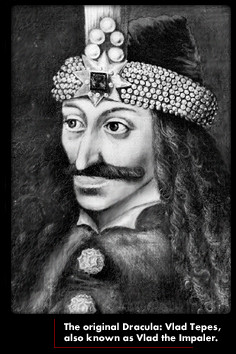
Bram Stoker's Dracula, however, is the ultimate vampire story. Today, more than a century after his creation in 1897, Dracula is still the archetypical vampire image. However, there were actually two Draculas. One was fiction, Stoker's creation. The other was real. He was known as Vlad Tepes, Vlad the Impaler, or -- since his father was called Dracul (which meant devil or dragon) -- he was also called Dracula, which means "son of Dracul."
Vlad Dracula was a real Romanian prince who lived in the 15th century who was noted for his military campaigns against the Turks. In Romania he is considered a hero, even today. (For instance, the Romanian military has honored him by naming a modern assault helicopter the AH1 RO-Dracula.) Vlad was also a mass murderer and a fiend whose favorite form of killing was impalement. This was a type of crucifixion except instead of hanging the victim on a cross, the victim was impaled, from bottom up, with a long, sharp, wooden pole -- in other words, a stake was driven into the body vertically. The body was then displayed for Vlad Dracula, who once enjoyed dining amidst a forest of impaled bodies. Allegedly Vlad once killed 20,000 Turks in this way and lined them up as scarecrows to terrify any further enemies. (Vlad did not limit his murderous means to impalement, however; he also enjoyed cooking his victims and chopping them up.)
As to whether Vlad Dracula was an actual vampire, this was not likely. However, according to perhaps the most authoritative modern account on Dracula (McNally and Florescu's In Search of Dracula), Vlad Dracula actually used the blood of his victims as a sauce with his meals, using human blood as a dip for his bread. This was according to a document called "The Story of a Bloodthirsty Madman called Dracula of Wallachia" written in 1463, a document which was only fairly recently discovered. So, it is possible after all that Vlad did enjoy consuming human blood.
Influenced by Vlad Dracula, the vampire which Bram Stoker created was more base, and quite frankly, uglier than the villain in the typical film versions -- although it has been said that the German 1922 film Nosferatu depicted Dracula as Stoker probably would have wanted it. Remember that vampires, according to legend, were essentially ugly, smelly, non-decomposed corpses; Stoker and the 1922 film Nosferatu followed this tradition of a grotesque vampire, which differs vastly from the suave and debonair modern version.
|