So, I've been sitting around thinking for a bit and came to wonder what people know of Hinduism. I know a few wonderful individuals on here who are Hindu's like I.
Now I wonder, what individuals might know of Hinduism. So here is your chance to throw it out there, let me know what you know or ask and see what can be gained.
- Sin
a.k.a
- Amar
Many people know nothing about it. They think they do, but what they know are just the off-shoots started by ignorant Americans trying to start a new fad. Believe it or not, Wikipedia has it pretty much spot on: http://en.wikipedia.org/wiki/Hinduism
It does have a lot on it, though the true aspects of Hinduism is so vast that the Wiki only touches a fragment of the depth of Hinduism. It is such a vast faith its staggering to think about. I mean I've done a lot of studying and even now I still know only a fraction of what is out there, learning more and more each day which burns deeply and fuels my love for it.
Hinduism is nothing like what they portray in the western world. The true essence of the culture is always lost or misinterpreted through translation. It is said to be one of the oldest religion in the world and also forms the basis for many other religions like Buddhism.
The culture is formed around the worships of deities and rituals which is the main reason why it is deemed to be dark or gothic in the western world. One of the main reasons why I don’t discuss it here on VR. What seems taboo to the others is a normal daily practice to me.
I hate reading through websites that gives elaborate definitions because half of what they mean is not true. Formed in primal mother land of India ... its about times when gods roamed the earth. Filled with mythology that defines indian morals and values ...
from a proud Indian ... a proud hindu ...
The Western world taints everything. For example, so many call the Yin and the Yan a Yin-Yang. Oh, the ignorance. I grew up learning Eastern philosophy, the teachings of Bruce Lee and of the Shaolin. In fact, I came very close to joining a new temple being built in upstate NY, but I doubt my long-term dedication.
One knows what one is exposed to actually. I learned about this in college because I was taking Ancient Asian Civilization rather than World History, because I wanted to learn something new. They delve probably somewhat superficially into it since they included India. You get the basic ideas. It is a very big topic quite frankly but it is a religious view and other than what has been drawn out of it in modern society and embraced by the average person, I don't remember much now because it was back in the 60s. Spiritualists follow some things from this view but I am not sure if they keep true to the meanings as followed in those places that it stems from. I would hear things and took some classes with spiritualists who are more akin to Universalism, but have a tendency to favor those things out of the East. I studied such things as chakras, kundalini and meditation. I have found over the years there are some who don't believe some of these things even exist but I believe they do. I just haven't refreshed my knowledge more recently.
I have no need to know like most here most likely, since in the west it is not a view most follow and you have sects within it as well, so it isn't the same in associated areas. There are ideas and practices (ie, yoga and types of meditation) that have been absorbed and not from the perspective of where it originated. I don't think that necessarily helped me learn anything because I was never involved directly with anyone from the area in a teaching capacity, physically.
In the big scheme of things now, I probably don't know much because I don't hold the belief and it is a religion so I don't normally discuss that since religion and politics are not topics we are suppose to be discussing here actually. Those who actively follow it would most assuredly know much more than I. I suppose it is all right to talk about clinically. I know bits and pieces quite frankly and am no expert. I have had classes relating to some beliefs that stem from it. I have had friends online from India teaching me different aspects. Karma of course is talked about often more loosely in regard to reincarnation and cause and effect, but I think in a more western viewpoint than what most who practice Hinduism follow.
As far as Yin and Yang, I thought that was associated to China and Taoism for the most part relating to balance but not really anything like good and evil? Anyway I have been introduced to these ideas, but like any other topic that is not in my overall belief system, I don't remember the details and descriptive words for things. I recognize words and philosophies but to define them, nope, not anymore. When I want to use concepts now, in writing an essay, etc, I look things up to be as accurate as I can be from a general outlook. I moved on to other interests.
lets see i shall try my best
Adi parashakti-- can be known as the power of ultimate reality--she sets the rules for all Gods and Goddesses Lords Brahma .Shiva and Vishnu along with all other deities worship her
Shiva Vishnu and Brahma are "Great Gods the 3 central aspects of the universal supreme God ..or the Trimurti symbolises the Samsara Brahma as creator, Vishnu as protector, and Shiva as destroyer or judge.
while there are several deities worshipped in Hinduism each one is considered a different aspect of the one God
..hope i wasnt too far off..religions are something i love learning about..will definately be following this thread..maybe if more people were willing to learn about a cultures religion they would have a better understanding of different cultures and maybe just maybe start moving away from wars and looking towards peace
Namaste jewlz
Hinduism is a religion that is described as sanatan dharma,
the eternal faith, because it is not based on the teachings of a single preceptor but on the collective wisdom and inspiration of great seers from the dawn of Indian civilization.
Depending on which aspect you follow depends on days you find holy along with specific colors, plants, elements and weather aspects. Lord Shiva, from what I've gathered through my dedication and study of him is that he is not only an Ascetic, one who would sit and repeat the endless knowledge of the universe in his mind, but also a very erotic and wild Deva as well.
Shiva is also know as the Lord of 108 names, those are 108 different aspects in which he is known form, different facets of who he is and what he can be to others.
..Nothing. I lived in the West of the United States, and here, Hinduism is not too much Advertised. In anther word, Islamism is very popular.
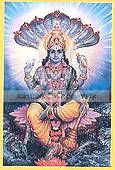
Lord Vishnu
The peace-loving deity of the Hindu Trinity, Vishnu is the Preserver or Sustainer of life with his steadfast principles of order, righteousness and truth. When these values are under threat, Vishnu emerges out of his transcendence to restore peace and order on earth.
Vishnu’s earthly incarnations have many avatars
Matsyavatara (fish), Koorma (tortoise), Varaaha (boar), Narasimha (the man lion), Vaamana (the dwarf), Parasurama (the angry man), Lord Rama (the perfect human of the Ramayana), Lord Krishna (the divine diplomat and statesman), and the yet to appear 10th incarnation called the Kalki avatar.
In his commonest form, Vishnu is portrayed as having a dark complexion – the color of passive and formless ether, and with four hands.
On one of the backhands he holds the milky white conch shell or ‘sankha’ that spreads the primordial sound of Om, and on the other a discuss or ‘chakra’ - a reminder of the cycle of time - which is also a lethal weapon that he uses against blasphemy. It is the famous Sudarshana Chakra that is seen whirling on his index finger. The other hands hold a lotus or ‘padma’, which stands for a glorious existence, and a mace or ‘gada’ that indicates punishment for indiscipline.
Out of his navel blossoms a lotus, known as Padmanabham. The flower holds Brahma, the God of Creation and the embodiment of royal virtues or ‘Rajoguna’. Thus, the peaceful form of Lord Vishnu discards the royal virtues through his navel and makes the Sheshnag snake that stands for the vices of darkness or ‘Tamoguna’, his seat. Therefore Vishnu is the Lord of ‘Satoguna’ - the virtues of the truth.
ApertureStar-
I find the posts you've made have a derogatory and offensive air about them. ' ignorant Americans' and The Western world taints everything'. While you are allowed to have an opinion please keep it respectful.