|
- A brief description of vampire mites.
Vampire mites are also named "varro mites" or "beekeeping mites" and can be considered among the worst natural enemies of bees. There are two species: Varroa destructor and Varroa jacobsoni.
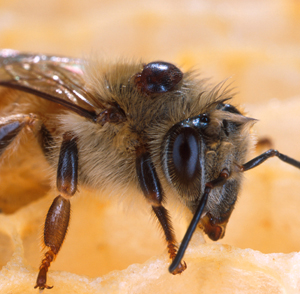
They are similar to little ticks with 8 legs, similar too tiny crabs about 0.5 mm long. Their colour varies from red to dark-brown, so that they are still visible on the body of the bees, where these mites usually attach themselves to the abdominal breaks in the bee's body.
They suck the internal fluids of the bees, well deserving their worrying name; doing this, they transmit infective bacterial or viral diseases in the bees colonies. The virus is particularly invalidating for worker bees because it makes them develop with deformed wings and unable to fly to collect nectar and pollinate the plants. In this manner, whole bees hives can be destroyed within few time. This infection easily propagates among bees and also the queen bee and the drones (the male bees), when infested, can easily spread the parasite as the queen bee mates and creates a new community.
In many farming areas, bees are breed not only for their honey, but mainly for the pollination of many fruit trees like almonds and apple trees, as already happened in the US in 2004-2005 with a great drop in beehives (40-60% in the whole US) due to this pest. Jerry Hayes, an apiary inspection chief of the California Division of Plant Industry, declared in March 2005: "If honeybees ceased to exist, two-thirds of the citrus, all of the watermelons, the blueberries, strawberries, pecans and beans would disappear".
- Discovery and diffusion.
This parasite is native of South-East Asia, where it was discovered in 1904. Later, in the early 1960's, it was found also in the Philippines and in Honk Kong. Later, the vampire mites reached America and the US in 1979, spreading more and more across several States. Then, this parasite has reached Great Britain (1992) and New Zealand (2000). In the US, the first to be affected was Maryland; then, it was found in Florida and, later, in Wisconsin (1987), until the worst national crisis caused by this parasite in 2004-2005, as reported above.
- Reproduction.
The living cycle of this parasite begins as a female mite lays its eggs among the eggs, pupae or larvae of the bees so that the parasites are born together with the bees. The female vampire mites die shortly after the eggs deposition and the new generation of mites develops on the bees
body during their whole life, for the little it can last in these conditions. Normally, these parasites die with their victim, but this doesn't hinder much their diffusion. So, the bees can show deformities at their birth or die precociously with a dramatic decline of the whole bees colony.
This parasite affects either the wild populations of bees and the domestic ones bred in the hives, making drop honey production for the death even of whole colonies. So far, only some populations living in the wild have acquired a natural resistance to this parasite.
- Treatments against the vampire mites.
The main types of treatments are two:
1) Chemical treatments - These use some chemical products that, as claimed by the EPA, kill the largest part of vampire mites without affecting the health and lifespan of bees colonies. The most reactive are:
a) Fluvalinate (commercial name: Apistan, Klartan, Minadox). This is a synthetic pyrethroid molecule that is liposoluble and not volatile. From some studies, this product is absent from honey because it tends to concentrate more in bees wax.
b) Coumaphos (commercial name CheckMite). This is an organophosphate pesticide that is reported as able to kill the mites but also the bees in their colonies.
Other products are less aggressive in their action:
c) Thymol (commercial name: ApiLive and Apiguard), This is a monoterpene phenol, extracted from thyme oil, solid and crystalline, with a pleasant smell. It's used against the vampire mites for its antiseptic properties.
d) Sucrose octanoate esters (commercial name: Sucrocide)
e) Oxalic acid (HOOC-COOH) and alternatively, formic acid (H-COOH) that are sold as gel packs or in other forms.
2) Mechanical treatments, used to hit the vampire mites in certain phases of their development, but they don't eliminate at all the parasites from the hives because they only keep their presence at a tolerable level inside the bees community. Some examples are:
a) The elimination of the drone broods, i.e., the cells of the hive where bees breed the males because it has been found that the vampire mites are 8-15 times more frequent in these cells than in the broods of worker bees. This method is effective mainly in protecting the bees in summer and early autumn, when bees are most vulnerable to these mites. The drone broods are arranged to occupy some of the removable combs that fill each hive and are placed in a separate position, in the upper brood chamber and periodically removed and eliminated every 25-30 days. The whole procedure is better explained in the 3rd site of the references.
b) By spreading powdered sugar in the beehives induces to clean more frequently them and to remove more easily many mites.
c) The use a screened bottom for the hive that makes fall down through it and outside the hive any mite removed from the bees. Another device that can be coupled with a screened bottom is in course of testing in the last years; it consists in a series of restrictions at the entrance of the hives that scratch away from the body of bees the mites and make them fall outside the hive.
|