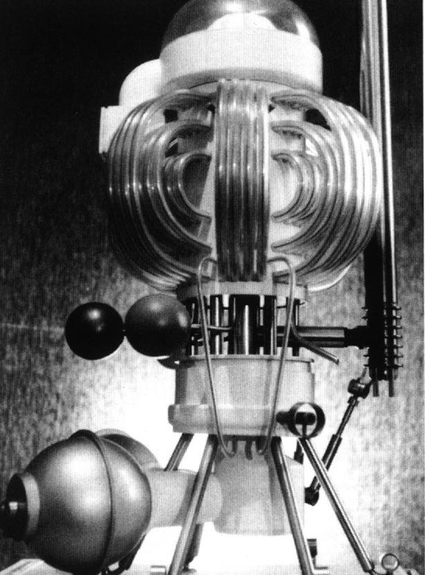
I agree Sinora,but it seems that sometimes we are just a little behind on figuring things out due to one reason or another.Here is a translated description of that thing in the pic.crazy Sci fi looking thats for sure!!I understand this is a realllly long cut and paste,but I find it fascinating and thought you might too.
The Holy Grail
Chalice or Manna Machine?
By
Dr. Johannes Fiebag and Peter Fiebag
Translated from the German by
George T. Sassoon
The Kabbalah, a body of Jewish traditional knowledge, was kept secret until the 13th Century AD, it s content was regarded from the magical-mystical point of view particularly so with respect to the Ancient of Days. This was considered to be a Jewish demi-god until in 1978 two English engineers, George Sassoon and Rodney Dale, concluded that the description of the Ancient of Days in the Zohar, one of the books of the Kabbalah, was not of an ominous god-figure, but rather a machine. A close investigation of the text convinced them that the machine produced the biblical manna which fed the Israelites during their forty-year wandering in the desert and was probably of extraterrestrial origin [1].
The machine, called the Othiq Yomin in the Zohar, worked on the basis of the cultivation and processing of an algae-culture, probably one of the chlorella species, which was maintained by a supply of dew, or water, and of radiation from a nuclear-powered light-source.
The Zohar description is so exact that Sassoon and Dale were able to reconstruct the machine in all its details. At the top was a dew-distilling apparatus, which consisted of a curved, cooled surface. Air flowed over this, and from it water condensed. This water was the basic material for the vessel at the center, which contained the lightsource and the algae itself, which ciruclated in various pipes, permitting an exchange of oxygen and carbon dioxide with the atmosphere and also dissipated heat. The chlorella sludge was then taken to another vessel, where the starch content was partically hydrolysed to malt-like substances (hence the »honey and wafer« taste of the manna), and the dried matter was then finally stored in two collection containers from which it was later drawn off.
To reconstruct such a complex machine from the text of the Zohar neccessitated a fresh translation of the original text, which was accomplished by Sassoon, a linguist and computer expert, as well as an electronics engineer [2]. While the textual desrciption of the machine is extremely detailed, it is not immediately apparent that it is a technical service manual because the parts of the Othiq Yomin (originally translated as Ancient of Days, when the »Transportable One of the Tanks« would be more accurate) are designated with the terminology in use about 1000 B.C. For example, in the Zohar we read passages such as the following:
»There are three upper heads; two, and one which contains them.«
At the time the Zohar was written, there were no words for »perspex dome«, or »algae-cultivation-vessel«, so they used »head«, »skull« and very often »face«, such as in the following extract:
»The dew of the white head drops into the skull of the Small-faces One
and there is it stored.«
To enable regeneration of the algae-culture, it was made to flow through a transparent circulation system, which is known in the Zohar as the »venerable beard«, through which went the »oil of the gread goodness«, that is, the algal sludge. These »pipes« are discussed thusly:
»And those parts which are found in the beard,
they are shaped and lead downwards in many directions.«
The machine was equipped with a considerable number of control lamps, which are called »shining eyes« in the Zohar text, and which light up in various colors:
»In his lower eyes there are a left and a right eye,
and these two have two colours,
except when they are seen in the white light of the upper eye.«
The complete machine was regarded as a deity or demi-deity consisting of male and female parts. It was given to the Israelites at the beginning of their wandering in the wilderness, possibly by extraterrestrials and produced the manna which enabled them to survive. By all accounts, the machine was kept in the so-called Ark of the Covenant, which served as a transport container for the nuclear-powered machine, which was easily damaged under desert conditions. In the time of David an Solomon it found its place in the Holy of Holies in Solomon’s Temple in Jerusalem, while before that it was kept in the Holy Tent, or Tabernacle.
The last mention of the Ark in the Old Testament is in the book of Maccabees, where the prophet Jeremias hides the Ark and the Machine on Mount Nebo. After that the Bible says no more, and nowhere in it do wie find any further trace. Such was the state of knowledge about the Ancient of Days and the Ark of the Covenant after the publication of Rodney Dale and George Sassoon’s book The Manna Machine.
In 1980, we began to investigate the history of the machine. We asked ourselves how it was possible for such an important and unusual object to disappear without a trace, and whether it was possible for it to have re-appeared as some »Holy Device« at some time during the course of the follwoing 2500 years. Now, at the end of our preliminary studies on this subject, we have come to the conclusion that the Manna Machine was brought from Israel to Europe.
Our statement that the machine was re-discovered and transported is based on two pieces of evidence: first the Parsifal (Parzival) epic of the upper middle ages, and second the history of the Order of the Brotherhood of the Templars.
The Parsifal epic was first set down in written form around 1200 AD almost simultaniously in French and German, by the French poets Chrestian de Troyes and Robert de Boron, and by the German story-teller Wolfram von Eschenbach. In essence, it is a traditional story of a young hero who was brought up far from any contact with the knightly and courtly culture of the middle ages, and who escapes into the wide world where he has many adventures and meets King Arthur. He is dubbed a knight by the King, resumes his adventurous existence and is finally led to the castle of Munsalvatsch bei the »hand of God«. In this magical fortress there is a clan of nobles called the Guardians of the Grail. Their king has committed many sins which have condemned him to eternal sickness, from which he can be freed only if a God-fearing man asks him a question as to the reason for his illness. Parsifal is invited to a meal, but fails to ask the question. For many years he wanders hither and thither until he finally has another opportunity to visit Munsalvatsch. This time he asks the crucial question, the King’s illness and suffering disappear and Parsifal himself is crowned »Grail-King«.
Several medievalists have already noted that the Parsifal epic consists of a conglomerate of very different texts. In fact, there existed a long time previously the so-called Peredur tradition, a celtic myth which already contained many elements of the later legends. In it there are parts of the Arthur material, various heathen myths, christian influences and the actual grail-tradition itself, which must be considered completely separate.
But what actually was the Grail? Authors of the middle ages carefully avoid any exact description. It is obvious that they had never seen the »holy object« themselves. The two French writers describe it simply as a »handsome vessel« or as a »metal bowl«, and Robert de Boron states that it is the very chalice used at the Last Supper. It is here that the christian influence on the Parsifal saga is most apparent. Wolfram von Eschenbach, on the other hand, is even more reticent. He writes simply:
»It was a thing, called the Grail,
that gave all earthly desires in abundance.«
And:
»The stone was also called the grail.«
Etymologically speaking, several derivations are to be found of the Grail concept. From the middle Latin gradalis and the French gradale, meaning »bowl«; from the Provencal grazaal which corresponds to the old Catalonian gresal, which can also be tranlated as »bowl«, »basin«, or »dish«, but also with the connotations of »milk-jug«, »pleasure«, »charity«, and »bread«; and from a Nordic version of the Parsifal tradition - and this strikes us as most significant - the grail is spoken of as an object known as the gangandi greidi which can be translated as »tranformer of consumable material«.
Wolfram von Eschenbach speaks occassionally of a stone which he calls lapsit exillis. Philologically speaking, it has not yet been derminded with certainty what is meant by this, however there is general agreement that lapsit is in fact a corruption of the word »lapis«, or »stone«. One author emphazes that »a contributor to the formation of „lapsit" is the Latin „lapsus", as a word designating any „sliding downward movements, fall or dive"«. In addition, lapsit exillis is also interpreted as lapis elixir, that is, »stone of the wise«, which agrees well with the miracle-working nature of the grail. Other derive it from lapis exilii (»stone of the exile«), or lapis exulis (»the stone that is found far from home«). Finally, there is another very interesting translation: lapis lapsus ex illis stellis, that is »the stone that came down from the stars«.
We now approach the point where we can make a hypothesis that the »Holy Grail« of the middle ages must have been the same as the Manna Machine of the Israelites described in the Kabbalah. This line of thinking is supported by two imprtant factors: the principal fuction of the Grail and its origin. In the Zohar we find the following information about the foodstuff produced by the Manna Machine:
»And from that dew they grind the manna of the just ones for the world to come.
At that time the Ancient of Days fed them from that place.«
Also:
»See, I will make bread from Heaven to rain upon ye.«
And further:
»God gave thee of the dew of heaven.«
Thus the Israelites had at their disposal a machine, called by their priests Othiq Yomin (»The Transportable One of the Tanks«) which fed them wit manna - food. Wolfram von Eschenbach says exactly the same thing about the Grail:
»Now know ye this also: a hundred squires were summoned, who respectfully took bread on white linen from the Grail... They said to me, and I say it to you, that it came forth from the Grail, when ever one of them put out his hand to it... for the Grail was the fruit of the blessed ones, such a fullness of earthly sweetness, that it was like almost everything that might come from the Kingdom of Heaven.«
Chrestian de Troyes describes it similarly, though with the christian influences manifesting itself; he speaks of the bread taken from the Grail as a »host«.
The correspondences between Manna Machine and Grail are astonishing: both the Othiq Yomin and the Grail were able to make »food«. Just as the Zohar speaks of the manna as the food of »the just ones of the world to come«, so also is the Grail, in relation to the nourishment it dispenses, referred to as the »fruit of the blessed ones.«
These resembles and parallels would have little weight if it was stated in the Parsifal literature that the Grail was an earthly »objekt«, that is, that it had come from the workshoop of a goldsmith or a stonemason. In fact, the opposite is the case. As already shown the derivation of the words lapsit exillis can be interpreted as the »stone that came down from the stars«. This translation would be a very appropriate description for the Manna Machine, which was probably the product of an extraterrestrial technology.
Wolfram von Eschenbach gives us an even more impressive piece of evidence which is absolutely astonishing. This is what he wrote at the beginning of the 13th Century about the origin of the Grail:
»Once upon a time it brought a troop,
which flew back to the high stars,
because their innocence drew them homewards.«
With this, Wolfram von Eschenbach excluded any other prossible interpretation: there were beings - a whole troop of them - who once broght the Grail to Earth, before they returned to their home stars.
We can now form these preliminary observations:
1. Manna Machine and Grail produced the same food.
2. Manna Machine and Grail had similar or identical properties attributed to them quite independently from each other.
3. Manna Machine and Grail are of artificial, extraterrestrial origin.
Thus we can justify the conclusion that the Manna Machine and the Grail were clearly identical; these are simply different names for the same object.
There now arises the question as to how the tradition of the Manna Machine came to be incorporated into the saga-epics of the middle ages. We would like to make it clear once again that all trace of the machine was lost in the year 587 BC, when Jeremiah hid it at Mount Nebo. But, in the Jewish world memories of it persisted.
In the course of our research, we came across the remakable Jewish concept of the Shekhina, which appears particularly often in the Talmud, a work which was compiled in early post-biblical times, about 200 AD. It comprises a body of teaching in the realm of legends, parables, sayings and prayers.
The concept of the Shekhina, as it occurs in the Talmud, means literally »that which descends«, a »dwelling« or a »resting place«. It is a difficult concept, and its significance changed in the course of time, but originally it meant nothing other than »God’s presence among men«, that is, his bodily presence. On this subject the theologican, A. Hauck, wrote: »Thus we have in the Shekhina a cover-name or nickname for God, which stands for God himself, but brings him nearer to human consciousness through his actual presence in the world.«
Also according to Hauck: »The Shekhina accompanied the people of Israel everywhere that the Tabernacle was erected, until it finally after a long time found its resting-place in the Temple erected by David and Solomon.«
As already noted, Shekhina denotes also God’s »dwelling« among his people. Again, this dwelling relates to the interior of the Ark of the Covenant, as we can assume from Exodus 25:
»And you shall make for me a holy place, that I may dwell among you.«
It could hardly be the intention of the compilers of the Pentateuch to give the impression that almighty God could be imprisoned within the Ark of the Covenant. So, whatever was inside the Ark was certainly not the creator of the universe, but some material object. On this point Hauck writes: »When Aaron performed the Temple service, the Shekhina rested on his hands. According to a legend, Simon the Righteous saw the Shekhina with his own eyes on his annual entry into the Holy of Holies.«
It is most interesting that the term most used is »the face of the Shekhina«. This tends to confirm the suggestion that the Shekhina and the Manna Machine were identical. Further confirmation comes from Hauck when he writes: »Sometimes the Shekhina itself is called the „image".«
Finally, these forms of speech are used to denote the Shekhina in a material sense: to receive the face of the Shekhina; to refresh oneself in the brilliance of the Shekhina; anyone who receives the face of the Shekhina experiences here on Earth a foretaste of eternal bliss.
We can sumarize the Shekhina as follows:
1. It is not identical with God, though like the Othiq Yomin it is venerated in the same way as God, though not to be identified with Him.
2. The Shekhina is located in the Ark of the Covenant.
3. The Shekhina is a physical object which can be seen and handled.
4. It accompanies the people of Israel through the wilderness and is to be found with the other equipment in Solomon’s Temple.
5. One can »receive« the Shekhina and »refresh oneself« with it.
In our opinion, all these characteristics belong to but one single object in Jewish history: to the Manna Machine! Only the machine prossesses all these properties, and only the machine can be meant by the term »Shekhina«.
Is there a connection with the Holy Grail? The Jewish theologian Scholem writes about the Hebrew book of Bahir: »The Shekhina ist not only the handsome vessel, it is also referred to in several places in the book Bahir itself as the precious stone or the pearl.« Note that the phrase »handsome vessel« is identical to that used earlier to describe the Grail.
With this we can now make a connection. The Manna Machine, known in the Jewish secret tradition as Othiq Yomin (the Ancient of Days, or the »Transportable One of the Tanks«), becomes the Shekhina in the official Hebrew literature, and then the Holy Grail in the high middle ages. H. Kolb, writing in 1963, states: »The name „grail" appears to be a secret name for the Hebrew Shekhina«.
There is yet another trail which could lead us to the clearing up of the mystery of the grail tradition, which we shall now follow.
Let us examine the origin of the Parsifal tradition. Robert de Boron and Chrestian de Troyes, the French authors, state that they obtained their information from a »great book«, in which »the sublime mysteries which are named after the grail are described«. Wolfram von Eschenbach is the most explicit about this book. He says:
»Kyot, the well-known master, found at Toledo descarded (buried) in heathen script the original edition of the adventure. The meaning of the alphabet used in the work he had first to learn, also the black art (secret teaching). It helped that he was baptisted, otherwise this tale would still be unknown today. No heathen cunning would help us to tell of the like of the grail, how one penetrates its mysteries.«
Toledo, then, is to be the key-point four our further investigations. If we look at medieval Spain, we see that the Iberian peninsula had been occupied for a long time by the Moslems, and Toledo was in fact the scientific center of the Islamic world. It was there that the authenticator of Wolfram von Eschenbach’s tale found a manuscript, possibly in Arabic, which contained the grail tradition. Writing of the original author of the text, Wolfram von Eschenbach states:
»A heathen, Flegetanis, once famous for his arts, with great knowledge of nature (a physicist?) born on his mother’s side of Solomon (the tribe of Solomon), of Israelitic race. He wrote of the adventure of the grail. On his father’s side he was a heathen, Flegetanis, who worshipped a calf, as if it was his God. He said, it was a thing called „the grail".«
Whole generations of scholars have puzzled over the question of who can have been meant here, because Moslems do not worship idols. But in fact there was at the time of Solomon a man to whom the above description applies exactly. The first book of Kings contains much information about him. On his mother’s side he stemmed from the Jewish tribe of Naphtali, but his father was a Phoenician who worshipped the god, Baal, in the form of a calf. He was, the Bible says, »full of wisdom, understanding and knowledge«. His name: Hiram-Abiff. His position: adviser, architect and astrologer of the King of Tyre. His life’s work: the building of King Solomon’s Temple!
Sometimes there are remarkable chance coincidences, but we can no longer believe that this is one. Hiram-Abiff, as the builder in particular of the Holy of Holies of the House of God, was the one and only outsider who must have known what it was all about. As a member of a sea-going race, which travelled all over the known world, a wise man, a scholar, and an astronomer, he would hardly have been satisfied to build a gigantic Temple simply to house an »empty box«. Jewish tradition also confirms the assumption that he knew what was going on, for acccording to them he was murdered after the building work was completed. However, it seems that he was nevertheless able to send a report about the Othiq Yomin to his lord, the Phoenician King, and in this way it passed into the later Moslem world, and after the conquest of Spain it came to Toledo.
So what happened next? Unfortunately Wolfram von Eschenbach gives us no dates for his authenticator, Kyot, so we must try a different route. In the legend the Grail is guarded by a so-called »grail knighthood«, which Wolfram von Eschenbach refers to as Templeisen. This name is reminiscent of the monastic knightly Order of the Templars, and in fact, because of many diverse correspondences, a connection between the two is generally taken for granted by the community of literary scholars. The Templars were officially founded in 1128 and dissolved in 1312 by command of the then-reigning French King, Philip the Fair. The question which now arises is: were the Templars in possession of the Manna Machine, were they the »guardians of the grail«?
The two principal personalities involved were Hugues, Count of Campagne, and Hugues de Payens. In 1104 these men set off for their second journey to the Holy Land, but after only a few months they returned to France, where they formed a connection with the Cistercian Order, whose monks thereupon set about a long-term study of the Old Hebrew texts. Jewish rabbis were brought in to help with the translation work - something very unusual for the time. Then in 1114 Hugues de Champagne made another short visit to Palestine. As soon as he returned, he presented the Order with the forest of Bar-sur-Aube, and instigated the foundation there of the Abbey of Clairvaux. This project was taken in hand by Bernard of Clairvaux, later Saint Bernard, and the translation work was continued under his direction.
Then in 1119, Hugues de Payens set off for Palestine yet again, with seven trusted friends. Later Hughues de Campagne joined the group. They called themselves The Poor Knights of Solomon’s Temple, and rightly so, for they took up their quarters right over the ruins of the House of God built by Hiram-Abiff!
During their eight-year stay, they took part in not one single battle, but instead carried out excavations in the Temple area and ranged the length of breadth of Palestine. Then, obviously something decisive happened: two of the Templars returned to France and reported to Bernard of Clairvaux, who thereupon wrote to the Pope, to the King of France and then to the other Templars in Jerusalem, who at once left the Holy Land. On their arrival in France, the Order of the Templars was officially founded, on which occassion, Bernard wrote in the preamble of the Rules of the Order: »With God’s help, the great work has been accomplished.«
What actually happened in those years between 1105 and 1128? When we review the whole body of evidence, there is only one possible explanation: the Templars did not got to Palestine to fight, but to search for something particularly important, something extraordinary, something holy, something which was located in Israel and was found after years of painstaking search - the Holy Grail, the Manna Machine!
In 1312 at the proceedings brought against the Order of the Templars for its dissolution, the list of charges against it included:
»That they possessed idols in every province, which were called „heads", which had sometimes three faces, and sometimes a single face.
That in their assemblies, especially in the grand chapters, they venerated the image as a God, as their saviour, and stated that this head could save them.
That the idol had in its eye-sockets carbuncle-eyes, which shone with the brightness of Heaven, and they believed it was their supreme God. Its skin had half a beard in its face and the other half in its behind, which was a repugnant thing.«
During the inquisition carried out against the members of the Order, not a single example of the idols was found, although the senior members of the Order did not deny its existence. In fact, most of them stressed the »beard« of the »image«, many mentioned that the idol (whose name was Baphomet) was »bald-headed«, and one stated that it »glittered like gilded silver«.
There is little doubt that the Templars did find the Holy Grail in Jerusalem and brought it to France where it was venerated as a holy object. During the 200 year history of the Templars only the leading members of the Order had access to it; they were the real »Guardians of the Grail«. Among the lower ranks, only rumors of an idol were circulated. Therefore, we can state categorically and without the slightest doubt that the »Holy Grail« was in fact the »Manna-Machine«.
What, then, happened to the Manna Machine? According to a statement from Jean de Chalon, a Templar, during the night before the country-wide arrests, a convoy of wagons, loaded with heavy wooden chests, left the Temple in Paris and headed towards the coast. The question is, where to? It is known that many Templars flew to Scotland and became the founder of the later freemasons. One of them, Sir Henry Sinclair, started an expedition to America in 1398, about hundred years before Columbus reached the >New World