Okay my research continues....If you are not in this house of haven't been around awhile knowledge of which spider is the mascot and symbol of The House of Umbrae Octo.
The Black Widow ladies and gentelman...
Black Widow Spider
Binomial name Latrodectus mactans
Scientific classification---
Kingdom: Animalia
Phylum: Arthropoda
Class: Arachnida
Order: Araneae
Family: Theridiidae
Genus: Latrodectus
Species: L. mactans
The black widow spider is a spider notorious for its neurotoxic venom. It is a large widow spider found throughout the world and commonly associated with urban habitats or agricultural areas. Although the common name 'black widow spider' is used to refer specifically to L. mactans it is occasionally also applied to several members of the Latrodectus (widow spider) genus in which there are 31 recognized species including the Australian red-back and brown widow spider. In South Africa, the black widow is also known as the button spider. Also found in all four deserts of the American Southwest, including the Sonoran Desert where Phoenix is located.
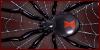
Adult female black widow spiders are shiny black with an hourglass shaped marking on the bottom of its abdomen which, although most commonly red, may range in color from white to yellow to various shades of orange and red. They also bear a small, usually red (colors vary) dot near the spinerettes, which is separate from the hourglass. In some varieties, the two halves of the hourglass shape may be separated into two separate dots. Female black widow spiders are about 1.5 inches (38 mm) counting legspan. The body is about 0.5 inches (13 mm). Male black widow spiders are half the size of the female or smaller. They have longer legs and a smaller abdomen in relation to their body size. They are also usually dark brown with varying colors of stripes/dots, with no hourglass mark. Adult males can be distinguished from juvenile females by their more-slender body, longer legs and large pedipalps typical of most other male spiders. Juvenile black widow spiders start white, molting to dark brown to black exoskeletons with white, yellow, orange and red stripes and/or dots on their backs.
As with many poisonous creatures, the brightly coloured markings serve as a warning to predators. Eating a black widow will normally not kill a small predator (birds, et cetera), but the sickness that follows digestion is enough for the creature to remember that the bright red means not to eat. Because the adult female black widow typically hangs and moves about its web upside down, its hourglass in on its front. However, juvinille widows (female) spend a large quantity of time in search of an optimal environment. Once an optimal location is found, adult female widows often times spend their entire lives in one place. However, because juvinille females must first find this optimal location, they bear brightly colored marks upon their backs, so that they may be seen by predators when the widow is travelling upon its legs. Males bear similair marks to the females to serve as warning while they are searching for mates, however, the marks are not as prominent (not as brightly colored, or as large). Males, being less poisonous, are less of a threat to predators, so having similair marks not as prominent helps predators to better judge their prey (some large birds can eat male widows without adverse effect, and so only avoid female widows. Those who cannot eat any widow without adverse effect eat nothing with the marks.) Female juvinilles develop an hourglass before the dorsal markings are shed.
Black widow spiders live in temperate and tropical zones. They typically prey on a variety of insects, but occasionally they do feed upon woodlice, diplopods, chilopods and other arachnids. When the prey is entangled by the web, L. mactans quickly comes out of its retreat, wraps the prey securely in its strong web, then punctures and poisons its prey. The venom takes about ten minutes to take effect, meanwhile the prey is held tightly by the spider. When movements of the prey cease, digestive enzymes are released into the wound. The black widow spider then carries its prey back to its retreat before feeding.
As is characteristic of all arthropods, black widow spiders have a hard exoskeleton composed of chitin and protein. When a male is mature, he spins a sperm web, deposits semen on it, and charges his palpi with the sperm. Black widow spiders reproduce sexually when the male inserts his palpus into the female's spermathecal openings. The female deposits her eggs in a globular silken container which they remain camouflaged and guarded. A female black widow spider can produce nine egg sacs in one summer, each containing about 400 eggs. Usually, eggs incubate for twenty to thirty days. Rarely do more than one hundred survive through this process, due to cannibalism. On average, thirty will survive through the first molting, due to cannibalism, lack of food, or lack of proper shelter. It takes two to four months for black widow spiders to mature enough to breed, however full maturation typically takes six to nine months. The females can live for up to five years, while a male's lifespan is much shorter. Lifespans depend upon environment, shelter being the greatest determining factor; food the second greatest.
Though its venom is extremely potent, little of it is injected and deaths from Latrodectus bites are rare, only sixty-three having been reported in the United States between 1950 and 1989. Black Widows have the most potent venom of any spider, and the venom is in fact 15 times more potent than a cobra. But Sydney Funnel Webs and Brazilian Wandering Spiders are more dangerous because they inject far more venom. Black widow venom acts by causing a localized release of the neurotransmitter acetylcholine, which is involved in muscular contraction.
There are a number of active components in the venom. There are a few high-molecular mass components (These proteins, called latrotoxins, cause a massive transmitter release from a diversity of nerve endings); a number of smaller polypeptides, toxins interacting with cation channels which display spatial structure homology. They can affect the functioning of calcium, sodium, or potassium channels. There are also a few even more simple molecules, adenosine, guanosine, inosine, and 2,4,6-trihydroxypurine. The mechanism of the venom relates to the toxin initially being carried by the lymphatic system until it reaches the blood stream. Once in the blood, the toxin is moved by the circulation and deposited in the nerve ends where they insert into the muscle. Most strongly affected are back, abdomen, and thigh muscle areas. The venom acts at the nerve ends to prevent relaxation of the muscle, causing tetany - or constant, strong, painful contractions of the muscles. Standard treatments usually involve symptomatic therapy with pain medication, muscle relaxants, and, rarely, antivenin. The venom does not typically cause problems at the bite site itself, unless a secondary skin infection occurs.
The use of antivenin is generally reserved for use only when absolutely necessary. Due to the low mortality rate of victims, the risk of major injuries or death due to serum sickness are greater than the risk of death due to the neurotoxons. In past years, injections of calcium gluconate were used to replace calcium rendered unusable by the neurotoxins, but hospitals have been switching over to the use of prescription painkillers, especially opiates, such as morphine and others, to reduce symptoms, as the calcium injections do very little for the pain, and do not significantly reduce the recovery time.
The female eats the male after mating. She hangs belly upward and rarely leaves the web (VR).
You will find black widow spider most often in dark, hidden places, like garages, sheds, or woodpiles. Webs are usually near the ground.
The best way to keep black widow spiders away is to keep areas clean and free of webs. The spiders prey on insects like crickets and roaches, so if you regularly rid your property of insects you will have fewer black widow spiders.
If you are working around areas where black widow spiders may be established, like in piles of stored boxes in the garage, or piles of wood outside, wear gloves.
Common insecticides may or may not be helpful. Check all labels before using commercial insecticides, especially if you have small children or pets. When in doubt, contact your local exterminator.
http://en.wikipedia.org/wiki/Black_widow_spider
http://phoenix.about.com/cs/desert/a/spider.htm