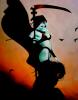
The Valkyrie is, in the oldest strata of belief, a corpse goddess, represented by the carrion-eating raven. The name in Old Norse, valkyrja, means literally, "chooser of the slain." The Valkyrie is related to the Celtic warrior-goddess, the Morrigan, who likewise may assume the form of the raven.
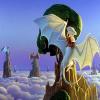
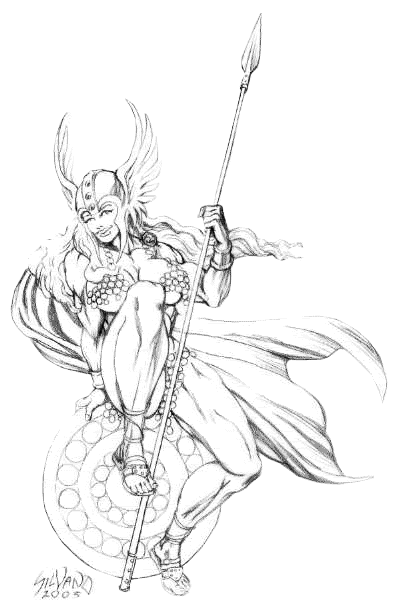
Midway between the third and eleventh centuries, the Valkyries begin assuming a more benign aspect. Small amulets and pictures on memorial stones begin to depict the figure of the beautiful woman welcoming the deceased hero with a horn of mead to the afterlife. Valkyries are usually represented as blonde, blue eyed and fair skinned. They wear scarlet corslets and carry shields and spears.
By this later time, the Valkyries, as demigoddesses of death, had their legend conflated with the folklore motif of the swan maiden (young girls who are able to take on the form of a swan, sometimes as the result of a curse). If one could capture and hold a swan maiden, or her feathered cloak, one could extract a wish from her. This is why valkyries were sometimes known as swan maidens or wish maidens.
Although the sources consulted are not clear on this, the chief of the Valkyries seems to have been the goddess Freyja. She is the Norse goddess of love, fertility, and beauty, sometimes identified as the goddess of battle and death. Blond, blue-eyed, and beautiful, Freyja travels on a golden-bristled boar or in a chariot drawn by cats. She resides in the celestial realm of Folkvang. Like Odinn, she received half of those slain in battle, but since ladies go first she was allowed first choice! Freyja possessed a magical cloak of falcon feathers that allowed her to take the shape of a falcon if she wished, making the swan maidens similar to the goddess by having "feather coats" or cloaks that enable their shape-shifting abilities and the power of flight.
The Valkyries carry out the will of Odinn in determining the victors of the battle, and the course of the war. Their primary duty is to choose the bravest of those who have been slain, gathering the souls of dying heros or warriors found deserving of afterlife in Valhalla. They scout the battle ground in search of mortals worthy of the grand hall. If you are deemed by the Valkyries as un-worthy of the hall of Valhalla you will be received after death by the goddess Hel in a cheerless underground world.
The descriptions of Odinn's hall describe the Valkyries as foster-daughters, just as the einherjar (the chosen warriors of Odinn) are foster sons Freyja is said to be the first of the Valkyries, called Valfreyja, "Mistress of the Slain," she pours ale at the feasts of the Aesir . The Valkyries also have duties in the great hall. There, having exchanged their armor for pure white robes, they will serve the warriors they have chosen.
Aalhalla, the great hall of slain warriors is located in Asguard, the realm of Odinn. It contains 540 doors each of which leads to a room which can accommodate 800 warriors. The roof is made of warrior's shields. There the warriors spend their days fighting and their nights feasting, until Ragnarok, the day of the final world battle, in which the old gods will perish and a new reign of peace and love will be instituted.
There are several traditional names for Valkyries mentioned in the sagas and the Eddas:
Brynhildr ("Byrnie of Battle" or "Mail-coat of Battle") Sigrdrifa ("Victory Blizzard")
Sigrún ("Victory Rune") Sváva
Kára Hrist ("The Shaker")
Mist ("The Mist" or "The Fog") Skeggjöld ("Wearing a War Axe")
Skögul ("Battle" or "Rager") Hildr ("Battle")
Þrúðr ("Power") Hlökk ("Noise", "Din of Battle")
Herfjötur ("War-Fetter") Göll ("Loud Cry", "Battle Cry")
Geirahöd ("Spear of Battle") Randgríðr ("Shield of Peace")
Ráðgri'ðr ("Counsel of Peace" or "Gods' Peace") Reginleif ("Heritage of the Gods")
Gunnr ("Battle") Róta ("She Who Causes Turmoil")
Skuld ("She Who Is Becoming") Göndul ("Magic Wand" or "Enchanted Stave" or perhaps, "She-Were-Wolf")
Friagabi ("Giver of Freedom")
The Valkyries are connected with the legend of the Raven Banner. This banner was woven of the cleanest and whitest silk and no picture of any figure was found upon it except in the case of war, at which time a raven always appeared upon it, as if woven into it.
If the Danes were going to win the upcoming battle, the raven appeared with his beak wide open, flapping its wings and restless on its feet.
If they were going to be defeated, the raven did not stir at all, and its limbs hung motionless.
Sometimes the blood-covered Valkyrie-prophetesses are seen themselves as weavers, to prophesy the outcome of the next day's battle.
The Valkyries are also Odinn's messengers and when they ride forth on their errands, their armor causes the strange flickering light that is called the "Aurora Borealis" (Northern Lights).
Depending on who you talk to, the number of Valkyries varies from three to sixteen.
Any maiden who becomes a valkyrie will remain immortal and invulnerable as long as they obey the gods and remain virginal.
It is often said that if you see a Valkyrie before a battle, you will die in that battle.
The Valkyries appeared riding in a troop, often of nine war-like women
I found this article very interesting, what do you think?
Very well written.
I suppose it would then be a bad idea to attempt to summon one of them for purposes of war...
Thank you for this info.
Most of the information comes from a website run by one called Viking Answer Lady. That is of course her online name. So author would not be unknown. She sales books on amazon.com.
Yes, I tried submitting it as an article but it has to be written by yourself to be published into the Members Articles section
ok, what are we suppose to discuss here? am I wrong or is this suppose to be a forum for discussion? Sorry to say but it seems in the wrong section or place, should be in the article or in a journal.

Unless there is a duscussion I miss... I'll be more then glad to do it, I found Valkyries interesting too.
I am glad you put this up many people have a really bad misconception of who and what they were and whet they actually represent thanks for the post.
I totally believe in them of course I am of Native american heretage also lOL!
AshtridOfDarkness,
Great work. They were not only seen as Ravens but even Riding Ravens into the heart of battles to cull those who were chosen to die. They were even rumored to join the "Great Hunt" as well.
Morrigan was a triple Goddess as well. Her two sisters were Maub and Macha.
Both have more celtic Origins. Macha was the more Warlike of the three. Known as the "Battle Raven" herself. It was said that after the battle. the heads of the slain enemies were placed on pikes in large circles known as the "Mast of Macha", where she would walk them wearing a cloak of Raven Feathers. Like walking in a garden if you will.
Nice article, sad there is no real discussion on the subject itself, more of a poll: yes like or no dont.
I love valkyries, but dont really know what to dicusss about here, not much post of discussion, more of : good article. and things usually in the member's aritcle comment space.
I read a book on them, it was quite interesting so I looking it up online :)
an interesting an accurate article. it confirms the brief readings I've come into contact with that mention the valkyries. good information; better as an article.
i can only add that somewhere i had read the valkyries came for warriors who died holding their weapon, which lead me to wonder what happened to those who died in their sleep. no valhalla for you if you were sleeping i guess. lol
very interessting....i have been trying to find information on Valkyries and Odin but am having no such luck so far....seems i have a very sensative IE.....
Thanks for the post Astrid, it is very informative and well now I know a heck of a lot more about valkyries. I always thought valkyries were vampiric sort of old women that finished off they dying so to speak, like vultures. So glad I have been corrected :D
I considered it an interesting read. I also think perhaps someone should look up more on it and post it to the database for all to see. (the books and where to buy them that is)
Well it was a good read, i never really new anything about the valkyries until now, so that story helped me to know more about them...
All I'd ever known about the Valkyries was that they were eight sisters, daughters of Odin, who rode in the skies above battlefields on horseback (in some mythos I've read, the horses were winged, and in others they weren't, I'm not sure which is more accurate)
The Valkyries would descend upon the battlefields after the battle was over, and pick up the souls of the warriors who fought the bravest and escorted them to Valhalla.
This was a very enlightening read. I love reading up on ancient myths, but my knowledge of Norse mythology is very limited. Thank you for posting this, I feel so enlightened now ♥
In Norse mythology the valkyries are dísir, minor female deities, who served Odin. The valkyries' purpose was to choose the most heroic of those who had died in battle and to carry them off to Valhalla where they became einherjar. This was necessary because Odin needed warriors to fight at his side at the preordained battle at the end of the world, Ragnarök. In Valhalla the valkyries also “serve drink and look after the tableware and drinking vessels” (Prose Edda Gylfaginning 36).
In Gylfaginning of the Prose Edda and the poem Grimnismál of the Poetic Edda, it is said that Freyja receives half of the slain heroes in her hall Fólkvangr, however there are no descriptions about life at Fólkvangr. Freyja is also called Vanadís, which suggests that she is related to the dísir.
It appears, however, that there was no clear distinction between the valkyries and the norns. Skuld is for instance both a valkyrie and a norn, and in the Darraðarljóð (lines 1-52), the valkyries weave the web of war (see below). According to the Prose Edda (Gylfaginning 36), “Odin sends [the valkyries] to every battle. They allot death to men and govern victory. Gunnr and Róta [two valkyries] and the youngest norn, called Skuld, always ride to choose who shall be slain and to govern the killings”.
Moreover, artistic licence permitted the name Valkyrie to be used for mortal women in Old Norse poetry, or to quote Snorri Sturluson's Skáldskaparmál on the various names used for women:
Woman is also metaphorically called by the names of the Asynjur or the Valkyrs or Norns or women of supernatural kind.[1]
Obviously I am gonna be hated for this but....is there any discussion here? Cause this i saccording to the VR manual a simple article and should not be in the forum but in the member's article.
I am suprise a dominar has not interven yet. I knwo I ma gonna get flamm for this but I notice several ask what was the discussion about and so far all it was it: good article good post..blah blah similare post.
I have seen not even one that would lead to discussion, its is sad.
Again I think I am gonn get hated but, this thread should be close and the article place in the member's article
Very good artical.I was always told the Valkries at one time were the ones who decided who woul live and die.Then Odin decided he would tell them who he wanted to die and win the wars.When he decided to do this some rebelled and went to Hella.Hella isn't really the way she is portrayed.She has a beautiful aspect also.Just what I was told.Loki helped them steal some horses just to piss odin off.
KA
I did submit it but they rejected it. I know it's someone elses article and I think the information is interesting and different.
Very well written .. Yes it is amazing How much we pick up and where.. seems alot of the Valkyries Gods and goddesses is also Used in the Lifestyle of Gor.. Odin Especially as Northern Gorean FreeMen Followed and Worshipped the God Odin and prayed to Him for Guidence.. Now i know where He came from
I await the Valkyries, As I will sit at the feast of fallenwarriors, And did you know that a gold pice or some form of gold is to be offerd as payment into the great hall? Hence the tradition for sailers to wear gold ear rind to pay for ther bureal
loki is still changed to the rocks as the serpent drips acid from its fangs onto him, His wife holds a sheild to protect him and he only feels it when she emptys the sheild, This was his demise for betraing the god Oden
This was a great article. I'm reminded that the Walkyriun came to take those men who died in battle, those who best embodied (both in battle and in the rest of their life) the Nine Noble VIrtues of Asatru: Boldness; Sooth, Honor, Troth, Discipline, Guest-friendliness, Busyship, Freedom, and Steadfastness.
dracshierbloodtears please may I have the source of you story of Loki?As I follow Loki and last I spoke to him he was running free still playing pranks.i follow all tricksters along with Anubis.
The Norse mythology concerning Valkyries
is wonderful reading. I have enjoyed reading about them. I would love to beleive they may have really existed. The powers they possessed is interesting to me as a feminst as well. Thanks for the article.
I just read an article on them and it is amazing the things that they did and believed in .
Good article. I don't often get to study mythology but I've come across the name Freyja before, and which I believe was in a book regarding Freemasonry. Could someone give further information regarding this Goddess? Is she akin to the Babylonian Ishtar, or Grecian Venus? Was she associated with the stars or planets?
here is another story that i picked up that could help this thread..
a story of Valkyries
That was a very good article and had a lot of good information in it as well I liked it very much
Nothing like being honour guarded by the Valkyries to Valhalla...Take heed all who venture forth, will be blinded by the hand of Fates wing, one should say? Hell yeah, such an invite, on the back of Thors carriage...Let the gates open wide.
that was very interesting and that is true that they were the best and most popular of women warriors. I admire them greatly
I enjoyed your post, it taught me a lot I did not know about the Valkyries.
Thank you for the info, was very insightful.
Just to be pedantic though, they wouldn't be in Hell, they would be in Henna, the Norse version of hell.
this story wet my "chops" im drooling to learn more.
if any one knows of some good books or movies (other than the thirteenth warrier),
please let me know.
I knew I had read the name somewhere. Freemason Robert Lomas, author of The Hiram Key, and Turning the Hiram Key, wrote the following.
"I have developed an hypothesis that modern Freemasonry was created by William St Clair during the building of the Chapel at Roslin. I believe that he drew on various religious traditions, such as Enochian Judaism, Phoenician Goddess worship, Christianity and the Norse mythology of Freyja. ..the path of Freemasonry evolved from a mix of some of the oldest teachings on spiritual growth." Turning the Hirma Key
I've since lost the book, but I don't recall him ever going into the connection between the Goddess Freyja and the Craft. I vaguely remember him commenting on the Kirkwall Scroll, suggesting that the images on it were not scenes of the Garden of Eden - rather images of this Goddess.
According to Wikipedia, she was a goddess of love, beauty, fertility, and attraction - all traits of the Goddess Venus.
This is a really well written posy Morrigan, So powerful. thanks fro the great postings !
Freya was the ruling ancestress of the Vanir or elder gods, who ruled before the arrival of Odin. Like all forms of the goddess, Freya represented sexual love, which is why her alternate name Frigg became a colloquialism for copulation.
Frey was her consort, though he was sometimes called her twin bro, like the Artemis-Appollo, Isis-Osiris pairs, Frey made a lingam-yoni combination with Freya.
Many of Freya's names were only kennings (metaphors) from the hymns composed in her honor by her skalds. Focusing on the theme of love, "woman songs" these compositions were specifically forbidden by the medieval church. Despite the opposition of the clergy, Germans persisted in believing Freya's sacred day, Friday, was the luckiest day for weddings.
Encyclopedia of Myths and Secrets.
Here's some interesting info from the same book re. Valkyries and it fits in nicely with a VR theme: bedecking themselves with feathers or appearing as ravens . . .the blood of slain men was called "the raven's drink." Valkyries also known as "man-eating women."
Valhalla was the death-realm of Hel, the Great VAla. Though it was taken over by new gods led by Father Odin, its archaic feminine name remained.